6 Oct 2026
We develop a mesh-free neural JKO scheme for advection-reaction-diffusion equations with a gradient-flow structure in the Hellinger-Kantorovich (HK) geometry of unbalanced optimal transport.
Trending research and the full catalog - each paper linked to the benchmarks, methods, and models it introduces.
Filtering here covers the 2,000 most recent papers, as much as one page can hold in memory. See the full index of 22,617 papers.
6 Oct 2026
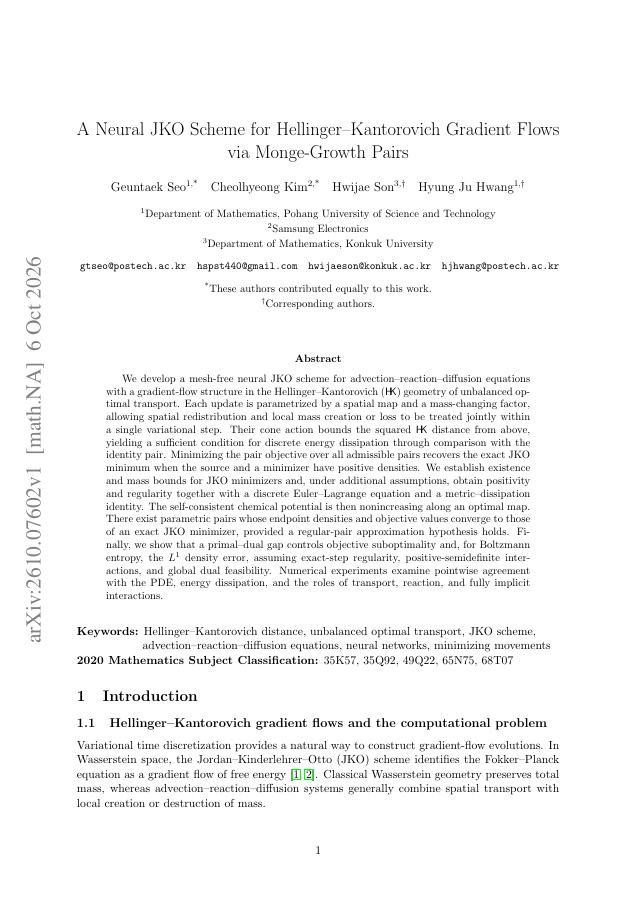
We develop a mesh-free neural JKO scheme for advection-reaction-diffusion equations with a gradient-flow structure in the Hellinger-Kantorovich (HK) geometry of unbalanced optimal transport.
6 Oct 2026
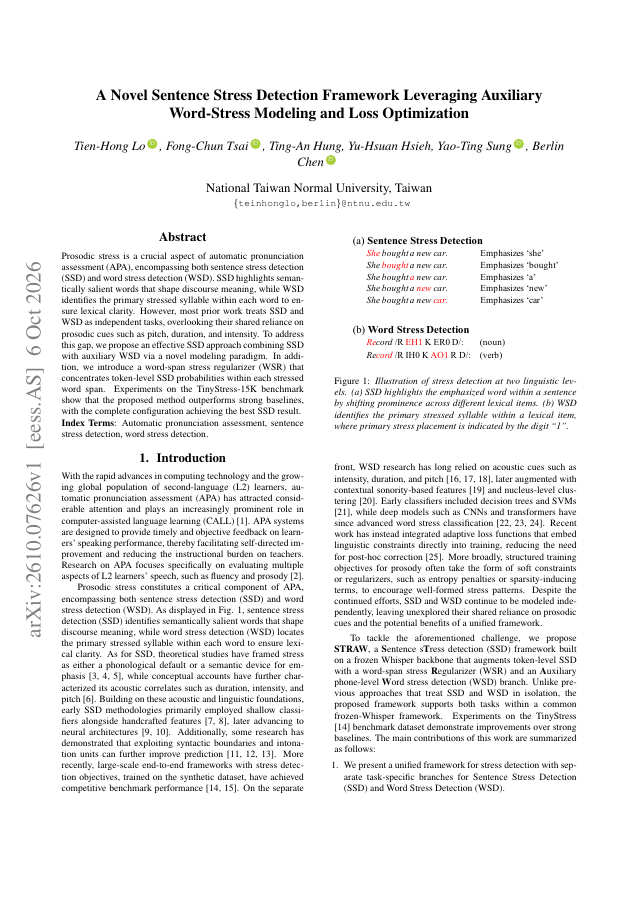
Prosodic stress is a crucial aspect of automatic pronunciation assessment (APA), encompassing both sentence stress detection (SSD) and word stress detection (WSD). SSD highlights semantically salient words that shape discourse meaning, while WSD identifies the primary stressed…
6 Oct 2026
Machine-learning emulators of chaotic and stochastic systems are usually validated on forecast skill and long-run statistics. Neither certifies that an emulator responds correctly to forcing, the property that projection and attribution studies rely on.
6 Oct 2026
Low-rank adaptation (LoRA) is widely used as a parameter-efficient fine-tuning technique for pre-trained deep neural networks, which approximates the weight update via full fine-tuning by a low-rank matrix $BA^\top$.
6 Oct 2026
A safe action is not necessarily a viable one. A frozen vision-language-action (VLA) policy can favor a locally admissible move that leaves no policy-supported route to safe task completion.
6 Oct 2026
A central challenge for scientific agents is to turn analytical experience into reusable expertise grounded in physical evidence. Here we introduce Gan Jiang, a self-learning agent for powder X-ray diffraction built on a diffraction-analysis ecosystem we developed: XMatcher,…
6 Oct 2026
The large KV-cache size of modern LLMs creates a barrier to efficient deployment. Recent work has explored replacing attention layers' RoPE positional embeddings with alternative decay-based mechanisms, which can then be used to prune KV-cache during inference.
6 Oct 2026
AlphaFold 3 predicts protein structures with remarkable accuracy, yet how structural information emerges within the model remains poorly understood. Here, through causal interventions on internal representations and direct probing of every Pairformer block, we trace the…
6 Oct 2026
Large language models (LLMs) are increasingly being integrated into hardware verification to automate specification interpretation, verification-artifact generation, debugging, formal reasoning, and tool orchestration.
6 Oct 2026
Early stress detection in crops is a necessity today to improve efficiency and reduce waste of time, money, and effort. However, most modern techniques, such as hyperspectral imaging and AI-based systems, are too costly and complex for medium and small-scale farmers to…
6 Oct 2026
Large language models (LLMs) are increasingly used to judge how well an advertisement matches a query, but the fairness of these judgments has received limited attention.
6 Oct 2026
Generative Information Retrieval (GIR) has emerged as a transformative paradigm, shifting document retrieval from a traditional "retrieve-and-rank" workflow to sequence-to-sequence generation, where a model directly predicts document identifiers (DocIDs).
6 Oct 2026
Endpoint accuracy on abstract-reasoning benchmarks does not reveal whether a language model has acquired a transferable rule or fit distribution-specific regularities. We study this distinction in small language models on the ARC-TGI benchmark, which organizes abstract grid…
5 Oct 2026
Field-effect transistor (FET) layouts on exfoliated two-dimensional flakes are typically drawn by hand for each flake, placing contacts and gates to match its position and outline in optical micrographs.
5 Oct 2026
Modern text-to-speech (TTS) systems can clone a target speaker from a short reference clip or be fine-tuned on a target voice, yet their behaviour on morphologically rich, lower-resource languages such as Turkish remain under-characterised.
5 Oct 2026
Tactical Combat Casualty Care (TC3) requires responders to connect visual observations of injuries and interventions with established clinical guidance. Developing vision-language models to support this process requires supervision that links visible evidence to traceable…
5 Oct 2026
Low-Rank Adaptation (LoRA) has become a standard approach for parameter-efficient fine-tuning, yet a fundamental practical question remains unresolved: how should the adapter rank be chosen? An overly small rank may lead to a poorly conditioned optimization landscape, whereas an…
5 Oct 2026
We present a new perspective on the problem of likelihood approximation within the framework of simulation-based inference that promotes scalable and controllable simulation routines for large-scale data analysis, allows efficient parameter space exploration or smooth…
5 Oct 2026
As technology scales to smaller nodes, increasing current densities make electromigration (EM) one of the dominant reliability challenges in on-chip interconnects. Accurate transient stress analysis is needed to identify wires susceptible to EM degradation, but applying…
5 Oct 2026
An inaccurate expert can still provide useful information after correction. We study online learning to defer in which the learner chooses an expert and fixes a correction function before purchasing its answer, then applies that function to the answer received.
5 Oct 2026
Recent advances in penalty-based methods for stochastic bilevel optimization (SBO) have eliminated the need for second-order derivative oracles. However, for stochastic nonconvex-strongly convex bilevel problems, existing first-order methods typically rely on nested loops and/or…
5 Oct 2026
A recurring design principle in modern optimizers is to decouple update magnitude from the raw gradient norm, yet its consequences for learning-curve and resource scaling remain unclear.
5 Oct 2026
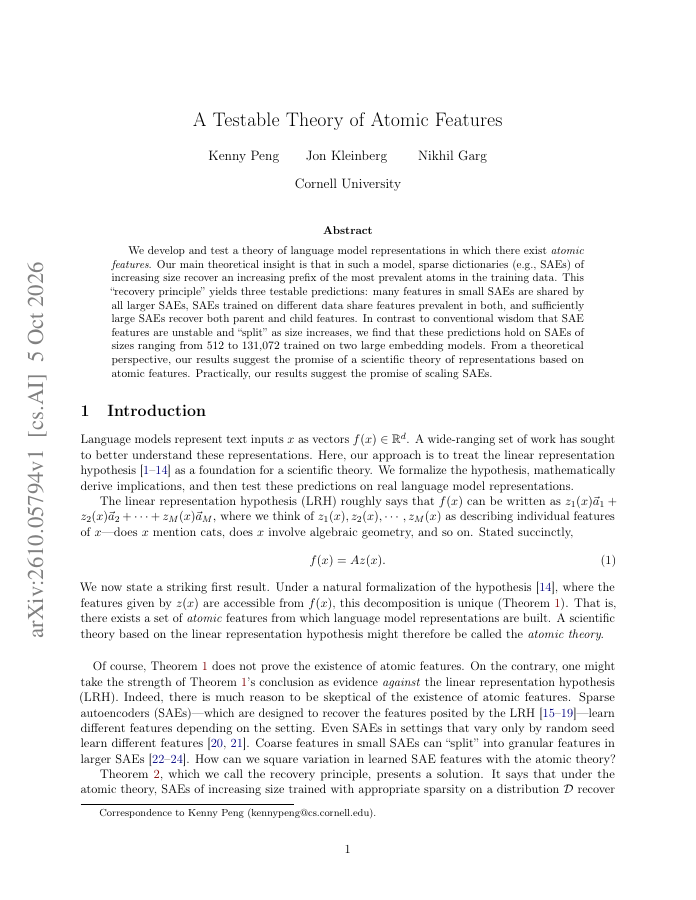
We develop and test a theory of language model representations in which there exist atomic features. Our main theoretical insight is that in such a model, sparse dictionaries (e.g., SAEs) of increasing size recover an increasing prefix of the most prevalent atoms in the training…
5 Oct 2026
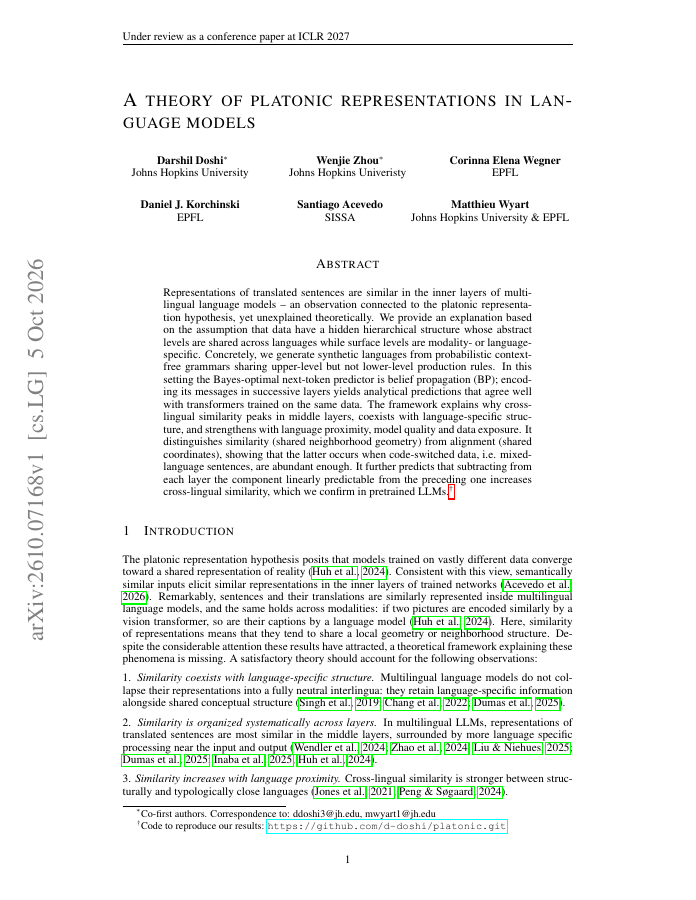
Representations of translated sentences are similar in the inner layers of multilingual language models -- an observation connected to the platonic representation hypothesis, yet unexplained theoretically.