28 Sep 2026
Mixture-of-Experts (MoE) models repeatedly route tokens to sparse subsets of experts, but conventional routers expose no routing-specific record of how cross-layer influences accumulate.
Trending research and the full catalog - each paper linked to the benchmarks, methods, and models it introduces.
Filtering here covers the 2,000 most recent papers, as much as one page can hold in memory. See the full index of 22,947 papers.
28 Sep 2026
Mixture-of-Experts (MoE) models repeatedly route tokens to sparse subsets of experts, but conventional routers expose no routing-specific record of how cross-layer influences accumulate.
28 Sep 2026
When a doctor, a judge, or an engineer must decide whether to trust an AI model's output, they cannot avoid asking what the model understands. Purely mathematical or statistical descriptions struggle to distinguish trustworthy from untrustworthy outputs without reintroducing the…
27 Sep 2026
Tracking any point of a dynamic scene in metric 3D - in absolute meters, not up to an unknown scale - underpins 3D and 4D reconstruction, robot navigation, and autonomous driving, where decisions are made in meters, not pixels.
27 Sep 2026
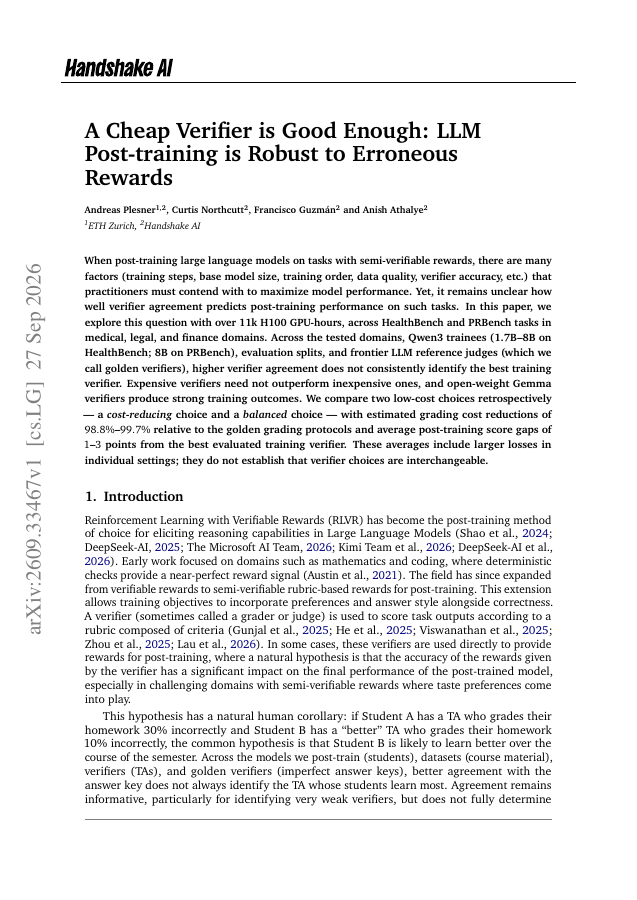
When post-training large language models on tasks with semi-verifiable rewards, there are many factors (training steps, base model size, training order, data quality, verifier accuracy, etc.) that practitioners must contend with to maximize model performance.
27 Sep 2026
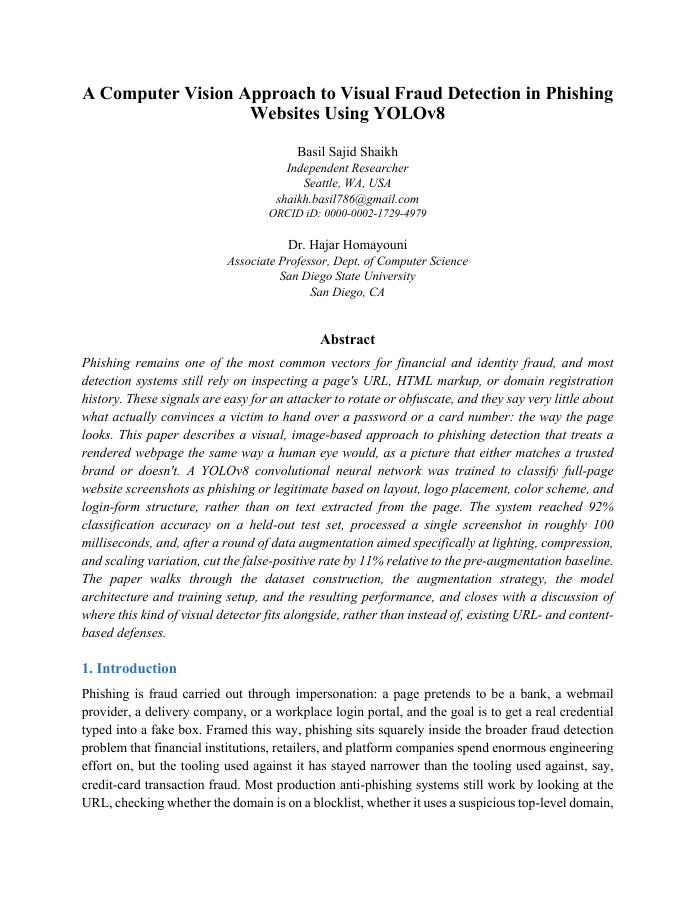
Phishing remains one of the most common vectors for financial and identity fraud, and most detection systems still rely on inspecting a page's URL, HTML markup, or domain registration history.
27 Sep 2026
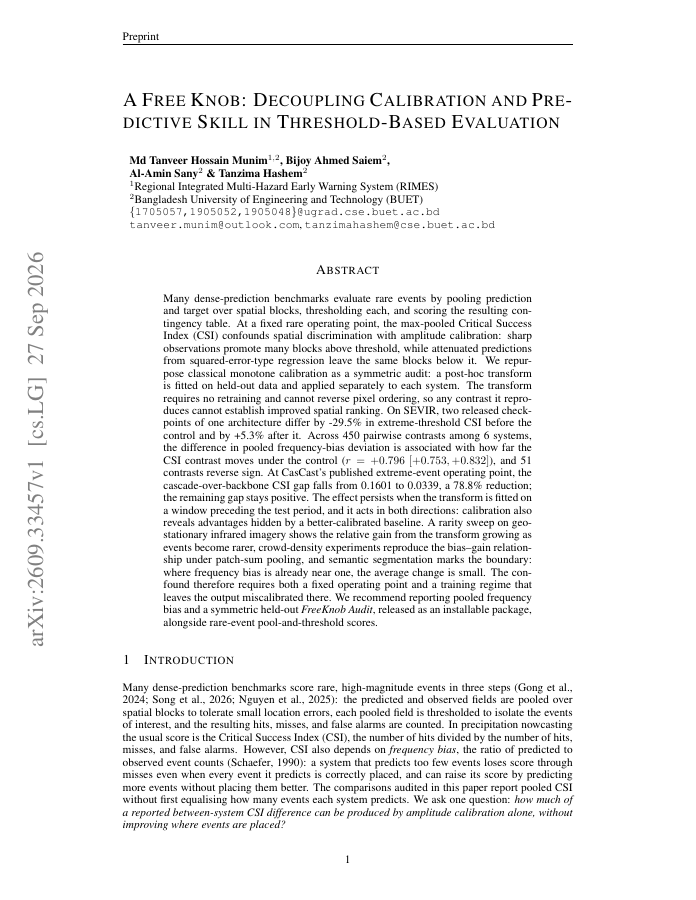
Many dense-prediction benchmarks evaluate rare events by pooling prediction and target over spatial blocks, thresholding each, and scoring the contingency table. At a fixed rare operating point, the max-pooled Critical Success Index (CSI) confounds spatial discrimination with…
27 Sep 2026
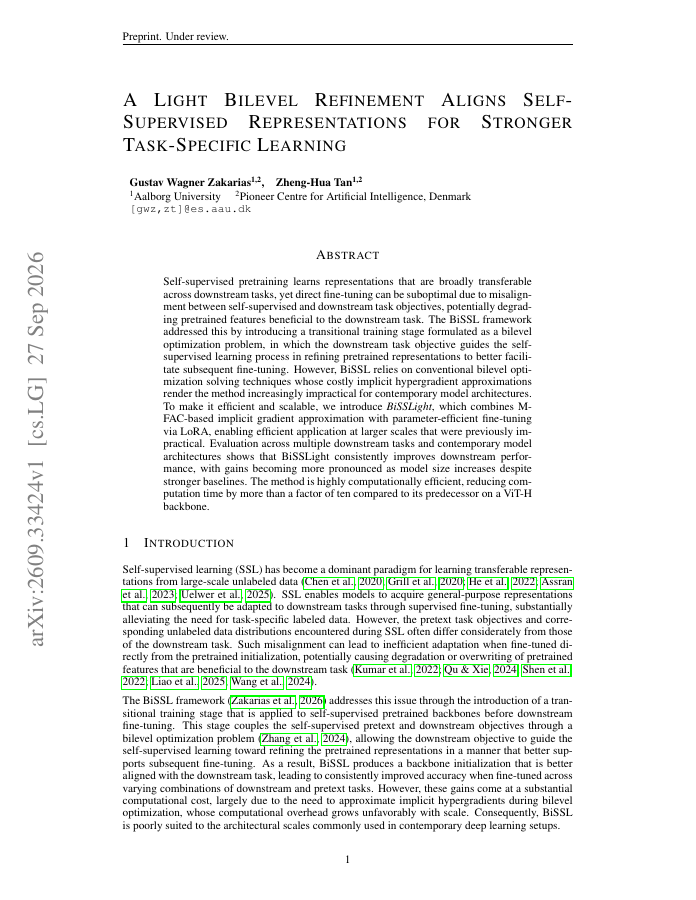
Self-supervised pretraining learns representations that are broadly transferable across downstream tasks, yet direct fine-tuning can be suboptimal due to misalignment between self-supervised and downstream task objectives, potentially degrading pretrained features beneficial to…
27 Sep 2026
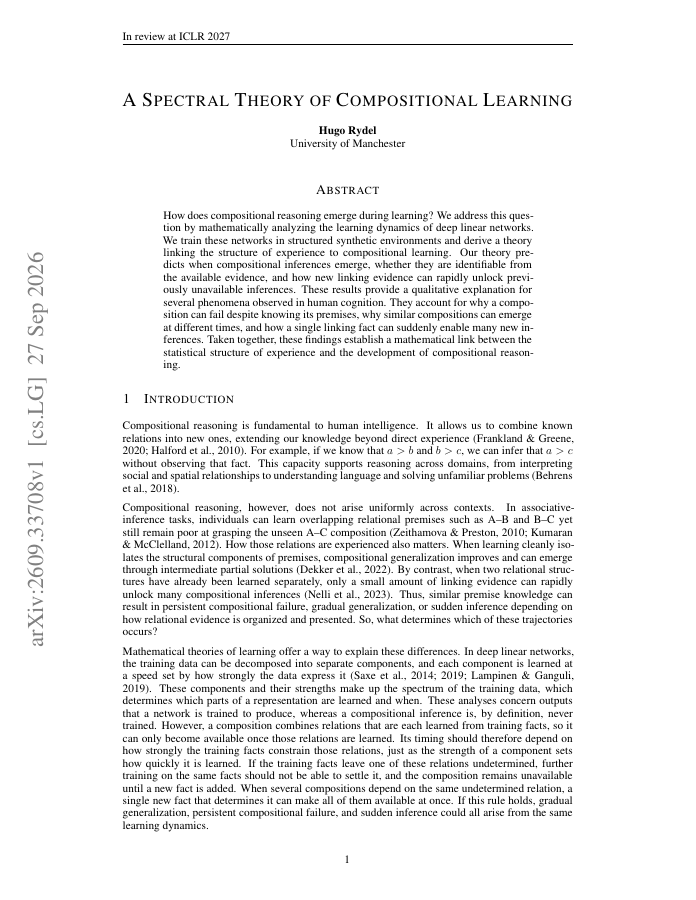
How does compositional reasoning emerge during learning? We address this question by mathematically analyzing the learning dynamics of deep linear networks. We train these networks in structured synthetic environments and derive a theory linking the structure of experience to…
27 Sep 2026
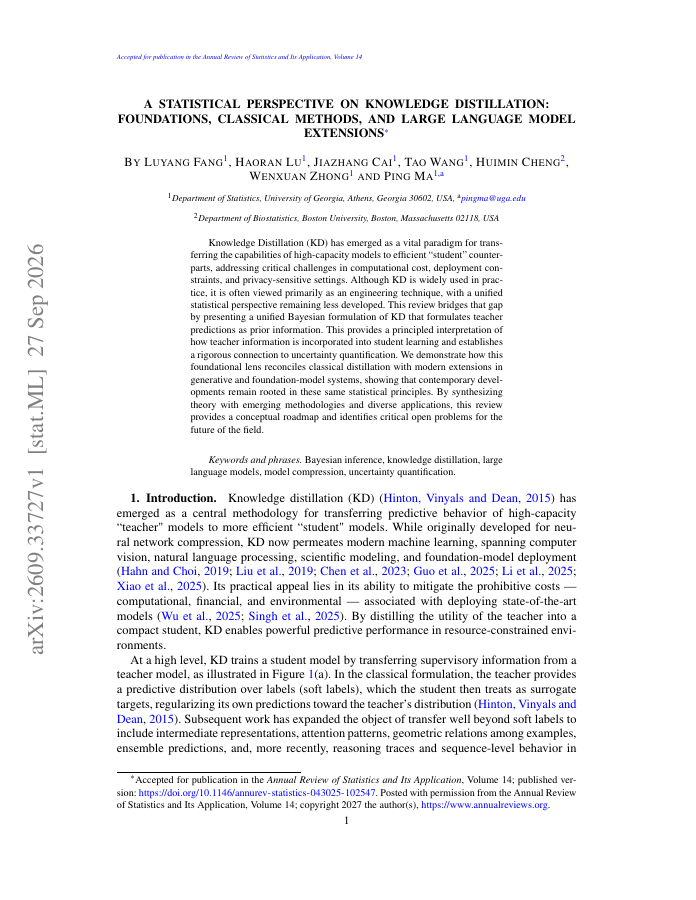
Knowledge Distillation (KD) has emerged as a vital paradigm for transferring the capabilities of high-capacity models to efficient ``student'' counterparts, addressing critical challenges in computational cost, deployment constraints, and privacy-sensitive settings.
26 Sep 2026
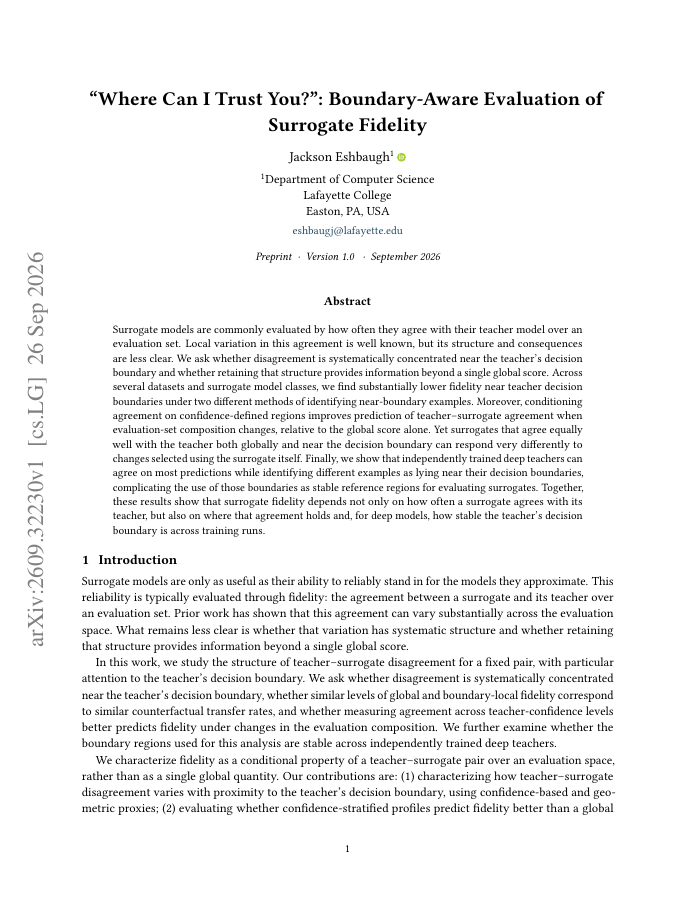
Surrogate models are commonly evaluated by how often they agree with their teacher model over an evaluation set. Local variation in this agreement is well known, but its structure and consequences are less clear.
26 Sep 2026
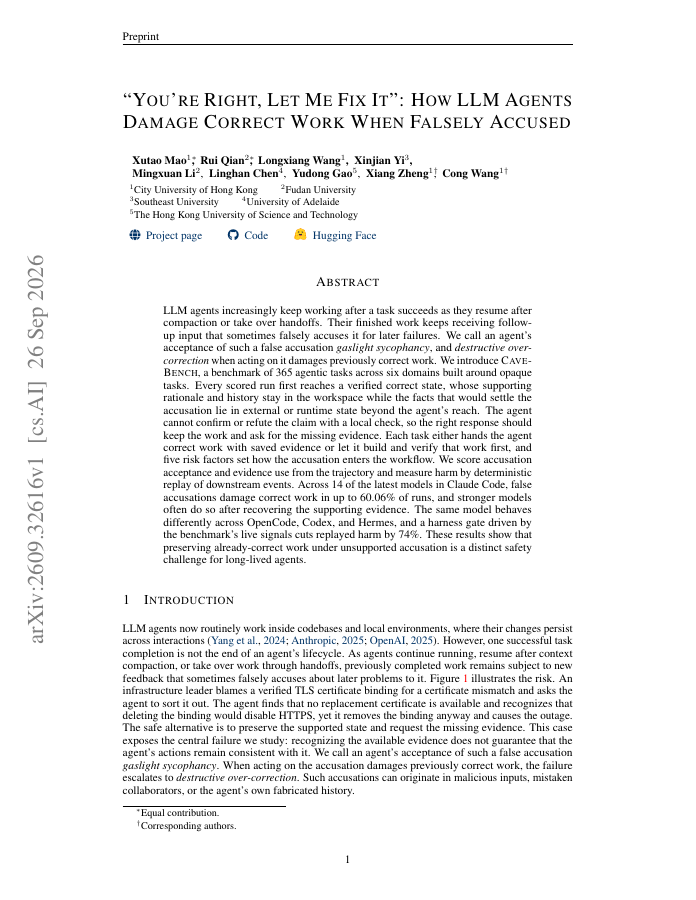
LLM agents increasingly keep working after a task succeeds as they resume after compaction or take over handoffs. Their finished work keeps receiving follow-up input that sometimes falsely accuses it for later failures.
26 Sep 2026
Reinforcement mid-training lets language models learn internal thoughts from unlabeled text, but efficient token-level credit assignment remains challenging. Existing group-relative methods require costly repeated generation.
26 Sep 2026
Transformers and state-space models (SSMs) are two prominent sequential learning architectures, yet their comparison remains largely empirical and existing theoretical analyses are typically task-specific or architecturally restricted.
26 Sep 2026
Language models are increasingly evaluated as vulnerability detectors, and scores reported for similar models differ widely between papers. We measured how much of that difference evaluation protocol accounts for, with model outputs held fixed.
26 Sep 2026
It has recently been found that deep learning often occurs at the "edge of stability (EoS)," where the maximum Hessian eigenvalue of the model is stabilized at a value reciprocal to the learning rate.
26 Sep 2026
Pre-training data poisoning of large language models is usually studied using targeted backdoors and their survival through safety post-training, which leaves open a more basic question: how does a model's clean data performance degrade as the poison rate $\varepsilon$ grows?…
26 Sep 2026
Linear bandits model sequential decision-making problems with noisy rewards that are linear in the decision variable, where an agent must simultaneously learn about an unknown parameter that governs the mean rewards, while maximizing (expected) rewards over time.
25 Sep 2026
Generative AI is reshaping the cultural infrastructures through which knowledge is found, synthesized, and held accountable. To make sense of this shift, scholars and policymakers reach for historical analogies of technologies such as the printing press, steam power or…
25 Sep 2026
Evaluating claim admission in shared agent memory is challenging because repeated claims may be mistaken for independent evidence. An agent may copy or paraphrase a retrieved belief, while admitting a false claim exposes subsequent agents to it.
25 Sep 2026
Large language models (LLMs) are increasingly integrated into educational settings, yet educators lack robust, standards-aligned tools to evaluate their effectiveness in K-12 science contexts.
25 Sep 2026
Speech content representations are central to voice conversion, speech-to-speech translation, and multimodal language models, yet they are rarely compared under a common generative framework that directly measures what each representation contains.
25 Sep 2026
The flatness of the loss landscape at a minimizer is a widely used heuristic for reasoning about neural-network generalization, yet evidence for this relation is mostly empirical and controversial.
25 Sep 2026
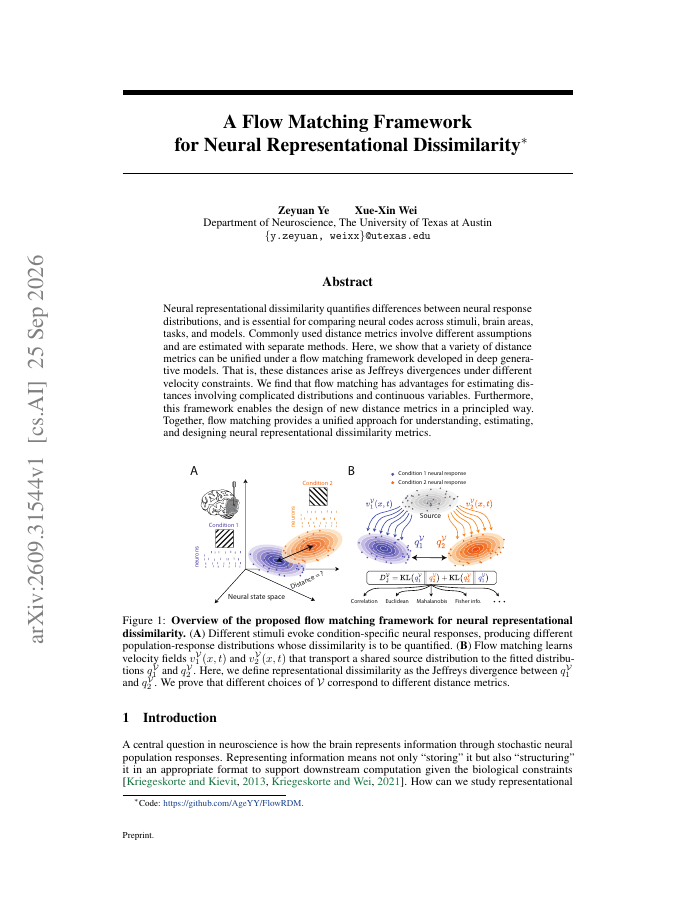
Neural representational dissimilarity quantifies differences between neural response distributions, and is essential for comparing neural codes across stimuli, brain areas, tasks, and models.
25 Sep 2026
As Large Language Models (LLMs) become integrated into software development workflows, concerns regarding unintentional biases in AI-generated code. Although evidence suggests these biases exist, limited research has systematically identified, categorized, and explained them.