20 Aug 2026
A learning architecture induces a prior over its expressible models. Recent work links architectural success to a broad complexity spectrum: model probabilities spanning many orders of magnitude.
Trending research and the full catalog - each paper linked to the benchmarks, methods, and models it introduces.
Filtering here covers the 2,000 most recent papers, as much as one page can hold in memory. See the full index of 23,060 papers.
20 Aug 2026
A learning architecture induces a prior over its expressible models. Recent work links architectural success to a broad complexity spectrum: model probabilities spanning many orders of magnitude.
20 Aug 2026
Watermarking is a central tool for provenance in generative models, yet its application to multivariate time series remains hindered by reliability failures under post-editing attacks.
20 Aug 2026
This document describes the application of a first order linearised nonlinear repeated measurements approach to the analysis of battery cell ageing profiles generated under controlled conditions in a laboratory.
20 Aug 2026
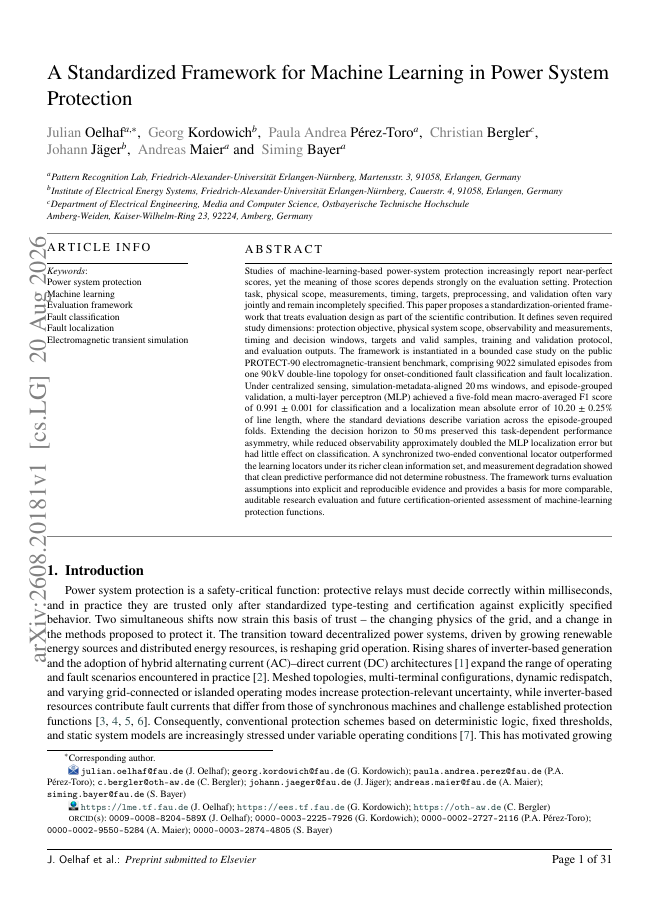
Studies of machine-learning-based power-system protection increasingly report near-perfect scores, yet the meaning of those scores depends strongly on the evaluation setting.
20 Aug 2026
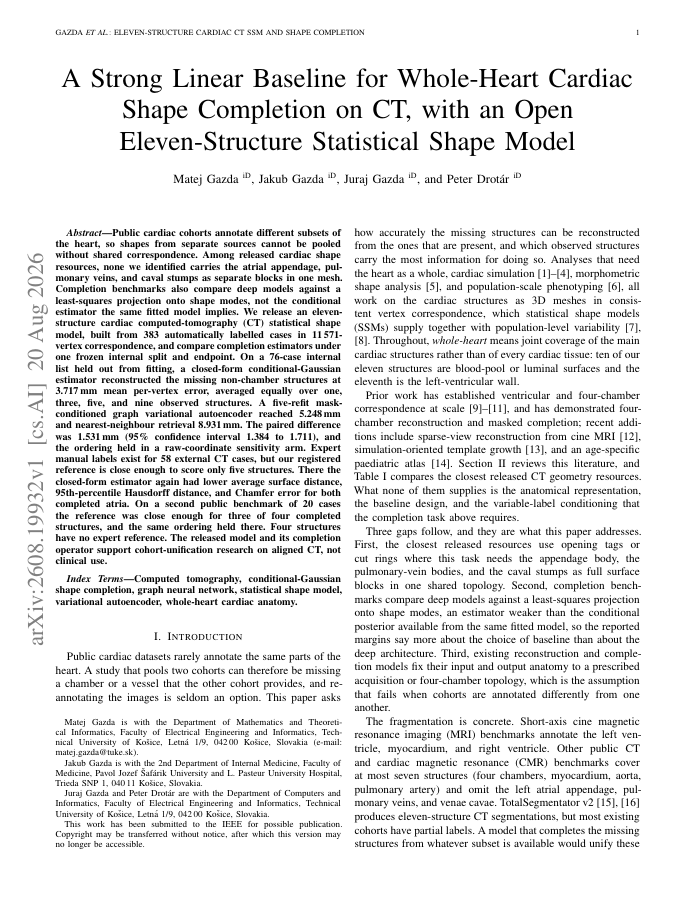
Public cardiac cohorts annotate different subsets of the heart, so shapes from separate sources cannot be pooled without shared correspondence. Among released cardiac shape resources, none we identified carries the atrial appendage, pulmonary veins, and caval stumps as separate…
20 Aug 2026
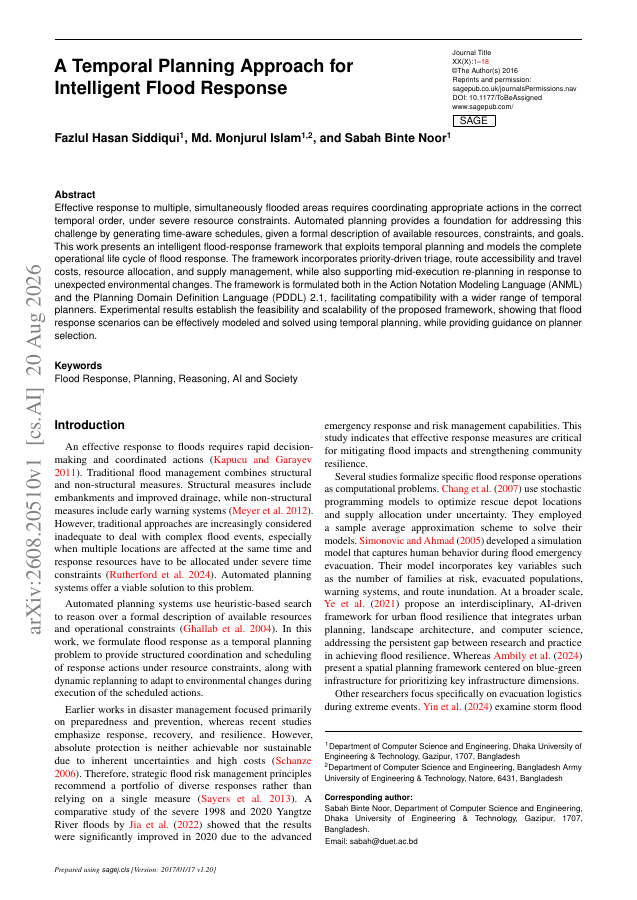
Effective response to multiple, simultaneously flooded areas requires coordinating appropriate actions in the correct temporal order, under severe resource constraints. Automated planning provides a foundation for addressing this challenge by generating time-aware schedules,…
20 Aug 2026
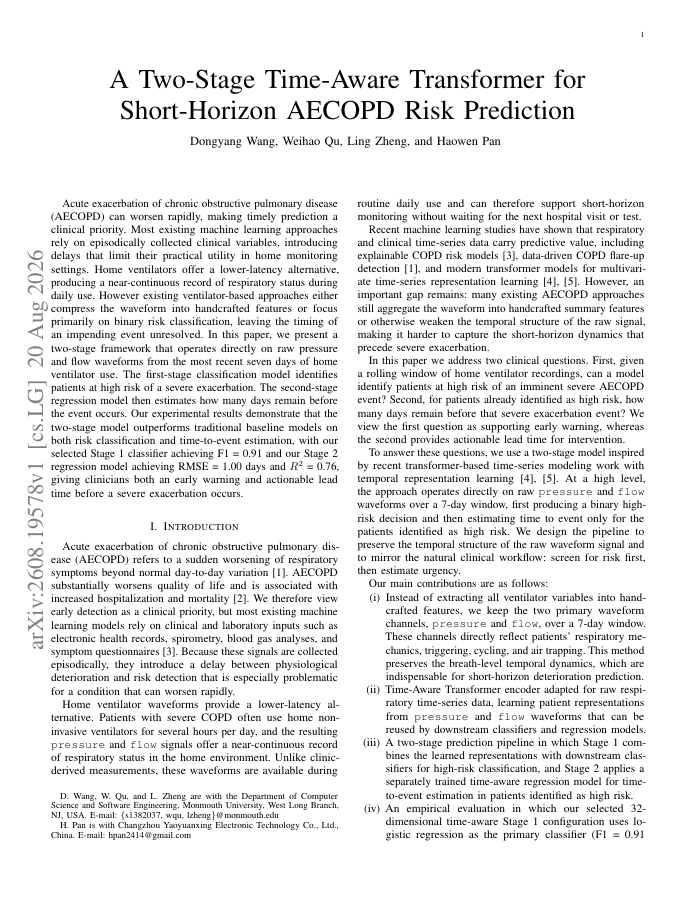
Acute exacerbation of chronic obstructive pulmonary disease (AECOPD) can worsen rapidly, making timely prediction a clinical priority. Most existing machine learning approaches rely on episodically collected clinical variables, introducing delays that limit their practical…
19 Aug 2026
Diagnostic medical tests and devices provide useful information for evaluating the potential benefits and risks of therapeutic treatments. However, unlike treatments, their impact on health outcomes is generally indirect because measuring diagnostic information typically does…
19 Aug 2026
Foundation models are increasingly breaking what seemed to be impossible not long ago by enabling unprecedented accuracy and cross-domain generalization. Yet their lack of interpretability, tendency to be overconfident, and sensitivity to real-world domain shifts pose critical…
19 Aug 2026
Medical image segmentation is essential for clinical workflows such as treatment planning and disease assessment. While specialist tools like TotalSegmentator and MRSegmentator achieve strong performance, they require large annotated datasets for training.
19 Aug 2026
Artificial intelligence (AI) models have demonstrated remarkable capabilities across various domains, yet their widespread deployment is impeded by significant computational costs, particularly on resource-constrained devices.
19 Aug 2026
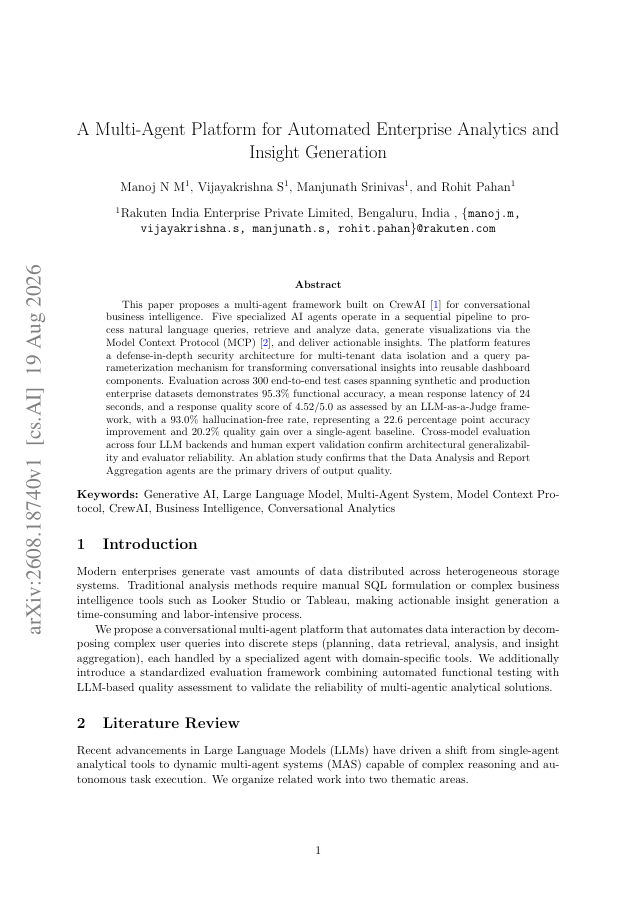
This paper proposes a multi-agent framework built on CrewAI [1] for conversational business intelligence. Five specialized AI agents operate in a sequential pipeline to process natural language queries, retrieve and analyze data, generate visualizations via the Model Context…
19 Aug 2026
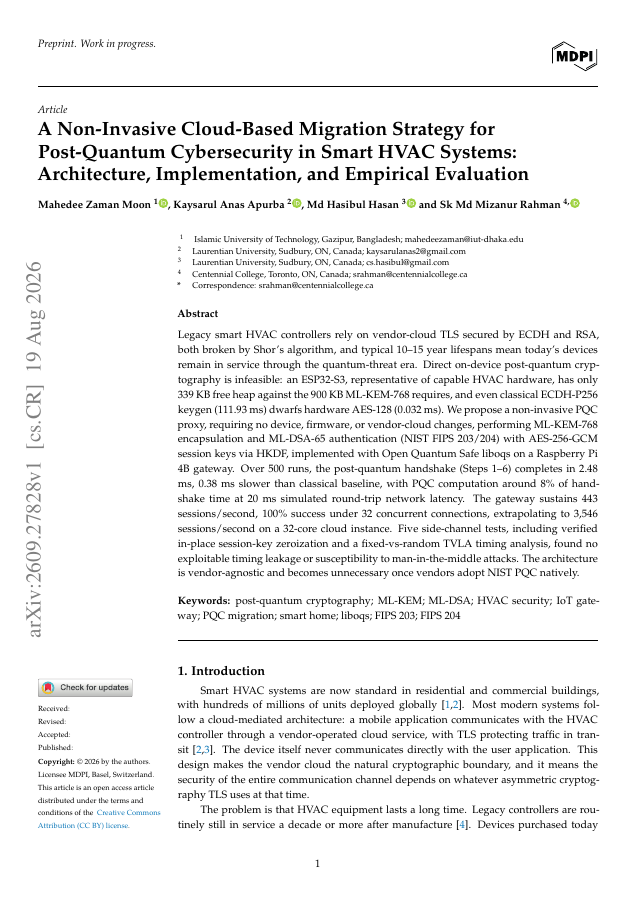
Legacy smart HVAC controllers rely on vendor-cloud TLS secured by ECDH and RSA, both broken by Shor's algorithm, and typical 10-15 year lifespans mean today's devices remain in service through the quantum-threat era.
19 Aug 2026
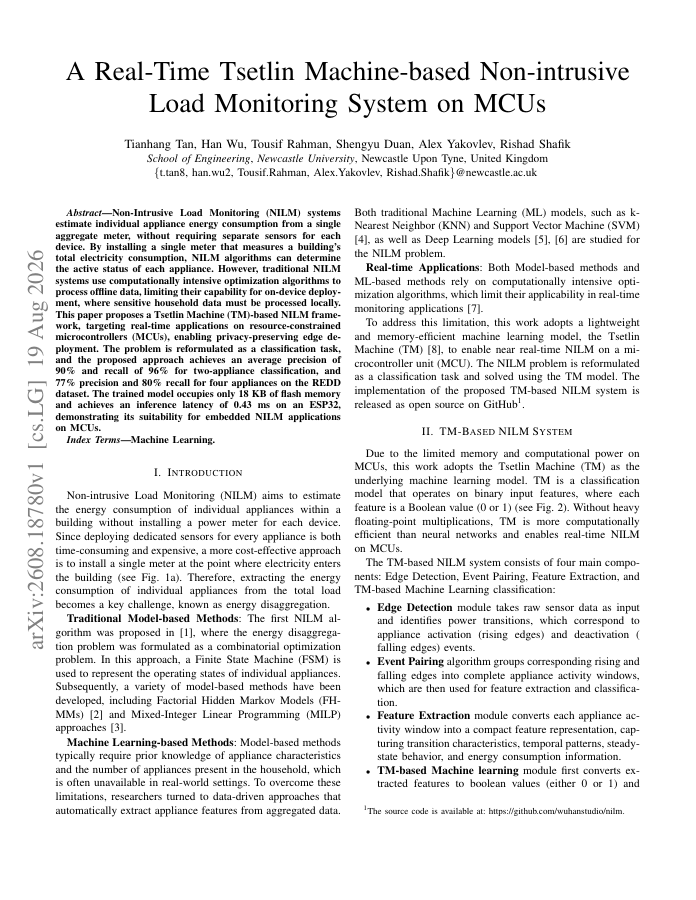
Non-Intrusive Load Monitoring (NILM) systems estimate individual appliance energy consumption from a single aggregate meter, without requiring separate sensors for each device.
19 Aug 2026
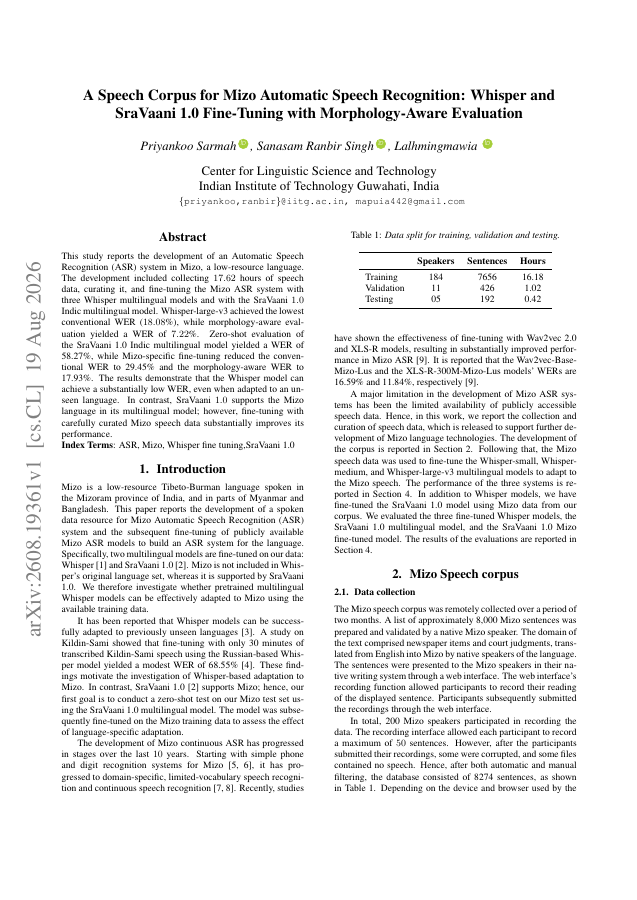
This study reports the development of an Automatic Speech Recognition (ASR) system in Mizo, a low-resource language. The development included collecting 17.62 hours of speech data, curating it, and fine-tuning the Mizo ASR system with three Whisper multilingual models and with…
19 Aug 2026
Debates have recently emerged as a useful methodology for agentic AI to improve performance as well as to aid explainability and user engagement. For example, LLM-empowered agents may debate internally (with themselves) and/or externally (with other agents).
18 Aug 2026
Generative AI is rapidly entering adolescents' everyday lives during a critical period of cognitive, social and emotional development. Yet its adoption is outpacing evidence on how adolescents themselves experience, understand and negotiate its expanding role in their lives.
18 Aug 2026
Metasurfaces have revolutionized the development of photonic devices by enabling unprecedented precision in light manipulation. However, their design processes are often constrained by computationally expensive simulations and complex high-dimensional design spaces.
18 Aug 2026
Online platforms have become arenas for the public contestation of climate change, shaping how scientific knowledge, denial, and uncertainty are expressed and disputed. Yet longitudinal evidence remains limited for YouTube, especially for Portuguese-language discourse.
18 Aug 2026
We present a learning algorithm for inferring threshold Boolean networks (TBNs) with a prescribed set of fixed points. The proposed method employs a custom differentiable loss function that jointly enforces fixed point preservation, penalizes spurious attractors, encourages…
18 Aug 2026
This paper investigates the feasibility of using residual learning to improve unsteady aerodynamic load prediction for aeroelastic applications. The machine learning technique selected for the study is the long short-term memory (LSTM) neural network, which is used for its…
18 Aug 2026
In the Lifelong Multi-Agent Path Finding (L-MAPF) problem, agents must repeatedly move from one destination to another while avoiding obstacles and inter-agent collisions.
17 Aug 2026
In cognitive science, resource rationality asks how an agent should allocate limited computation to maximize expected value. Most reasoning and agent benchmarks use independent per-task budgets; existing shared-budget studies do not calibrate suite performance against the same…
17 Aug 2026
High-fidelity finite-element simulations can provide accurate numerical predictions for side-branch resonators, but large simulation datasets are expensive to generate and purely data-driven surrogates may become unreliable when simulation-labelled data are scarce.