1 Mar 2026
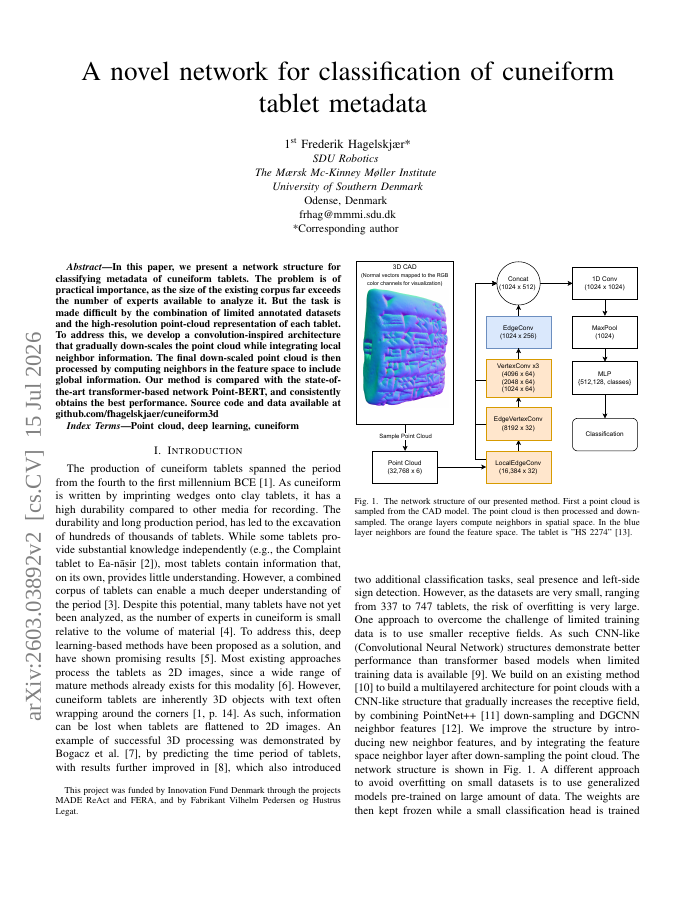
In this paper, we present a network structure for classifying metadata of cuneiform tablets. The problem is of practical importance, as the size of the existing corpus far exceeds the number of experts available to analyze it.
Trending research and the full catalog - each paper linked to the benchmarks, methods, and models it introduces.
Filtering here covers the 2,000 most recent papers, as much as one page can hold in memory. See the full index of 22,411 papers.
1 Mar 2026
In this paper, we present a network structure for classifying metadata of cuneiform tablets. The problem is of practical importance, as the size of the existing corpus far exceeds the number of experts available to analyze it.
1 Mar 2026
We revisit the standard perturbation-based approach of Abernethy et al. (2008) in the context of unconstrained Bandit Linear Optimization (uBLO). We show the surprising result that in the unconstrained setting, this approach effectively reduces Bandit Linear Optimization (BLO)…
1 Mar 2026
Upcoming stage-IV surveys such as Euclid and Rubin will deliver vast amounts of high-precision data, opening new opportunities to constrain cosmological models with unprecedented accuracy.
1 Mar 2026
Accurate cardiovascular risk prediction is crucial for preventive healthcare; however, the development of robust Artificial Intelligence (AI) models is hindered by the fragmentation of clinical data across institutions due to stringent privacy regulations.
1 Mar 2026
This paper surveys recent developments at the intersection of operator learning, statistical learning theory, and approximation theory. First, it reviews error bounds for empirical risk minimization with a focus on holomorphic operators and neural network approximations.
1 Mar 2026
Incremental Learning (IL) aims to learn new tasks while preserving previously acquired knowledge. Integrating the zero-shot learning capabilities of pre-trained vision-language models into IL methods has marked a significant advancement.
1 Mar 2026
Tabular data is more challenging to generate than text and images, due to its heterogeneous features and much lower sample sizes. On this task, diffusion-based models are the current state-of-the-art (SotA) model class, achieving almost perfect performance on commonly used…
1 Mar 2026
This survey (re)introduces reinforcement learning methods to economists. The curse of dimensionality limits how far exact dynamic programming can be effectively applied, forcing us to rely on suitably "small" problems or our ability to convert "big" problems into…
1 Mar 2026
Out-of-distribution (OOD) detection is critical in safety-sensitive applications. While this challenge has been addressed from various perspectives, the influence of training objectives on OOD behavior remains comparatively underexplored.
1 Mar 2026
This paper examines how value is constructed and negotiated in today's increasingly automated language and translation industry. Drawing on interview data from twenty-nine industry stakeholders collected within the LT-LiDER project, the study analyses how human value,…
1 Mar 2026
This study investigates the diverse characteristics of nouns, focusing on both semantic (e.g., countable/uncountable) and morphosyntactic (e.g., masculine/feminine) distinctions. We explore inter-word variations for gender markers in noun morphology.
1 Mar 2026
While diffusion models have emerged as a powerful class of generative models, their learning dynamics remain poorly understood. We address this issue first by empirically showing that standard diffusion models trained on natural images exhibit a distributional simplicity bias,…
1 Mar 2026
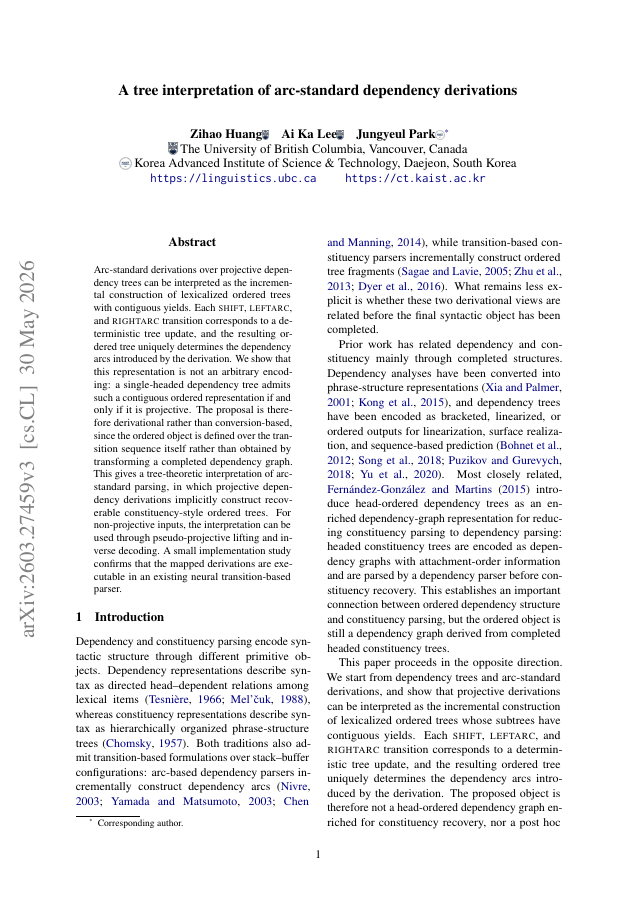
Arc-standard derivations over projective dependency trees can be interpreted as the incremental construction of lexicalized ordered trees with contiguous yields. Each \textsc{shift}, \textsc{leftarc}, and \textsc{rightarc} transition corresponds to a deterministic tree update,…
1 Mar 2026
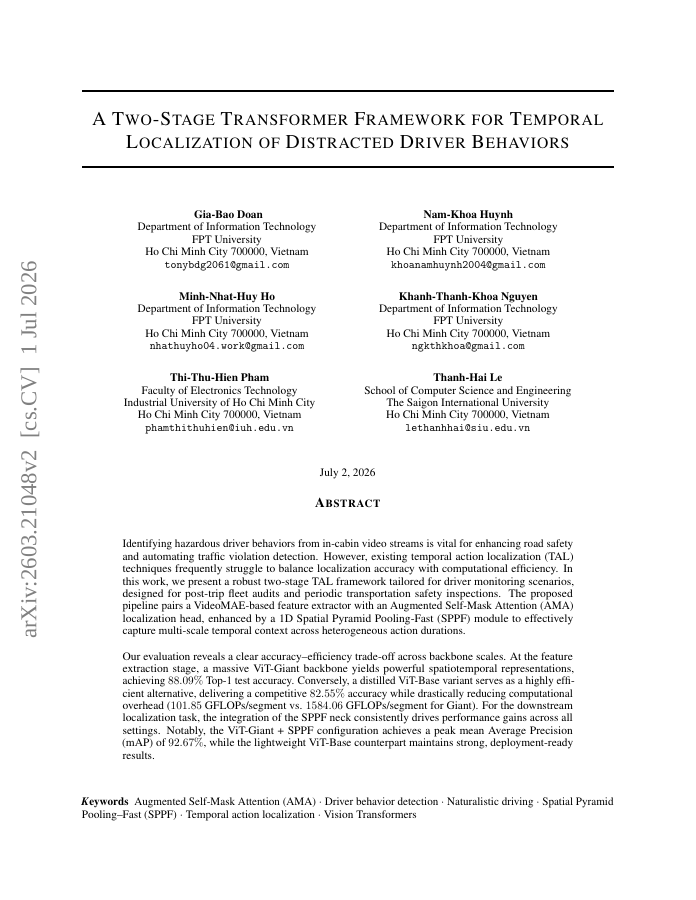
The identification of hazardous driving behaviors from in-cabin video streams is essential for enhancing road safety and supporting the detection of traffic violations and unsafe driver actions.
1 Mar 2026
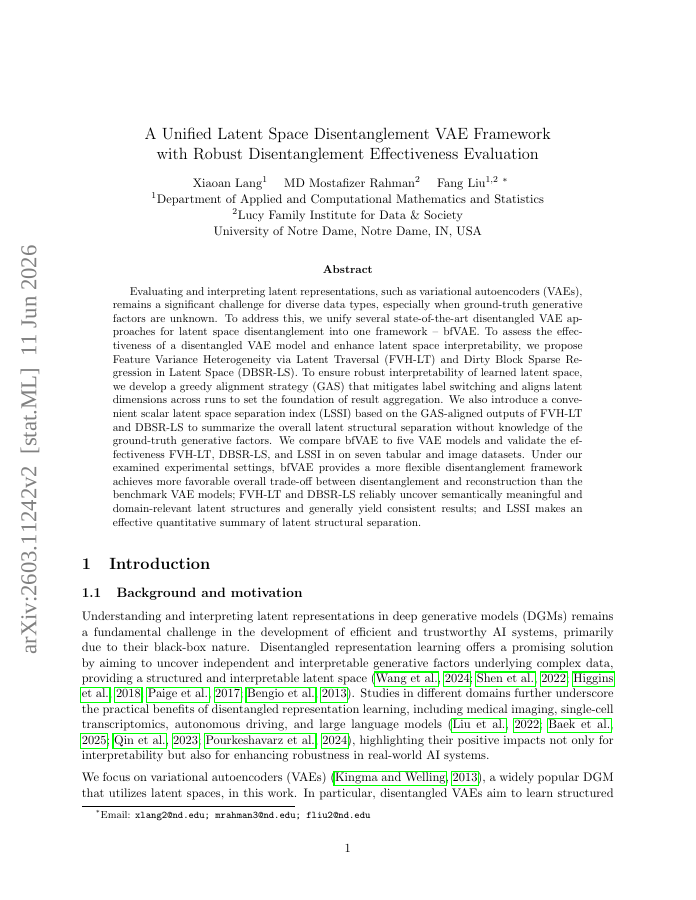
Evaluating and interpreting latent representations, such as variational autoencoders (VAEs), remains a significant challenge for diverse data types, especially when ground-truth generative factors are unknown.
1 Mar 2026
While multilingual language models successfully transfer factual and syntactic knowledge across languages, it remains unclear whether they process culture-specific pragmatic registers, such as slang, as isolated language-specific memorizations or as unified, abstract concepts.
1 Mar 2026
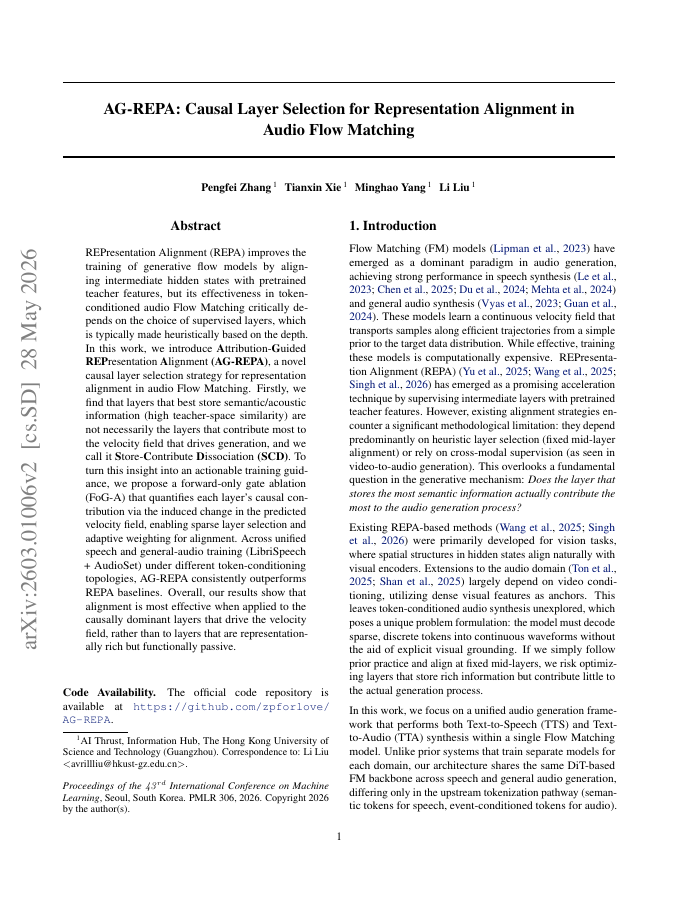
REPresentation Alignment (REPA) improves the training of generative flow models by aligning intermediate hidden states with pretrained teacher features, but its effectiveness in token-conditioned audio Flow Matching critically depends on the choice of supervised layers, which is…
1 Mar 2026
Large language model-based AI agents are now able to autonomously execute substantial portions of a high energy physics (HEP) analysis pipeline with minimal expert-curated input.
27 Feb 2026
Large language model (LLM) agents, such as OpenAI's Operator and Claude's Computer Use, can automate workflows but unable to handle payment tasks. Existing agentic solutions have gained significant attention; however, even the latest approaches face challenges in implementing…
Danyang Zhang, Dahua Lin, Ziqiao Ma · 23 Feb 2026
Rapid progress in video models has largely focused on visual quality, leaving their reasoning capabilities underexplored. Video reasoning grounds intelligence in spatiotemporally consistent visual environments that go beyond what text can naturally capture, enabling intuitive…
Yousof Gheisari, Mohammadreza Ghaffarzadeh-Esfahani · 21 Feb 2026
AAVGen is a generative AI framework that designs AAV capsids with improved traits through protein language models, supervised fine-tuning, and reinforcement learning techniques.
Gabriel Mongaras, Eric C. Larson · 19 Feb 2026
Researchers enhance linear attention by simplifying Mamba-2 and improving its architectural components to achieve near-softmax accuracy while maintaining memory efficiency for long sequences.
Johannes Kirmayr, Lukas Stappen, Elisabeth André · 17 Feb 2026
Users prefer adaptive feedback mechanisms in in-car AI assistants, starting with high transparency to build trust and then reducing verbosity as reliability increases, particularly in attention-critical driving scenarios.
Nihal V. Nayak, Sara Beery, David Alvarez-Melis · 16 Feb 2026
Instruction fine-tuning of large language models (LLMs) often involves selecting a subset of instruction training data from a large candidate pool, using a small query set from the target task.