11 Nov 2026
Comparing soccer teams that rarely or never meet is a fundamental challenge in sports analytics: clubs play mostly within their national leagues, and national teams within their confederations.
Trending research and the full catalog - each paper linked to the benchmarks, methods, and models it introduces.
Filtering here covers the 2,000 most recent papers, as much as one page can hold in memory. See the full index of 23,155 papers.
11 Nov 2026
Comparing soccer teams that rarely or never meet is a fundamental challenge in sports analytics: clubs play mostly within their national leagues, and national teams within their confederations.
11 Nov 2026
Machine learning models are increasingly used to support freight transportation decisions, but their predictions are rarely accompanied by evidence that the associated explanations can be trusted.
11 Nov 2026
Intelligent fault diagnosis models are typically developed for a single machine under a specific set of operating conditions, such that each new machine or condition requires retraining from scratch. This one-machine-one-model paradigm scales poorly.
10 Nov 2026
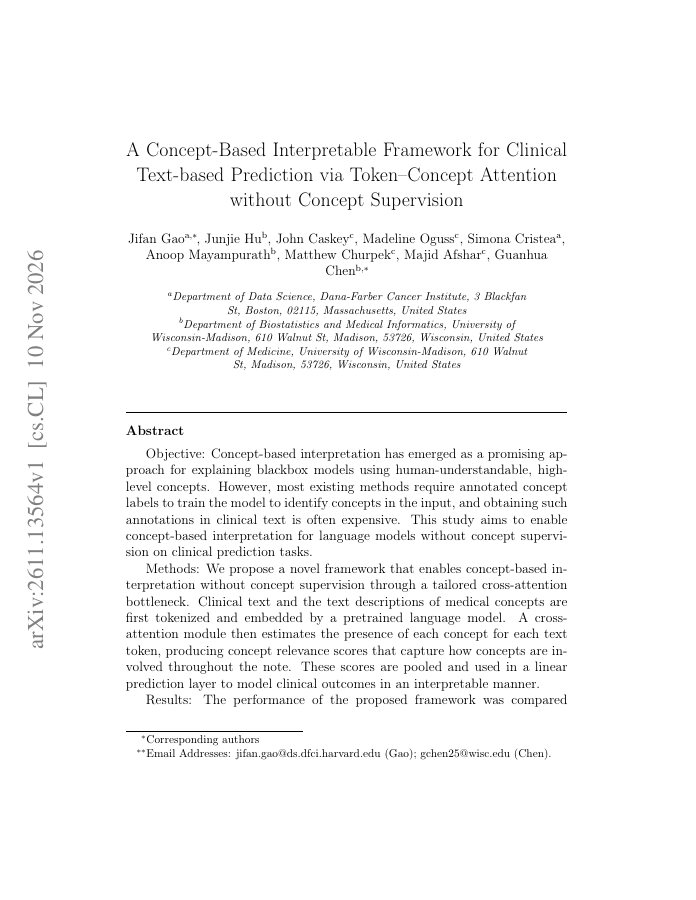
Objective: Concept-based interpretation has emerged as a promising approach for explaining blackbox models using human-understandable, high-level concepts. However, most existing methods require annotated concept labels to train the model to identify concepts in the input, and…
10 Nov 2026
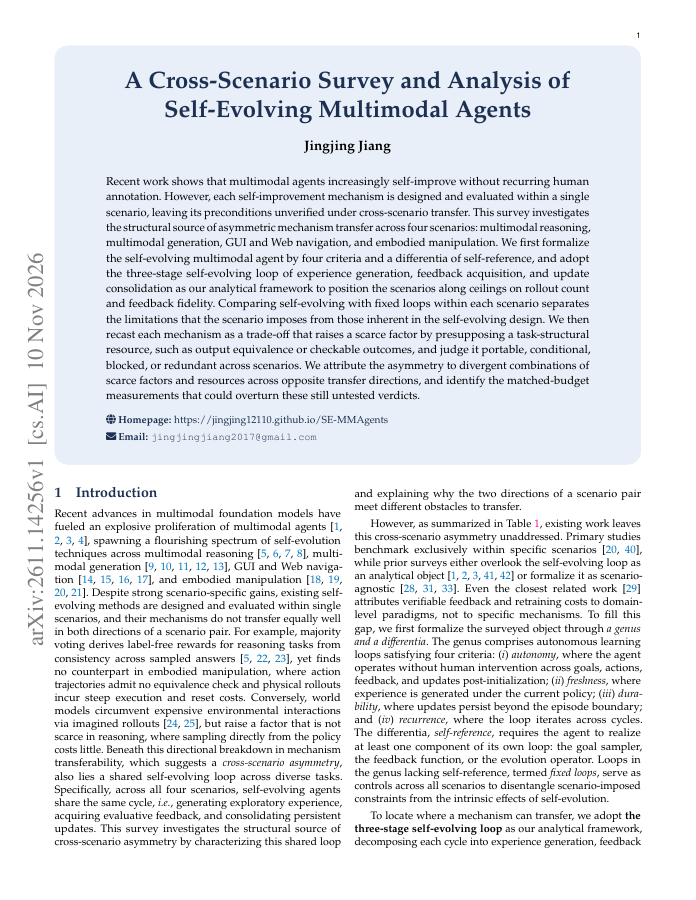
Recent work shows that multimodal agents increasingly self-improve without recurring human annotation. However, each self-improvement mechanism is designed and evaluated within a single scenario, leaving its preconditions unverified under cross-scenario transfer.
10 Nov 2026
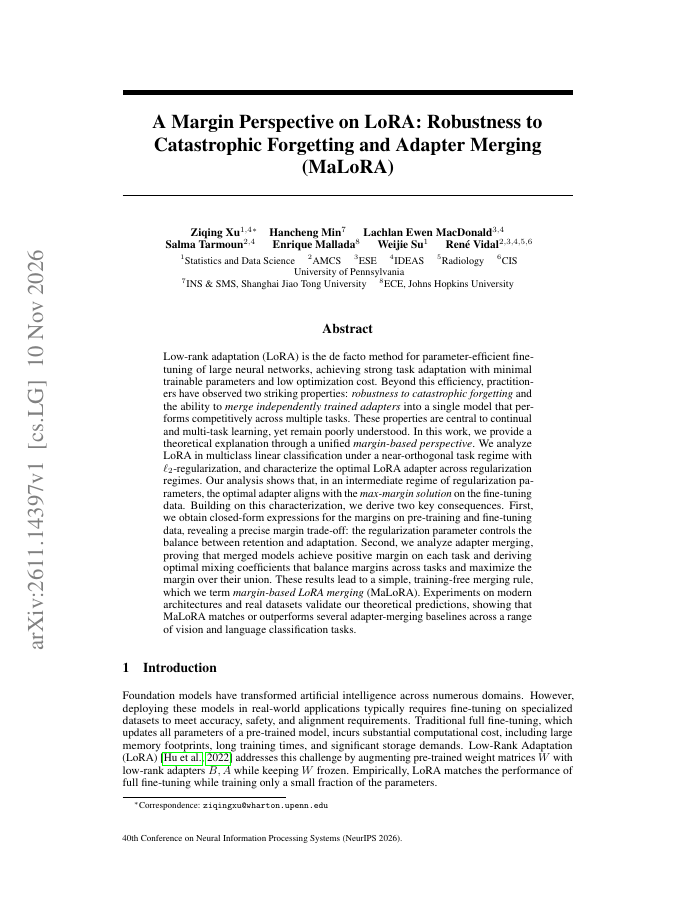
Low-rank adaptation (LoRA) is the de facto method for parameter-efficient fine-tuning of large neural networks, achieving strong task adaptation with minimal trainable parameters and low optimization cost.
10 Nov 2026
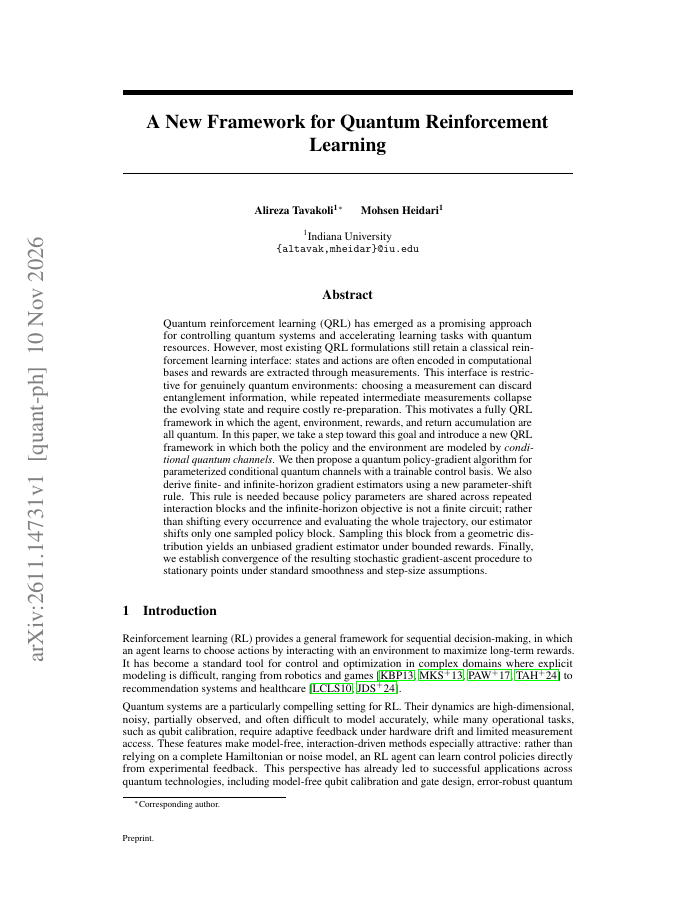
Quantum reinforcement learning (QRL) has emerged as a promising approach for controlling quantum systems and accelerating learning tasks with quantum resources. However, most existing QRL formulations still retain a classical reinforcement learning interface: states and actions…
10 Nov 2026
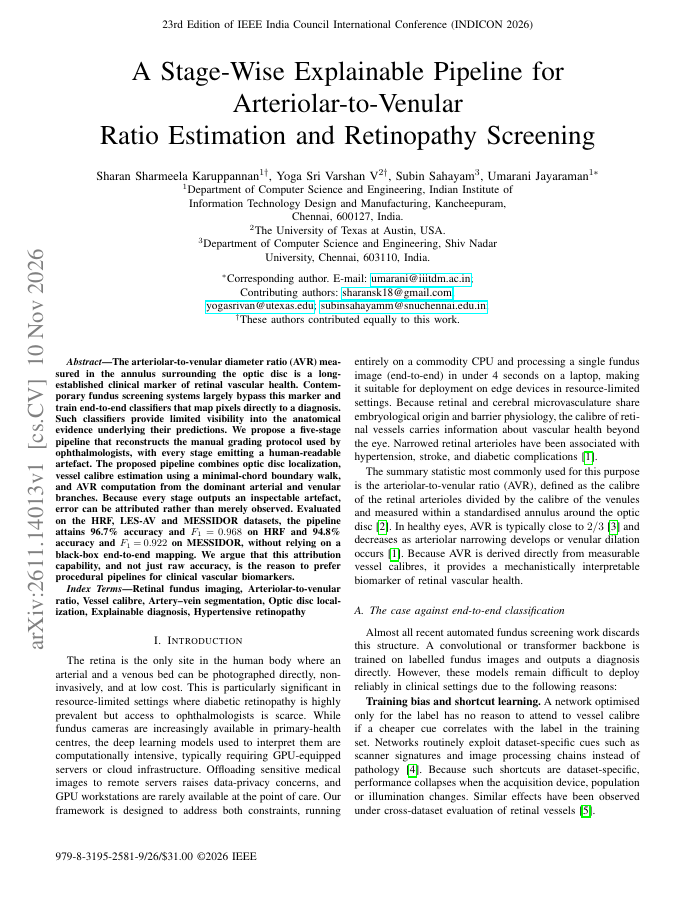
The arteriolar-to-venular diameter ratio (AVR) is a clinically motivated marker of retinal vascular health. We present a five-stage pipeline for AVR estimation and exploratory retinopathy screening from fundus images, with inspectable intermediate outputs at each stage.
10 Nov 2026
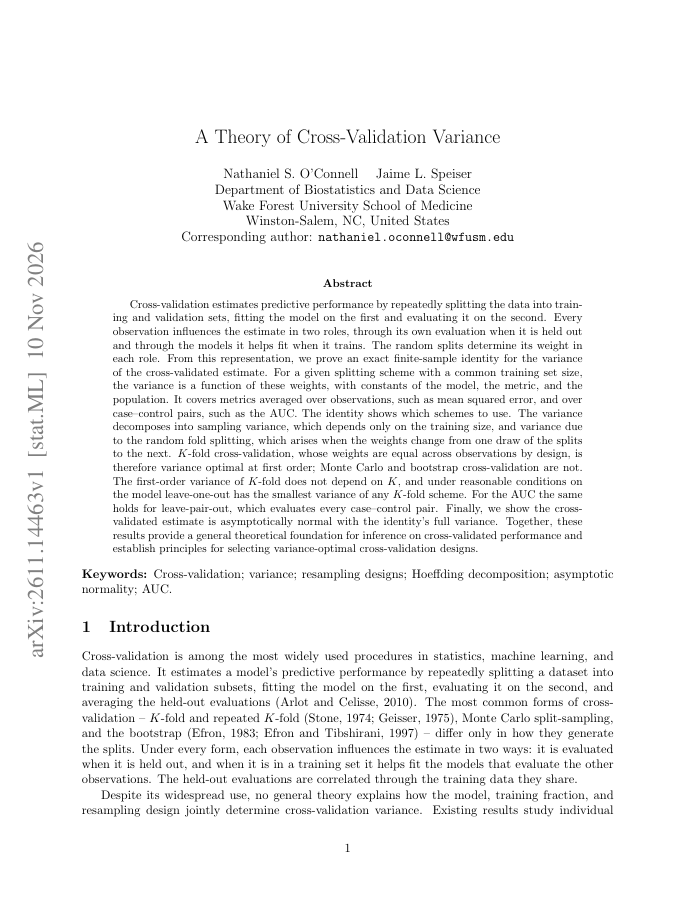
Cross-validation estimates predictive performance by repeatedly splitting the data into training and validation sets, fitting the model on the first and evaluating it on the second.
10 Nov 2026
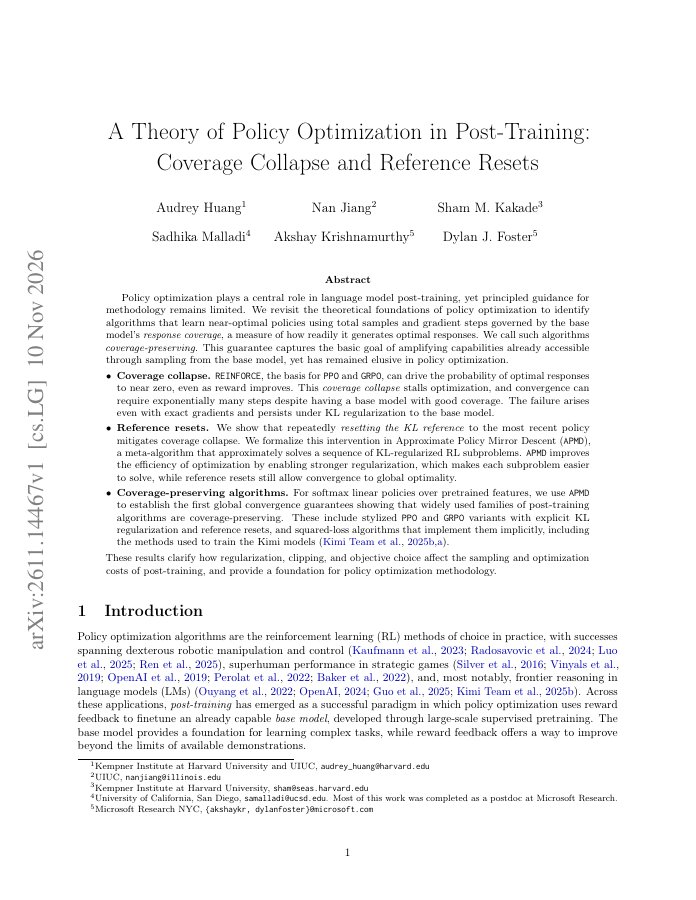
Policy optimization is central to language model post-training, yet principled guidance remains limited. We revisit its theoretical foundations to identify algorithms that learn near-optimal policies using total samples and gradient steps governed by the base model's response…
9 Nov 2026
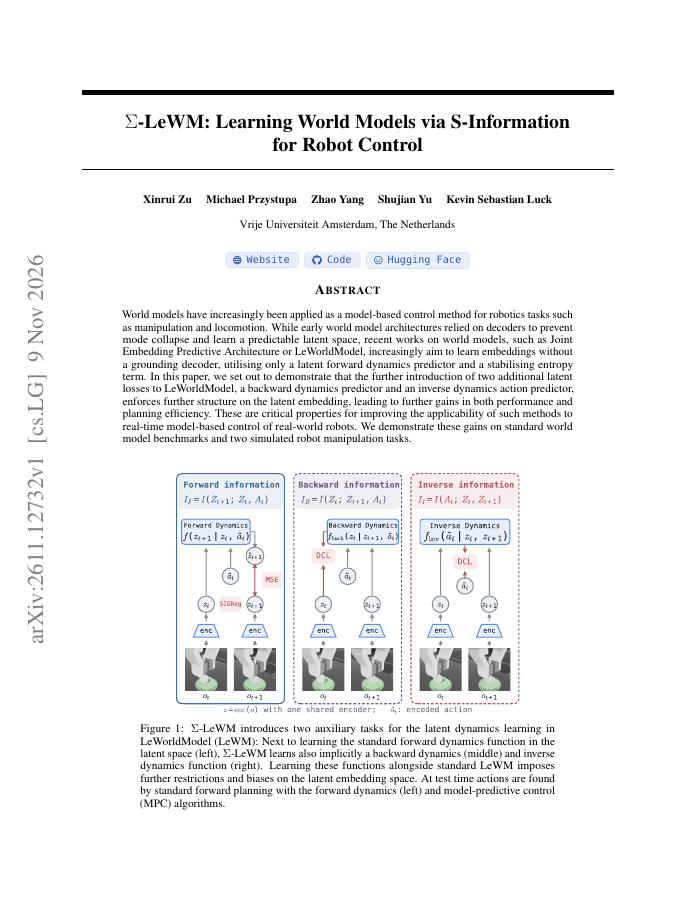
World models have increasingly been applied as a model-based control method for robotics tasks such as manipulation and locomotion. While early world model architectures relied on decoders to prevent mode collapse and learn a predictable latent space, recent works on world…
9 Nov 2026
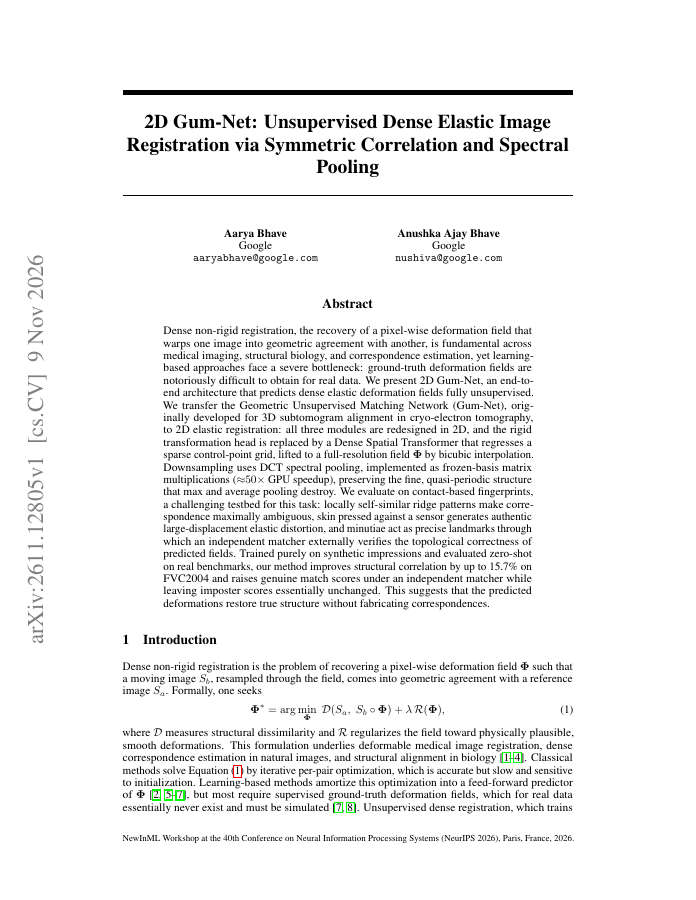
Dense non-rigid registration, the recovery of a pixel-wise deformation field that warps one image into geometric agreement with another, is fundamental across medical imaging, structural biology, and correspondence estimation, yet learning-based approaches face a severe…
9 Nov 2026
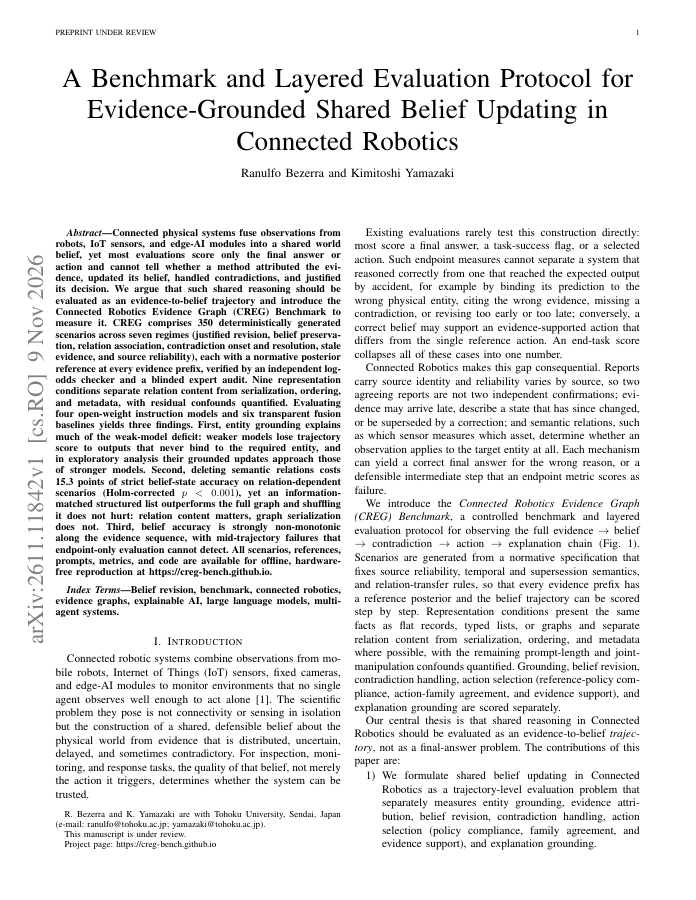
Connected physical systems fuse observations from robots, IoT sensors, and edge-AI modules into a shared account of the world, yet most evaluations score only the final answer or action and cannot tell whether a method attributed the evidence, updated its belief, handled…
9 Nov 2026
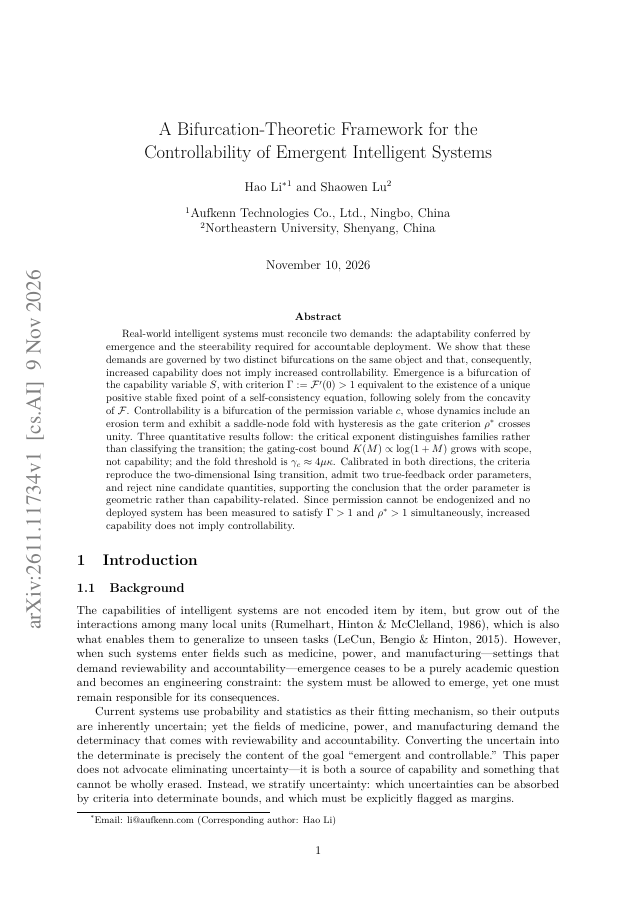
Real-world intelligent systems must reconcile two demands: the adaptability conferred by emergence and the steerability required for accountable deployment. We show that these demands are governed by two distinct bifurcations on the same object and that, consequently, increased…
9 Nov 2026
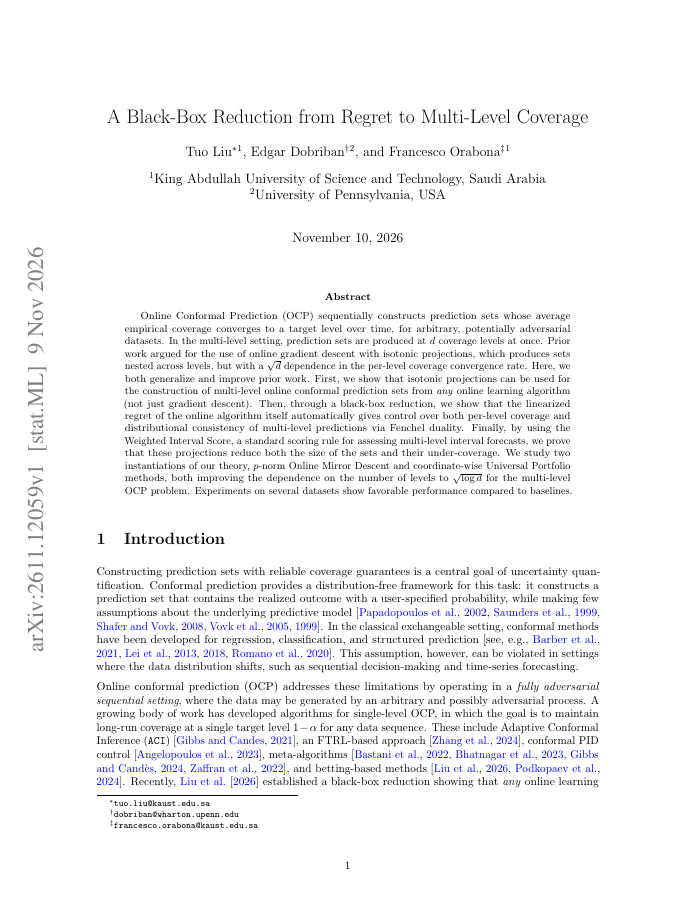
Online Conformal Prediction (OCP) sequentially constructs prediction sets whose average empirical coverage converges to a target level over time, for arbitrary, potentially adversarial datasets.
9 Nov 2026
A worked solution can make self-generated training targets shorter and cheaper, but accuracy on the practiced operation may hide how well a model can reuse newly learned rules. We study this choice in a 2B-parameter reasoning model learning two invented quantitative rules.
9 Nov 2026
Transformers are built with continuous symmetries in the attention mechanism. We derive $ρ$, a scalar invariant that measures each head's capacity to couple to rotary positional encodings.
9 Nov 2026
Securing patent protection across countries requires drafting claims separately for each national patent office, in the relevant language and according to its legal and stylistic conventions.
9 Nov 2026
Ottoman Divan poetry is composed in aruz, a quantitative meter based on the weights of syllables. The meter is sensitive to specific characters recorded in the original writing in the Arabic script.
9 Nov 2026
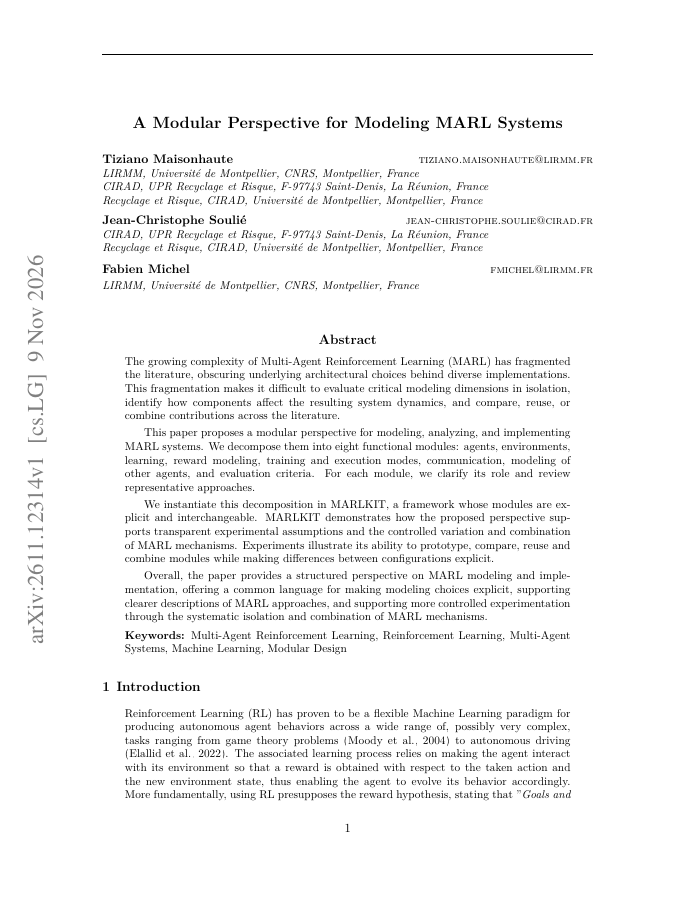
The growing complexity of Multi-Agent Reinforcement Learning (MARL) has fragmented the literature, obscuring underlying architectural choices behind diverse implementations.
9 Nov 2026
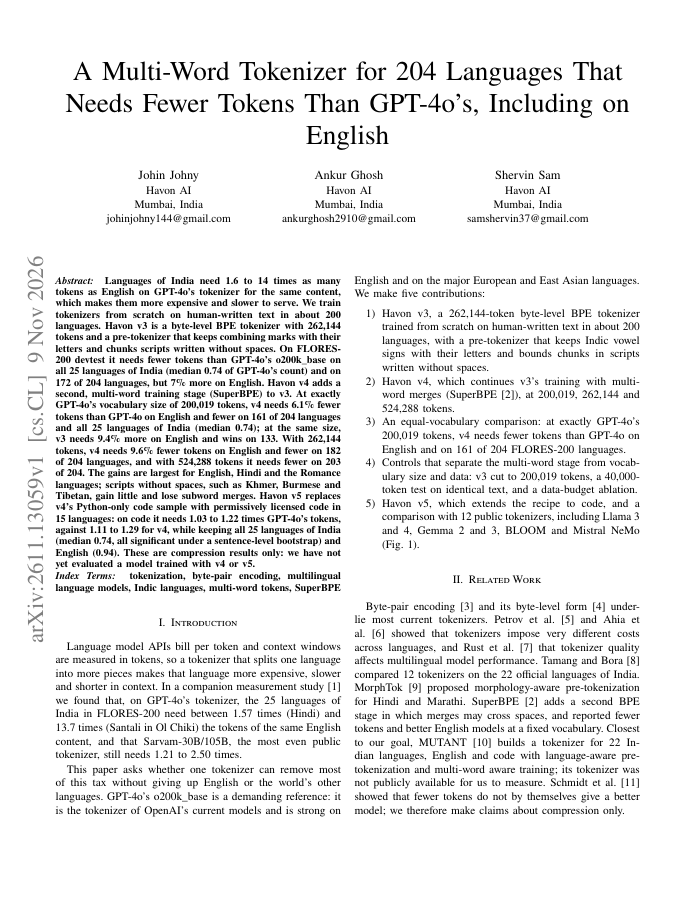
Languages of India need 1.6 to 14 times as many tokens as English on GPT-4o's tokenizer for the same content, which makes them more expensive and slower to serve. We train tokenizers from scratch on human-written text in about 200 languages.
9 Nov 2026
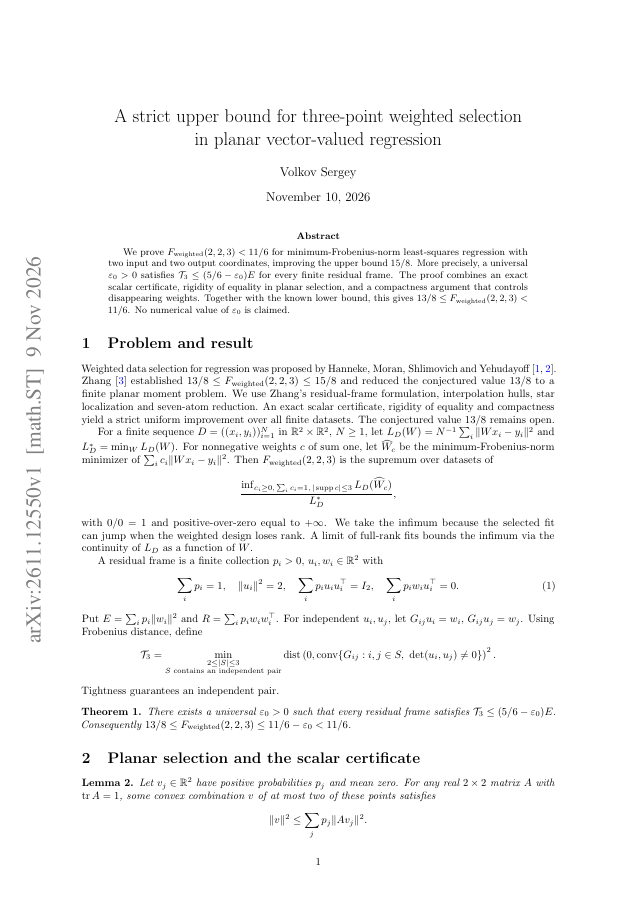
We prove $F_{\mathrm{weighted}}(2,2,3)<11/6$ for minimum-Frobenius-norm least-squares regression with two input and two output coordinates, improving the upper bound $15/8$.
9 Nov 2026
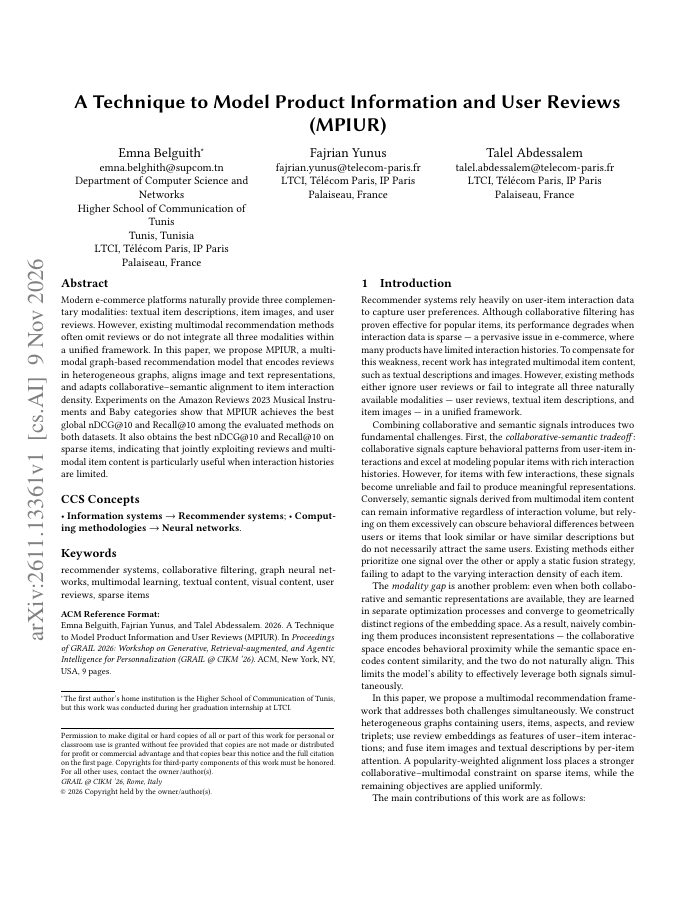
Modern e-commerce platforms naturally provide three complementary modalities: textual item descriptions, item images, and user reviews. However, existing multimodal recommendation methods often omit reviews or do not integrate all three modalities within a unified framework.
8 Nov 2026
We introduce HBAR (Hierarchical Brain Activity Representation), a hierarchical tokenization framework for learning compact, multi-scale representations of neuroimaging data.