17 Jun 2026
The March 2020 INCOSE INSIGHT special issue on AI and Systems Engineering (SE) became the most downloaded issue in the publication's history and launched a research community that now draws over 250 registrants to its annual workshop.
Trending research and the full catalog - each paper linked to the benchmarks, methods, and models it introduces.
Filtering here covers the 2,000 most recent papers, as much as one page can hold in memory. See the full index of 22,091 papers.
17 Jun 2026
The March 2020 INCOSE INSIGHT special issue on AI and Systems Engineering (SE) became the most downloaded issue in the publication's history and launched a research community that now draws over 250 registrants to its annual workshop.
17 Jun 2026
Physical events are not understood by their names alone, but by the causal state changes that compose them. A clip-level label such as "bounce" can be correct while hiding the process that makes the event physically valid, from support loss and contact onset to rebound…
16 Jun 2026
Binary data factorization is common, but real-valued methods ignore discreteness and yield hard-to-interpret factors. Boolean Matrix Factorization (BooMF) instead decomposes a binary matrix into two lower-rank binary matrices via logical AND and OR, expressing the data as a…
16 Jun 2026
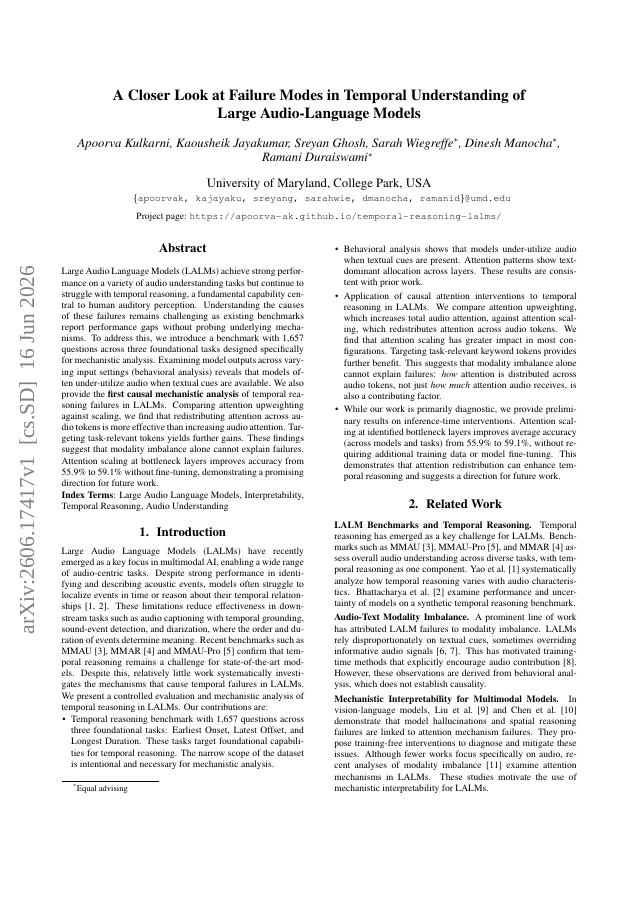
Large Audio Language Models (LALMs) achieve strong performance on a variety of audio understanding tasks but continue to struggle with temporal reasoning, a fundamental capability central to human auditory perception.
16 Jun 2026
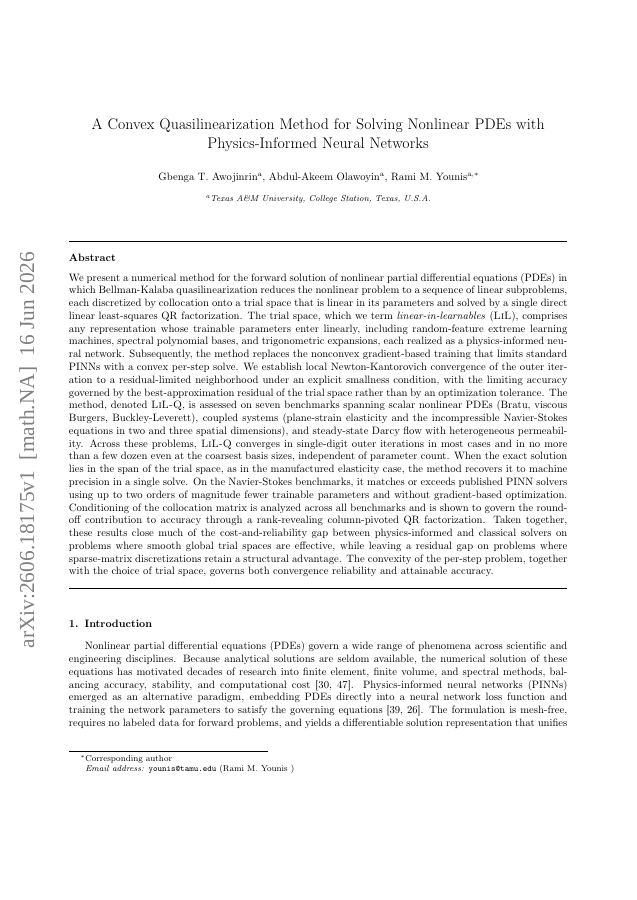
We present a numerical method for the forward solution of nonlinear partial differential equations (PDEs) in which Bellman-Kalaba quasilinearization reduces the nonlinear problem to a sequence of linear subproblems, each discretized by collocation onto a trial space that is…
16 Jun 2026
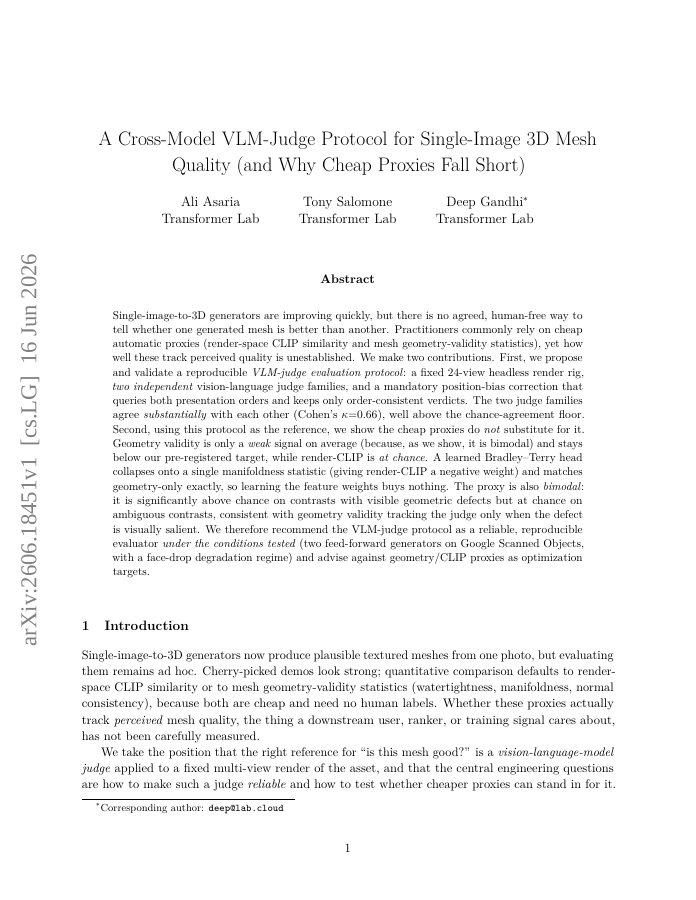
Single-image-to-3D generators are improving quickly, but there is no agreed, human-free way to tell whether one generated mesh is better than another. Practitioners commonly rely on cheap automatic proxies (render-space CLIP similarity and mesh geometry-validity statistics), yet…
16 Jun 2026
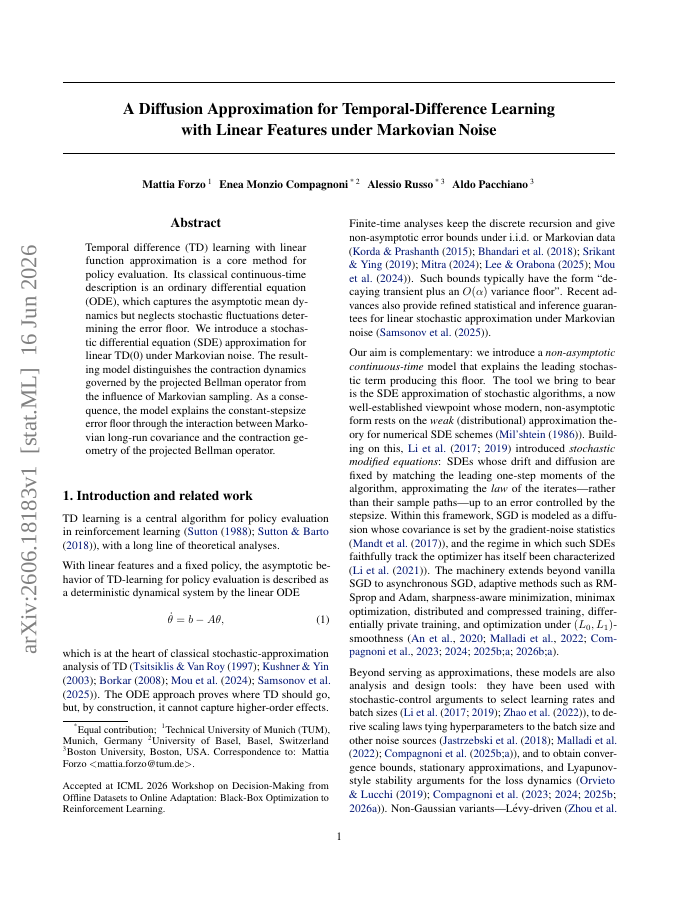
Temporal difference (TD) learning with linear function approximation is a core method for policy evaluation. Its classical continuous-time description is an ordinary differential equation (ODE), which captures the asymptotic mean dynamics but neglects stochastic fluctuations…
16 Jun 2026
Fairness has become a central concern in ranking problems involving individuals or social groups, particularly under the Responsible Artificial Intelligence agenda. In Multi-Criteria Decision Analysis, Stochastic Multicriteria Acceptability Analysis (SMAA) provides a robust…
16 Jun 2026
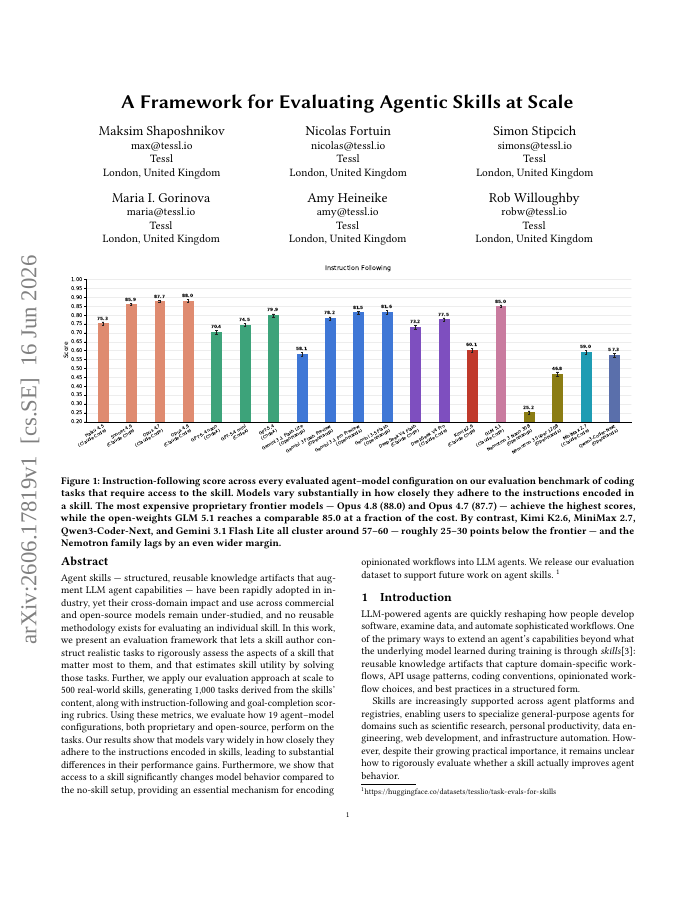
Agent skills -- structured, reusable knowledge artifacts that augment LLM agent capabilities -- have been rapidly adopted in industry, yet their cross-domain impact and use across commercial and open-source models remain under-studied, and no reusable methodology exists for…
16 Jun 2026
In speech processing, most state-of-the-art sequence prediction models rely on auto-regressive (AR) strategies to generate output sequences based on the raw predictions of the model.
16 Jun 2026
A wide range of neurosymbolic (NeSy) systems compute one functional: a belief-weighted sum of a logical quantity over a space of $σ$-structures, of which weighted model counting, fuzzy logic, and probabilistic logic are special cases.
16 Jun 2026
We develop a mathematically explicit link between shock-wave theory and the symmetry-quotiented learning dynamics of stochastic gradient descent, drawing on differential geometry, Lie group theory, and fluid mechanics.
16 Jun 2026
Traditional comorbidity scores (e.g., Charlson and Elixhauser) are widely used for risk adjustment and patient stratification, but they have two key limitations: (i) they are largely mortality-centric and do not align well with other clinical outcomes, and (ii) their linear,…
16 Jun 2026
Reasoning about what agents can achieve through strategic interaction is a core challenge in Multi-Agent Systems (MAS). Logics for strategic ability, such as ATL, provide rigorous methods, but their adoption is often hindered by the computational cost of strategy synthesis.
16 Jun 2026
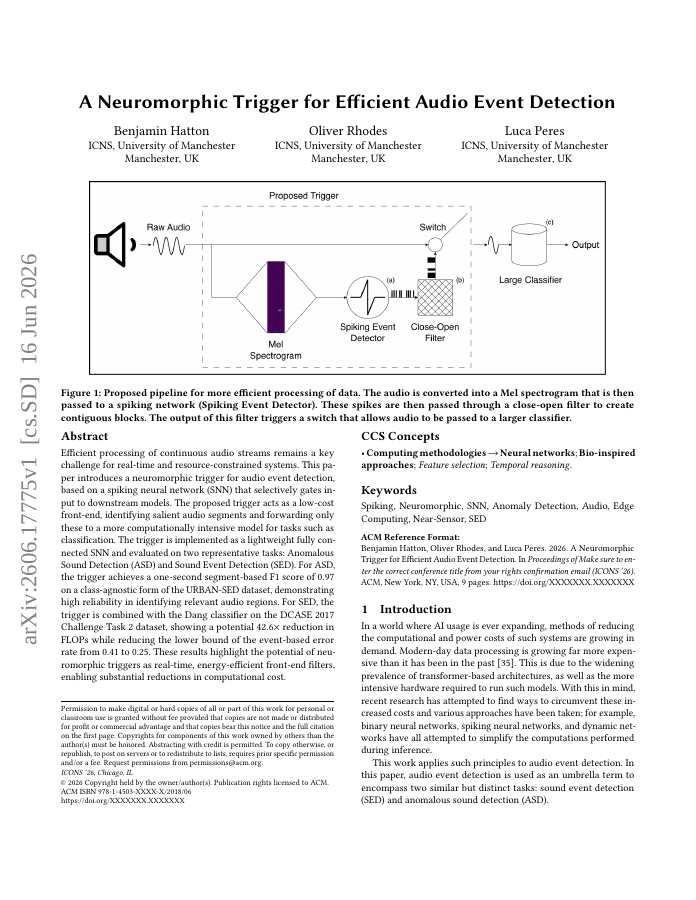
Efficient processing of continuous audio streams remains a key challenge for real-time and resource-constrained systems. This paper introduces a neuromorphic trigger for audio event detection, based on a spiking neural network (SNN) that selectively gates input to downstream…
16 Jun 2026
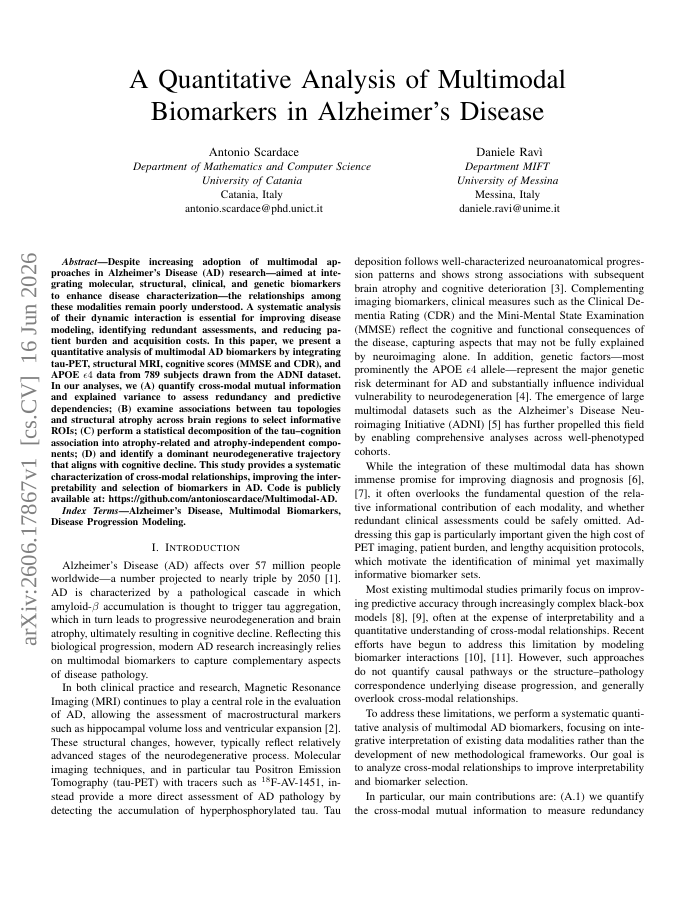
Despite increasing adoption of multimodal approaches in Alzheimer's Disease (AD) research -- aimed at integrating molecular, structural, clinical, and genetic biomarkers to enhance disease characterization -- the relationships among these modalities remain poorly understood.
16 Jun 2026
We evaluate the adversarial robustness of two frontier large language models (LLMs) developed by Anthropic, Fable 5 and Opus 4.8, against four families of automated jailbreak attack across 7 826 harmful intents spanning a ten-category harm taxonomy.
16 Jun 2026
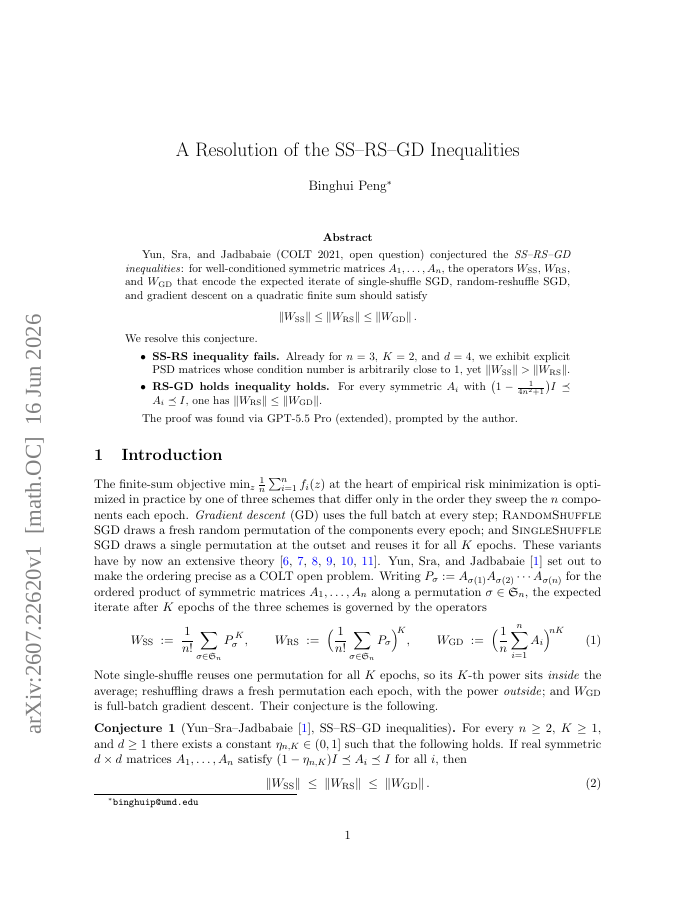
Yun, Sra, and Jadbabaie (COLT 2021, open question) conjectured the SS--RS--GD inequalities: for well-conditioned symmetric matrices $A_1,\dots,A_n$, the operators $W_{ss}$, $W_{rs}$, and $W_{gd}$ that encode the expected iterate of single-shuffle SGD, random-reshuffle SGD, and…
16 Jun 2026
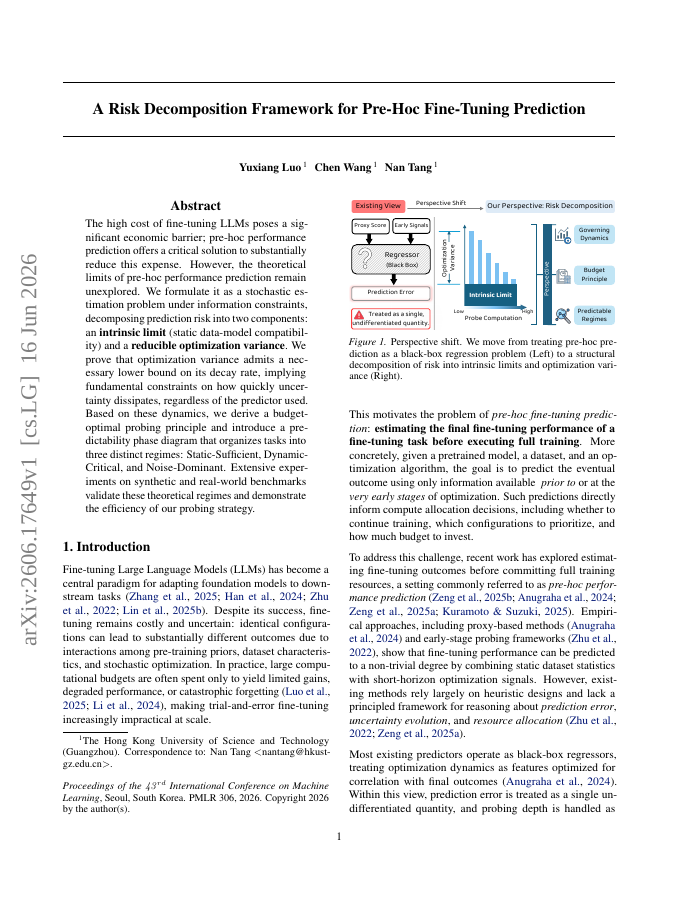
The high cost of fine-tuning LLMs poses a significant economic barrier; pre-hoc performance prediction offers a critical solution to substantially reduce this expense. However, the theoretical limits of pre-hoc performance prediction remain unexplored.
16 Jun 2026
Soil Moisture (SM) modelling constitutes a complex spatiotemporal learning problem characterised by nonlinear environmental interactions, heterogeneous data sources, and limited ground observations.
16 Jun 2026
Optical networks need intent-driven, closed-loop agentic management, a key enabler for higher autonomy levels. We present the first T-API-compliant reasoning and act (ReAct) loop.
16 Jun 2026
Retrieval-Augmented Generation (RAG) has emerged as a paradigm for enhancing large language models (LLMs) with external knowledge, yet existing graph-based methods face a fundamental limitation: entity-centric and chunk-centric approaches operate on representations anchored to…
16 Jun 2026
This paper develops a variational framework for regulated language generation. Starting from autoregressive token sampling, we derive the induced distribution over complete messages and relate it to an entropy-regularized Gibbs law.
16 Jun 2026
Generative AI (GenAI) deployment in the workplace is accelerating rapidly. Nevertheless, questions of who adopts, who benefits, and who is left behind and why are still understudied.