1 Sep 2026
Large language models (LLMs) are increasingly trained to decline queries that fall outside their knowledge (knowledge-based refusal, KR) or violate safety policies (safety-based refusal, SR).
Trending research and the full catalog - each paper linked to the benchmarks, methods, and models it introduces.
Filtering here covers the 2,000 most recent papers, as much as one page can hold in memory. See the full index of 22,617 papers.
1 Sep 2026
Large language models (LLMs) are increasingly trained to decline queries that fall outside their knowledge (knowledge-based refusal, KR) or violate safety policies (safety-based refusal, SR).
31 Aug 2026
Language models learn about grammatical number primarily from co-occurrence, and show frequency effects as a result---sometimes taken to indicate that they do not learn abstract ``rules'', and are instead dependent on specific lexical items.
31 Aug 2026
Generative models have become central across science and industry, from image and text synthesis to the design of molecules and materials. Quantum generative models are considered one of the most promising applications for quantum computers, since a quantum circuit naturally…
31 Aug 2026
The fundamental theorem of statistical learning states that, under suitable measurability assumptions, finite Vapnik--Chervonenkis (VC) dimension guarantees that every proper consistent learning rule is probably approximately correct (PAC).
31 Aug 2026
Geospatial foundation models have emerged as state-of-the-art methods for downstream Earth observation tasks. However, existing pretraining methodologies process imagery through a single-concept lens, failing to capture the highly compositional nature of complex satellite…
31 Aug 2026
This paper develops a general convolutional neural network (CNN) framework for detecting heterogeneous event-driven dynamics in univariate time series windows. We show that the induced CNN class exactly represents classifiers based on range, maximum drawup, maximum drawdown and…
31 Aug 2026
Can an artificial intelligence (AI) generate a scientific hypothesis outside a human collaborator's active hypothesis space (AHS), and can human-AI research be organized to make such breakthroughs more likely? We document such a case while proving a theorem that connects two…
31 Aug 2026
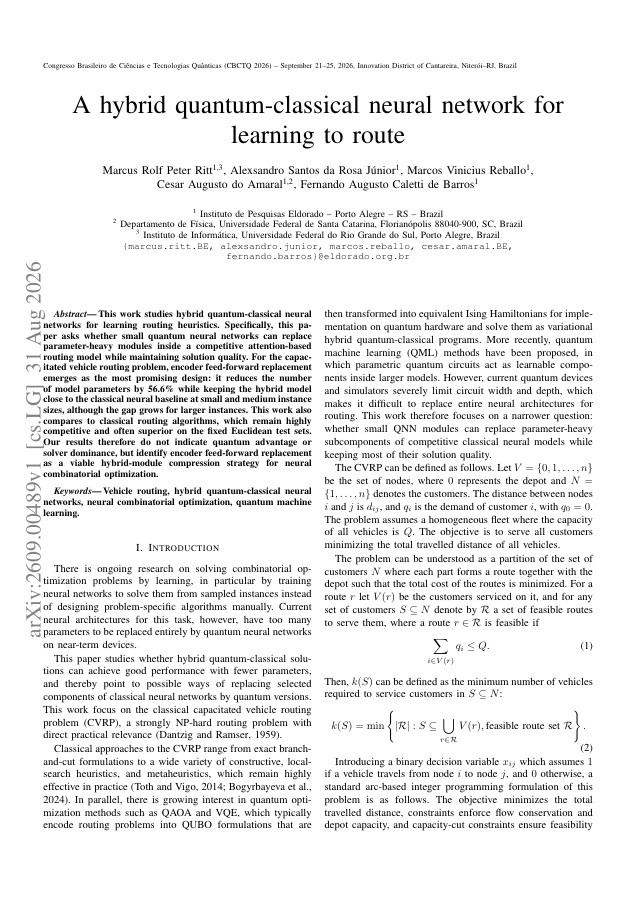
This work studies hybrid quantum-classical neural networks for learning routing heuristics. Specifically, this paper asks whether small quantum neural networks can replace parameter-heavy modules inside a competitive attention-based routing model while maintaining solution…
31 Aug 2026
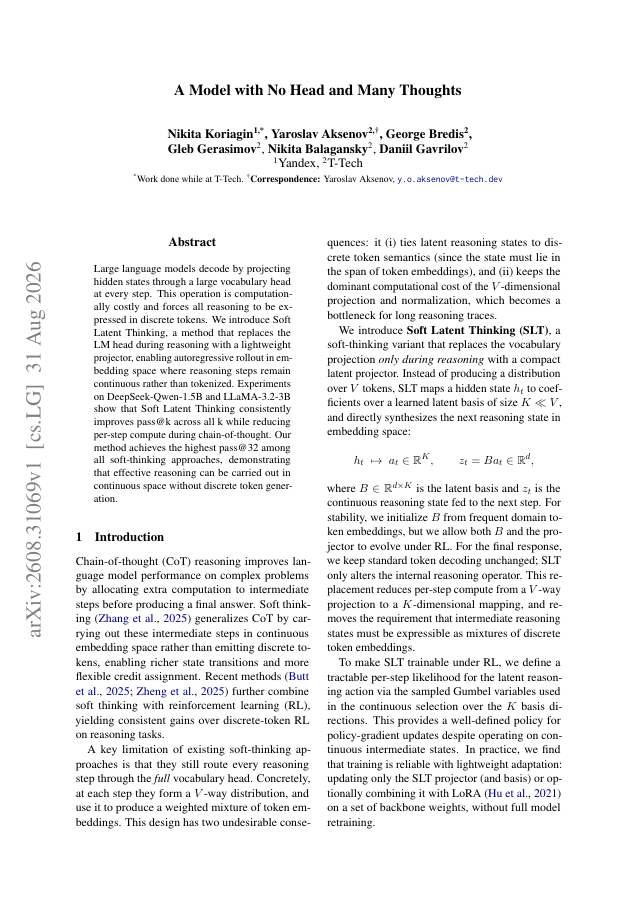
Large language models decode by projecting hidden states through a large vocabulary head at every step. This operation is computationally costly and forces all reasoning to be expressed in discrete tokens.
31 Aug 2026
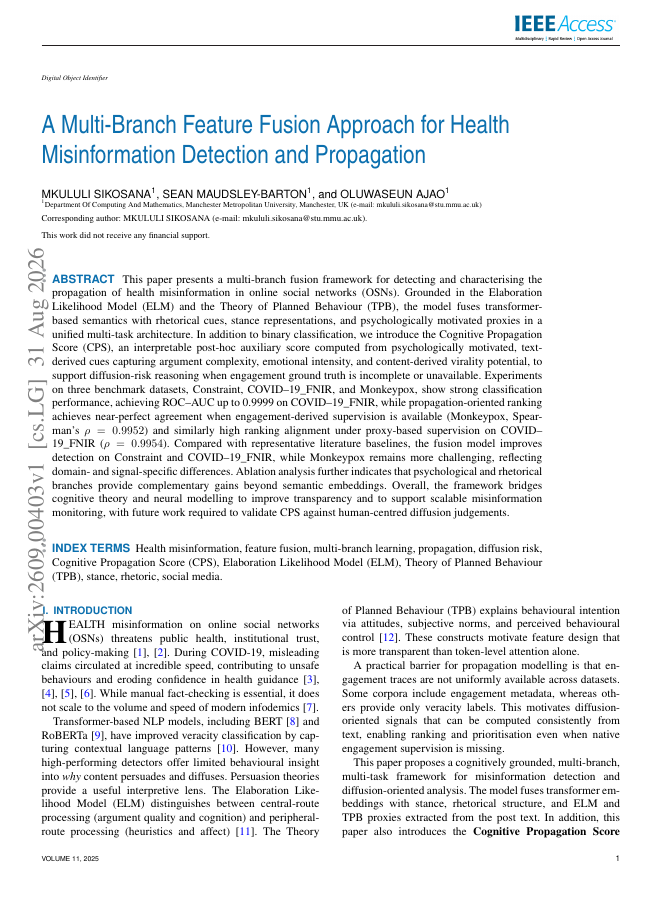
This paper presents a multi-branch fusion framework for detecting and characterising the propagation of health misinformation in online social networks (OSNs). Grounded in the Elaboration Likelihood Model (ELM) and the Theory of Planned Behaviour (TPB), the model fuses…
31 Aug 2026
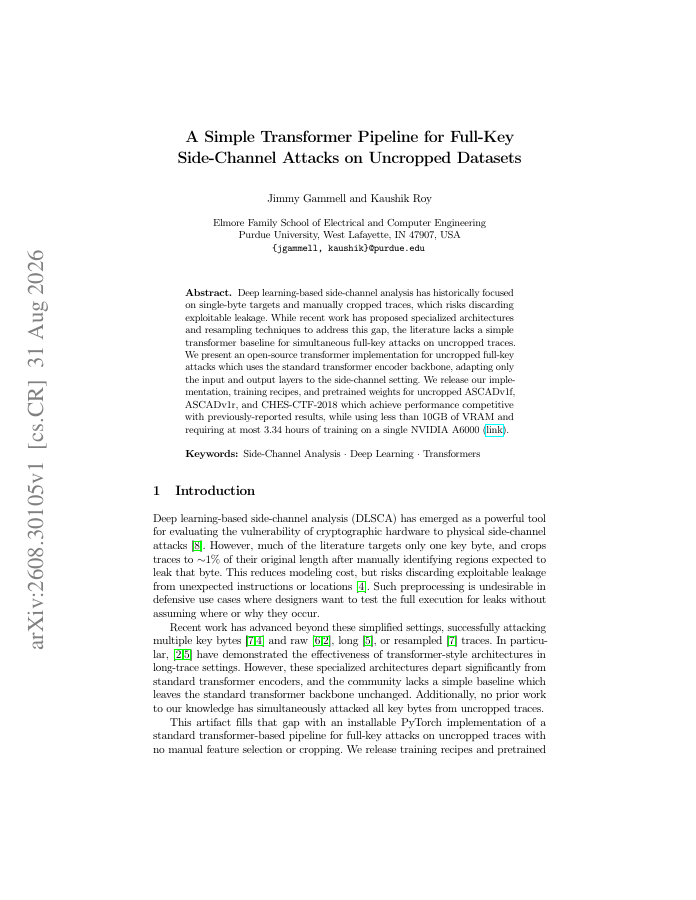
Deep learning-based side-channel analysis has historically focused on single-byte targets and manually cropped traces, which risks discarding exploitable leakage. While recent work has proposed specialized architectures and resampling techniques to address this gap, the…
31 Aug 2026
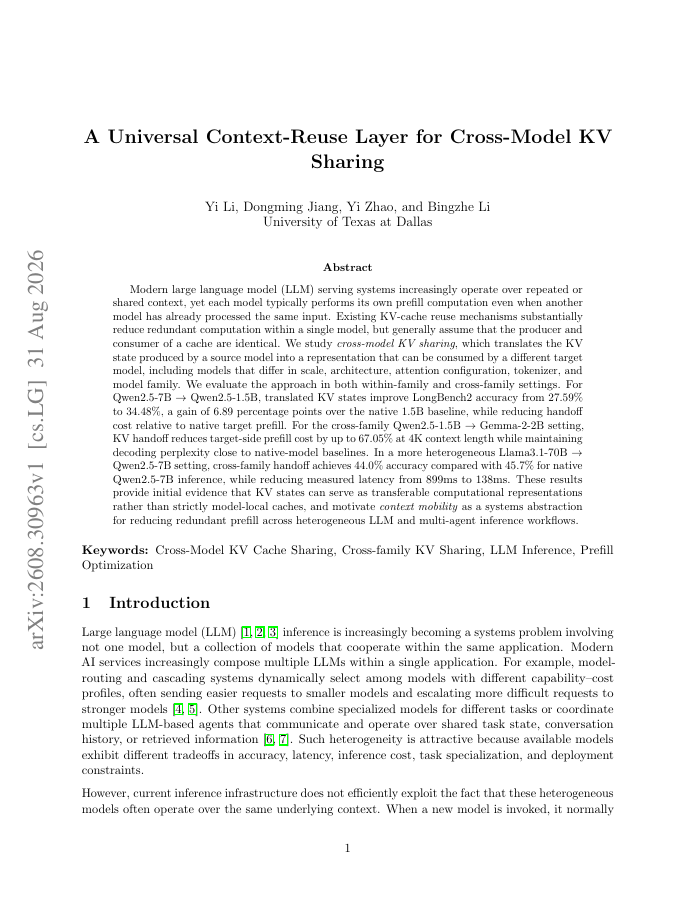
Modern large language model (LLM) serving systems increasingly operate over repeated or shared context, yet each model typically performs its own prefill computation even when another model has already processed the same input.
31 Aug 2026
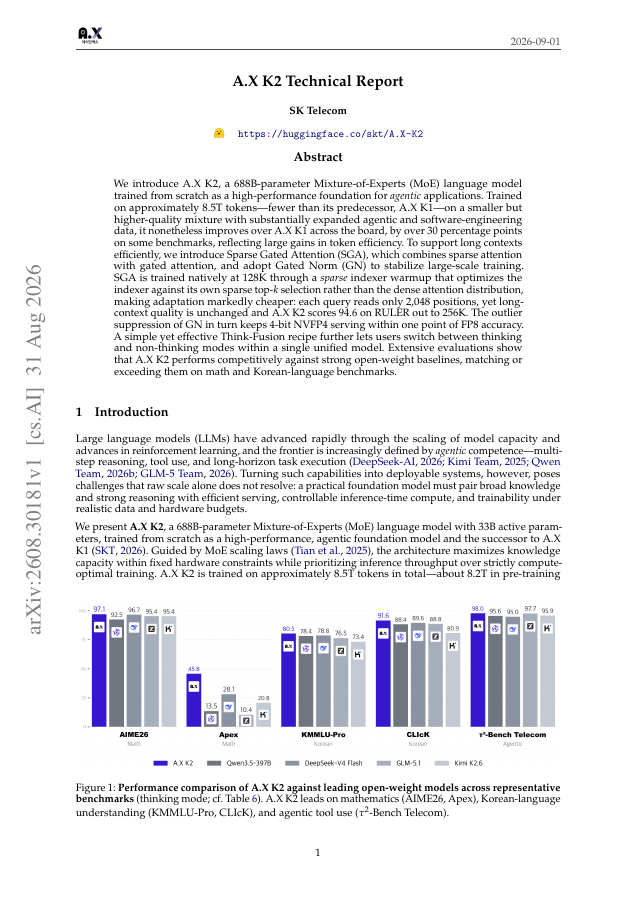
We introduce A.X K2, a 688B-parameter Mixture-of-Experts (MoE) language model trained from scratch as a high-performance foundation for \emph{agentic} applications. Trained on approximately 8.5T tokens---fewer than its predecessor, A.X K1---on a smaller but higher-quality…
30 Aug 2026
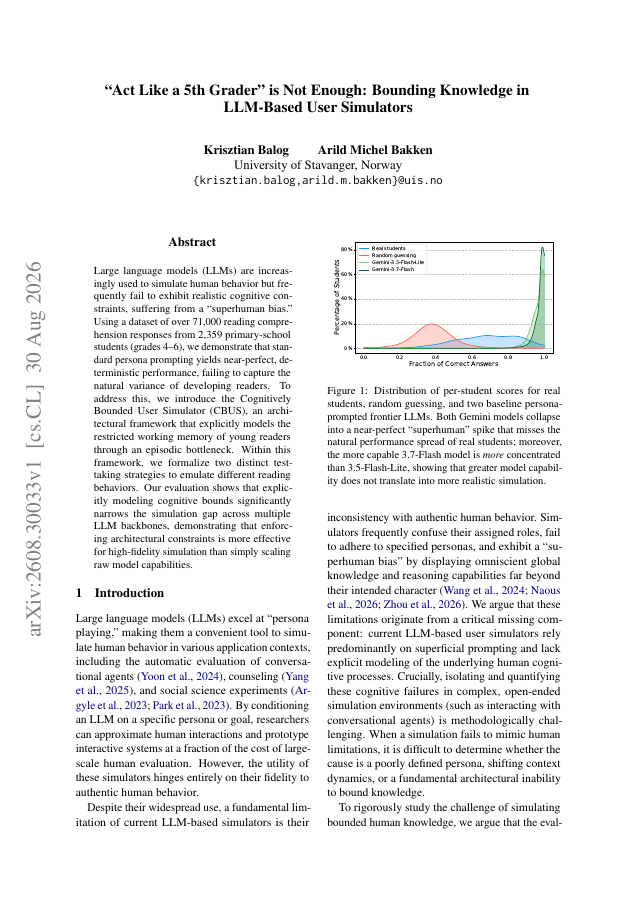
Large language models (LLMs) are increasingly used to simulate human behavior but frequently fail to exhibit realistic cognitive constraints, suffering from a "superhuman bias." Using a dataset of over 71,000 reading comprehension responses from 2,359 primary-school…
30 Aug 2026
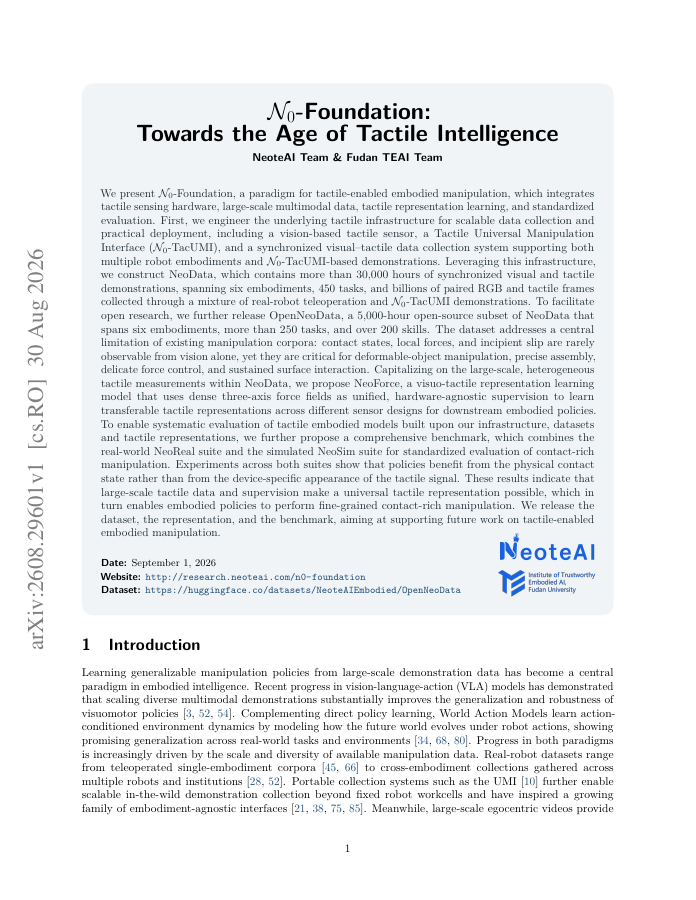
We present $N_0$-Foundation, a paradigm for tactile-enabled embodied manipulation, which integrates tactile sensing hardware, large-scale multimodal data, tactile representation learning, and standardized evaluation.
30 Aug 2026
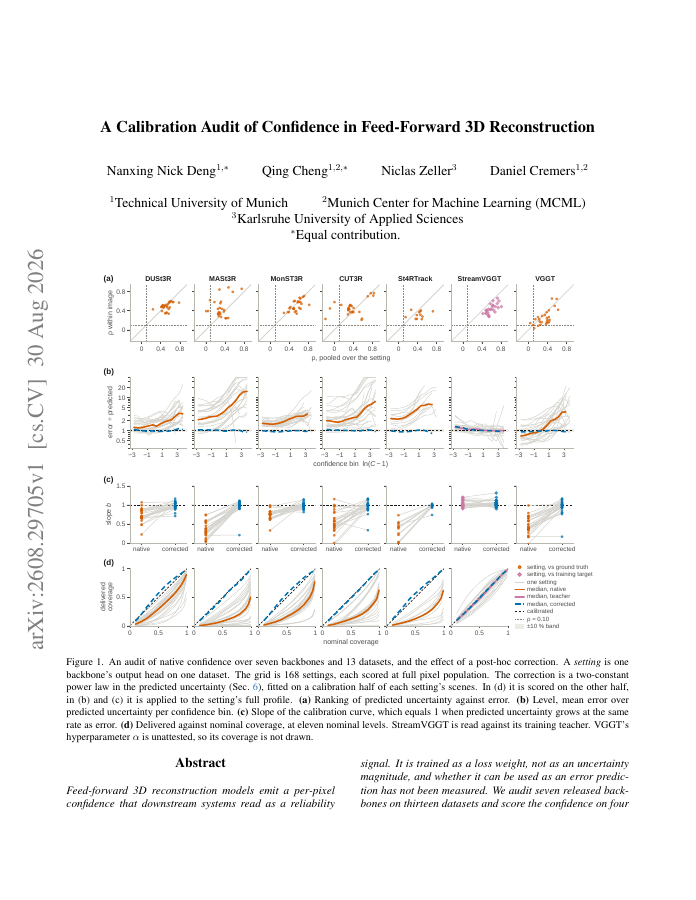
Feed-forward 3D reconstruction models output a per-pixel confidence that is used by downstream systems as an uncertainty signal. The confidence is trained to serve as a weight in the training loss of models.
30 Aug 2026
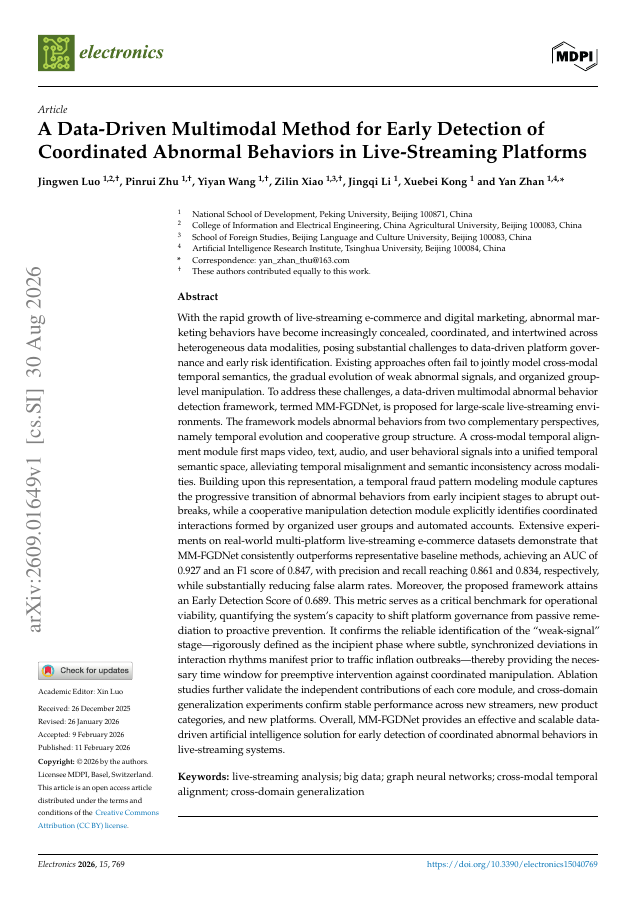
With the rapid growth of live-streaming e-commerce and digital marketing, abnormal marketing behaviors have become increasingly concealed and coordinated across heterogeneous modalities, challenging platform governance and early risk identification.
30 Aug 2026
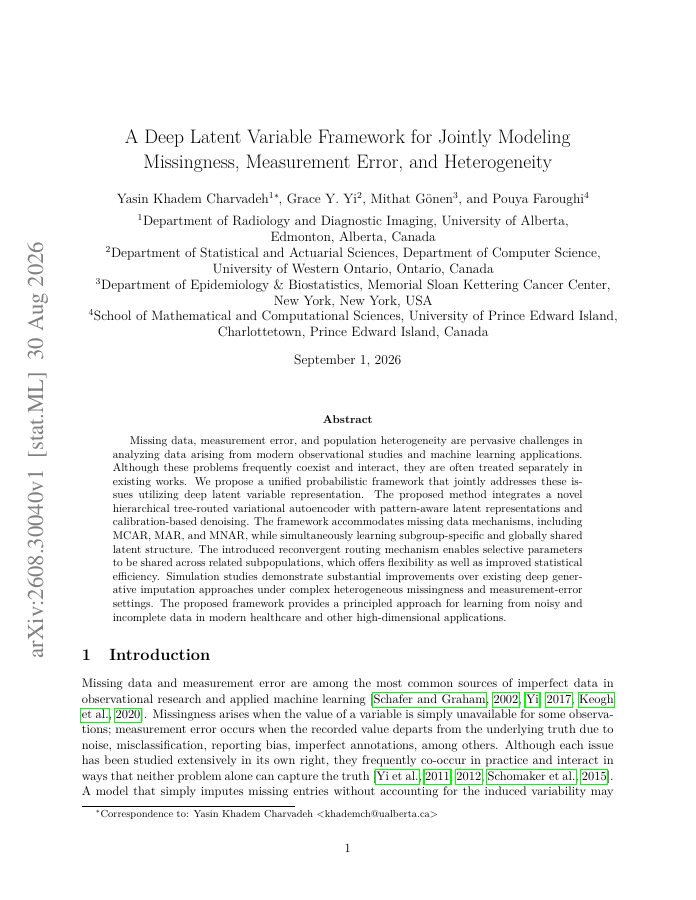
Missing data, measurement error, and population heterogeneity are pervasive challenges in analyzing data arising from modern observational studies and machine learning applications.
30 Aug 2026
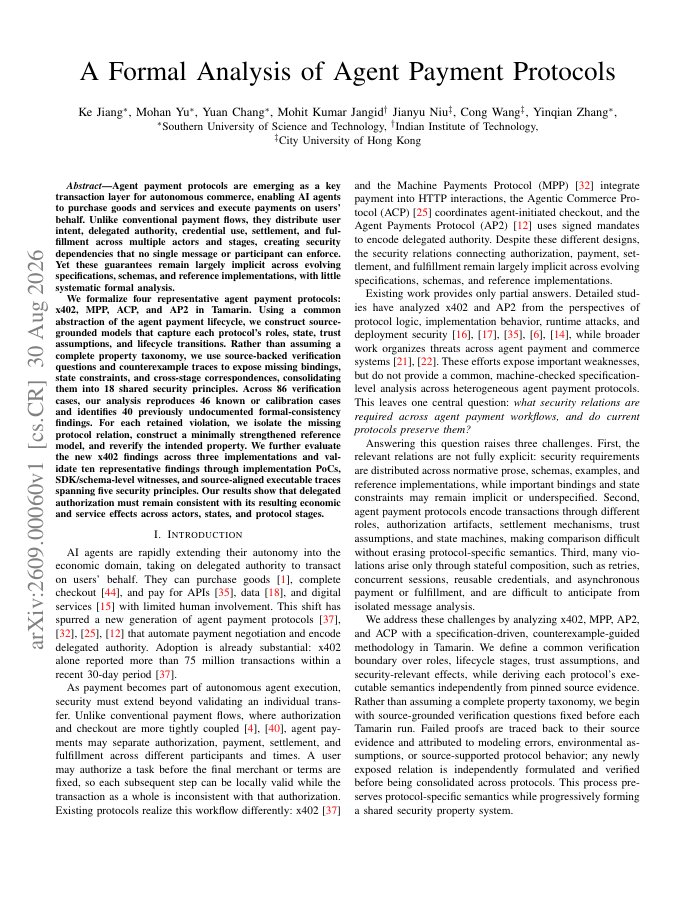
Agent payment protocols are emerging as a key transaction layer for autonomous commerce, enabling AI agents to purchase goods and services and execute payments on users' behalf.
30 Aug 2026
A token-embedding table holds a hub of short rows near its origin, and we show that this cluster biases what nearest-neighbor intrinsic-dimension (ID) estimators report.
30 Aug 2026
Sequence models---the architecture family behind large language models and, increasingly, state-of-the-art image recognition---have redefined how machines learn from high-dimensional data.
30 Aug 2026
Accurate detection of tomato growth stages is essential for stage-specific greenhouse management and precision agriculture. In Bhutan, greenhouse cultivation is affected by altitude variability, large diurnal temperature fluctuations, diffuse illumination, limited automation,…
30 Aug 2026
Autonomous large language model (LLM) agents increasingly face reliability, context consumption, and execution stability bottlenecks when deployed on complex, long-horizon tasks.
30 Aug 2026
The rapid development of LLMs incurs prohibitive memory footprints and intensive computational demands. Quantization-Aware Training (QAT) techniques have emerged as a promising solution to address these challenges by explicitly simulating quantization effects during model…