8 Oct 2026
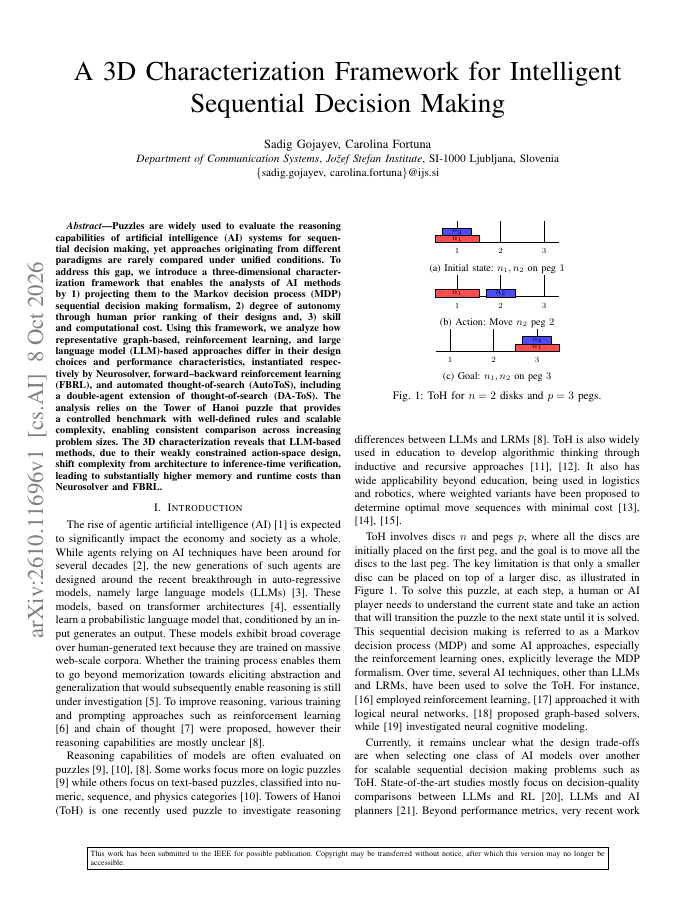
Puzzles are widely used to evaluate the reasoning capabilities of artificial intelligence (AI) systems for sequential decision making, yet approaches originating from different paradigms are rarely compared under unified conditions.
Trending research and the full catalog - each paper linked to the benchmarks, methods, and models it introduces.
Filtering here covers the 2,000 most recent papers, as much as one page can hold in memory. See the full index of 22,502 papers.
8 Oct 2026
Puzzles are widely used to evaluate the reasoning capabilities of artificial intelligence (AI) systems for sequential decision making, yet approaches originating from different paradigms are rarely compared under unified conditions.
8 Oct 2026
General-purpose robots must perform a wide range of tasks from agile locomotion to dexterous manipulation. While sim-to-real reinforcement learning (RL) has proven to be a useful tool for this goal, current RL pipelines depend on engineering-heavy, per-task structural priors…
8 Oct 2026
Parameter-efficient fine-tuning has hundreds of methods, usually compared by parameter count and benchmark score. We compare them as maps. A pretrained checkpoint is a base point in weight space, and a weight-space method is a smooth map from a small parameter space that starts…
8 Oct 2026
Black-box optimization (BBO) arises in many scientific and engineering problems where objective evaluations are expensive and limited. Recent large language model (LLM) agents offer a new way to approach BBO by combining task semantics, computation, optimization tools, and…
8 Oct 2026
Large language models are stochastic by nature. Repeated executions under the same experimental conditions may produce different responses. We propose a framework that can be applied across the model lifecycle, from task design to residual behavior and continuous monitoring.
8 Oct 2026
The kernel bandit problem consists of sequentially optimizing an unknown function with noisy feedback, where the function has bounded norm in a given Reproducing Kernel Hilbert Space (RKHS).
8 Oct 2026
Off-policy actor--critic methods control overestimation bias by taking the minimum of two critics. This uses the same aggregation rule everywhere, regardless of how the critics disagree.
8 Oct 2026
Skillful prediction of biomass-burning activity several days in advance is important for air-quality forecasting and aerosol prediction. Two operational constraints motivate this work.
8 Oct 2026
Automated methods have been proposed to overcome the limitations of human verbal deception detection, but evidence remains fragmented across disciplines. We systematically reviewed 25 years of research (289 reports, 6,136 classification models) and meta-analyzed 3,653 models…
8 Oct 2026
High-dimensional sparse recipe formulation in process industries involves nonlinear association of various covariates, bounded by sparsity constraints and multi-criteria tolerances.
8 Oct 2026
Learning and problem solving depend critically on the structure of internal representations. While many modern data-driven artificial systems achieve strong predictive performance, their learned representations often lack explicit structure for expressing abstraction,…
8 Oct 2026
Predicting the structure and response of inhomogeneous polymer electrolytes requires a description of ion correlations that retains molecular-scale accuracy while remaining transferable across spatial scales and geometries.
8 Oct 2026
Reinforcement learning in safety-critical domains requires maximizing task performance while strictly adhering to safety constraints. Existing safe reinforcement learning paradigms typically force a trade-off: they either require a priori knowledge to provide strict safety…
7 Oct 2026
Despite its widespread use, Proximal Policy Optimization with clipping (PPO-Clip) remains difficult to tune, and the interactions among critic learning, clipping, and rollout reuse remain incompletely understood.
7 Oct 2026
There are more than 2,000 listed companies on the UK's London Stock Exchange, divided into 11 sectors who are required to communicate their financial results at least twice in a single financial year. UK annual reports are very lengthy documents with around 80 pages on average.
7 Oct 2026
Continual pre-training and fine-tuning in Large Language Models (LLMs) inevitably induce catastrophic forgetting, typically mitigated by replay using often-inaccessible original data. In this data-free regime, we analyze where forgetting occurs and why.
7 Oct 2026
Can a biological wiring diagram serve as a useful computational substrate beyond the behaviors for which it evolved? We use the publicly released MaleCNS v1.0 connectome, reconstructed from a single adult male Drosophila specimen, as the fixed recurrent topology of an artificial…
7 Oct 2026
Background: Modern software systems increasingly rely on Machine Learning (ML) assets (i.e., pre-trained models, datasets, benchmarks) for building, evaluating, and integrating ML-based systems.
7 Oct 2026
Reinforcement Learning (RL) from outcome rewards suffers from sparse supervision, particularly on difficult, long-horizon tasks where successful trajectories are rare and costly to generate.
7 Oct 2026
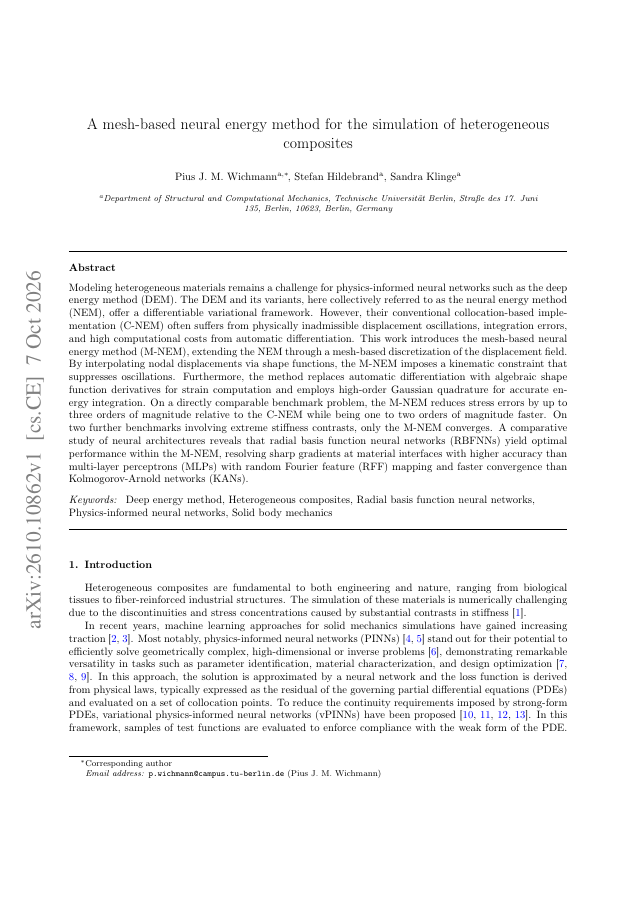
Modeling heterogeneous materials remains a challenge for physics-informed neural networks such as the deep energy method (DEM). The DEM and its variants, here collectively referred to as the neural energy method (NEM), offer a differentiable variational framework.
7 Oct 2026
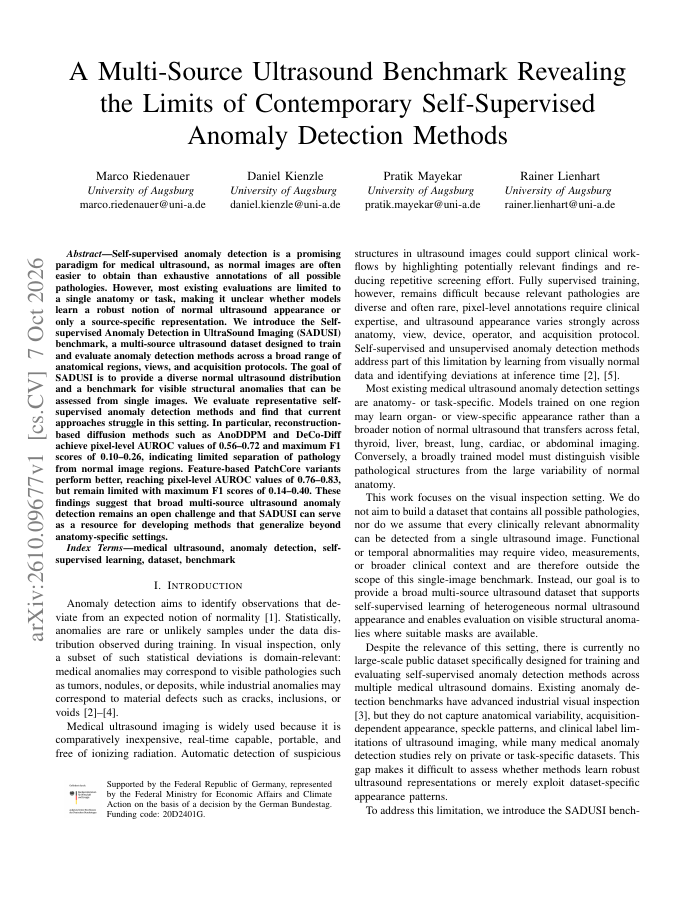
Self-supervised anomaly detection is a promising paradigm for medical ultrasound, as normal images are often easier to obtain than exhaustive annotations of all possible pathologies.
7 Oct 2026
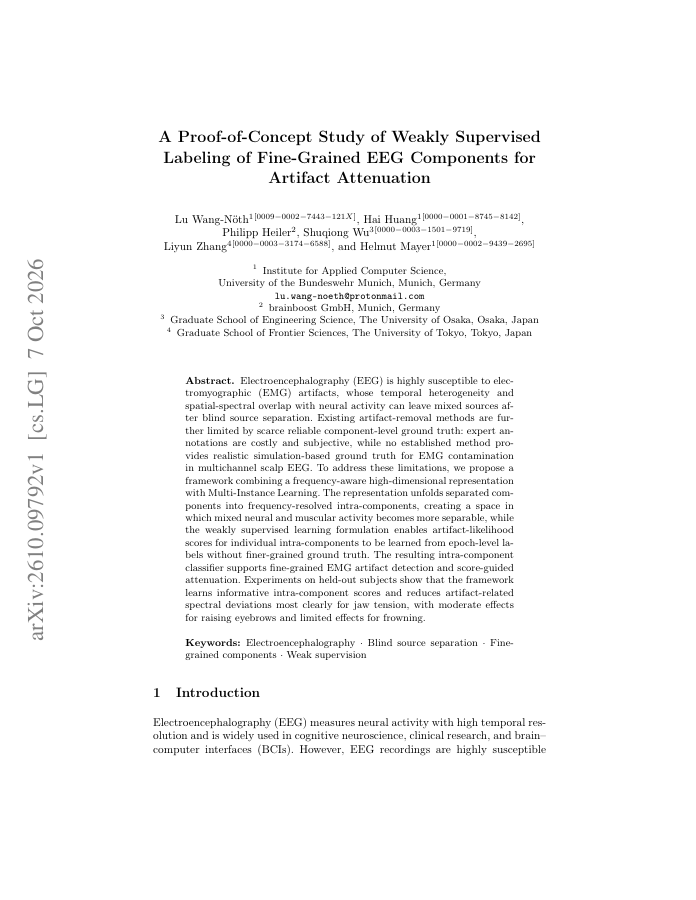
Electroencephalography (EEG) is highly susceptible to electromyographic (EMG) artifacts, whose temporal heterogeneity and spatial-spectral overlap with neural activity can leave mixed sources after blind source separation.
7 Oct 2026
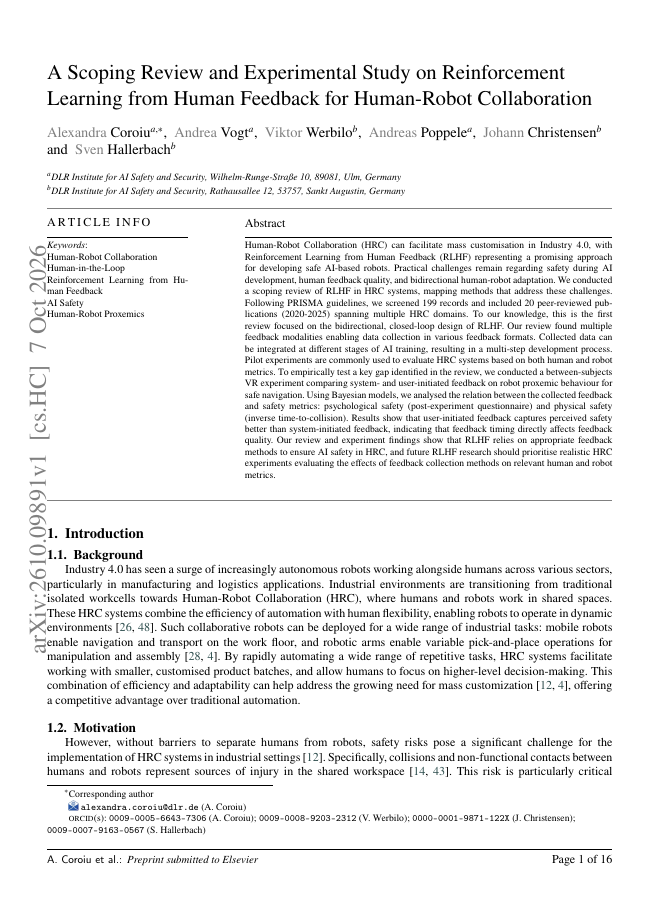
Human-Robot Collaboration (HRC) can facilitate mass customisation in Industry 4.0, with Reinforcement Learning from Human Feedback (RLHF) representing a promising approach for developing safe AI-based robots.
7 Oct 2026
Deployments of research agents are moving to populations of thousands that share one pool of compute, while most current systems organize one project at a time or leave the population unorganized.