30 Jun 2026
The increasing complexity of agentic tasks has led to rapidly growing trajectory lengths, which poses significant challenges for large language model (LLM) based agents with fixed context windows.
Trending research and the full catalog - each paper linked to the benchmarks, methods, and models it introduces.
Filtering here covers the 2,000 most recent papers, as much as one page can hold in memory. See the full index of 22,539 papers.
30 Jun 2026
The increasing complexity of agentic tasks has led to rapidly growing trajectory lengths, which poses significant challenges for large language model (LLM) based agents with fixed context windows.
29 Jun 2026
Current generative models, including GANs and diffusion models, have reached an outstanding level of photorealism, posing significant risks to privacy and security. To ensure real-world applicability, deepfake detectors must generalise effectively to unseen generators.
29 Jun 2026
Decision theory provides a formal framework for how agents should make choices under uncertainty, drawing on ideas from philosophy, probability, and causality. Despite significant progress, the field still lacks a unified modeling language, and key concepts - such as the…
29 Jun 2026
Objective: Accurate classification of physiological signals in real-world deployments is challenged by sensor noise, motion artifacts, and distribution shifts between training and deployment data.
29 Jun 2026
Measurements of proprietary LLM evaluators can become invalid within weeks -- we document one case and provide the diagnostic framework to detect it. We introduce EPC -- comprising the Multimodal Preference Collapse Index (MPCI), evaluator-indexed coupling matrix, and…
29 Jun 2026
Learned reconstruction operators for inverse problems are typically trained under a fixed noise model, and generalize poorly when the distribution during testing differs from the one assumed during training.
29 Jun 2026
Most corporate workplace environments enforce policies and technical controls that limit the storage of sensitive data on client endpoints. Consequently, ransomware operators have evolved variants that expand their attack surface from local systems to network drives and shared…
29 Jun 2026
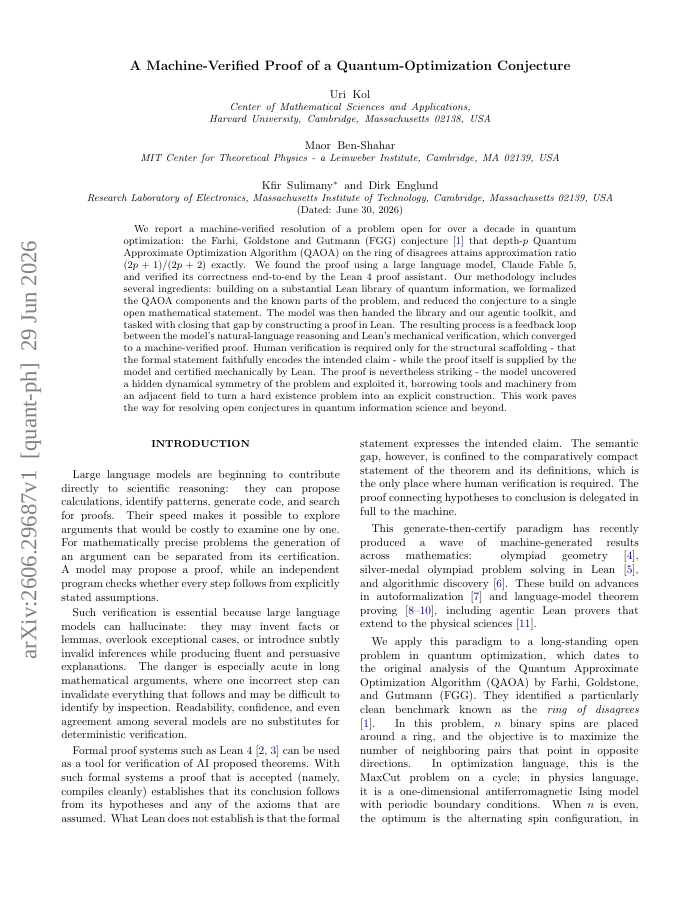
We report a machine-verified resolution of a problem open for over a decade in quantum optimization: the Farhi, Goldstone and Gutmann (FGG) conjecture that depth-$p$ Quantum Approximate Optimization Algorithm (QAOA) on the ring of disagrees attains approximation ratio…
29 Jun 2026
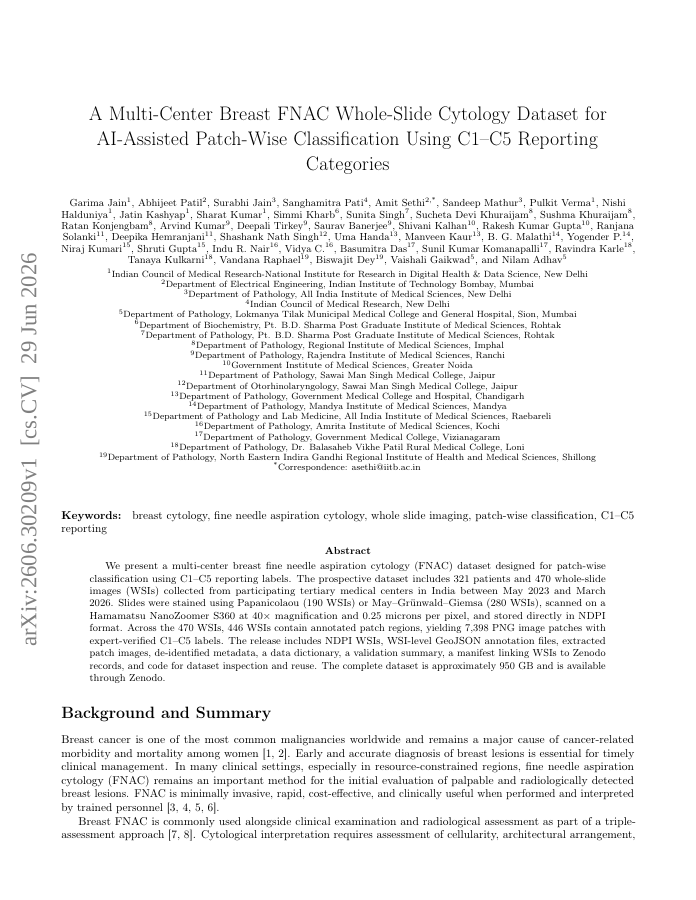
We present a multi center breast fine needle aspiration cytology (FNAC) dataset designed for patch wise classification using C1 to C5 reporting labels. The prospective dataset includes 321 patients and 470 whole-slide images (WSIs) collected from participating tertiary medical…
29 Jun 2026
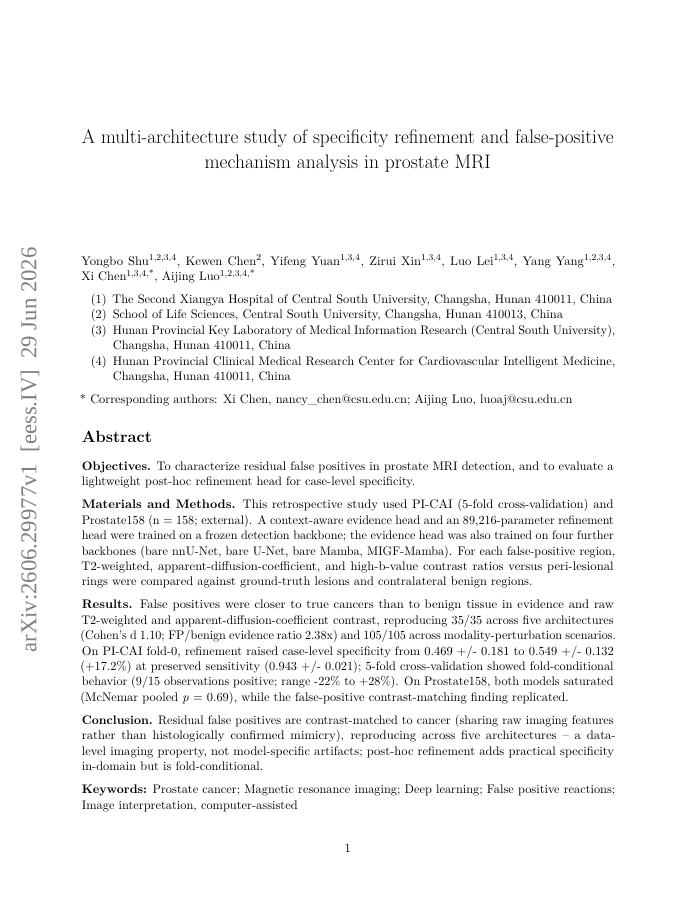
Objectives: To characterize residual false positives in prostate MRI detection, and to evaluate a lightweight post-hoc refinement head for case-level specificity. Materials and Methods: This retrospective study used PI-CAI (5-fold cross-validation) and Prostate158 (n=158;…
29 Jun 2026
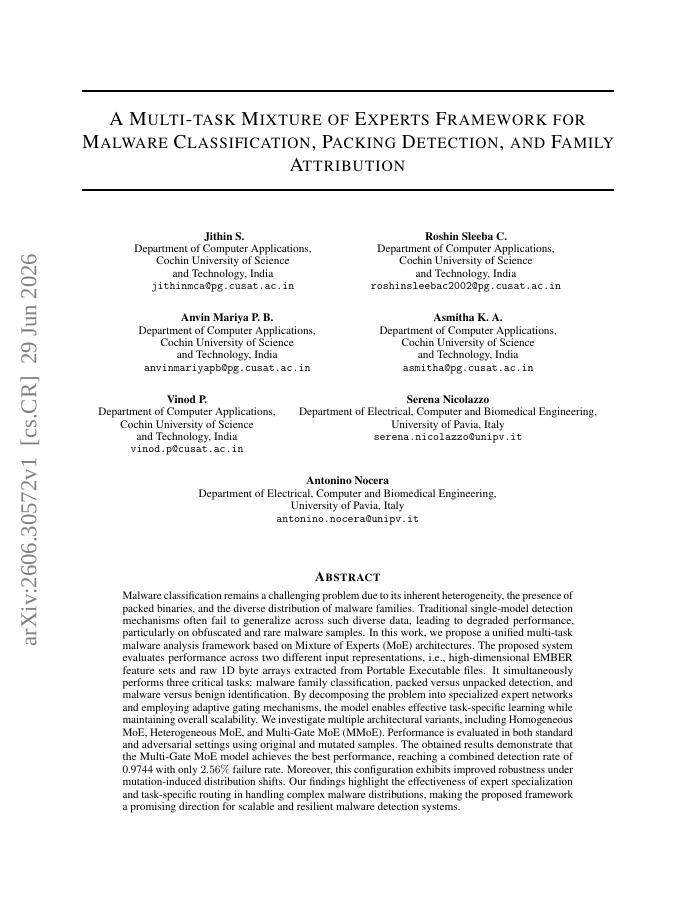
Malware classification remains a challenging problem due to its inherent heterogeneity, the presence of packed binaries, and the diverse distribution of malware families.
29 Jun 2026
In 2020, the U.S. Census Bureau adopted differential privacy for the Decennial Census by injecting integer-valued Gaussian noise into published census tabulations. Exactly evaluating the privacy guarantees of these data releases would enable the Bureau to determine the absolute…
29 Jun 2026
Enterprise AI agents route user queries to specialized skills by matching queries against natural language skill descriptions. When two skills share overlapping descriptions, the routing LLM misroutes queries, a failure we term skill collision.
29 Jun 2026
The number of trees is a central computational parameter in Random Forests: increasing it reduces finite-ensemble variability but increases training and prediction cost.
29 Jun 2026
Delayed generalization (\ie~grokking) refers to the phenomenon in which a neural network fits its training data early in training but only begins to generalize after a prolonged delay, often through an abrupt transition.
29 Jun 2026
Recent literature shows that large language models (LLMs) are useful for general-purpose tasks yet perform poorly on specific domain ones. One reason is the difficulty of supplying narrow context to a general-purpose model and of bounding the task it is asked to perform.
29 Jun 2026
Reconstructing who infected whom often relies on case timing and published transmission links. However, two important questions remain: can a temporal pattern learned from other diseases transfer to a new outbreak, and how reliable are the transmission links used as ground…
29 Jun 2026
Cooperative tasks in Multi-Agent Reinforcement Learning (MARL) require agents to collectively maximize a shared return. Under the Centralized Training with Decentralized Execution (CTDE) paradigm, policy gradients have remained difficult to compute directly.
28 Jun 2026
Agent-based evacuation simulations are widely used to study crowd behavior during emergencies, but many models rely on assumptions such as perfect event awareness, complete exit knowledge, and fully rational decision-making.
28 Jun 2026
Symmetry provides a quantum neural network structure, but on its own it does not keep the network trainable once noise is present. We ask which physical quantity decides whether the gradients of an equivariant circuit survive decoherence, and we answer with a compact training…
28 Jun 2026
Low-Earth orbit (LEO) satellite Internet has become an important infrastructure for enabling ubiquitous connectivity to align with the International Telecommunications Union vision for 6G telecommunications networks.
28 Jun 2026
Emotion recognition of song lyrics is a challenging task since lyrics may not necessarily align with the overall emotion of a song. As a result, lyrics annotation remains largely underexplored.
28 Jun 2026
We address the problem of online multi-human multi-robot matching through the lens of a linear matching bandit framework, where a learner assigns robots with unknown features from a fixed pool to distinct sets of human agents over multiple rounds.
28 Jun 2026
A central challenge in statistical modeling is identifying the subset of features that belong in the true regression model. The classical best subset selection problem, recently made tractable via mixed-integer optimization (MIO), finds the globally optimal sparse solution.