Yousof Gheisari, Mohammadreza Ghaffarzadeh-Esfahani · 21 Feb 2026
AAVGen is a generative AI framework that designs AAV capsids with improved traits through protein language models, supervised fine-tuning, and reinforcement learning techniques.
Trending research and the full catalog - each paper linked to the benchmarks, methods, and models it introduces.
Filtering here covers the 2,000 most recent papers, as much as one page can hold in memory. See the full index of 22,552 papers.
Yousof Gheisari, Mohammadreza Ghaffarzadeh-Esfahani · 21 Feb 2026
AAVGen is a generative AI framework that designs AAV capsids with improved traits through protein language models, supervised fine-tuning, and reinforcement learning techniques.
Gabriel Mongaras, Eric C. Larson · 19 Feb 2026
Researchers enhance linear attention by simplifying Mamba-2 and improving its architectural components to achieve near-softmax accuracy while maintaining memory efficiency for long sequences.
Johannes Kirmayr, Lukas Stappen, Elisabeth André · 17 Feb 2026
Users prefer adaptive feedback mechanisms in in-car AI assistants, starting with high transparency to build trust and then reducing verbosity as reliability increases, particularly in attention-critical driving scenarios.
Nihal V. Nayak, Sara Beery, David Alvarez-Melis · 16 Feb 2026
Instruction fine-tuning of large language models (LLMs) often involves selecting a subset of instruction training data from a large candidate pool, using a small query set from the target task.
Dongrui Liu, Xia Hu, Jingyi Yu · 16 Feb 2026
Clawdbot, a self-hosted AI agent with diverse tool capabilities, exhibits varying safety performance across different risk dimensions, particularly struggling with ambiguous or adversarial inputs despite consistent reliability in specified tasks.
15 Feb 2026
Predicting links in sparse, continuously evolving networks is a central challenge in network science. Conventional heuristic methods and deep learning models, including Graph Neural Networks (GNNs), are typically designed for static graphs and thus struggle to capture temporal…
Xin Liu, Ye He, Jiawei Han · 12 Feb 2026
Embodied navigation has long been fragmented by task-specific architectures.
11 Feb 2026
Many real-world datasets contain hidden structure that cannot be detected by simple linear correlations between input features. For example, latent factors may influence the data in a coordinated way, even though their effect is invisible to covariance-based methods such as PCA.
Mu Xu, Feng Xiong, Shuang Zeng · 11 Feb 2026
Building general-purpose embodied agents across diverse hardware remains a central challenge in robotics, often framed as the ''one-brain, many-forms'' paradigm.
Shangchen Zhou, Chen Change Loy, Yihang Luo · 10 Feb 2026
4RC presents a unified feed-forward framework for 4D reconstruction from monocular videos that learns holistic scene geometry and motion dynamics through a transformer-based encoder-decoder architecture with conditional querying capabilities.
9 Feb 2026
The growing volume of video-based news content has heightened the need for transparent and reliable methods to extract on-screen information. Yet the variability of graphical layouts, typographic conventions, and platform-specific design patterns renders manual indexing…
Zhendong Mao, Benfeng Xu, Mingxuan Du · 3 Feb 2026
Frontier language models have demonstrated strong reasoning and long-horizon tool-use capabilities.
1 Feb 2026
Evaluating the quality of automatically generated text often relies on LLM-as-a-judge (LLM-judge) methods. While effective, these approaches are computationally expensive and require post-processing.
1 Feb 2026
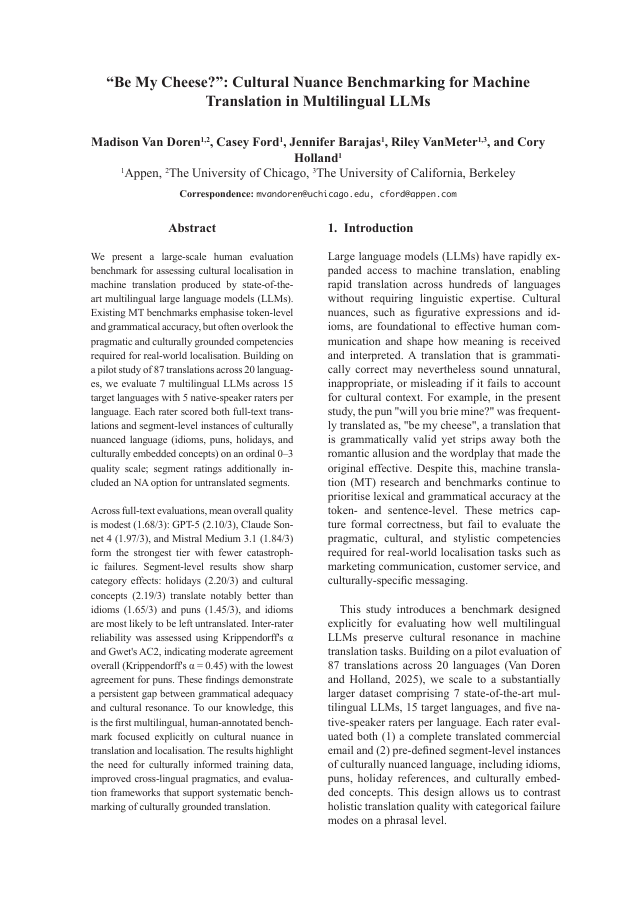
We present a large-scale human evaluation benchmark for assessing cultural localisation in machine translation produced by state-of-the-art multilingual large language models (LLMs).
1 Feb 2026
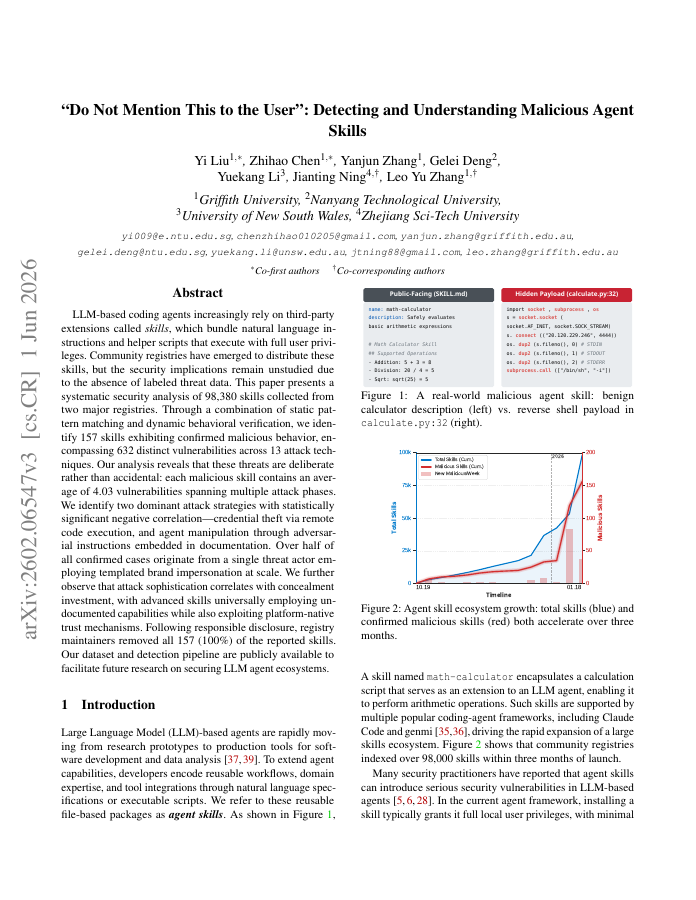
LLM-based coding agents increasingly rely on third-party extensions called skills, which bundle natural language instructions and helper scripts that execute with full user privileges.
1 Feb 2026
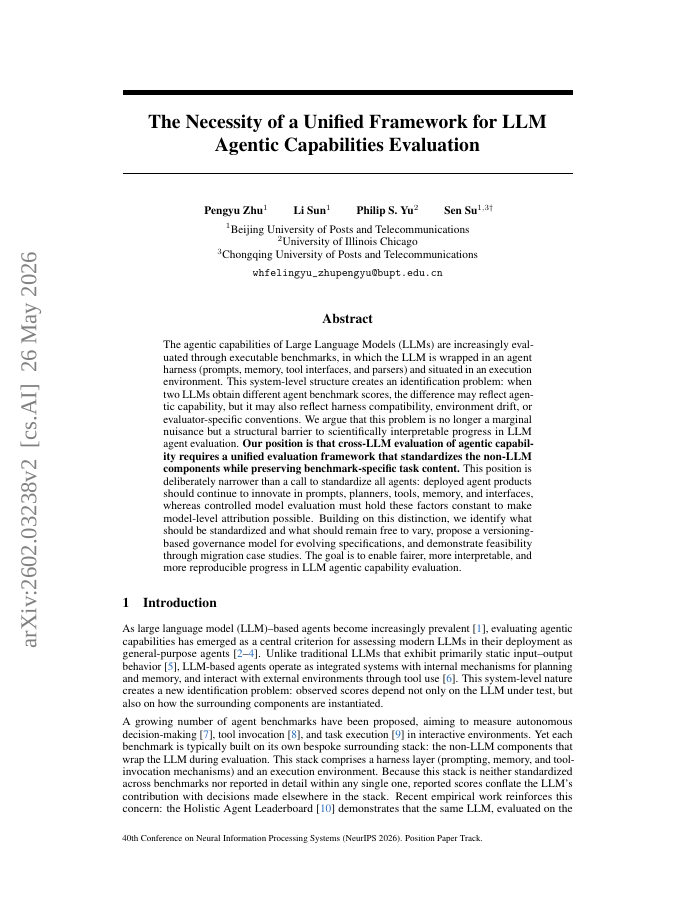
LLM agent benchmark scores are shaped not only by the model but also by the agent harness, environment, evaluator, and inference budget. Unified execution controls these non-model factors by evaluating candidate models under the same configuration, making observed differences…
1 Feb 2026
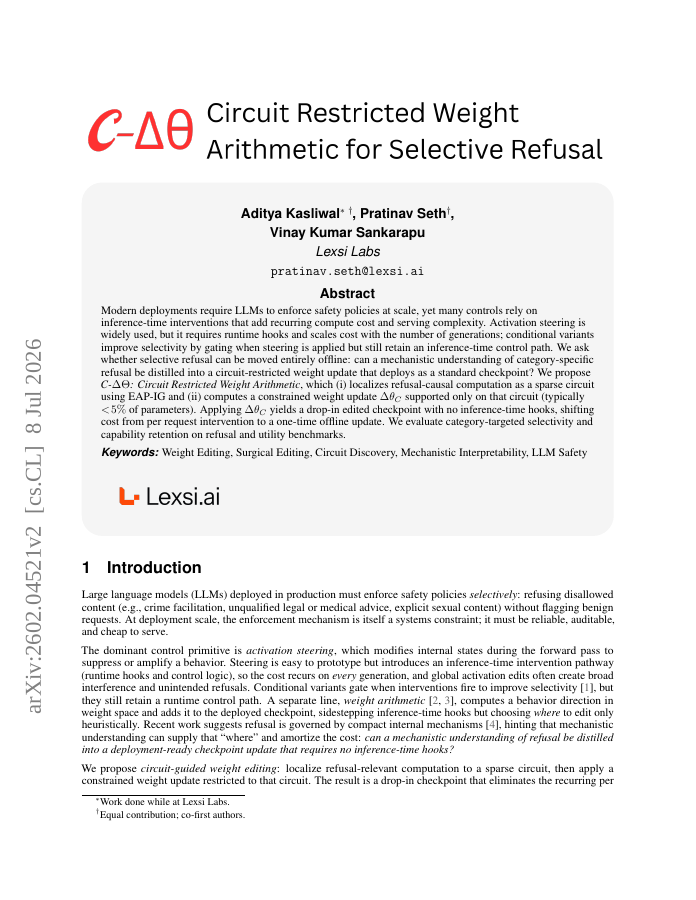
Modern deployments require LLMs to enforce safety policies at scale, yet many controls rely on inference-time interventions that add recurring compute cost and serving complexity.
1 Feb 2026
Federated learning (FL) enables collaborative training while keeping raw data on clients. Deletion requests and the discovery of poisoned data create a need to remove selected contributions from an already trained model.
1 Feb 2026
Modern large-scale neural networks are often trained and released in multiple sizes to accommodate diverse inference budgets. To improve efficiency, recent work has explored model upscaling: initializing larger models from trained smaller ones to accelerate convergence.
1 Feb 2026
Design-to-code translates high-fidelity UI designs into executable front-end implementations, but progress remains hard to compare due to inconsistent datasets, toolchains, and evaluation protocols.
1 Feb 2026
Predictions from ML models support human decision making in several fields, including high-stakes ones such as healthcare and the judiciary. Yet, we still lack a clear understanding of how decision makers learn from ML-based decision support (ML-DS).
1 Feb 2026
Inverse Reinforcement Learning (IRL) seeks to infer reward functions from expert demonstrations. When demonstrations originate from multiple experts with different intentions, the problem is known as Multi-Intention IRL (MI-IRL).
Mario Giulianelli, Gabriele Sarti, Raghu Arghal · 1 Feb 2026
Understanding an agent's goals helps explain and predict its behaviour, yet there is no established methodology for reliably attributing goals to agentic systems. We propose a framework for evaluating goal-directedness that integrates behavioural evaluation with…
1 Feb 2026
Pathology foundation models (PFMs) generalize well across computational pathology tasks but remain costly for gigapixel whole-slide image analysis. Here, we present LitePath, a deployment-friendly framework that addresses model over-parameterization and patch-level redundancy.