2 Nov 2026
Large-scale annotation of environmental sound recordings presents significant challenges under time and resource constraints, particularly when sound categories are imbalanced and only part of a dataset has been labeled.
Trending research and the full catalog - each paper linked to the benchmarks, methods, and models it introduces.
Filtering here covers the 2,000 most recent papers, as much as one page can hold in memory. See the full index of 23,060 papers.
2 Nov 2026
Large-scale annotation of environmental sound recordings presents significant challenges under time and resource constraints, particularly when sound categories are imbalanced and only part of a dataset has been labeled.
2 Nov 2026
For effective resource management, infrastructure planning, and sustainable tourism, it is really important to predict accurate visitors. This paper estimates the daily visitation of Nebraska lakes using spatial, basic temporal, and interpretable temporal features.
2 Nov 2026
Graph machine learning benchmarking results are scattered across papers that use quite different sets of datasets and baseline methods, making it difficult to tell whether a reported gain reflects architectural progress or merely an outdated comparison or weakly tuned baseline.
2 Nov 2026
Federated Learning (FL) offers a paradigm for collaborative machine learning model training among clients, preserving data privacy by avoiding direct data sharing. However, the gradient information exchanged in FL has been shown to be vulnerable to Gradient Inversion Attacks…
2 Nov 2026
We study online channel scheduling for a single queue served by $K$ channels under bandit feedback. We propose a simple best-of-both-worlds policy that explores when the queue is empty.
2 Nov 2026
Causal inference has emerged as a powerful paradigm enabling robots to make safe, efficient decisions by reasoning about the ``why'' behind events. However, its real-world application is hindered by the difficulty of collecting causal data, especially in human-populated…
2 Nov 2026
In the near future language model pretraining will become bound by total data rather than total compute. Such a regime requires revisiting scaling laws and scaling law theory.
2 Nov 2026
MRI morphometry pipelines are often evaluated by measurement agreement or downstream accuracy, yet their scientific value depends on the conclusions they support. Two pipelines can produce similar feature-level results yet support different conclusions about aging, cognitive…
2 Nov 2026
Long-lived agents rely on persistent memory of users, tasks and decisions, and this memory must stay consistent with a world that keeps changing. When an upstream fact changes, however, memory systems can revise the contradicted memory itself while the beliefs, plans and actions…
1 Nov 2026
Large language models (LLMs) are increasingly used for tutoring and professional knowledge retrieval, yet safety evaluations still focus mainly on overt harms such as toxicity while overlooking benevolent failure modes.
1 Nov 2026
Large language models increasingly provide formative writing feedback, but most systems evaluate only the submitted text. Process-aware systems can additionally incorporate intermediate drafts and interaction records, yet access to these traces does not establish whether…
1 Nov 2026
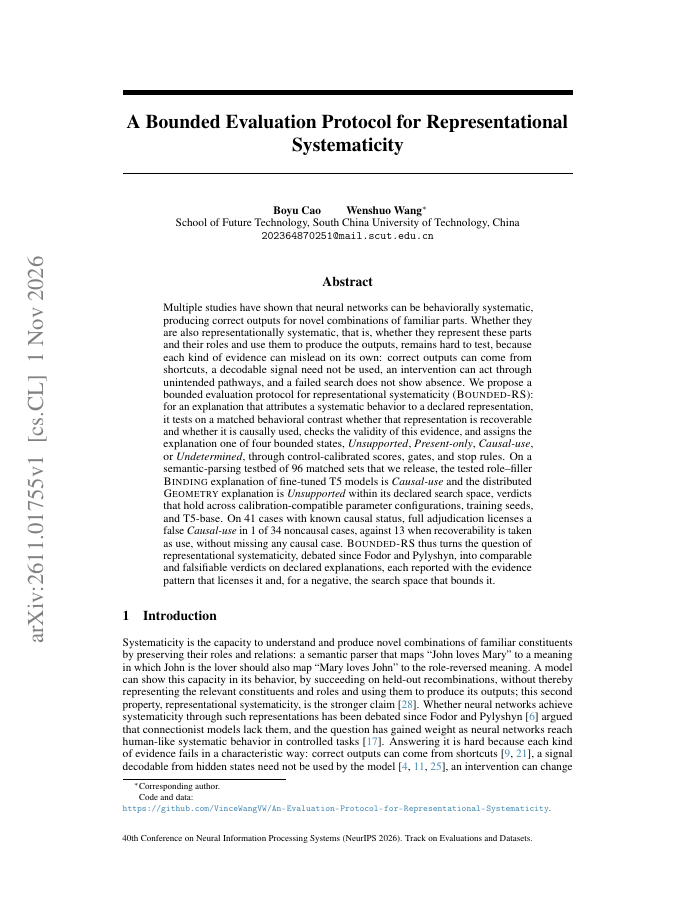
Multiple studies have shown that neural networks can be behaviorally systematic, producing correct outputs for novel combinations of familiar parts. Whether they are also representationally systematic, that is, whether they represent these parts and their roles and use them to…
1 Nov 2026
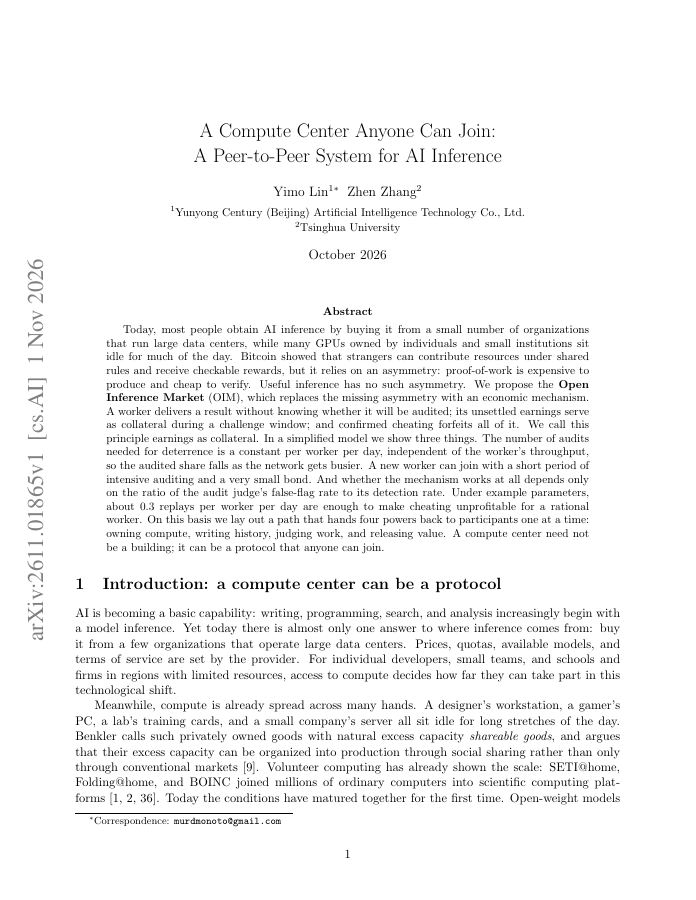
Today, most people obtain AI inference by buying it from a small number of organizations that run large data centers, while many GPUs owned by individuals and small institutions sit idle for much of the day.
1 Nov 2026
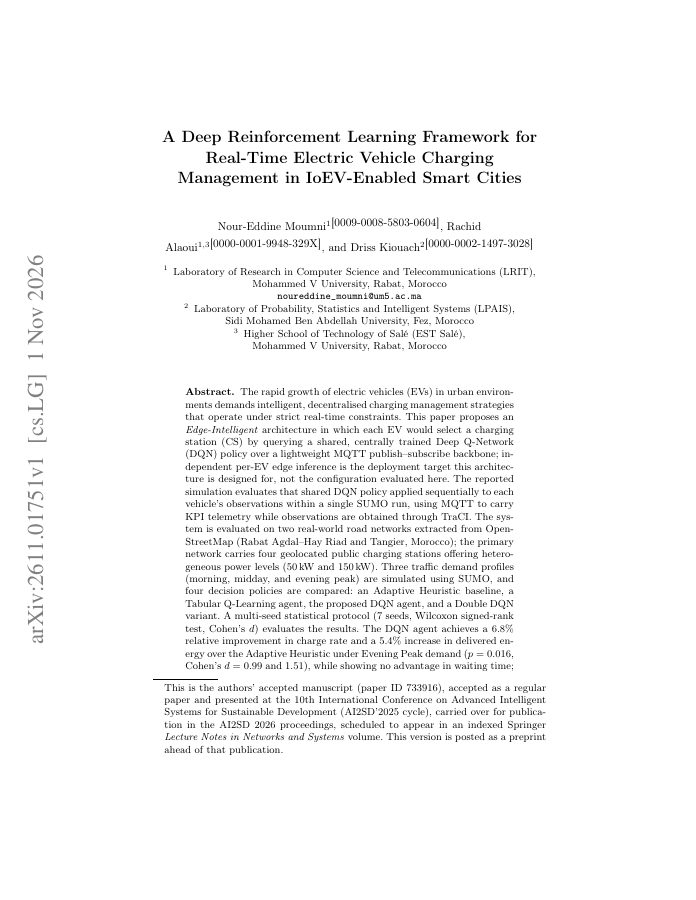
The rapid growth of electric vehicles (EVs) in urban environments demands intelligent, decentralised charging management strategies that operate under strict real-time constraints.
1 Nov 2026
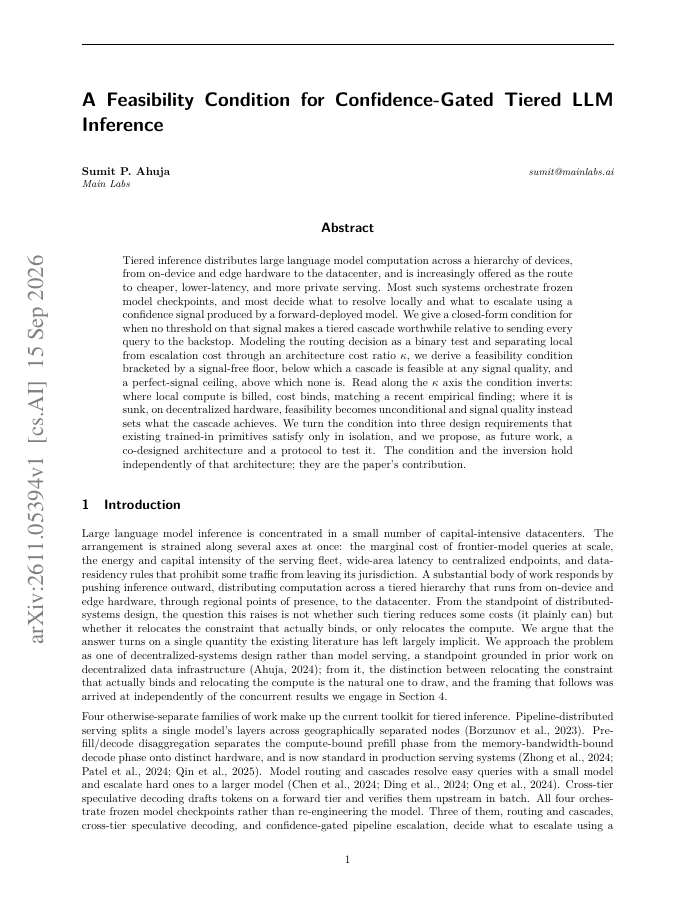
Tiered inference distributes large language model computation across a hierarchy of devices, from on-device and edge hardware to the datacenter, and is increasingly offered as the route to cheaper, lower-latency, and more private serving.
1 Nov 2026
In recent years, electric vehicles (EVs) have attracted much attention due to their potential to decarbonize the transport system. EV charging imposes challenges on power grids, such as load imbalance and voltage instability.
1 Nov 2026
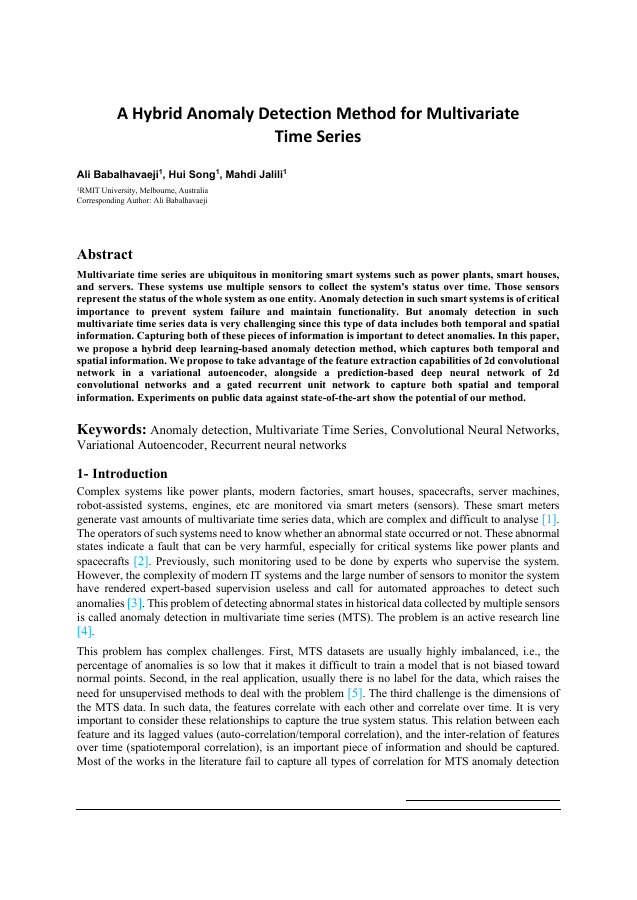
Multivariate time series are ubiquitous in monitoring smart systems such as power plants, smart houses, and servers. These systems use multiple sensors to collect the system's status over time. Those sensors represent the status of the whole system as one entity.
1 Nov 2026
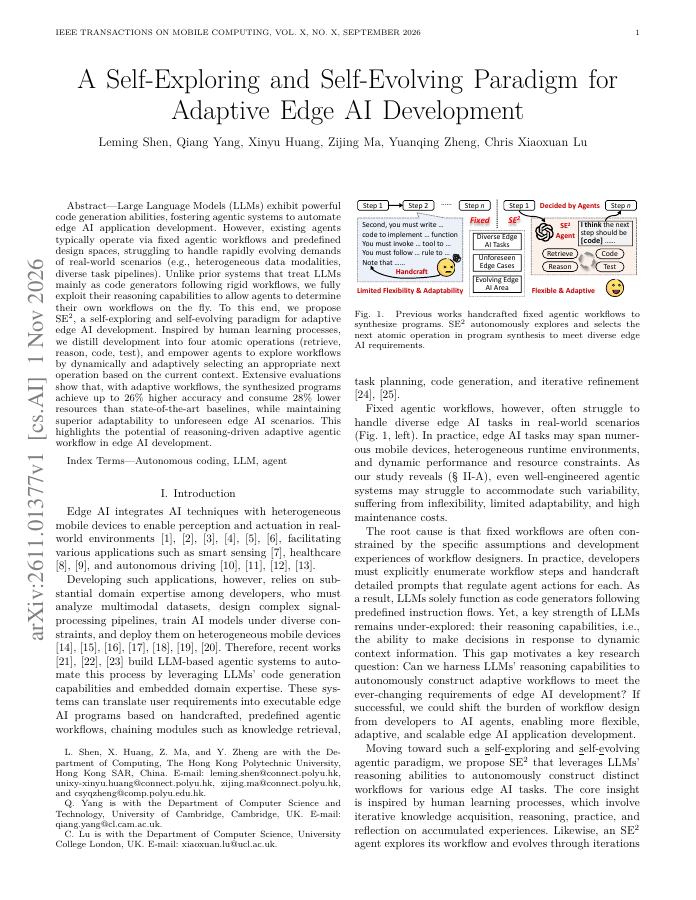
Large Language Models (LLMs) exhibit powerful code generation abilities, fostering agentic systems to automate edge AI application development. However, existing agents typically operate via fixed agentic workflows and predefined design spaces, struggling to handle rapidly…
1 Nov 2026
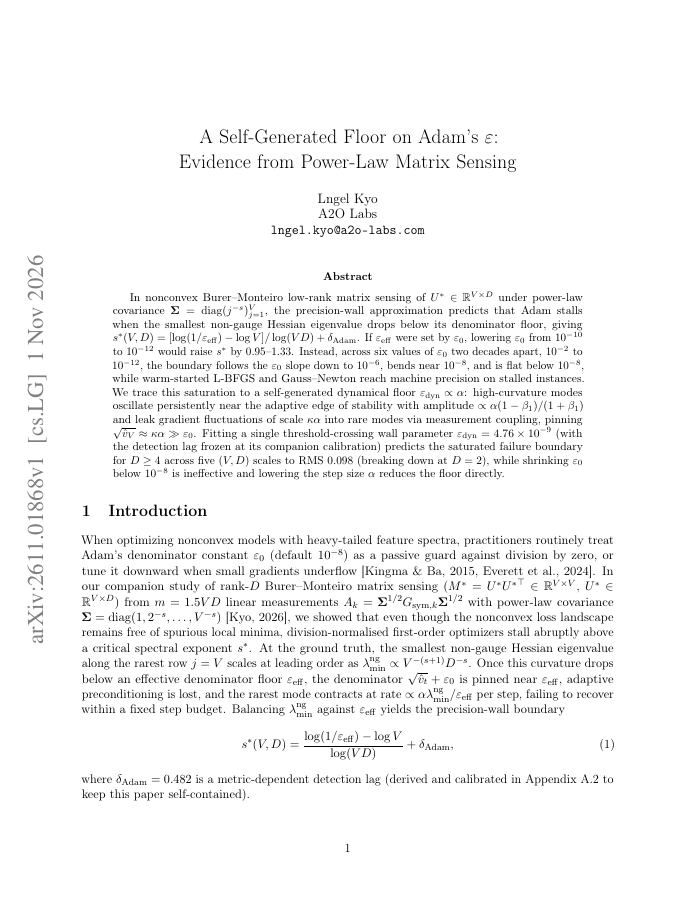
In nonconvex Burer--Monteiro low-rank matrix sensing of $U^\ast \in \mathbb{R}^{V \times D}$ under power-law covariance $Σ= \mathrm{diag}(j^{-s})_{j=1}^V$, the precision-wall approximation predicts that Adam stalls when the smallest non-gauge Hessian eigenvalue drops below its…
1 Nov 2026
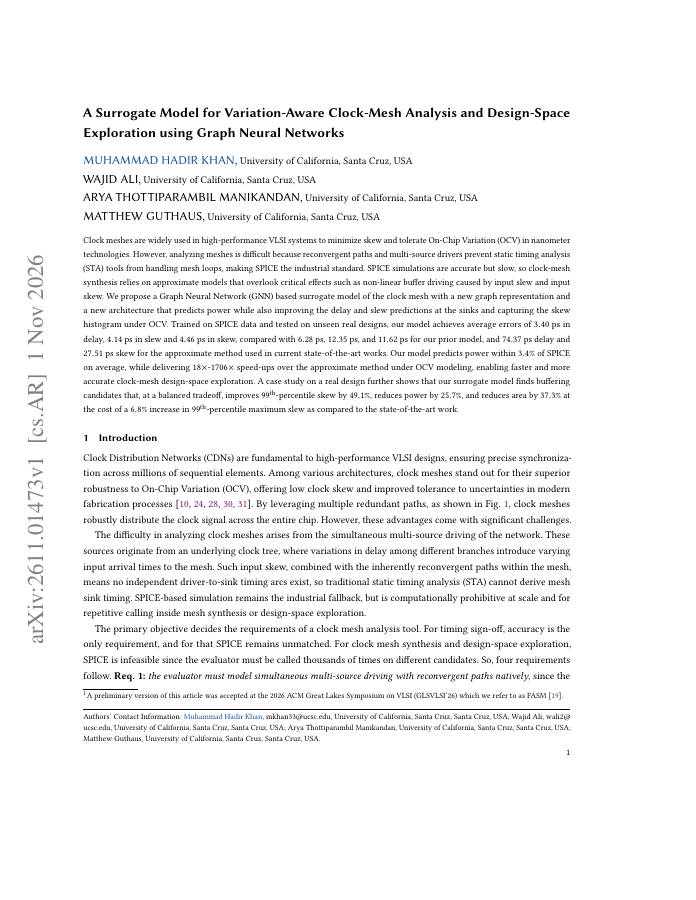
Clock meshes are widely used in high-performance VLSI systems to minimize skew and tolerate On-Chip Variation (OCV) in nanometer technologies. However, analyzing meshes is difficult because reconvergent paths and multi-source drivers prevent static timing analysis (STA) tools…
31 Oct 2026
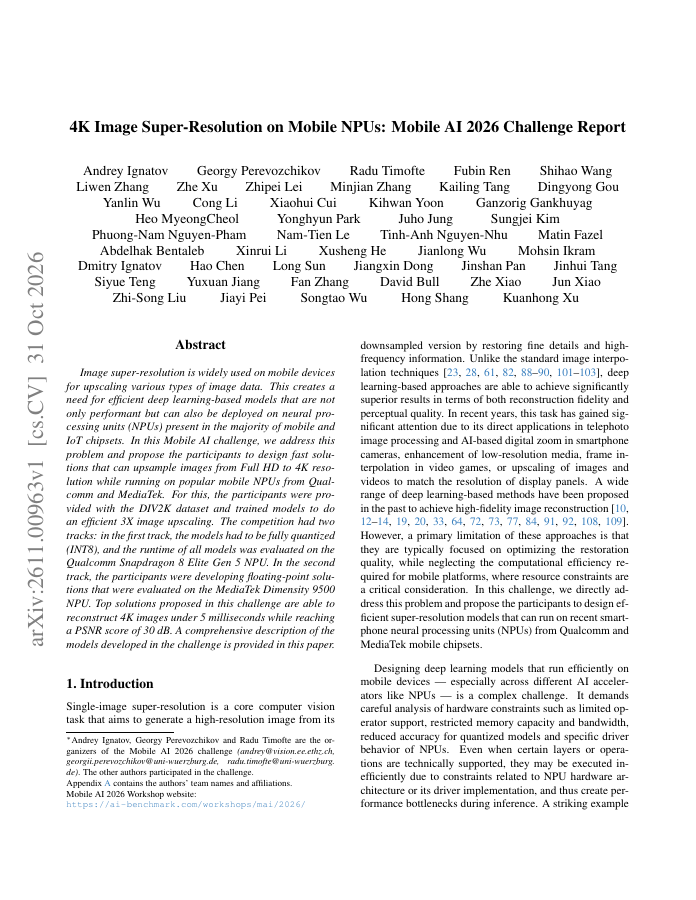
Image super-resolution is widely used on mobile devices for upscaling various types of image data. This creates a need for efficient deep learning-based models that are not only performant but can also be deployed on neural processing units (NPUs) present in the majority of…
31 Oct 2026
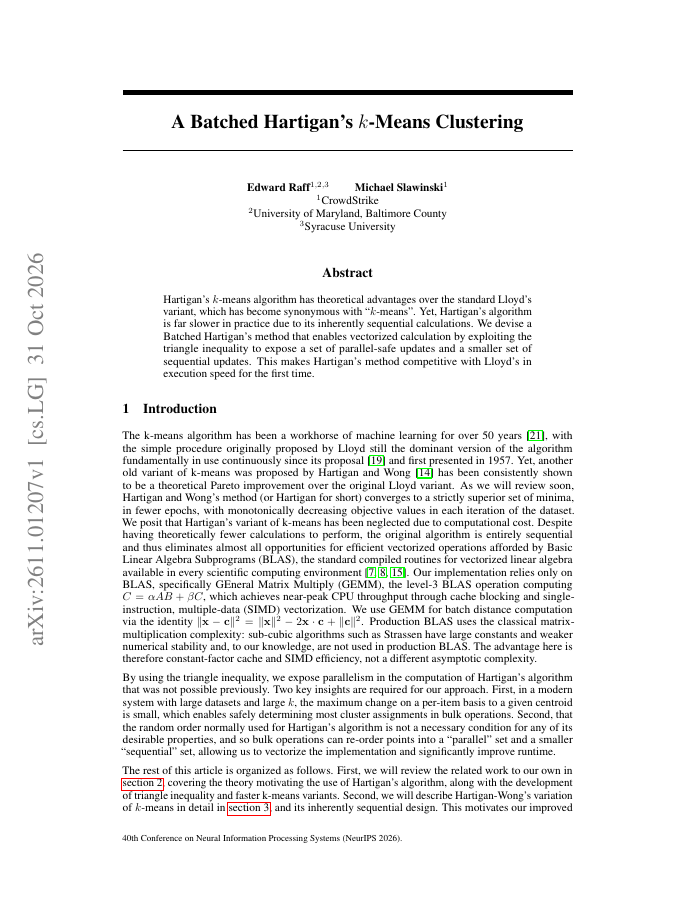
Hartigan's $k$-means algorithm has theoretical advantages over the standard Lloyd's variant, which has become synonymous with "$k$-means". Yet, Hartigan's algorithm is far slower in practice due to its inherently sequential calculations.
31 Oct 2026
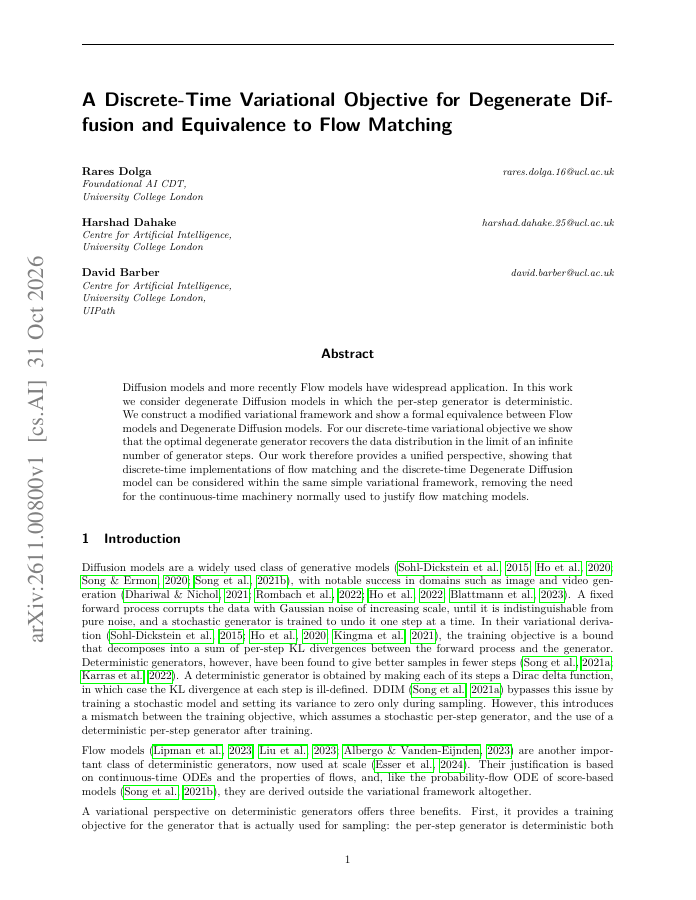
Diffusion models and more recently Flow models have widespread application. In this work we consider degenerate Diffusion models in which the per-step generator is deterministic.
31 Oct 2026
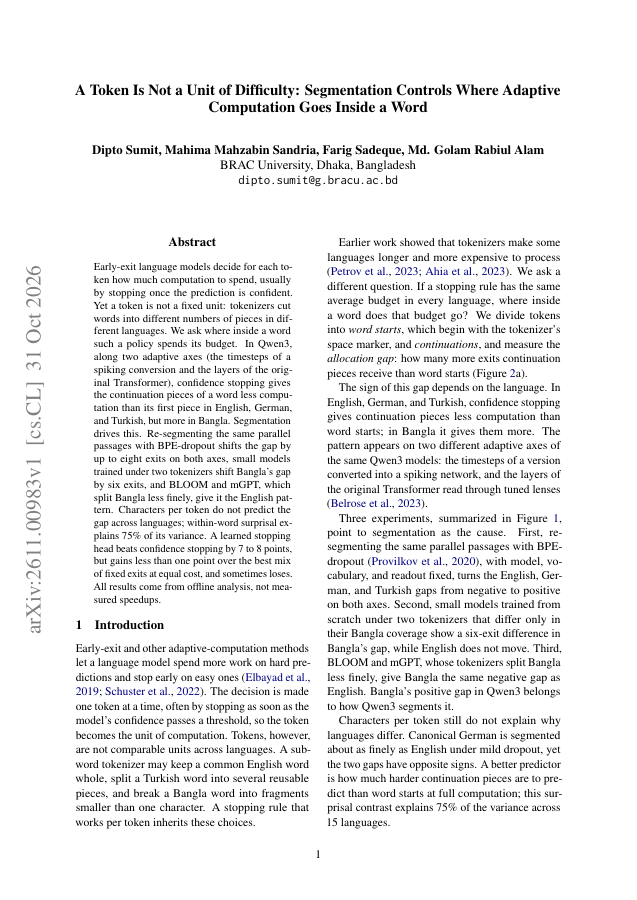
Early-exit language models decide for each token how much computation to spend, usually by stopping once the prediction is confident. Yet a token is not a fixed unit: tokenizers cut words into different numbers of pieces in different languages.