8 Sep 2026
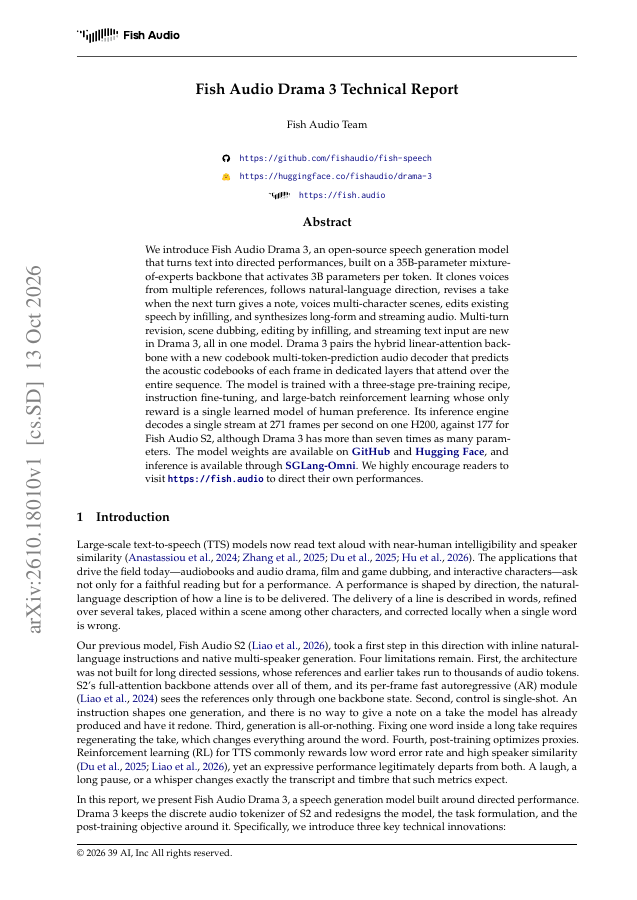
We introduce AuK, an open-source foundational model that unifies speech generation and editing through a common interface of natural-language instructions and audio context.
Trending research and the full catalog - each paper linked to the benchmarks, methods, and models it introduces.
Filtering here covers the 2,000 most recent papers, as much as one page can hold in memory. See the full index of 22,029 papers.
8 Sep 2026
We introduce AuK, an open-source foundational model that unifies speech generation and editing through a common interface of natural-language instructions and audio context.
8 Sep 2026
We present Miles v0.1, a full-stack, production-ready system for frontier post-training. Building upon the clean design of slime, Miles designs each stage of the reinforcement-learning (RL) training loop around a single principle: components should be verified, clean, and…
6 Sep 2026
Sequential memory agents process long documents by reading chunks one after another while maintaining a compact memory state, coupling document traversal to reasoning depth.
6 Jul 2026
Scaling pre-training, post-training, and test-time compute have become the central paradigms for improving the capabilities of LLMs. In this work, we identify verification, the ability to determine the correctness of a solution, as a new scaling axis.
20 Aug 2026
LLM agents learn by interacting with environments, yet these environments are hand-built and static: blind to an agent's weaknesses, and quickly left behind as it improves.
1 Sep 2026
AI tutors are most useful when they adapt to each student's strengths, weaknesses, and preferred guidance, but evidence about which guidance works for which student is sparse, slow, and costly to collect from real learners.
24 Jun 2026
Multi-fingered robots promise the speed and dexterity of human hands, yet challenging problems such as precise assembly have remained out of reach. These tasks are contact-rich, making data collection for imitation learning difficult, and sparse-reward, making direct exploration…
Jiacheng Zhu, Zijian Zhou, Ao Qu et al. · 2 Apr 2026
Large language model (LLM)-based evolution is a promising approach for open-ended discovery, where progress requires sustained search and knowledge accumulation. Existing methods still rely heavily on fixed heuristics and hard-coded exploration rules, which limit the autonomy of…
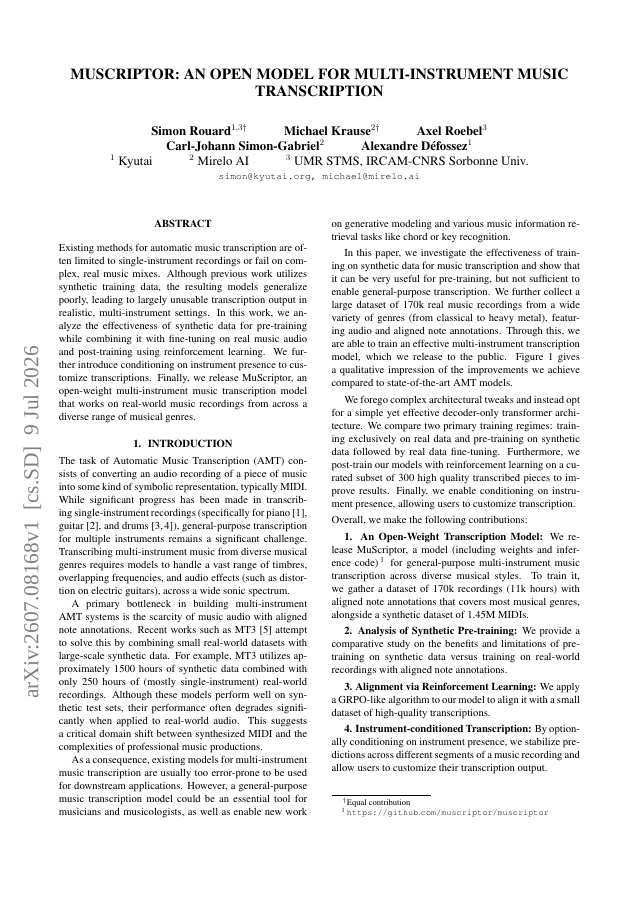
9 Jul 2026
Existing methods for automatic music transcription are often limited to single-instrument recordings or fail on complex, real music mixes. Although previous work utilizes synthetic training data, the resulting models generalize poorly, leading to largely unusable transcription…
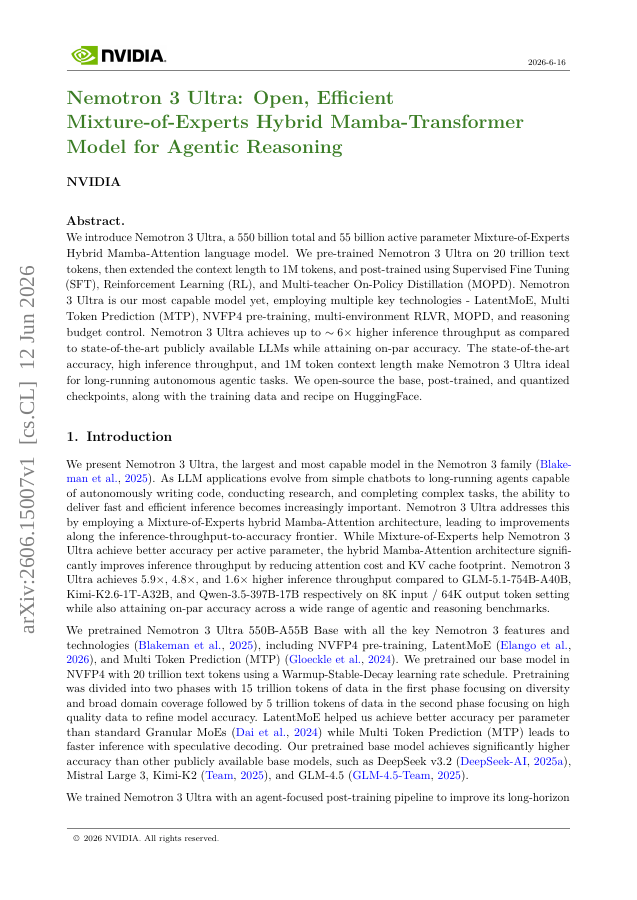
12 Jun 2026
We introduce Nemotron 3 Ultra, a 550 billion total and 55 billion active parameter Mixture-of-Experts Hybrid Mamba-Attention language model. We pre-trained Nemotron 3 Ultra on 20 trillion text tokens, then extended the context length to 1M tokens, and post-trained using…
10 Jun 2026
Scientific progress depends on a repeated loop of exploration, experimentation, and abstraction. Researchers test candidate directions, interpret the evidence, and carry the resulting lessons into later attempts.
27 Jul 2026
We introduce Kimi K3, a 2.8T parameter Mixture-of-Experts model with 104 billion activated parameters, native vision capabilities, and a 1-million-token context window. Kimi K3 is built on Kimi Delta Attention and Attention Residuals, which improve information flow across…
1 Jun 2026
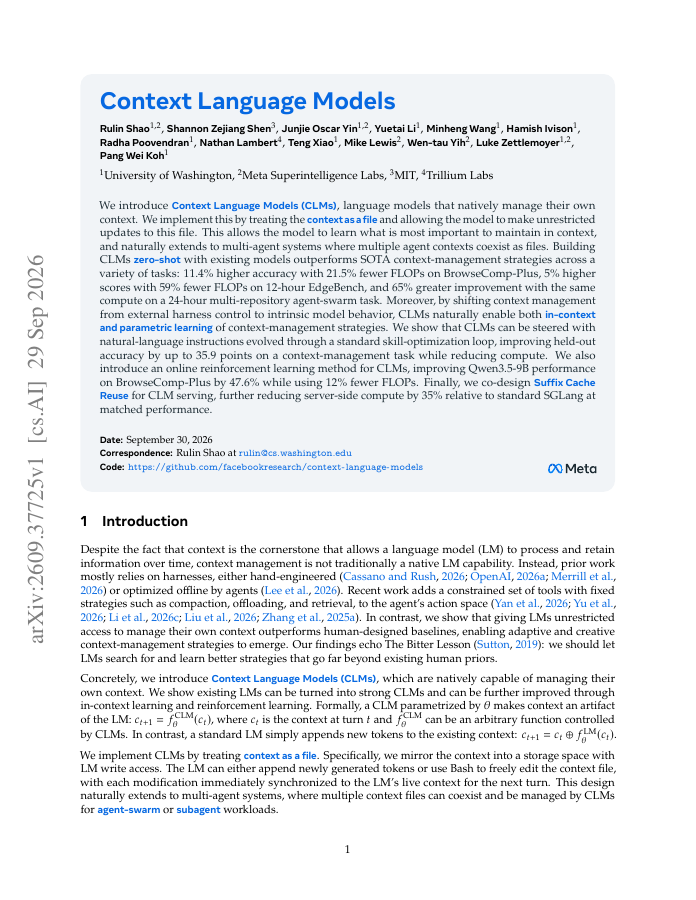
Search agents are often trained as policies over growing transcripts: the model must decide how to search while also remembering what it has seen, which evidence is useful, which constraints remain open, and which claims have actually been checked.
17 Jun 2026
Passive models for long video understanding typically rely on a "watch-it-all" paradigm, processing frames uniformly regardless of query difficulty, causing computational cost to grow with video duration.
3 Aug 2026
Multimodal large language models (MLLMs) have advanced visual understanding and reasoning, yet their static parametric knowledge limits their ability to address knowledge-intensive and dynamically evolving open-world problems.
15 Jun 2026
This technical report introduces VibeThinker-3B, a compact dense model with 3B parameters developed to investigate how far verifiable reasoning can be pushed within a strictly small-model regime.
31 Aug 2026
On-policy distillation (OPD) offers dense token-level supervision as an alternative to the sparse outcome-level advantages of reinforcement learning with verifiable rewards (RLVR).
27 Aug 2026
Recent prominent post-training methods, such as Reinforcement Learning (RL) and On-Policy Self-Distillation (OPSD), have driven rapid progress in mathematical reasoning for large language models, yet their reliance on ground-truth labels precludes test-time training (TTT).
3 Sep 2026
We present Iris-mini and Iris-pro, two search agents trained at the 35B-A3B and 397B-A17B scales, together with the data pipeline and training recipe behind them. Tasks are reverse-constructed from the hyperlink structure of a web corpus: we author multi-hop chains over an…
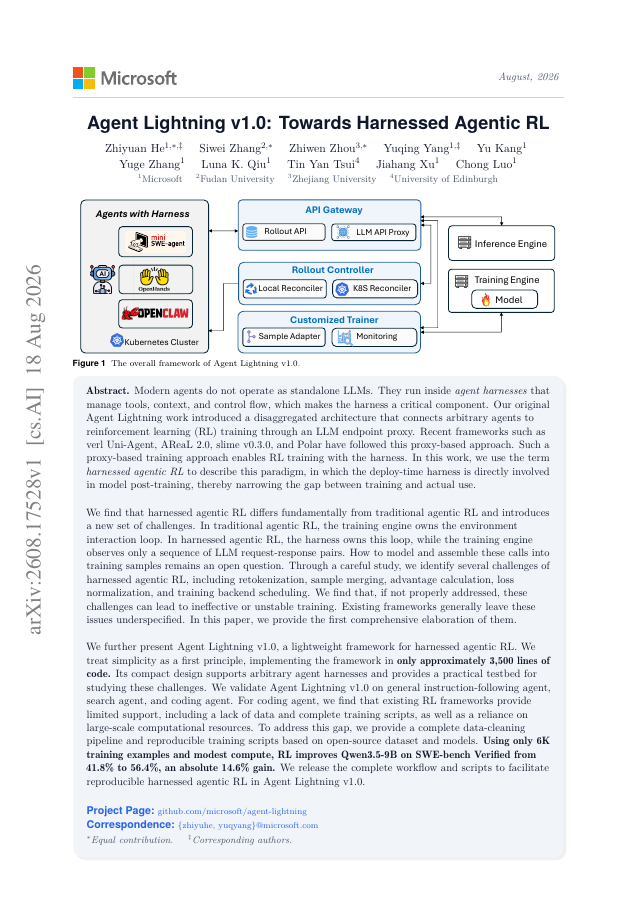
18 Aug 2026
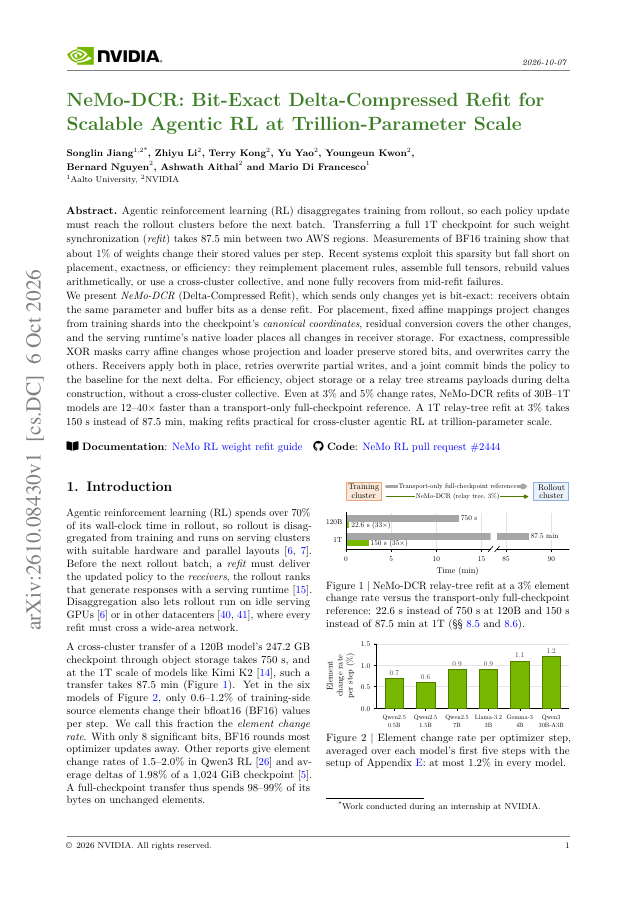
Modern agents operate inside agent harnesses that manage tools, context, and control flow, making the harness a critical part of the agent system. Our original Agent Lightning introduced a disaggregated architecture that connects arbitrary agents to RL training through an LLM…
16 Aug 2026
Foundation GUI agents can automate complex digital tasks, but deployment is hindered by scarce and biased training data, ambiguous prompts, and unreliable execution. Routine workflows rely on user-specific tools and tacit conventions, so unstated instructions can produce…
24 Aug 2026
Hint-based reinforcement learning addresses reward sparsity in long-horizon agentic tasks by retaining a prefix of an expert trajectory before each rollout, letting the policy explore from a state closer to success.
20 Aug 2026
Software increasingly functions as part of the scientific instrument itself, making failures in scientific code capable of compromising not only program behavior but also the evidence underlying scientific conclusions.
31 Aug 2026
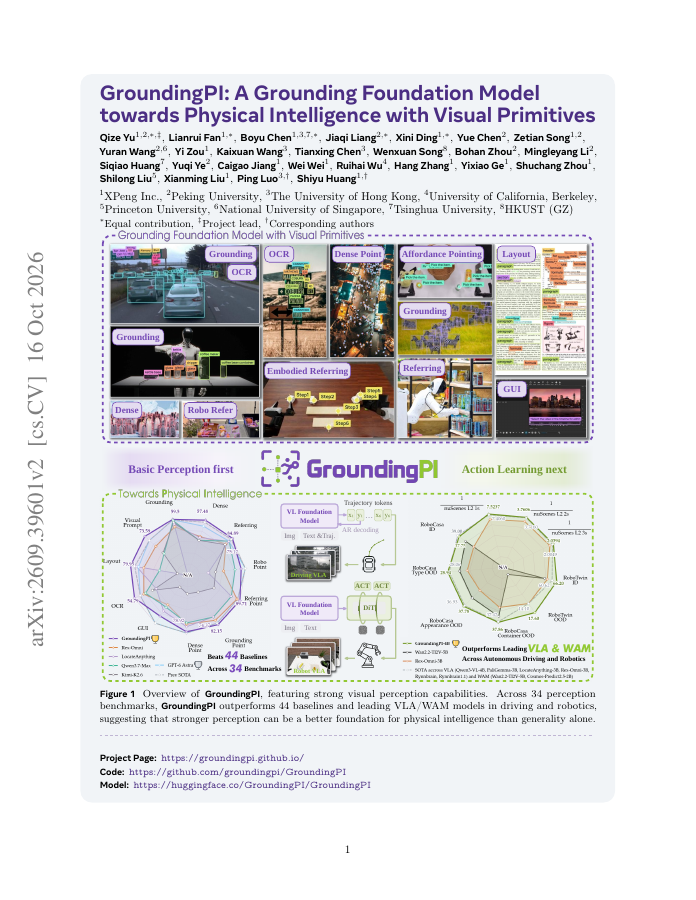
Embodied navigation requires agents to translate heterogeneous goals and visual observations into actions across tasks, environments, and robot embodiments. Modern vision-language models (VLMs) already encode spatial priors for visual grounding, spatial reasoning, and pointing,…