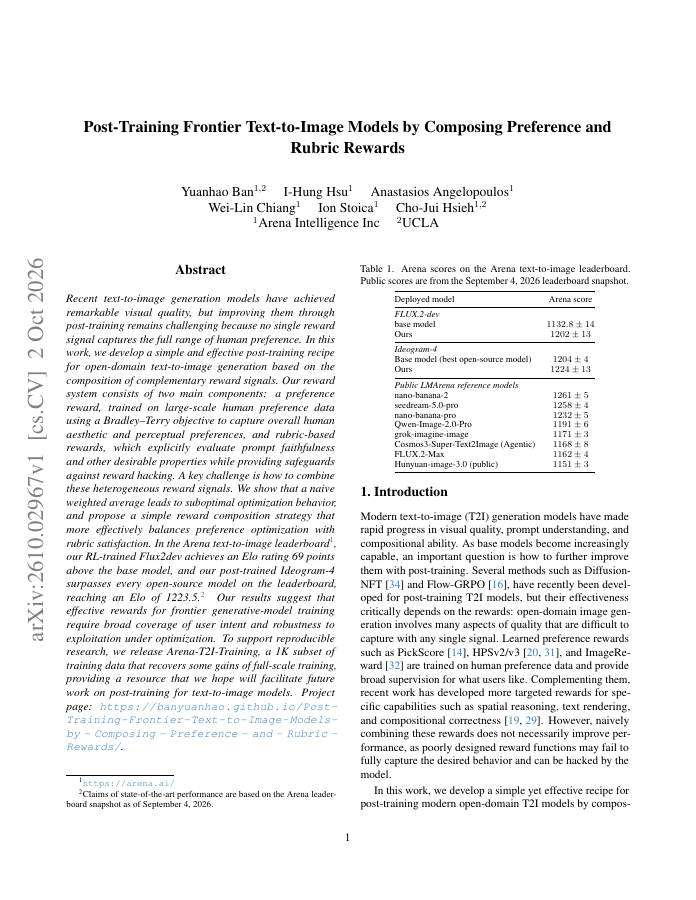
8 Sep 2026
We introduce AuK, an open-source foundational model that unifies speech generation and editing through a common interface of natural-language instructions and audio context.
Trending research and the full catalog - each paper linked to the benchmarks, methods, and models it introduces.
Filtering here covers the 2,000 most recent papers, as much as one page can hold in memory. See the full index of 22,059 papers.
8 Sep 2026
We introduce AuK, an open-source foundational model that unifies speech generation and editing through a common interface of natural-language instructions and audio context.
12 Aug 2026
Automating empirical research is a long-standing direction of AI. Recent automatic research (AutoResearch) agents bring this goal within reach, as modern LLMs show the capability to independently implement solutions and learn from the execution outcomes.
18 Aug 2026
Modern agents operate inside agent harnesses that manage tools, context, and control flow, making the harness a critical part of the agent system. Our original Agent Lightning introduced a disaggregated architecture that connects arbitrary agents to RL training through an LLM…
26 Aug 2026
Test-time scaling uses extra test-time compute to improve performance, such as letting language models reason longer when solving a problem. As models keep the entire reasoning trace in memory via full attention, hard tasks that need long thinking can be prohibitively expensive.
6 Jul 2026
Scaling pre-training, post-training, and test-time compute have become the central paradigms for improving the capabilities of LLMs. In this work, we identify verification, the ability to determine the correctness of a solution, as a new scaling axis.
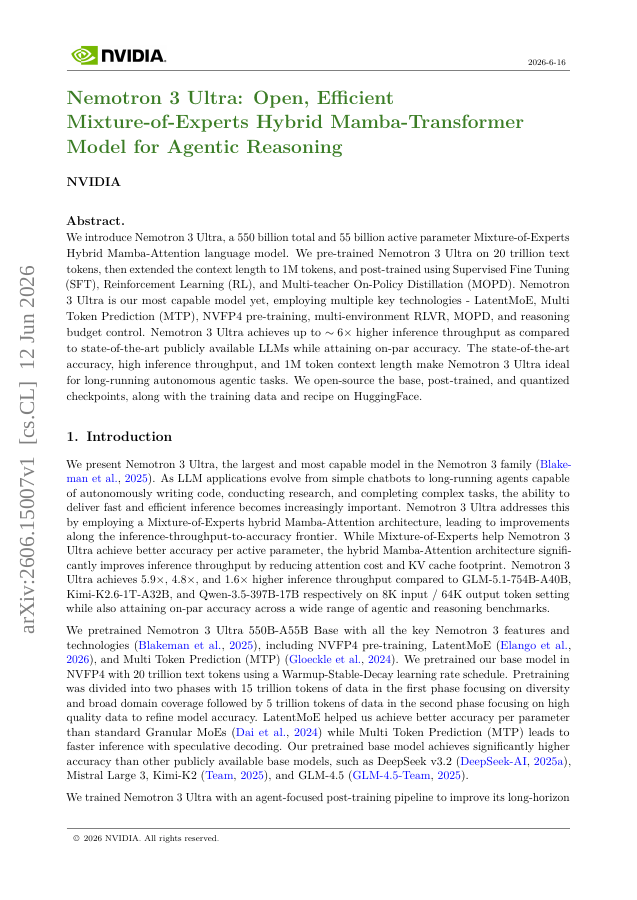
12 Jun 2026
We introduce Nemotron 3 Ultra, a 550 billion total and 55 billion active parameter Mixture-of-Experts Hybrid Mamba-Attention language model. We pre-trained Nemotron 3 Ultra on 20 trillion text tokens, then extended the context length to 1M tokens, and post-trained using…
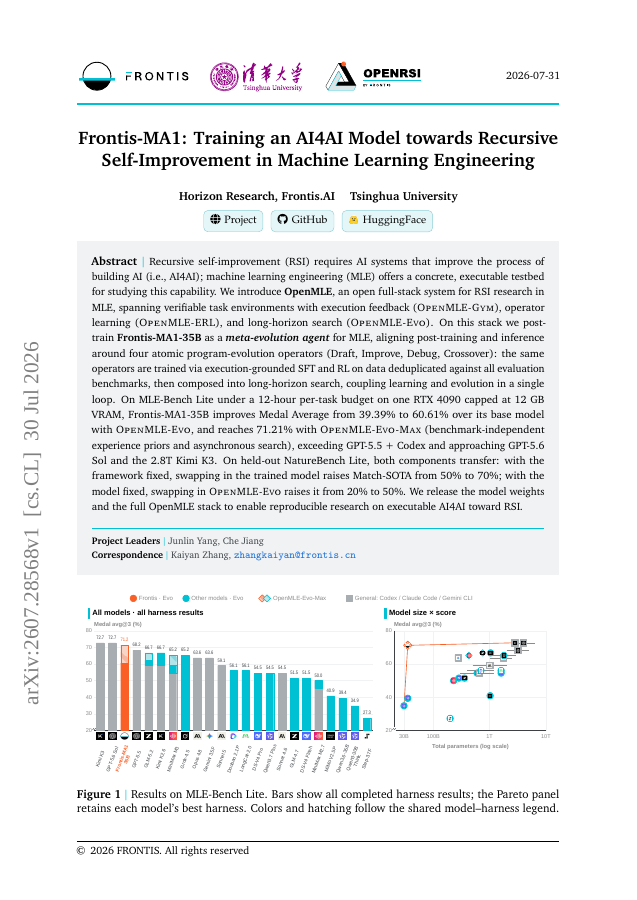
31 Jul 2026
Reinforcement learning (RL) post-training of Vision-Language-Action (VLA) models has shown strong promise for robotic manipulation. Among RL methods, critic-based approaches rely on a value estimator that predominantly operates on single-frame observations or single-frame VLM…
Pieter Abbeel, Marc Pollefeys, Jitendra Malik et al. · 30 Apr 2026
World models, which are predictive representations of how environments evolve under actions, have become a central component of robot learning.
Xingdi (Eric) Yuan, Rui Yang, Jianfeng Gao et al. · 14 May 2026
Agentic modeling aims to transform LLMs into autonomous agents capable of solving complex tasks through planning, reasoning, tool use, and multi-turn interaction with external environments. We present Orchard, an open-source framework for scalable agentic modeling.
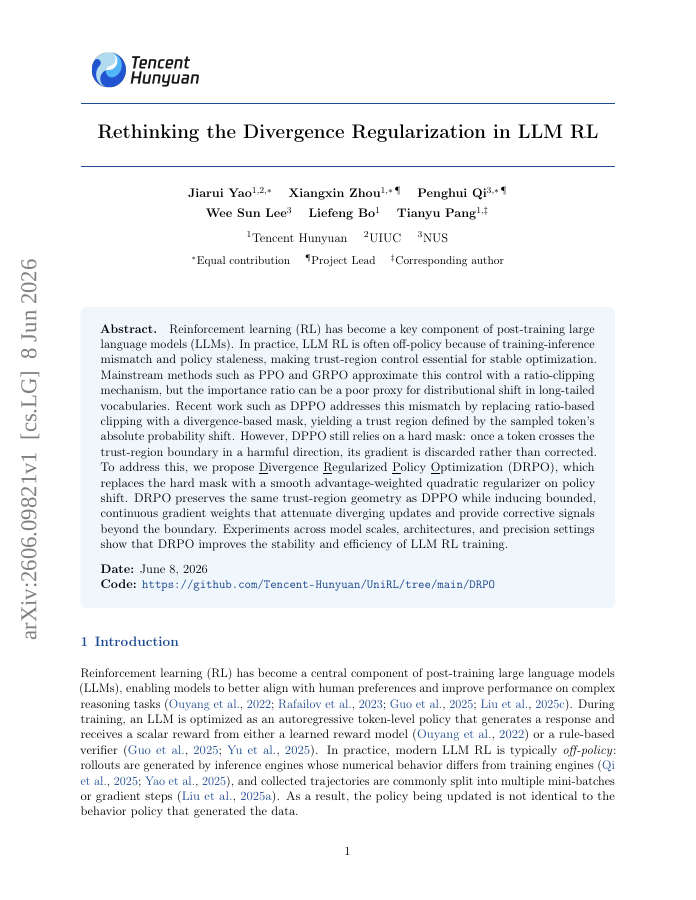
8 Jun 2026
Reinforcement learning (RL) has become a key component of post-training large language models (LLMs). In practice, LLM RL is often off-policy because of training-inference mismatch and policy staleness, making trust-region control essential for stable optimization.
8 Sep 2026
We present Miles v0.1, a full-stack, production-ready system for frontier post-training. Building upon the clean design of slime, Miles designs each stage of the reinforcement-learning (RL) training loop around a single principle: components should be verified, clean, and…
31 Aug 2026
Research planning is the decisive capability of AI scientists. Yet a research plan admits no verifiable answer, so reinforcement learning lacks the environment it requires: tasks paired with a critic. Rubrics extracted from scientific papers can supply the critic.
24 Aug 2026
Hint-based reinforcement learning addresses reward sparsity in long-horizon agentic tasks by retaining a prefix of an expert trajectory before each rollout, letting the policy explore from a state closer to success.
20 Aug 2026
LLM agents learn by interacting with environments, yet these environments are hand-built and static: blind to an agent's weaknesses, and quickly left behind as it improves.
31 Aug 2026
Embodied navigation requires agents to translate heterogeneous goals and visual observations into actions across tasks, environments, and robot embodiments. Modern vision-language models (VLMs) already encode spatial priors for visual grounding, spatial reasoning, and pointing,…
26 Aug 2026
A common strategy for scaling world models is to train on more crawled video with more compute. We argue that this strategy is inefficient: scaling world models also requires a recursive data engine that offers grounded reward signals.
19 Aug 2026
Multi-teacher on-policy distillation (M-OPD) has emerged as a promising paradigm for consolidating domain-specialized reinforcement learning (RL) experts into a single generalist student via dense, token-level reward supervision.
1 Sep 2026
AI tutors are most useful when they adapt to each student's strengths, weaknesses, and preferred guidance, but evidence about which guidance works for which student is sparse, slow, and costly to collect from real learners.
26 Aug 2026
Native visual reasoning treats visual generation as the medium of reasoning itself: visual states (i.e. images and videos) are not merely inputs to be understood or outputs to be rendered, but first-class substrates for problem solving beyond language.
13 Aug 2026
Transforming multimodal sources into condensed and structured media outputs can be fundamentally conceptualized as a long-horizon agentic process centered on a model-harness system.
6 Sep 2026
Sequential memory agents process long documents by reading chunks one after another while maintaining a compact memory state, coupling document traversal to reasoning depth.
7 Sep 2026
Speculative decoding accelerates rollout generation, which dominates the cost of reinforcement learning (RL) post-training. Online co-training can further increase the draft's accuracy, yielding greater speedups.
8 Sep 2026
Large Language Models demonstrate remarkable proficiency in static reasoning, yet training them as autonomous agents through Reinforcement Learning (RL) for long-horizon tasks is often hindered by severe reward sparsity.
27 Aug 2026
Multimodal GUI agents have emerged as a promising paradigm for digital task automation, yet transitioning from benchmark-oriented models to dependable real-world applications remains challenging due to limited environment coverage, brittle task construction, and unreliable…