24 Oct 2026
We present a generic actor-critic method that combines a ridge-regularized pathwise least-squares temporal-difference (LSTD) critic with importance-corrected momentum (ICM) actors.
Trending research and the full catalog - each paper linked to the benchmarks, methods, and models it introduces.
Filtering here covers the 2,000 most recent papers, as much as one page can hold in memory. See the full index of 22,824 papers.
24 Oct 2026
We present a generic actor-critic method that combines a ridge-regularized pathwise least-squares temporal-difference (LSTD) critic with importance-corrected momentum (ICM) actors.
23 Oct 2026
Negation occurs in every language, yet its surface realization differs drastically. Despite this, multilingual large language models (LLMs) translate negation robustly, raising the question of whether they share an underlying representation of negation across languages.
23 Oct 2026
Humans reason about the physical world by flexibly combining different forms of inference as a problem unfolds. Achieving this flexibility is a major open challenge in AI: capabilities often remain separated across specialized models, limiting how they can be composed and…
23 Oct 2026
Humans efficiently process multimodal streams spanning hours to years, building persistent, fine-grained spatiotemporal memories that support reasoning about and predicting long-horizon events.
23 Oct 2026
Locating relevant evidence in long inputs is a core capability of Multimodal Large Language Models. Prior studies attribute this capability to retrieval heads, a sparse set of attention heads that transfer information from the context to the output.
23 Oct 2026
Public drug-protein bioactivity resources commonly identify targets by UniProt accession, although one accession may represent distinct experimental sequences. We present Curate-DTI, a construct-aware dataset derived from the 1 July 2026 BindingDB export, with IC50, Ki, Kd and…
23 Oct 2026
Large language model agents launch simulations on high-performance computing (HPC) systems, where one sbatch or mpirun can commit thousands of node-hours and a forged result can cost lives.
23 Oct 2026
We study the dynamic allocation of scarce medications in Liberia's community health program. A central warehouse supplies a health facility and the Community Health Assistants (CHAs) it supervises.
23 Oct 2026
Longitudinal causal effect estimation is complicated by time-varying confounding and treatment-confounder feedback loops. Existing methods generally require data-specific nuisance-model fitting, and many are tailored to prespecified treatment sequences or prediction horizons,…
23 Oct 2026
Constitutive models for history-dependent, path-dependent materials typically encode this dependence in prescribed functional forms through internal variables such as damage or plastic strain that are phenomenological, model-dependent, and not directly observable.
23 Oct 2026
This paper develops a foundational measure-geometric theory of robustness in machine learning. Robustness is formulated as escape from a retained task state relative to a reference measure on a data-bearing manifold, a perturbation gauge, and an admissible realization mechanism.
23 Oct 2026
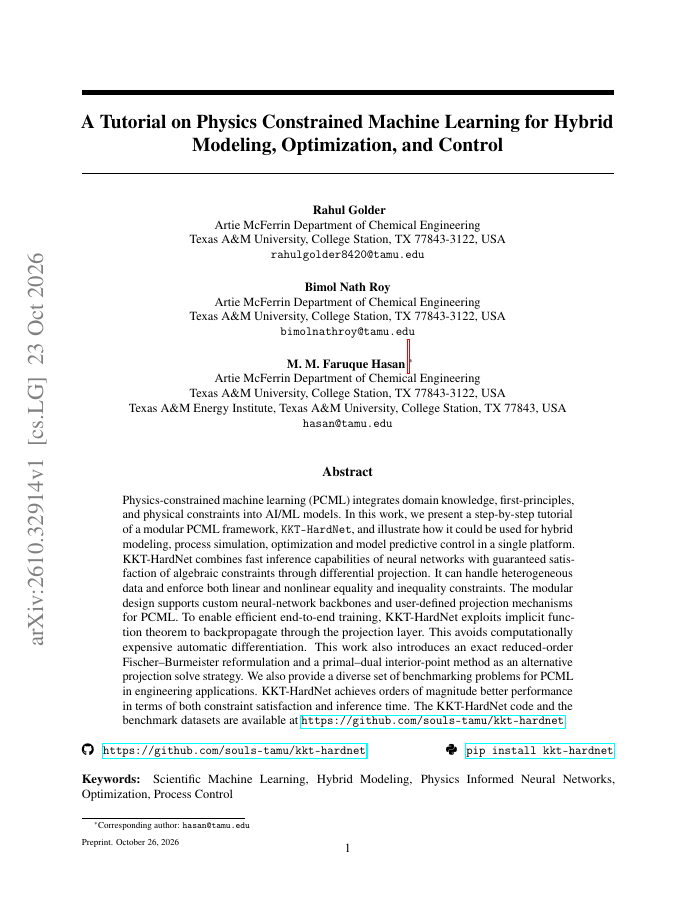
Physics-constrained machine learning (PCML) integrates domain knowledge, first-principles, and physical constraints into AI/ML models. In this work, we present a step-by-step tutorial of a modular PCML framework, KKT-HardNet, and illustrate how it could be used for hybrid…
22 Oct 2026
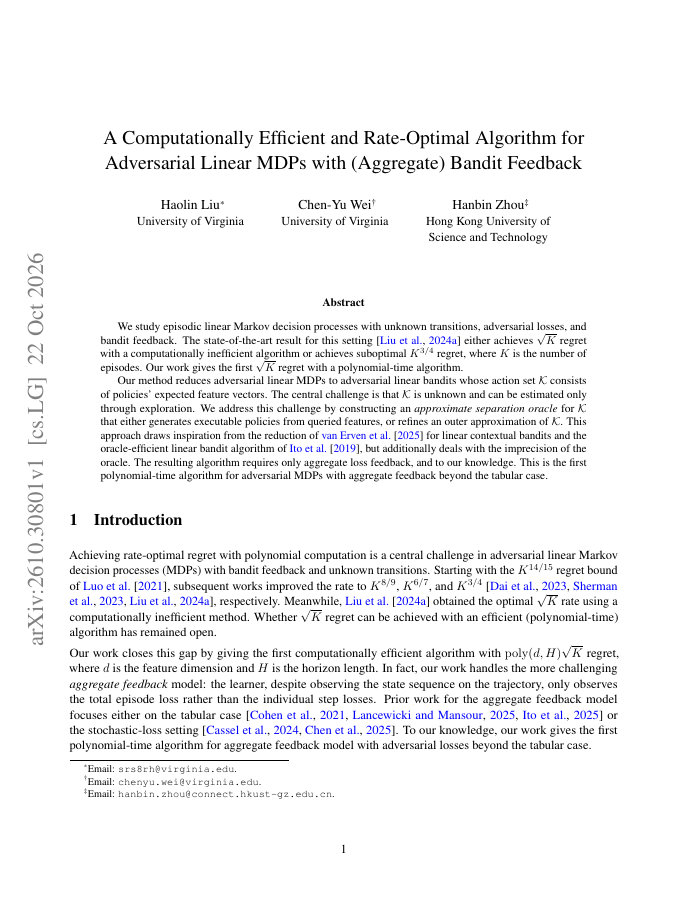
We study episodic linear Markov decision processes with unknown transitions, adversarial losses, and bandit feedback. The state-of-the-art result for this setting (Liu et al., 2024) either achieves $\sqrt{K}$ regret with a computationally inefficient algorithm or achieves…
22 Oct 2026
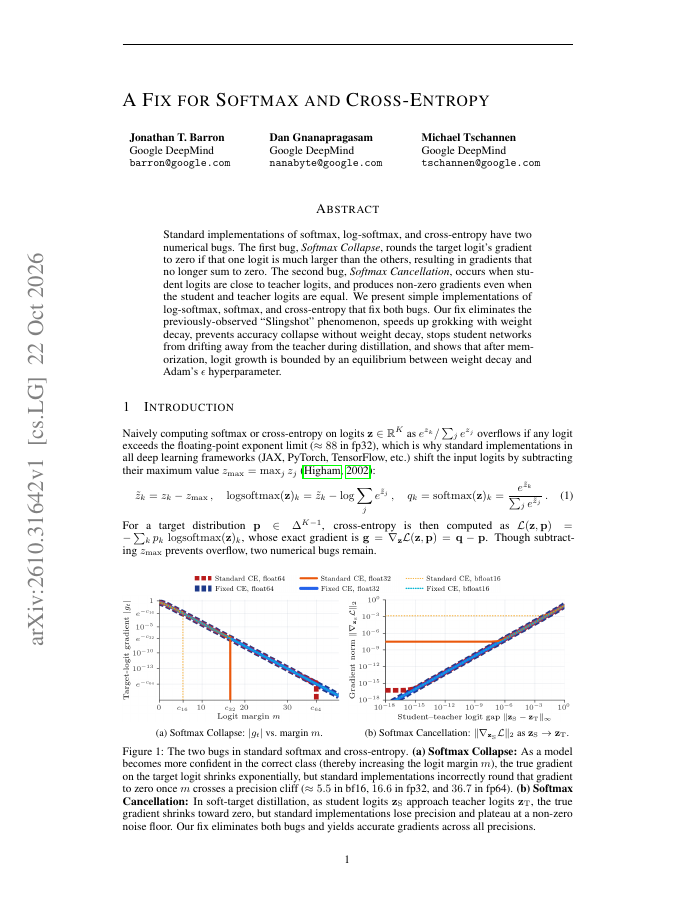
Standard implementations of softmax, log-softmax, and cross-entropy have two numerical bugs. The first bug, Softmax Collapse, rounds the target logit's gradient to zero if that one logit is much larger than the others, resulting in gradients that no longer sum to zero.
22 Oct 2026
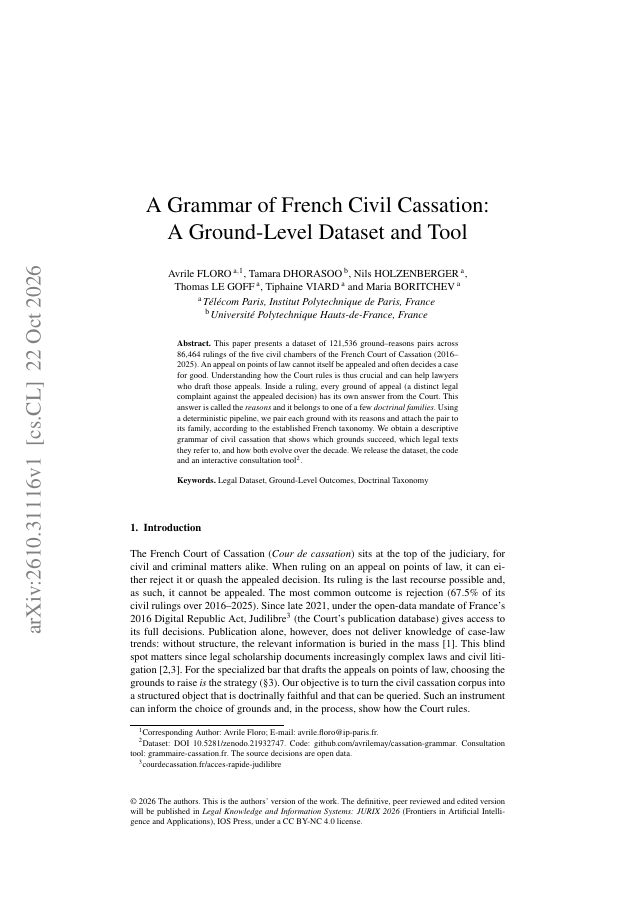
This paper presents a dataset of 121,536 ground-reasons pairs across 86,464 rulings of the five civil chambers of the French Court of Cassation (2016-2025). An appeal on points of law cannot itself be appealed and often decides a case for good.
22 Oct 2026
Recent work from Anthropic introduced a new interpretability tool, called the Jacobian lens (J-lens, Gurnee et al., 2026). This method identified linear directions in the hidden states of frontier language models that had properties reminiscent of working memory-like…
22 Oct 2026
Short-term building load forecasting remains challenging because load patterns can change rapidly with weather and operating conditions. Data-driven forecasting models may become less reliable when the current operating regime is rare or poorly represented during training, even…
22 Oct 2026
Large language models (LLMs) often fail to utilise the context given in the input, resulting in hallucinations or a fallback to parametric knowledge. Context augmentation methods aim to improve model performance by modifying the input, from inserting filler tokens that add…
22 Oct 2026
Search is a central component of Automatic Speech Recognition (ASR) systems and has been deeply investigated for classical ASR modeling based on Hidden Markov Models (HMMs).
22 Oct 2026
Visual document understanding is essential for acquiring knowledge from visually rich documents and is attracting growing research interest. Existing surveys emphasize architectures or technical approaches, with limited attention to how task bottlenecks shape technical choices…
22 Oct 2026
Open-world geographic artificial intelligence (GeoAI) agents can transform public geospatial data into accessible decision support for real-world challenges, but must balance autonomous reasoning with reliable spatial analysis and human oversight.
21 Oct 2026
Motivated by ten years of Learning-Based Control Invited Sessions at the IEEE Conference on Decision and Control (CDC), this tutorial paper reviews key advances at the intersection of machine learning and control.
21 Oct 2026
Diffusion language models generate by iteratively denoising a masked sequence under bidirectional attention, without the strict left-to-right commitment of autoregressive decoding.
21 Oct 2026
We study a jump-modified Wasserstein gradient flow of the squared maximum mean discrepancy generated by the energy kernels $K(z)=-|z|^q$, $0<q<2$, in every dimension $d\ge2$ as well as the one-dimensional range $1\le q<2$.