28 Jun 2026
Low-Earth orbit (LEO) satellite Internet has become an important infrastructure for enabling ubiquitous connectivity to align with the International Telecommunications Union vision for 6G telecommunications networks.
Trending research and the full catalog - each paper linked to the benchmarks, methods, and models it introduces.
Filtering here covers the 2,000 most recent papers, as much as one page can hold in memory. See the full index of 22,656 papers.
28 Jun 2026
Low-Earth orbit (LEO) satellite Internet has become an important infrastructure for enabling ubiquitous connectivity to align with the International Telecommunications Union vision for 6G telecommunications networks.
28 Jun 2026
Emotion recognition of song lyrics is a challenging task since lyrics may not necessarily align with the overall emotion of a song. As a result, lyrics annotation remains largely underexplored.
28 Jun 2026
We address the problem of online multi-human multi-robot matching through the lens of a linear matching bandit framework, where a learner assigns robots with unknown features from a fixed pool to distinct sets of human agents over multiple rounds.
28 Jun 2026
A central challenge in statistical modeling is identifying the subset of features that belong in the true regression model. The classical best subset selection problem, recently made tractable via mixed-integer optimization (MIO), finds the globally optimal sparse solution.
28 Jun 2026
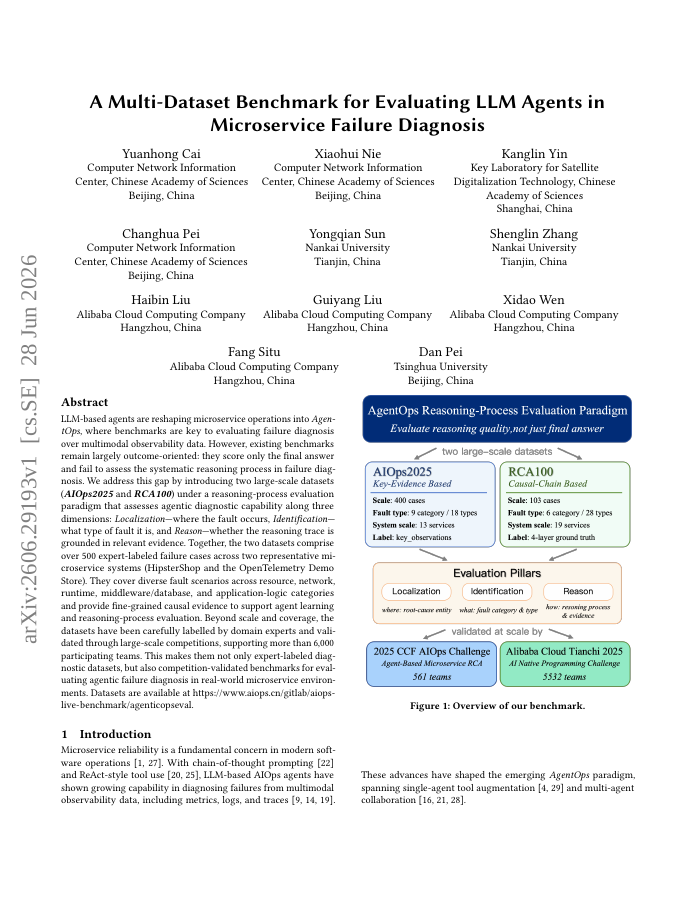
LLM-based agents are reshaping microservice operations into AgentOps, where benchmarks are key to evaluating failure diagnosis over multimodal observability data. However, existing benchmarks remain largely outcome-oriented: they score only the final answer and fail to assess…
28 Jun 2026
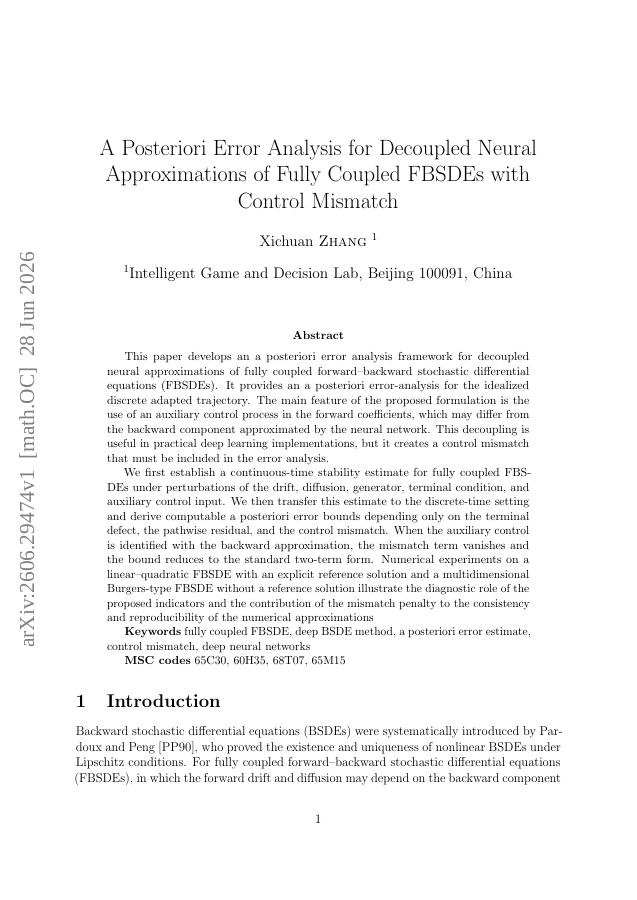
This paper develops an a posteriori error analysis framework for decoupled neural approximations of fully coupled forward--backward stochastic differential equations (FBSDEs). It provides an a posteriori error-analysis for the idealized discrete adapted trajectory.
28 Jun 2026
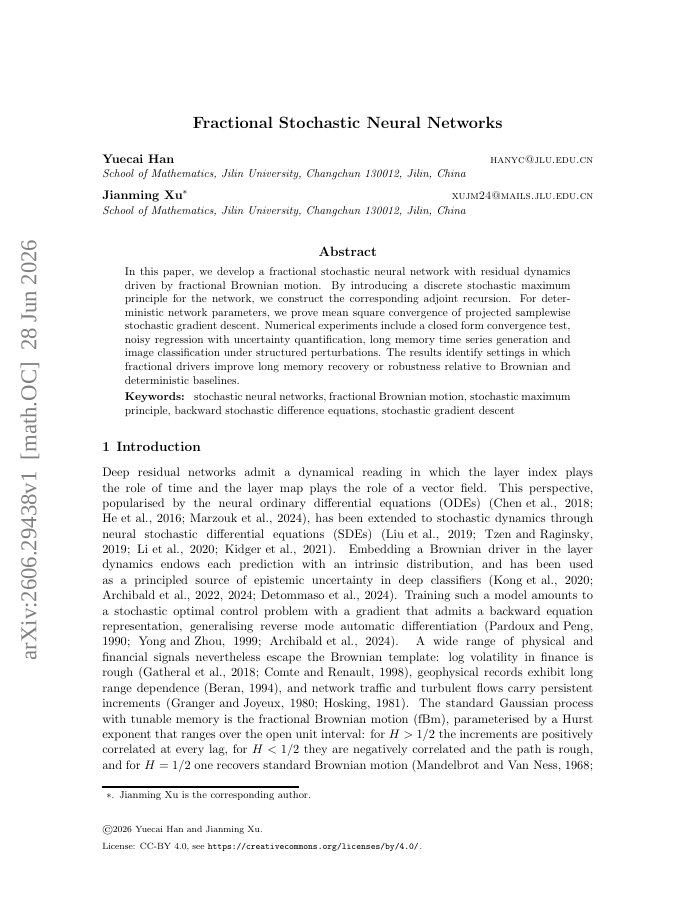
In this paper, we develop a fractional stochastic neural network with residual dynamics driven by fractional Brownian motion. By introducing a discrete stochastic maximum principle for the network, we construct the corresponding adjoint recursion.
27 Jun 2026
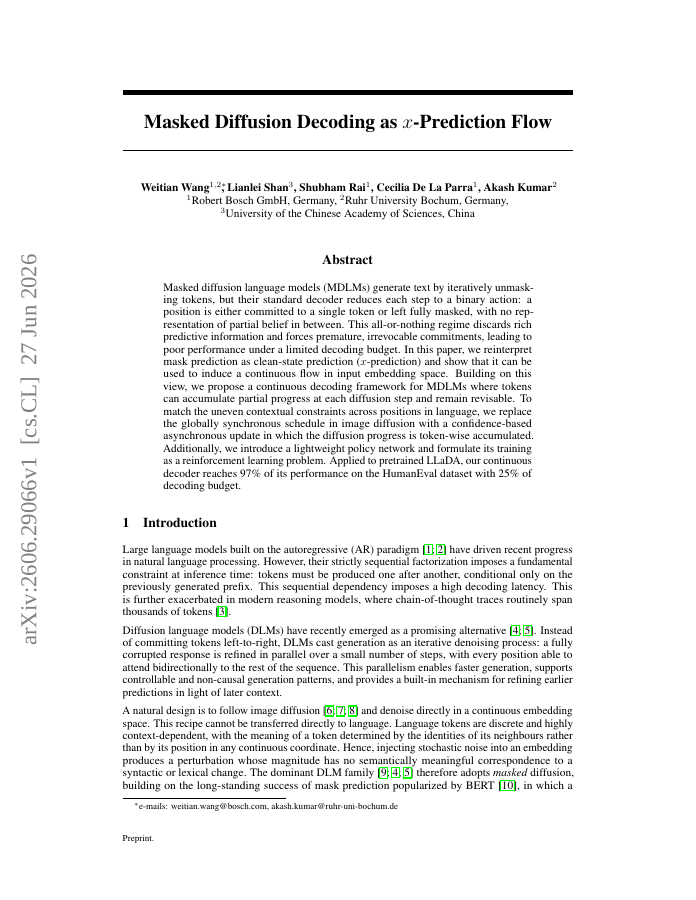
Masked diffusion language models (MDLMs) generate text by iteratively unmasking tokens, but their standard decoder reduces each step to a binary action: a position is either committed to a single token or left fully masked, discarding rich predictive information rather than…
27 Jun 2026
We introduce 5ting, our system for the SemEval2026 Task 8 (MTRAGEval), which evaluates multi-turn Retrieval Augmented Generation (RAG) systems. Multi turn RAG involves context drift, under specification, and hallucination risk.
27 Jun 2026
Predicting the aerodynamic performance (e.g. lift, drag, and moment coefficients) of an aircraft is challenging -- computational models are biased and direct simulations are prohibitive.
27 Jun 2026
Text encoders are known for their utility in natural language processing, as they are able to efficiently compress inputs into dense vectors while preserving semantics. These models have been applied to affective computing, in particular to help with solving sentiment analysis…
27 Jun 2026
Neurological disorders involve diverse pathologies of the brain and nervous system, making early and accurate detection essential. While many deep CNNs have been developed for MRI-based classification of neurological disorders, most are optimized for binary tasks and often fail…
27 Jun 2026
The main objective of this paper is to propose a general framework for prediction based on different sources of multimodal data in the healthcare domain. We evaluated whether frozen medical large language model (LLM) representations can serve as a shared embedding space for…
27 Jun 2026
In general, an ensemble classifier is more accurate than a single classifier. In this study, we propose an ensemble classifier called the kernel Fisher discriminant analysis forest (KFDA Forest), which is a tree-based ensemble method that applies KFDA.
27 Jun 2026
Causally linking disease-related factors to image-derived biomarkers provides a powerful pathway to understanding disease mechanisms. Despite growing interest in applying causal artificial intelligence (AI) approaches for this task, these methods still need to be adapted for…
27 Jun 2026
Deep learning, which in general relies on voluminous amounts of training data, is vulnerable to data poisoning attacks, including error-generic attacks and backdoors (Trojans). In this work, we propose a new data poisoning attack we dub a latent class attack.
27 Jun 2026
We propose a path-space formulation of prediction in AI world models. Rather than sequences of one-step conditional distributions, we argue that a world model implicitly defines a probability measure over future trajectories.
27 Jun 2026
Synthetic aperture radar (SAR) data augmentation is important for improving the generalization of data-driven SAR interpretation models, yet practical augmentation workflows are often hindered by heterogeneous dataset formats, task-dependent metadata requirements, diverse…
27 Jun 2026
In-context learning (ICL) is an emerging paradigm that employs the semantic information inherent in large language models (LLMs) for generating answers to user queries. While the remarkable performance of ICL has been widely known, a general modeling and a rigorous theoretical…
26 Jun 2026
Recent advances in Human Activity Recognition (HAR) from wearable sensors have shown that multi-modal deep learning models consistently outperform their uni-modal counterparts. Modalities can include IMUs, RGB cameras, audio signals, and others.
26 Jun 2026
The clinical and communication skills of medical students are commonly assessed through Objective Structured Clinical Examinations (OSCEs), which consist of brief scenario-driven simulations of doctor-patient interactions.
26 Jun 2026
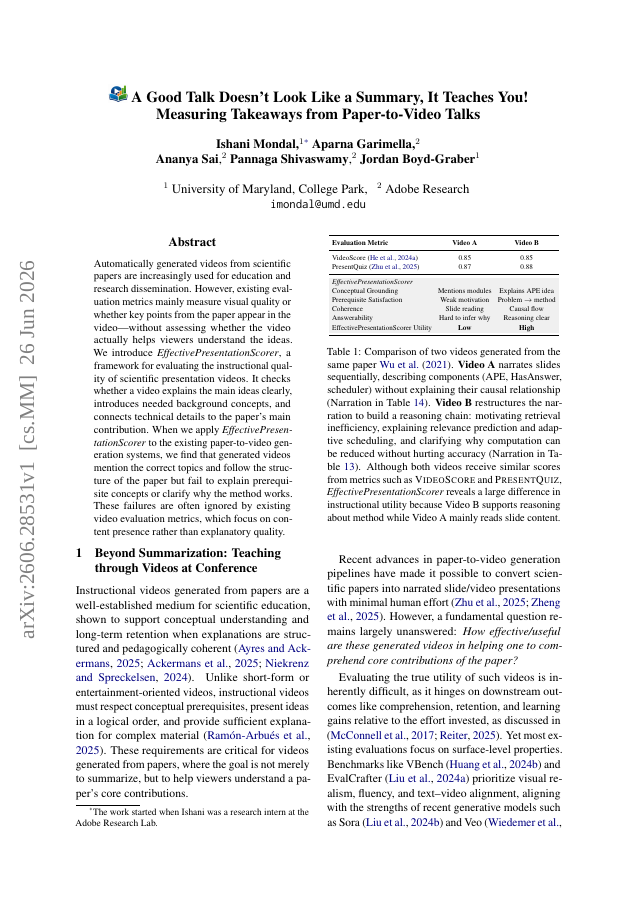
Automatically generated videos from scientific papers are increasingly used for education and research dissemination. However, existing evaluation metrics mainly measure visual quality or whether key points from the paper appear in the video without assessing whether the video…
26 Jun 2026
Safety alignment in large language models can degrade during post-training even when neither the data nor the objective is intentionally adversarial. Alignment rebound and reverse dynamics suggest that this degradation may reactivate behavior suppressed during safety alignment.
26 Jun 2026
Synthetic data is increasingly used to enable the development and evaluation of AI systems in domains where access to real-world data is restricted. In healthcare, clinical documentation presents particular challenges due to its sensitivity.