1 Jun 2026
We introduce Cosmos 3, a family of omnimodal world models designed to jointly process and generate language, image, video, audio, and action sequences within a unified mixture-of-transformers architecture.
Trending research and the full catalog - each paper linked to the benchmarks, methods, and models it introduces.
Filtering here covers the 2,000 most recent papers, as much as one page can hold in memory. See the full index of 22,688 papers.
1 Jun 2026
We introduce Cosmos 3, a family of omnimodal world models designed to jointly process and generate language, image, video, audio, and action sequences within a unified mixture-of-transformers architecture.
19 Oct 2026
GPT-6-Astra demonstrates a level of competence in robotic manipulation and navigation that challenges the conventional paradigm of building specialized models for individual tasks and embodiments.
14 Oct 2026
Progress toward general intelligence in the physical world requires scaling robot learning across diverse environments and interactions. However, existing robot policies use shared parameters that remain fixed across interaction contexts.
16 Oct 2026
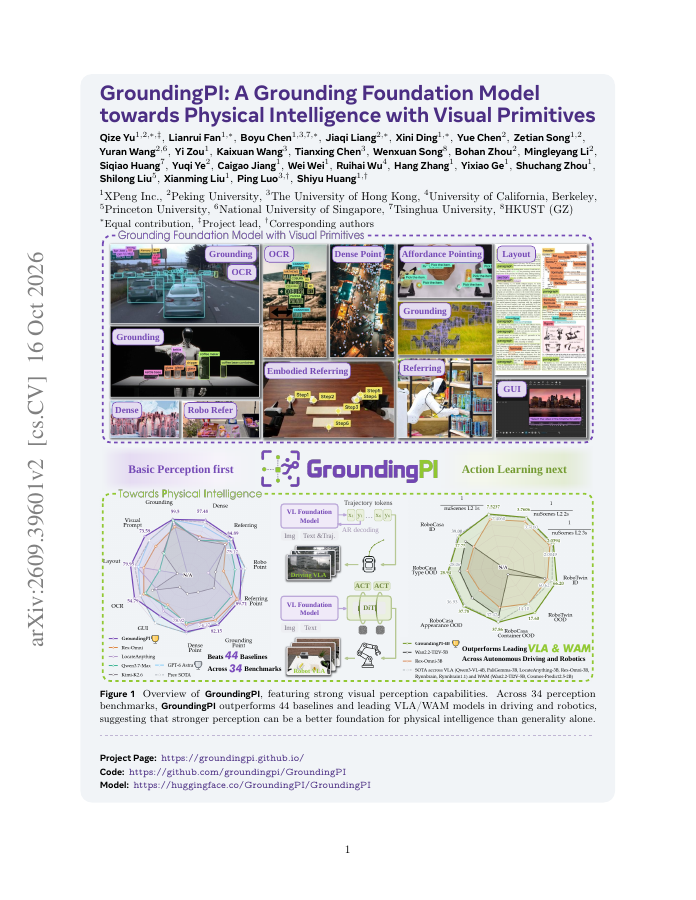
Precise grounding matters. It specifies which object is the target and where that object is, even in clutter and for tiny objects, and it has to be fast enough for closed-loop control.
20 Oct 2026
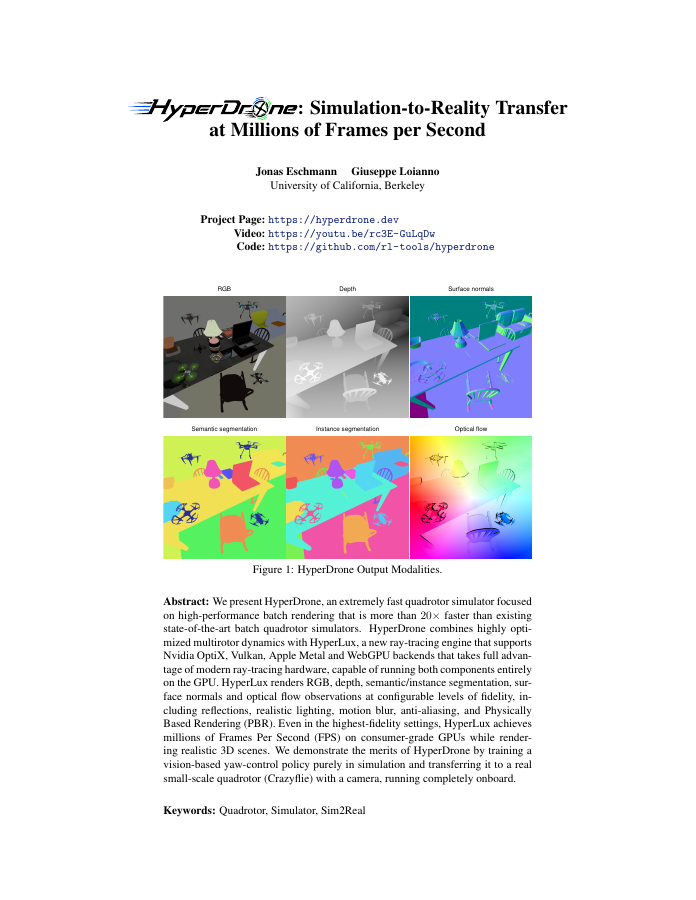
We present HyperDrone, an extremely fast quadrotor simulator focused on high-performance batch rendering that is more than 20x faster than existing state-of-the-art batch quadrotor simulators.
7 Oct 2026
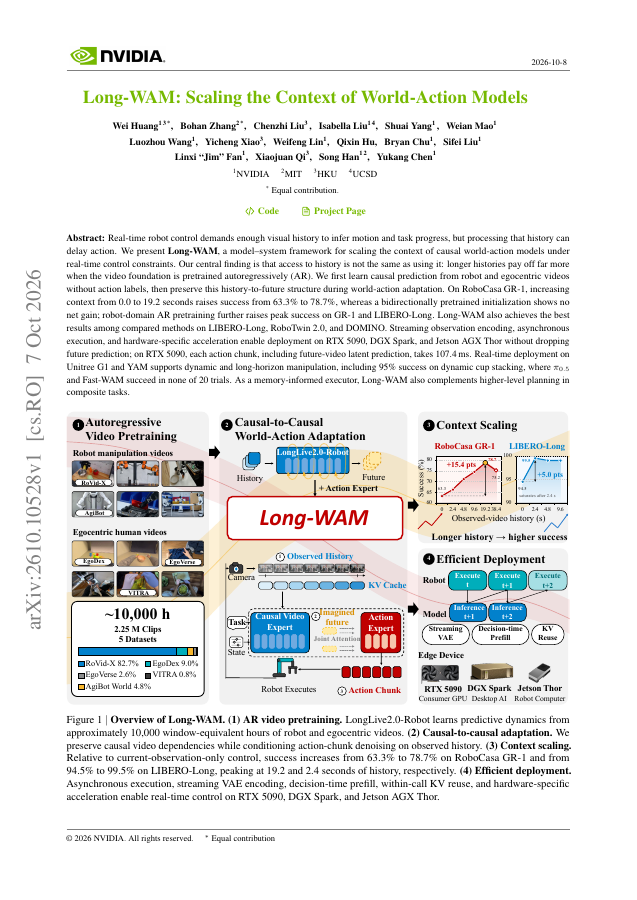
Real-time robot control demands enough visual history to infer motion and task progress, but processing that history can delay action. We present Long-WAM, a model-system framework for scaling the context of causal world-action models under real-time control constraints.
21 Oct 2026
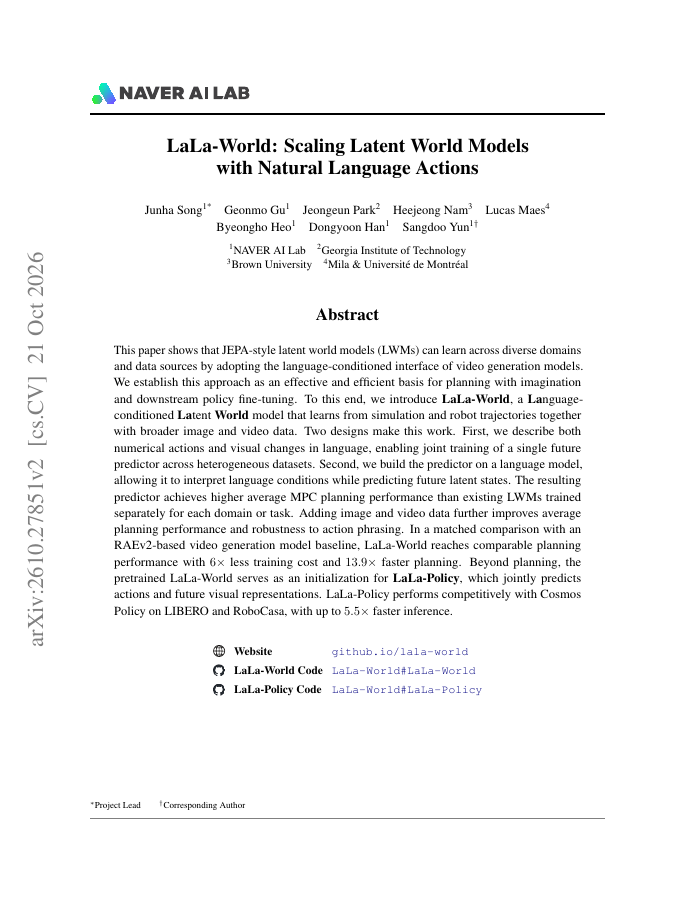
This paper shows that JEPA-style latent world models (LWMs) can learn across diverse domains and data sources by adopting the language-conditioned interface of video generation models.
20 Oct 2026
As a prototypical latent world model, Joint-Embedding Predictive Architectures (JEPAs) provide strong semantic representations. However, dense patch representations expose a redundant interface to downstream predictors, which must implicitly infer spatial organization and…