17 Oct 2026
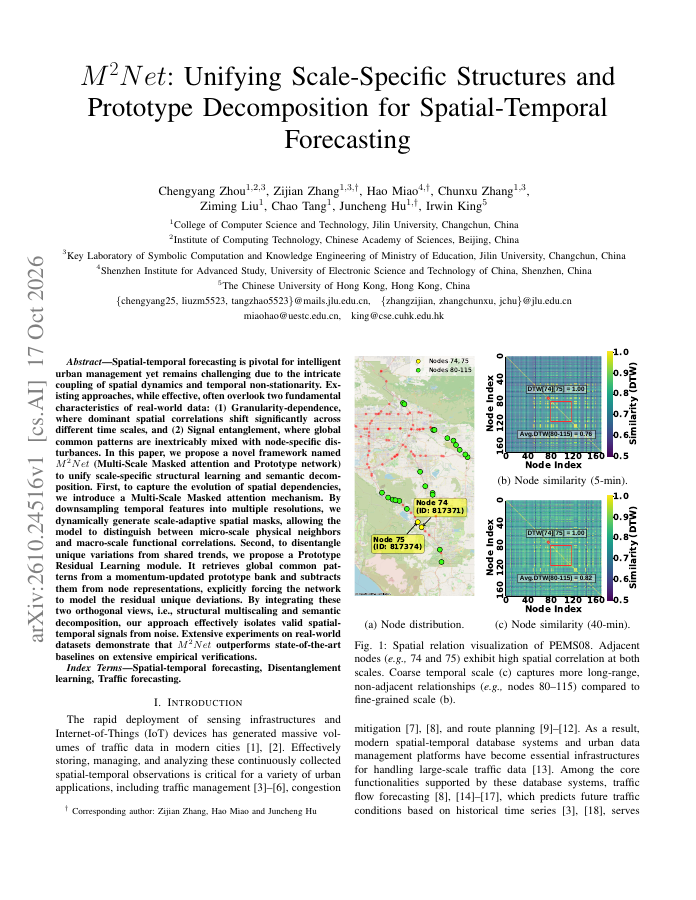
Spatial-temporal forecasting is pivotal for intelligent urban management yet remains challenging due to the intricate coupling of spatial dynamics and temporal non-stationarity.
Trending research and the full catalog - each paper linked to the benchmarks, methods, and models it introduces.
Filtering here covers the 2,000 most recent papers, as much as one page can hold in memory. See the full index of 22,874 papers.
17 Oct 2026
Spatial-temporal forecasting is pivotal for intelligent urban management yet remains challenging due to the intricate coupling of spatial dynamics and temporal non-stationarity.
17 Oct 2026
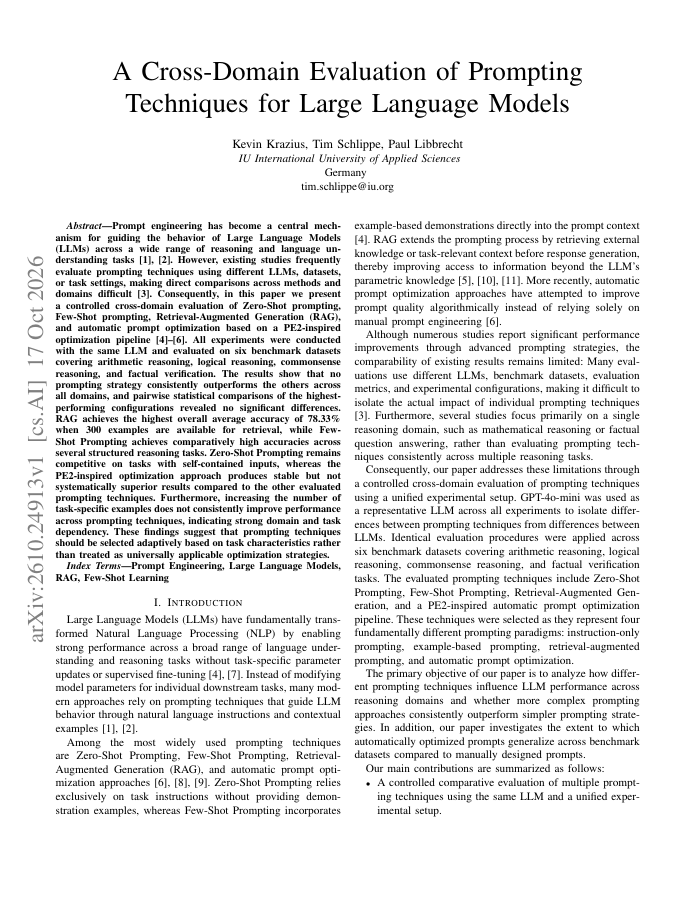
Prompt engineering has become a central mechanism for guiding the behavior of Large Language Models (LLMs) across a wide range of reasoning and language understanding tasks [1], [2].
17 Oct 2026
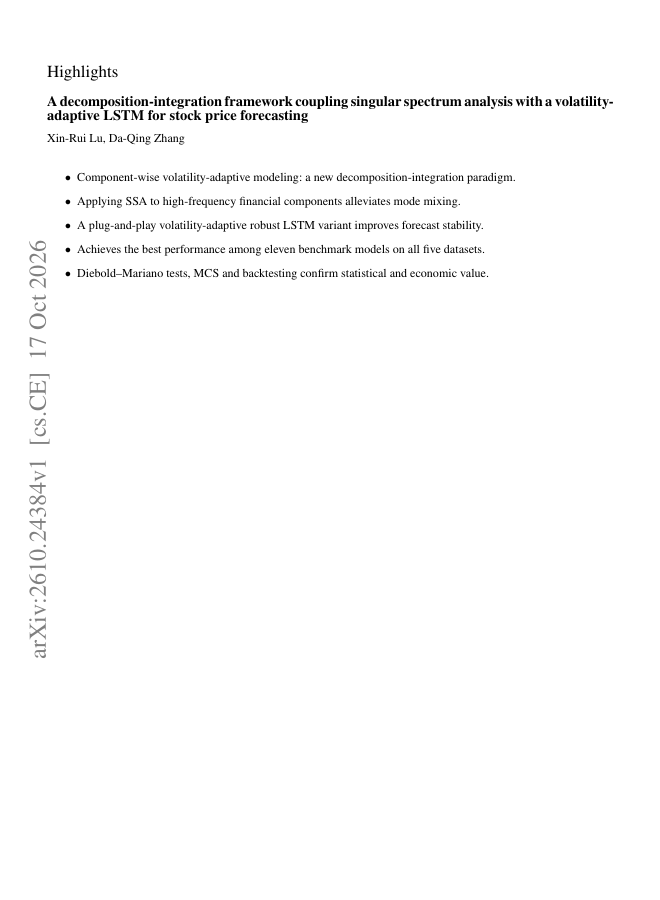
Financial time series exhibit multi-scale, high-noise, and non-stationary volatility dynamics. Decomposition--integration frameworks built on complete ensemble empirical mode decomposition with adaptive noise (CEEMDAN) have advanced this field, yet existing CEEMDAN hybrids…
17 Oct 2026
Federated learning has recently emerged as an important paradigm for large-scale distributed model training, which can be naturally formulated as a class of distributed learning problems.
17 Oct 2026
Robotic manipulation is inherently geometric, but what shape does the world take inside the policy that performs it? Prior work on vision-language-action (VLA) policies establishes that task-relevant variables are linearly readable from activations, yet readability certifies…
17 Oct 2026
Language models can treat semantically distinct inputs as interchangeable at the representation level, creating blind spots that standard sparse autoencoder (SAE) objectives do not target.
17 Oct 2026
Mobile device location-based service (LBS) data provide large-scale spatiotemporal observations that can help airport planners understand air travelers' mobility patterns.
16 Oct 2026
Given a labeled dataset $\{(x_i, y_i)\}_{i = 1}^n$, consider drawing a parameter vector $\hatθ$ uniformly at random from those that interpolate the data within a width-$W$ depth-$D$ ReLU architecture with continuous weights bounded within $[-M, M]$.
16 Oct 2026
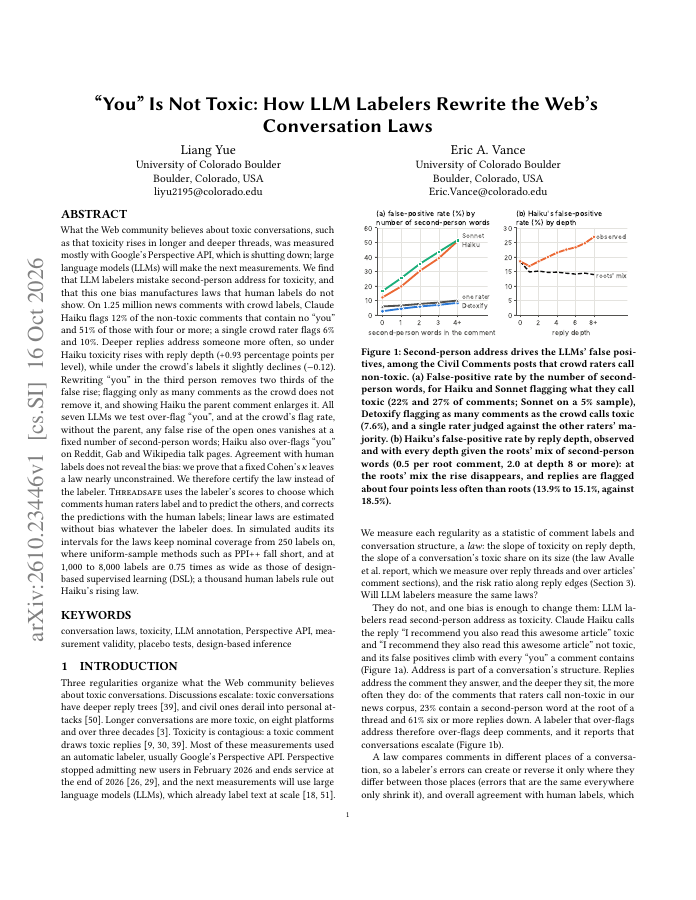
What the Web community believes about toxic conversations, such as that toxicity rises in longer and deeper threads, was measured mostly with Google's Perspective API, which is shutting down; large language models (LLMs) will make the next measurements.
16 Oct 2026
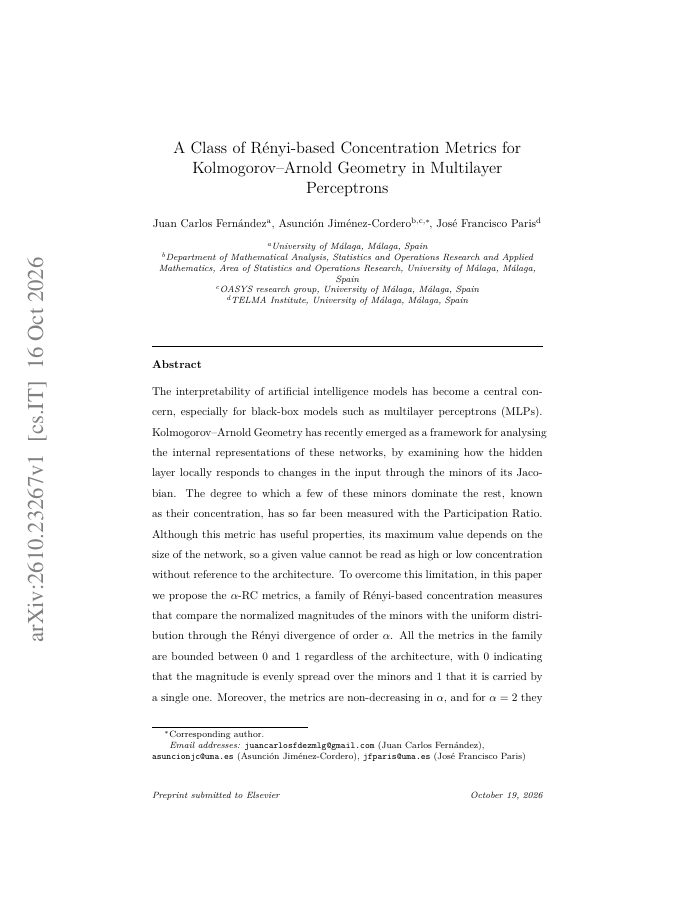
The interpretability of artificial intelligence models has become a central concern, especially for black-box models such as multilayer perceptrons (MLPs). Kolmogorov-Arnold Geometry has recently emerged as a framework for analysing the internal representations of these…
16 Oct 2026
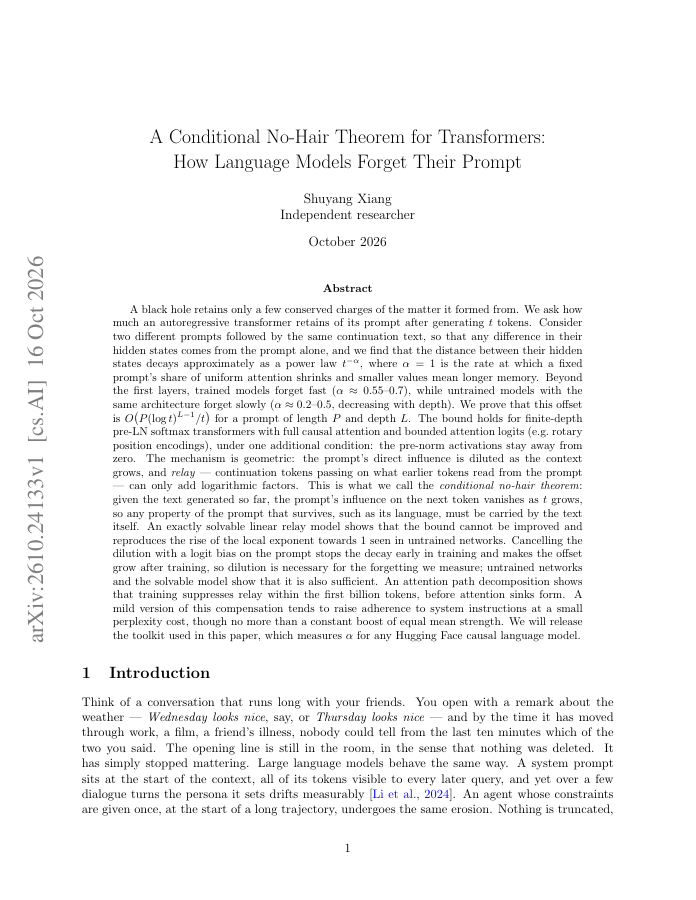
We ask how much an autoregressive transformer retains of its prompt after generating $t$ tokens. Consider two different prompts followed by the same continuation text, so that any difference in their hidden states comes from the prompt alone, and we find that the distance…
16 Oct 2026
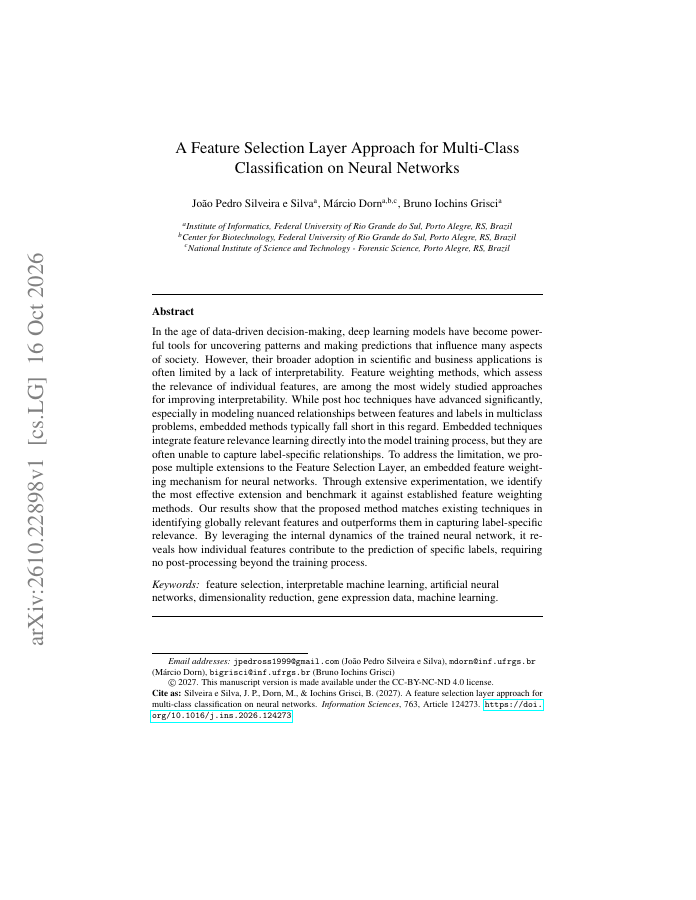
In the age of data-driven decision-making, deep learning models have become powerful tools for uncovering patterns and making predictions that influence many aspects of society.
16 Oct 2026
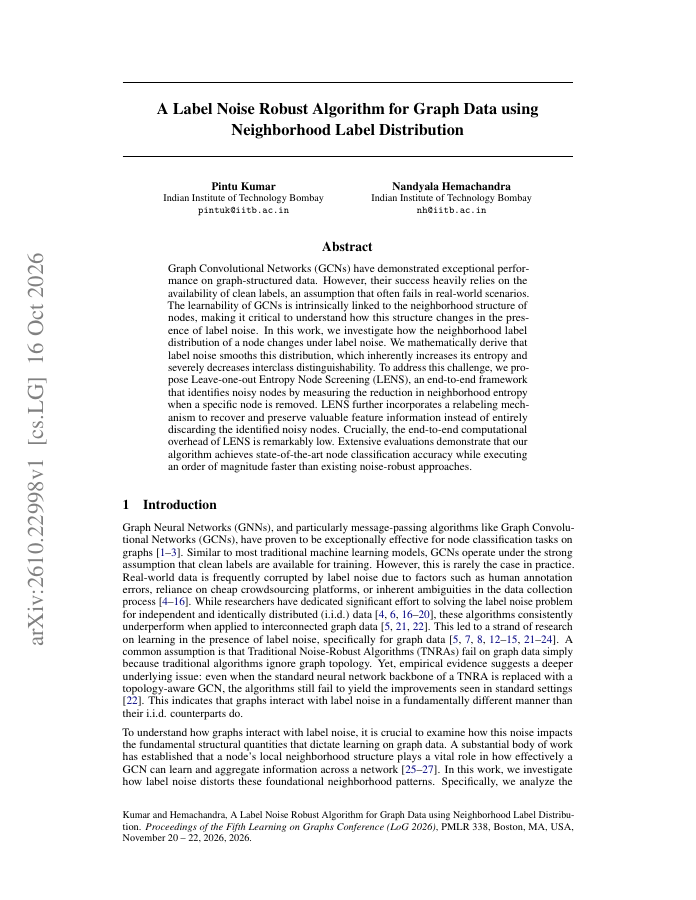
Graph Convolutional Networks (GCNs) have demonstrated exceptional performance on graph-structured data. However, their success heavily relies on the availability of clean labels, an assumption that often fails in real-world scenarios.
16 Oct 2026
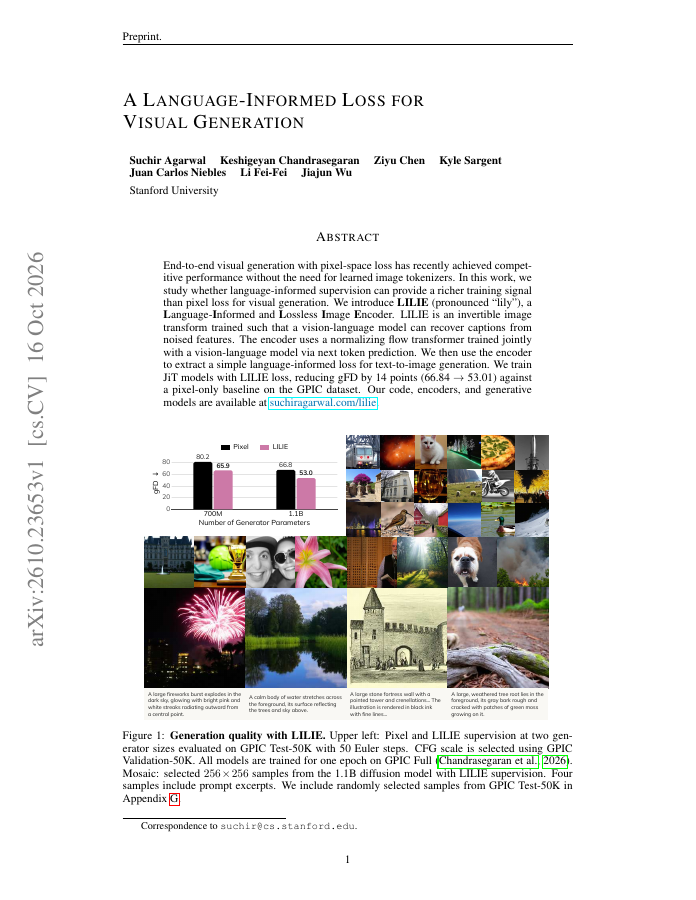
End-to-end visual generation with pixel-space loss has recently achieved competitive performance without the need for learned image tokenizers. In this work, we study whether language-informed supervision can provide a richer training signal than pixel loss for visual…
16 Oct 2026
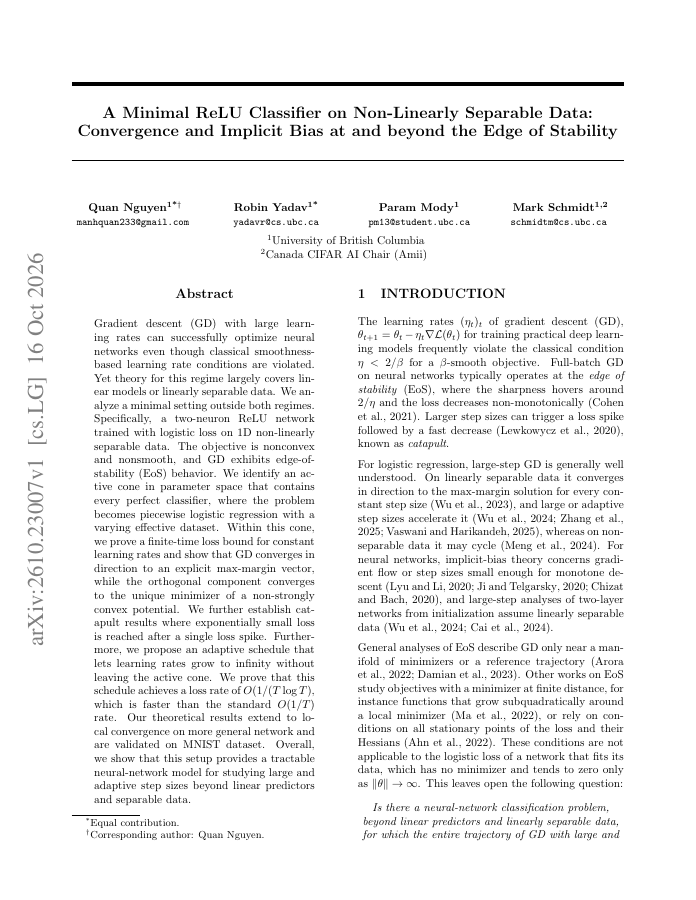
Gradient descent (GD) with large learning rates can successfully optimize neural networks even though classical smoothness-based learning rate conditions are violated. Yet theory for this regime largely covers linear models or linearly separable data.
16 Oct 2026
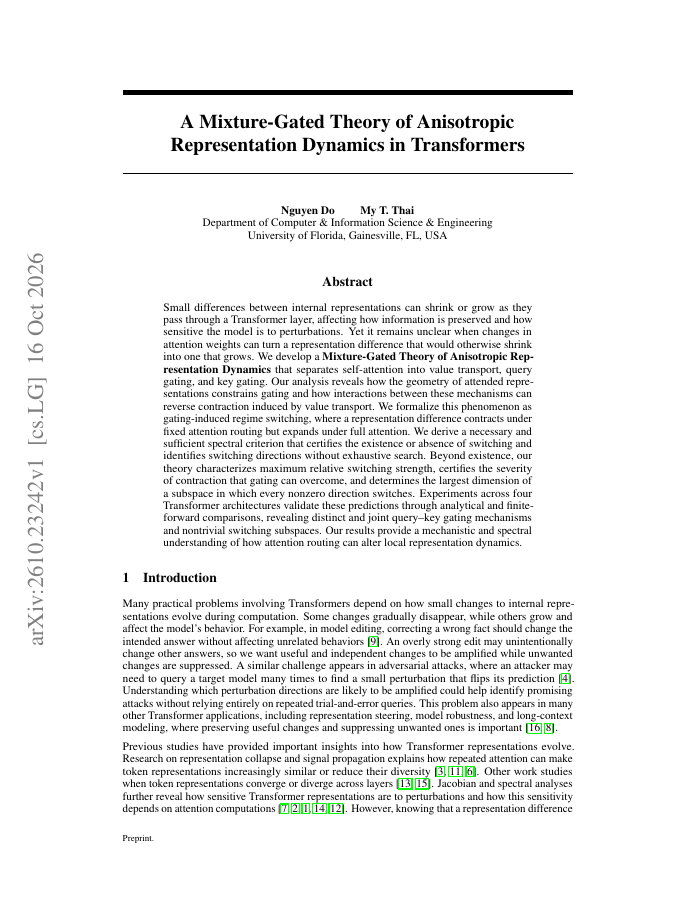
Small differences between internal representations can shrink or grow as they pass through a Transformer layer, affecting how information is preserved and how sensitive the model is to perturbations.
16 Oct 2026
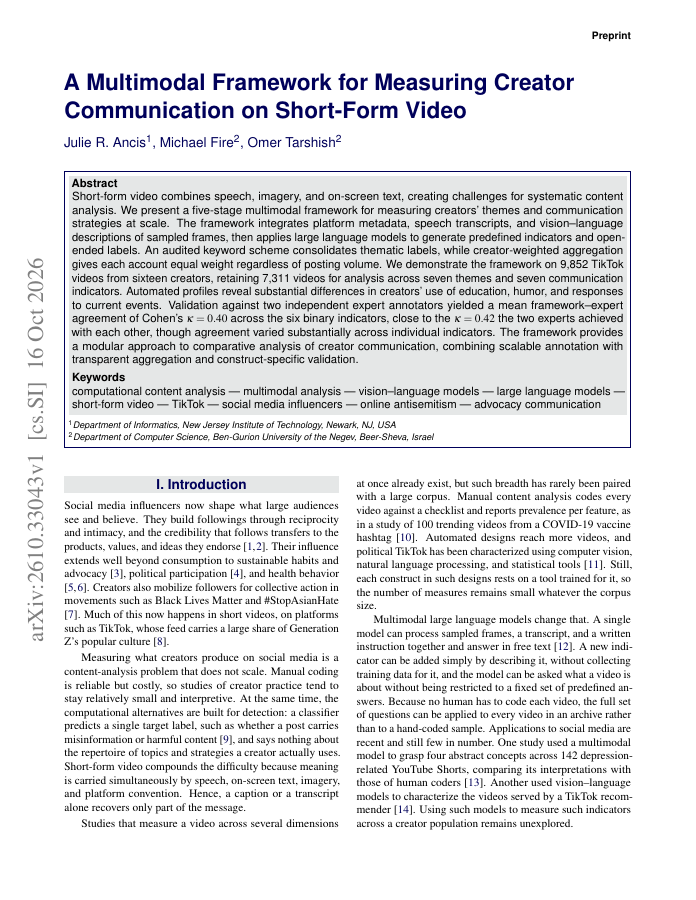
Short-form video combines speech, imagery, and on-screen text, creating challenges for systematic content analysis. We present a five-stage multimodal framework for measuring creators' themes and communication strategies at scale.
16 Oct 2026
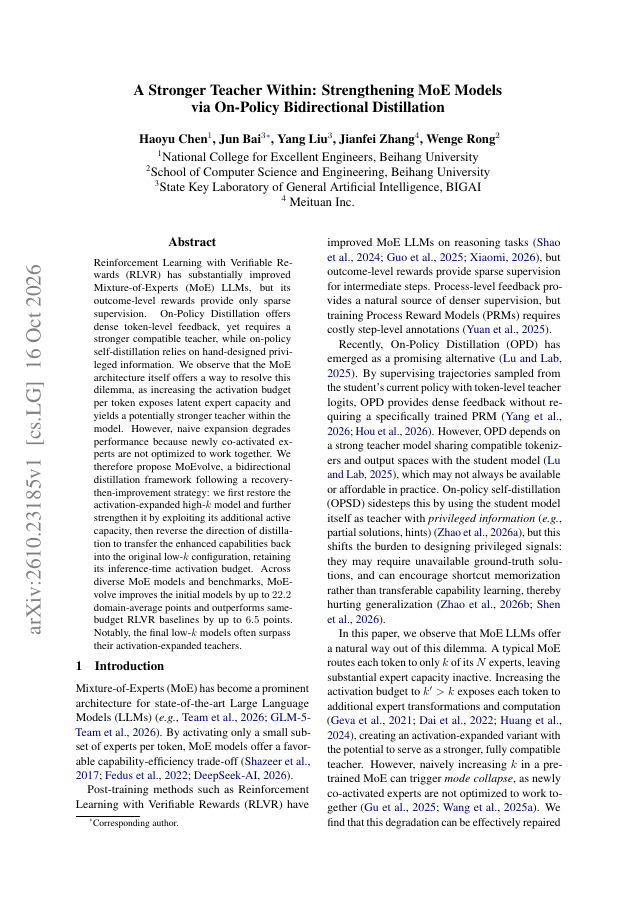
Reinforcement Learning with Verifiable Rewards (RLVR) has substantially improved Mixture-of-Experts (MoE) LLMs, but its outcome-level rewards provide only sparse supervision.
16 Oct 2026
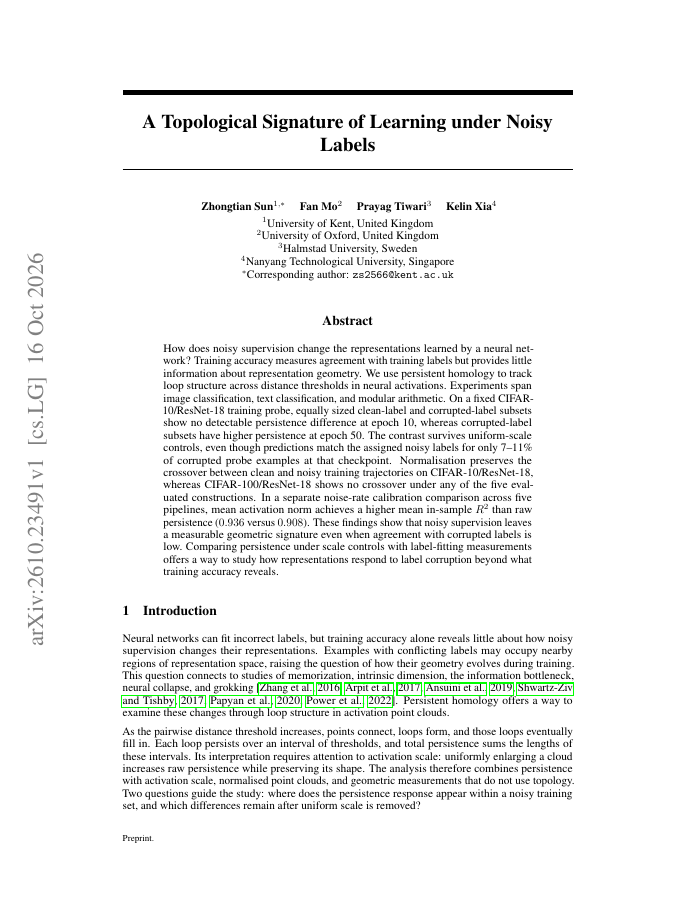
How does noisy supervision change the representations learned by a neural network? Training accuracy measures agreement with training labels but provides little information about representation geometry.
15 Oct 2026
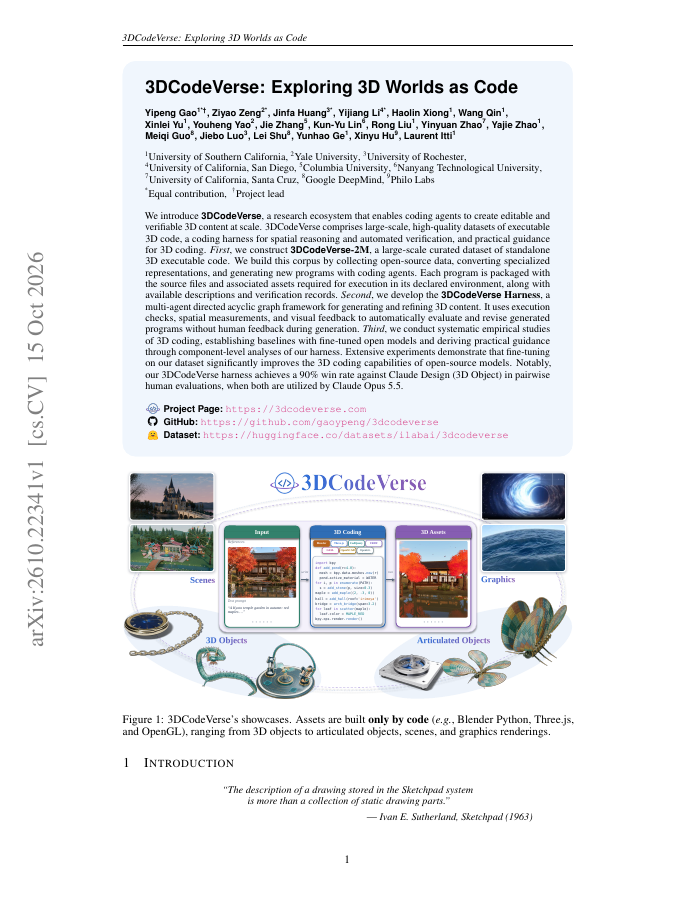
We introduce 3DCodeVerse, a research ecosystem that enables coding agents to create editable and verifiable 3D content at scale. 3DCodeVerse comprises large-scale, high-quality datasets of executable 3D code, a coding harness for spatial reasoning and automated verification, and…
15 Oct 2026
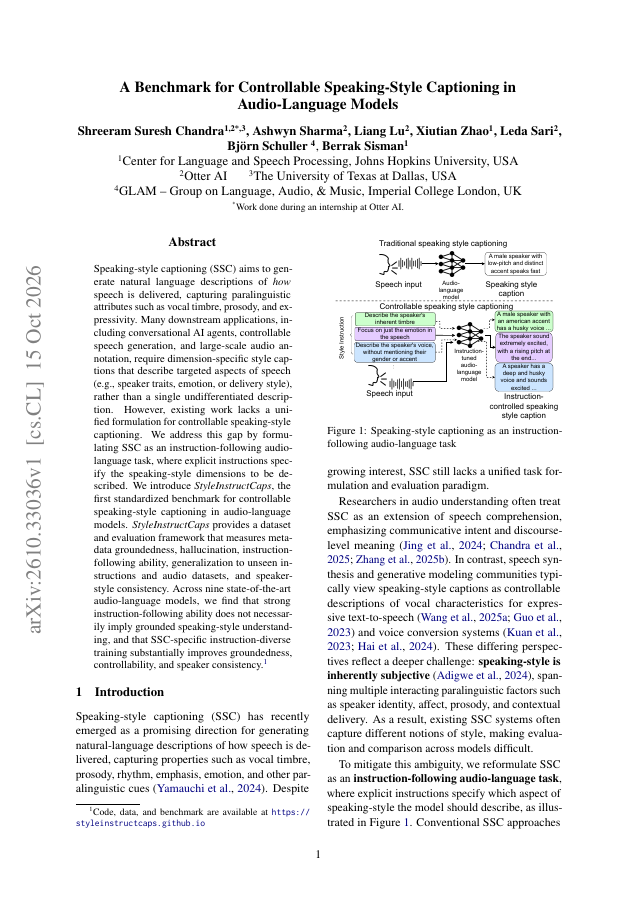
Speaking-style captioning (SSC) aims to generate natural language descriptions of how speech is delivered, capturing paralinguistic attributes such as vocal timbre, prosody, and expressivity.
15 Oct 2026
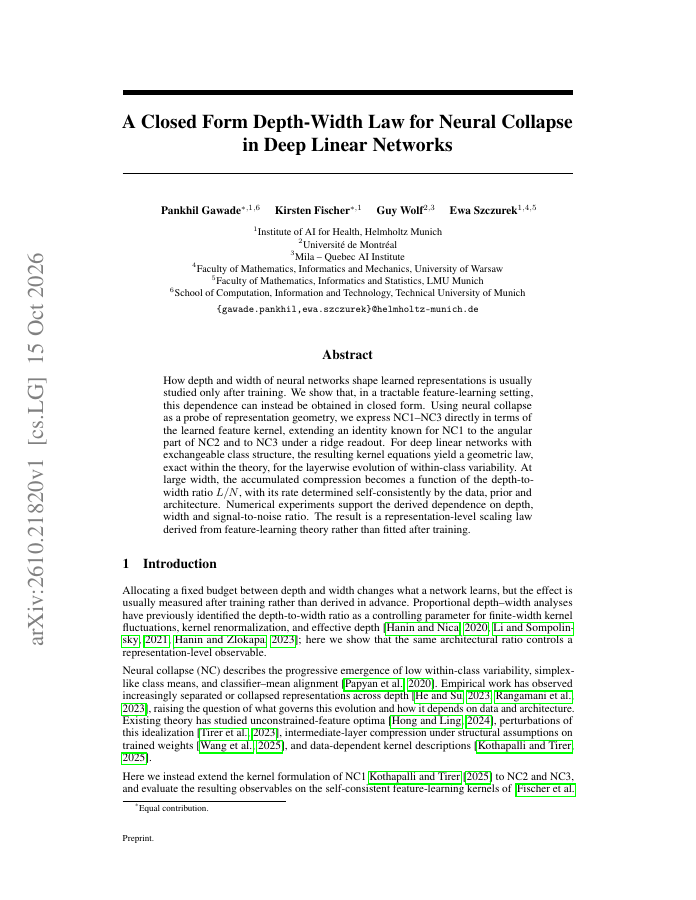
How depth and width of neural networks shape learned representations is usually studied only after training. We show that, in a tractable feature-learning setting, this dependence can instead be obtained in closed form.
15 Oct 2026
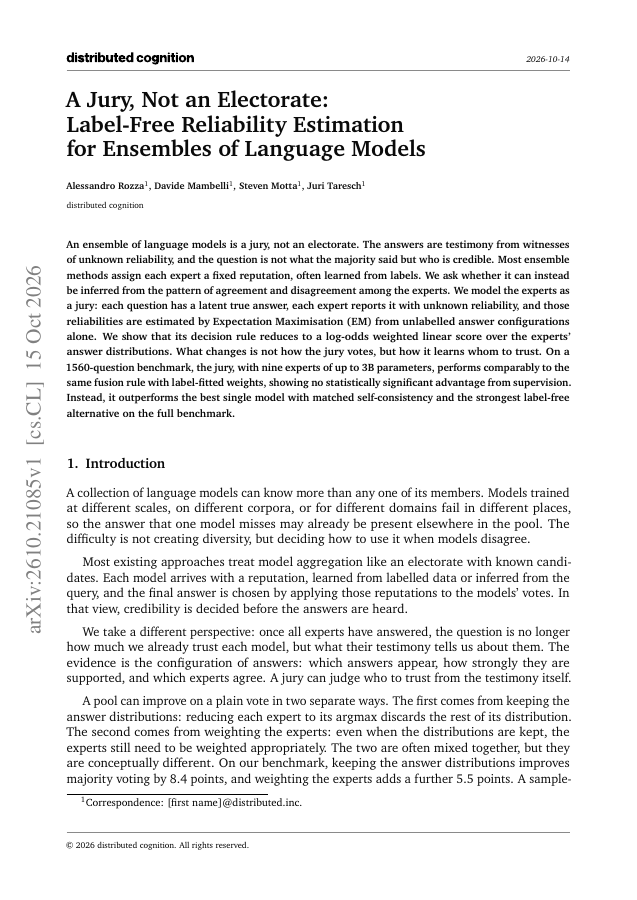
An ensemble of language models is a jury, not an electorate. The answers are testimony from witnesses of unknown reliability, and the question is not what the majority said but who is credible.
15 Oct 2026
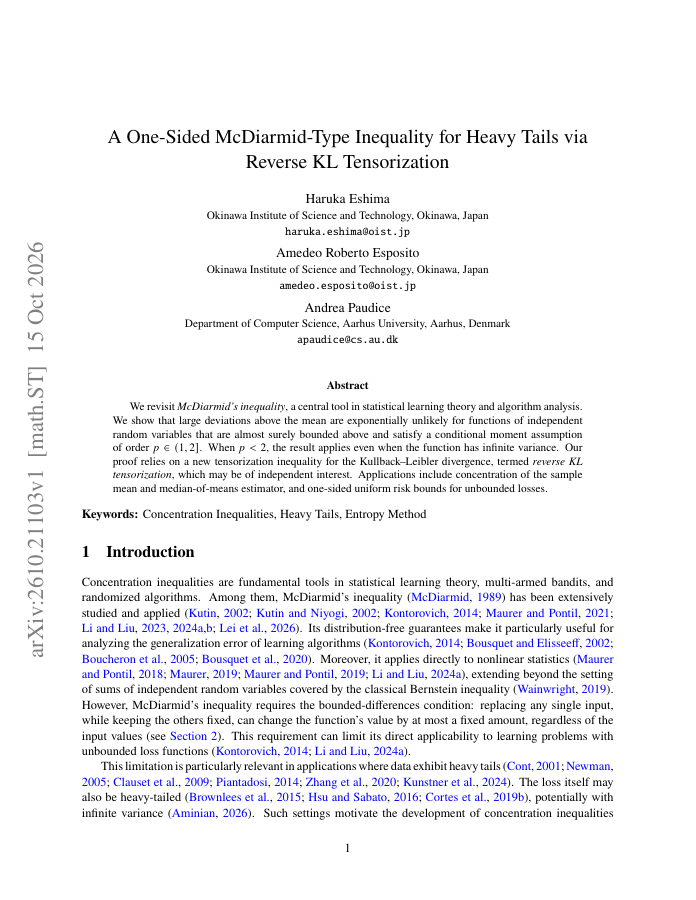
We revisit McDiarmid's inequality, a central tool in statistical learning theory and algorithm analysis. We show that large deviations above the mean are exponentially unlikely for functions of independent random variables that are almost surely bounded above and satisfy a…