4 Nov 2026
Researchers use large language models as agents in social simulations, where agents are prompted with observations and background information intended to shape their actions.
Trending research and the full catalog - each paper linked to the benchmarks, methods, and models it introduces.
Filtering here covers the 2,000 most recent papers, as much as one page can hold in memory. See the full index of 22,874 papers.
4 Nov 2026
Researchers use large language models as agents in social simulations, where agents are prompted with observations and background information intended to shape their actions.
3 Nov 2026
While conversational recommendation systems provide a more natural user interface, they face the challenge of progressively discovering a user's needs before they can recommend an item that satisfies them.
3 Nov 2026
The classical model-based optimal design criteria (D-, T-, L-, C-, and A-optimality) are usually motivated via the Cramér--Rao bound as optimizing scalar functions of the Fisher information matrix (FIM).
3 Nov 2026
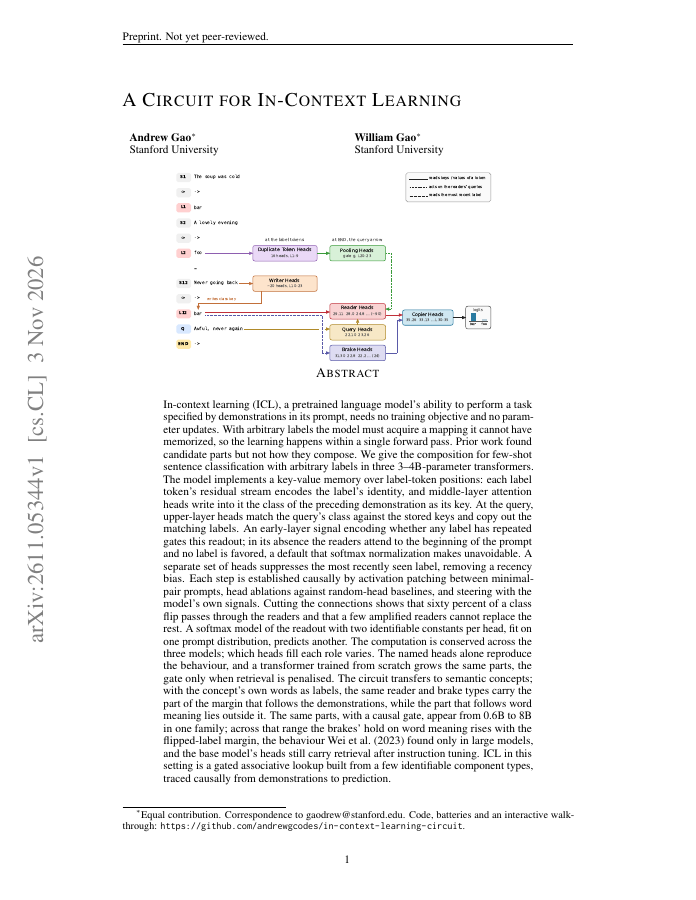
In-context learning (ICL) lets a pretrained language model perform a task specified by demonstrations in its prompt, with no parameter updates. With arbitrary labels the model must acquire a mapping it cannot have memorized, so the learning happens within a single forward pass.
3 Nov 2026
In this paper, we introduce the Cone Alignment Index (CAI), a scale-invariant sparsity measure associated with a Lorentz-cone geometry. We provide a probabilistic analysis of the distribution of the CAI score, including a general theorem and explicit corollaries for Gaussian and…
3 Nov 2026
We study a fundamental problem in machine learning: partial recovery of a planted signal $\boldsymbol{v} \in \mathbb{S}^{n-1}$ from a spiked tensor $\boldsymbol{\mathsf{X}} = λ\, \boldsymbol{v}^{\otimes p} + \boldsymbol{\mathsf{Z}}$, where $\boldsymbol{\mathsf{Z}}$ has symmetric…
3 Nov 2026
In this paper, three operations on Gibbs probability measures are studied: renormalization, normalized log-linear combination, and nesting. The resulting measures are shown to be Gibbs probability measures with explicit expressions for their objective functions, reference…
2 Nov 2026
Mapping the three-dimensional distribution of dark matter is key to tracing the growth of cosmic structure. Two-dimensional weak lensing mass maps recover its projected distribution, but they blend structures at different distances along the line of sight.
2 Nov 2026
Language models trained on the outputs of other models can acquire traits that those outputs never mention, such as a preference for an animal carried by lists of numbers. Such subliminal learning can pass on unwanted traits.
2 Nov 2026
As control engineering is applied to increasingly complex systems, learning-based control, which uses empirical data to reduce the reliance on first-principles models, has emerged as a promising paradigm.
2 Nov 2026
Sycophancy in language models is well documented as a behaviour but poorly localised as a mechanism. We ask whether capitulation under user pushback, the abandonment of a correct answer when a user objects, corresponds to a linear direction in the residual stream, and whether…
2 Nov 2026
Dynamic graphs capture evolving interactions in Web systems, including online communication, user engagement, and recommendation. Graph foundation models aim to reuse predictive capabilities across networks, but extending this capability to dynamic graphs faces two challenges.
2 Nov 2026
Large language models provide a variety of responses at inference (generation) that conventionally depend on a temperature parameter. Using a conditional mutual information approach, a quantitative, entropy based analysis of response variety is given.
2 Nov 2026
Matrix multiplication dominates both PHY signal processing and Deep Neural Network (DNN) inference, yet these domains place opposing demands on the matrix engine. Signal processing requires low-latency execution of relatively small matrix operations, whereas DNN inference,…
2 Nov 2026
Theoretical limitations of transformers on state tracking---the ability to track information about entities or variables over long contexts---have motivated new recurrent language modeling (LM) architectures such as Gated DeltaNet (GDN).
2 Nov 2026
Physically based two-dimensional hydraulic models are too slow for real-time inundation forecasting and large ensembles. We present a time-dependent geometry-informed neural operator (GINO) surrogate of LISFLOOD-FP for the municipality of Forlì (Italy), severely affected by the…
2 Nov 2026
Translating population-level exercise guidance into individualized prescriptions requires integrating clinical and wearable data, including diagnoses, medications, functional limitations, and baseline activity, with condition-specific recommendations, a process difficult to…
2 Nov 2026
Large-scale annotation of environmental sound recordings presents significant challenges under time and resource constraints, particularly when sound categories are imbalanced and only part of a dataset has been labeled.
2 Nov 2026
For effective resource management, infrastructure planning, and sustainable tourism, it is really important to predict accurate visitors. This paper estimates the daily visitation of Nebraska lakes using spatial, basic temporal, and interpretable temporal features.
2 Nov 2026
Graph machine learning benchmarking results are scattered across papers that use quite different sets of datasets and baseline methods, making it difficult to tell whether a reported gain reflects architectural progress or merely an outdated comparison or weakly tuned baseline.
2 Nov 2026
Federated Learning (FL) offers a paradigm for collaborative machine learning model training among clients, preserving data privacy by avoiding direct data sharing. However, the gradient information exchanged in FL has been shown to be vulnerable to Gradient Inversion Attacks…
2 Nov 2026
We study online channel scheduling for a single queue served by $K$ channels under bandit feedback. We propose a simple best-of-both-worlds policy that explores when the queue is empty.
2 Nov 2026
Causal inference has emerged as a powerful paradigm enabling robots to make safe, efficient decisions by reasoning about the ``why'' behind events. However, its real-world application is hindered by the difficulty of collecting causal data, especially in human-populated…
2 Nov 2026
In the near future language model pretraining will become bound by total data rather than total compute. Such a regime requires revisiting scaling laws and scaling law theory.