3 Sep 2026
Isolated Sign Language Recognition (ISLR) is conventionally cast as closed-set classification over gloss labels, which cannot generalize to signs unseen in training and ties every deployment to a gloss-annotated lexicon.

Trending research and the full catalog - each paper linked to the benchmarks, methods, and models it introduces.
Filtering here covers the 2,000 most recent papers, as much as one page can hold in memory. See the full index of 22,201 papers.
3 Sep 2026
Isolated Sign Language Recognition (ISLR) is conventionally cast as closed-set classification over gloss labels, which cannot generalize to signs unseen in training and ties every deployment to a gloss-annotated lexicon.
3 Sep 2026
Foundation models are beginning to reshape brain-signal analysis by moving the field beyond task-specific decoding pipelines toward reusable models pretrained on broad neural datasets.
3 Sep 2026
Scientific and clinical decision-making depends on evidence from the primary literature, but existing standards for representing that evidence (FHIR Evidence, ECO, SEPIO, and the GA4GH Genomic Knowledge Standards) are oriented toward clinical-trial workflows, evidence codes, or…
3 Sep 2026
Quantum error-correction decoders are typically benchmarked against synthetic circuit-level noise, under the assumption that a decoder's ranking under such noise transfers to hardware and improves as the noise model becomes more realistic.
3 Sep 2026
We generated synthetic multivariate time series for 27 refrigerators with a simplified physicsinspired simulator at one-minute resolution. The simulator includes ambient-temperature variation, door use, thermostat and compressor operation, heat exchange, defrost, electrical…
3 Sep 2026
Multilingual language models often produce inconsistent answers to semantically equivalent questions across languages, motivating methods to improve cross-lingual consistency (CLC).
3 Sep 2026
Accurate cloud resource forecasting is essential for proactive resource provisioning, maintaining Quality of Service (QoS), and reducing operational costs in dynamic cloud environments.
2 Sep 2026
Organizations in critical national infrastructure sectors must assess heterogeneous documents for sensitivity before routing or storage. Manual assessment is slow, inconsistent, and unscalable.
2 Sep 2026
Several classical machine-learning methods, such as KRRs and SVRs, are both computationally and analytically tractable since their estimators either admit closed-form expressions or are obtained by minimizing convex training objectives; neither feature is generally available for…
2 Sep 2026
Speech brain-computer interfaces (speech BCIs) translate neural activity into language, offering a path towards restoring speech for people with paralysis and, more broadly, enabling new forms of natural human-computer interaction.
2 Sep 2026
Graph construction is a critical but underexamined design choice in deep reinforcement learning for power grid control. We present a controlled experimental comparison of different graph representations, including physical topology, electrical-sensitivity, and hybrid variants…
2 Sep 2026
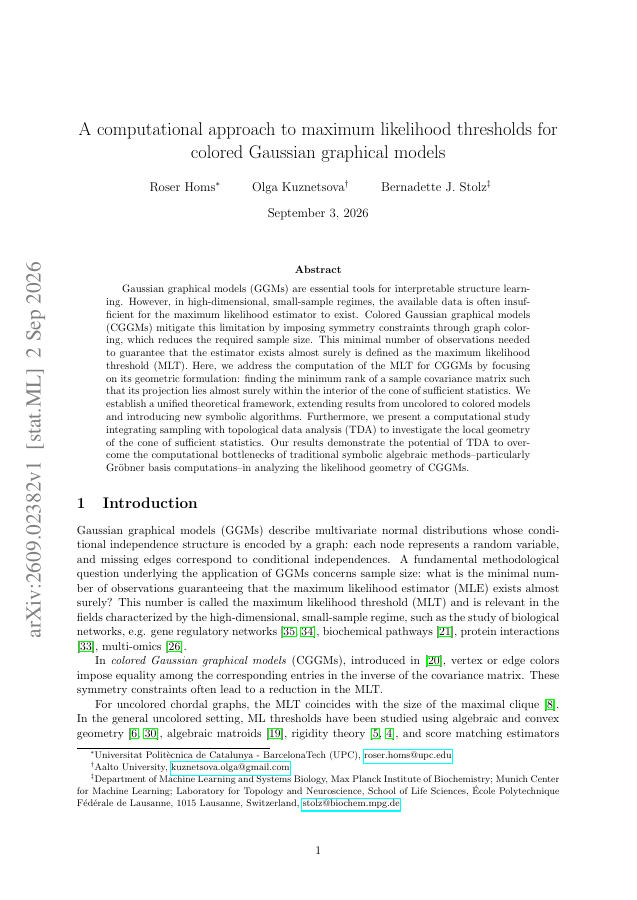
Gaussian graphical models (GGMs) are essential tools for interpretable structure learning. However, in high-dimensional, small-sample regimes, the available data is often insufficient for the maximum likelihood estimator to exist.
2 Sep 2026
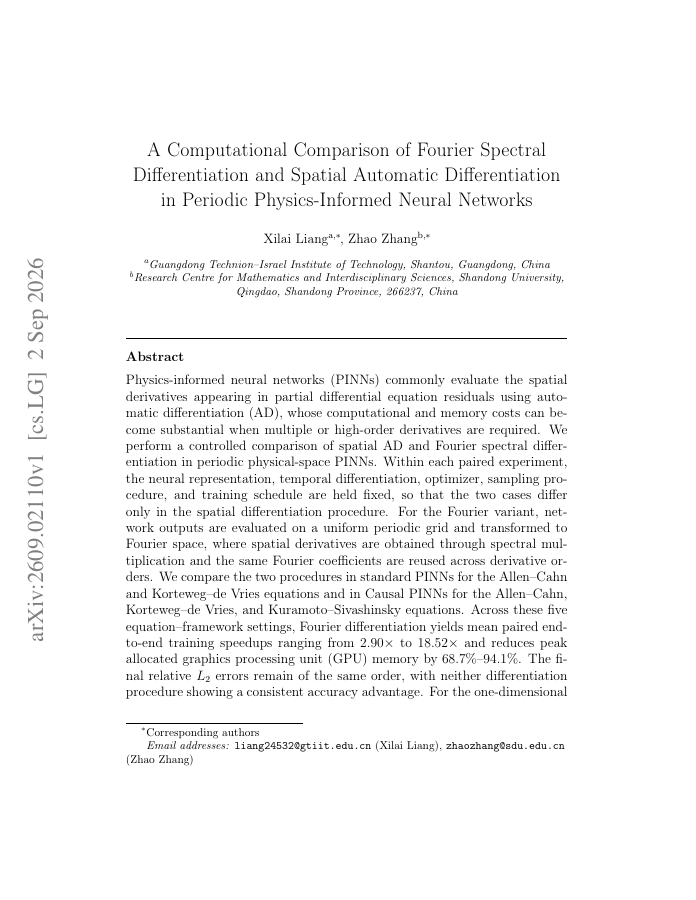
Physics-informed neural networks (PINNs) commonly evaluate the spatial derivatives appearing in partial differential equation residuals using automatic differentiation (AD), whose computational and memory costs can become substantial when multiple or high-order derivatives are…
2 Sep 2026
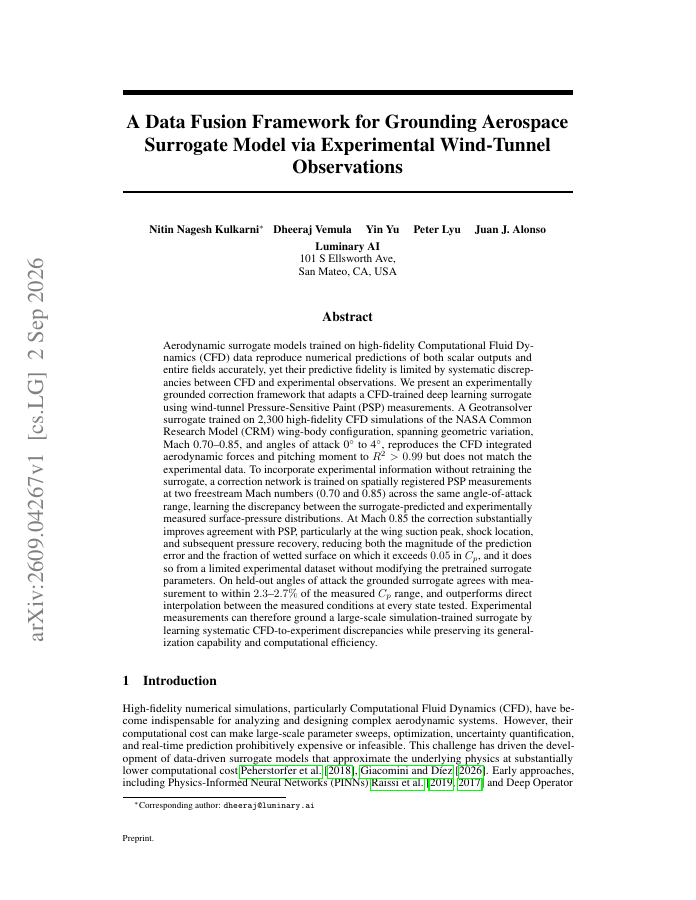
Aerodynamic surrogate models trained on high-fidelity CFD data reproduce numerical predictions of both scalar outputs and entire fields accurately, yet their predictive fidelity is limited by systematic discrepancies between CFD and experimental observations.
2 Sep 2026
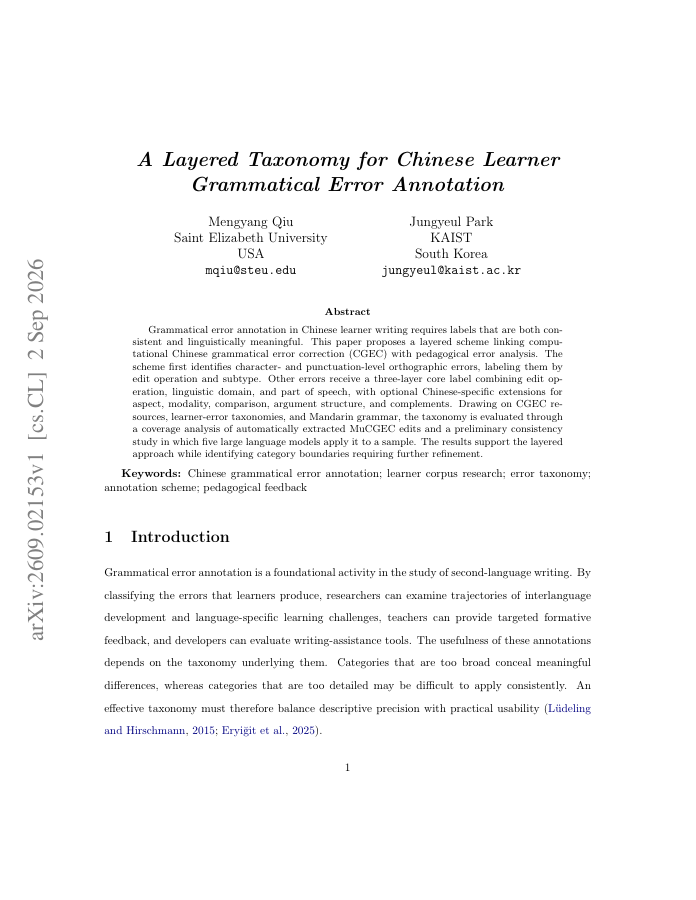
Grammatical error annotation in Chinese learner writing requires labels that are both consistent and linguistically meaningful. This paper proposes a layered scheme linking computational Chinese grammatical error correction (CGEC) with pedagogical error analysis.
2 Sep 2026
Most vector databases rely on graph-based indexes, notably HNSW and Vamana, for approximate nearest neighbor search. With embedding models widely adopted, the datasets these databases store grow rapidly.
2 Sep 2026
Background: Diagnosing head and neck cancer using PET/CT is clinically challenging and time-consuming due to the anatomical complexity of the region, motivating computer-aided diagnosis (CAD).
2 Sep 2026
Large Language Models (LLMs) are increasingly deployed in interactive systems where understanding user intent precisely is paramount. A key capability for such systems is effective question clarification, especially when user queries are ambiguous or underspecified.
2 Sep 2026
Data-driven process simulation aims to generate realistic case trajectories from historical event logs without requiring an explicitly specified model of the underlying dynamics.
2 Sep 2026
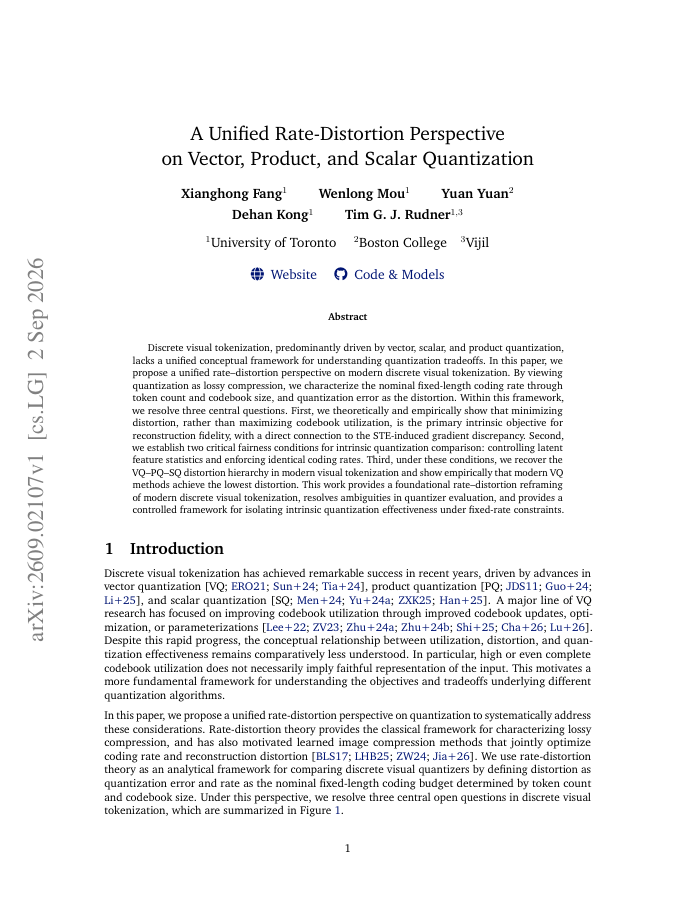
Discrete visual tokenization, predominantly driven by vector, scalar, and product quantization, lacks a unified conceptual framework for understanding quantization tradeoffs. In this paper, we propose a unified rate--distortion perspective on modern discrete visual tokenization.
2 Sep 2026
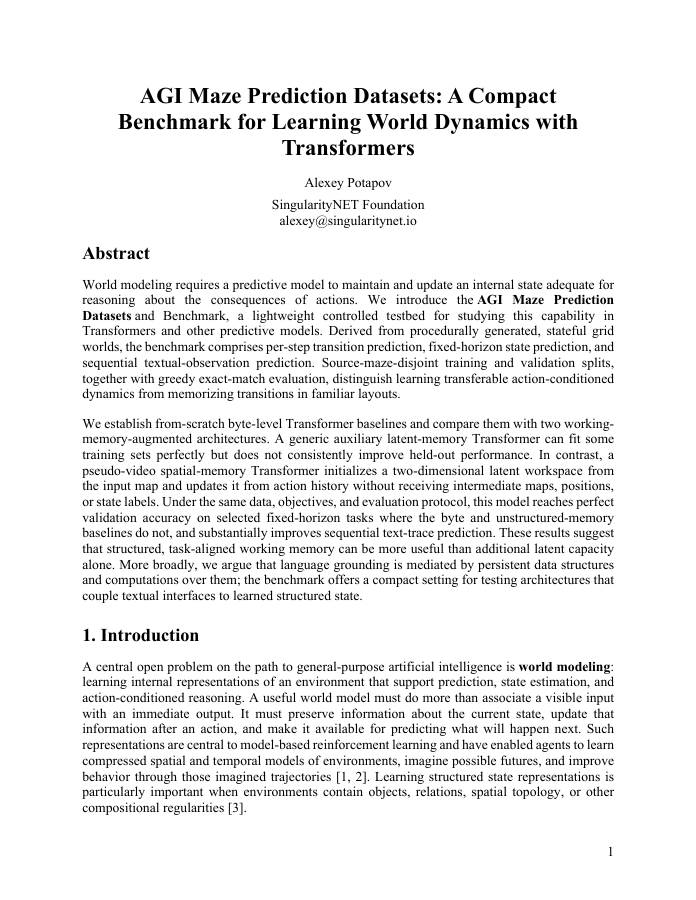
World modeling requires a predictive model to maintain and update an internal state adequate for reasoning about the consequences of actions. We introduce the AGI Maze Prediction Datasets and Benchmark, a lightweight controlled testbed for studying this capability in…
2 Sep 2026
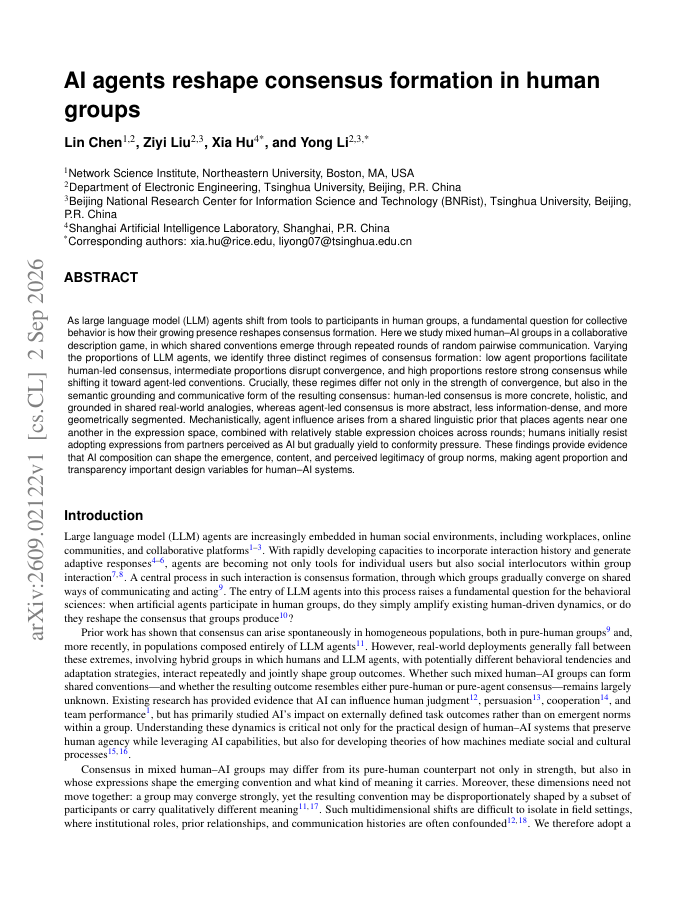
As large language model (LLM) agents shift from tools to participants in human groups, a fundamental question for collective behavior is how their growing presence reshapes consensus formation.
2 Sep 2026
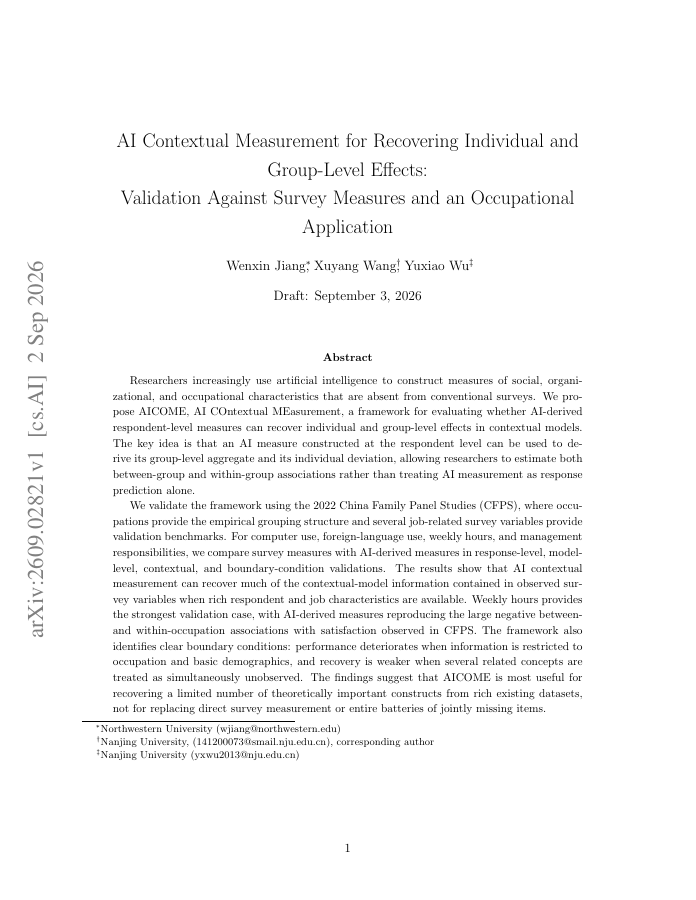
Researchers increasingly use artificial intelligence to construct measures of social, organizational, and occupational characteristics that are absent from conventional surveys.
1 Sep 2026
We present the first benchmark suite for formal verification of Programmable Logic Controller (PLC) programs that combines controlled ground truth with coverage of both textual (Structured Text, ST) and graphical (Ladder Diagram, LD) IEC 61131-3 encodings.