11 Sep 2026
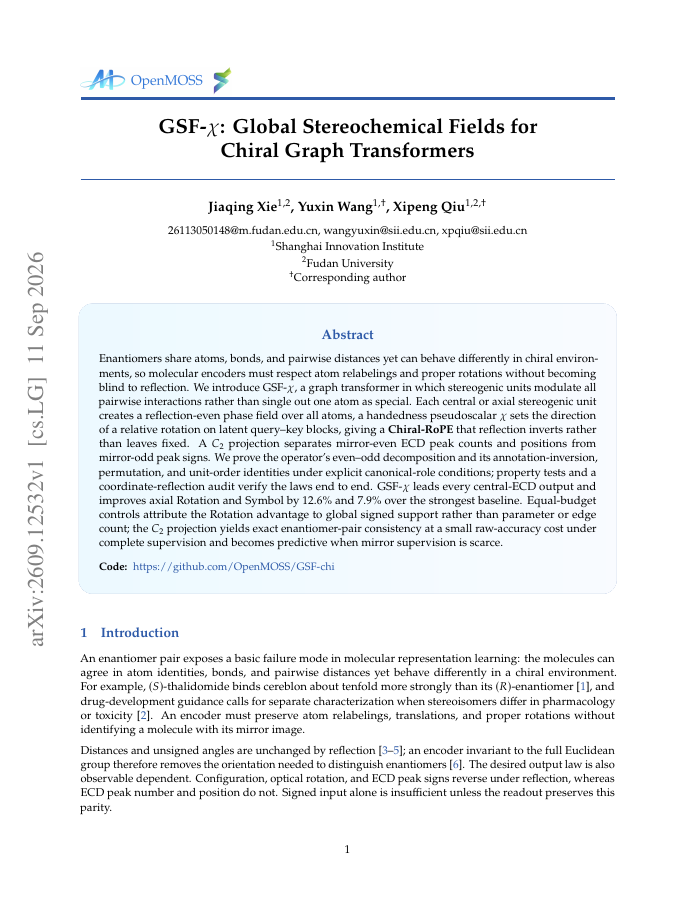
Enantiomers share atoms, bonds, and pairwise distances yet can behave differently in chiral environments, so molecular encoders must respect atom relabelings and proper rotations without becoming blind to reflection.
Trending research and the full catalog - each paper linked to the benchmarks, methods, and models it introduces.
Filtering here covers the 2,000 most recent papers, as much as one page can hold in memory. See the full index of 22,736 papers.
11 Sep 2026
Enantiomers share atoms, bonds, and pairwise distances yet can behave differently in chiral environments, so molecular encoders must respect atom relabelings and proper rotations without becoming blind to reflection.
11 Sep 2026
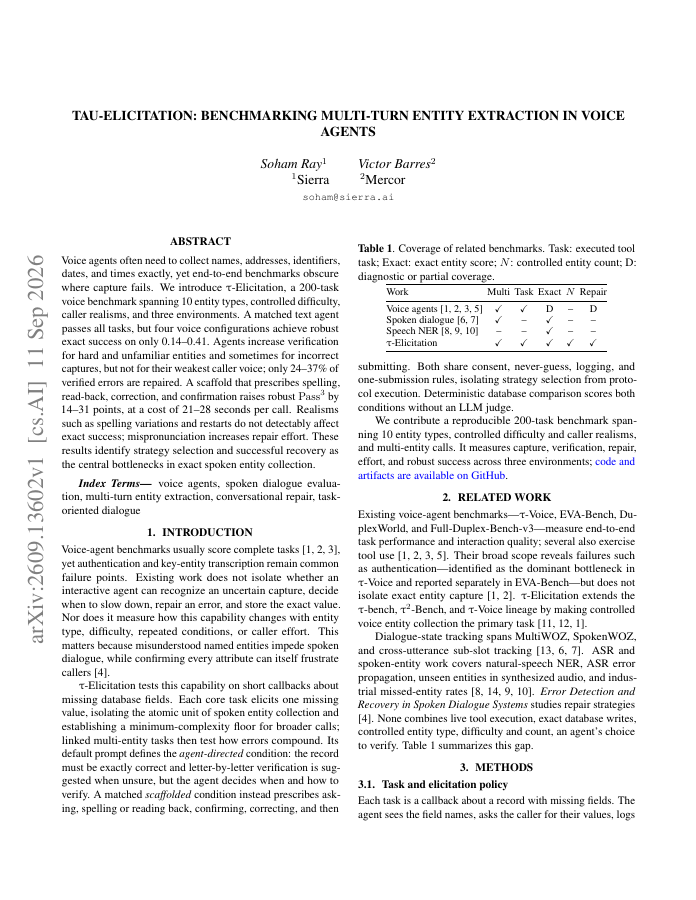
Voice agents often need to collect names, addresses, identifiers, dates, and times exactly, yet end-to-end benchmarks obscure where capture fails. We introduce $τ$-Elicitation, a 200-task voice benchmark spanning 10 entity types, controlled difficulty, caller realisms, and three…
11 Sep 2026
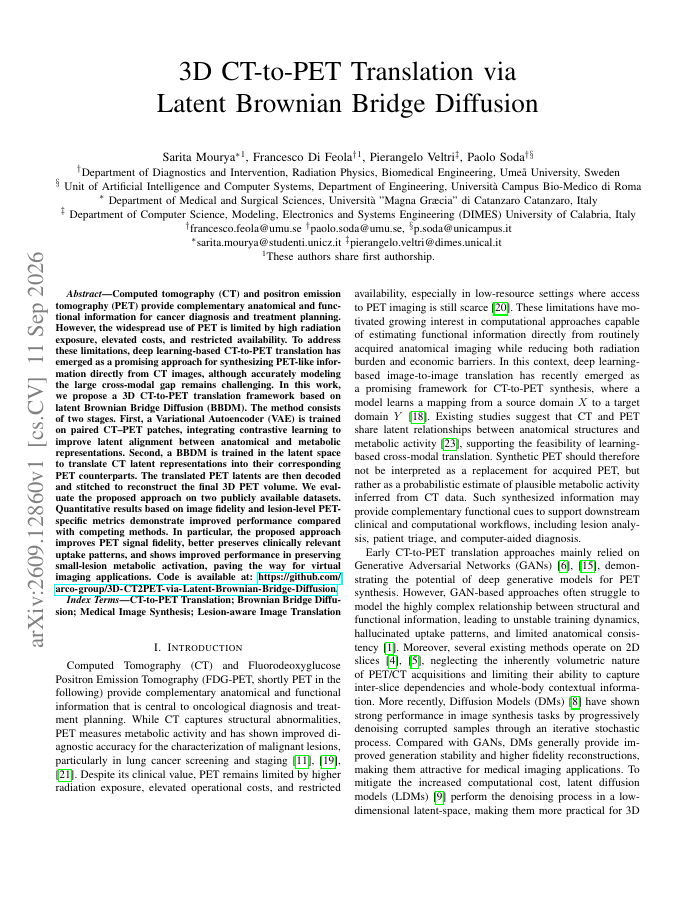
Computed tomography (CT) and positron emission tomography (PET) provide complementary anatomical and functional information for cancer diagnosis and treatment planning. However, the widespread use of PET is limited by high radiation exposure, elevated costs, and restricted…
11 Sep 2026
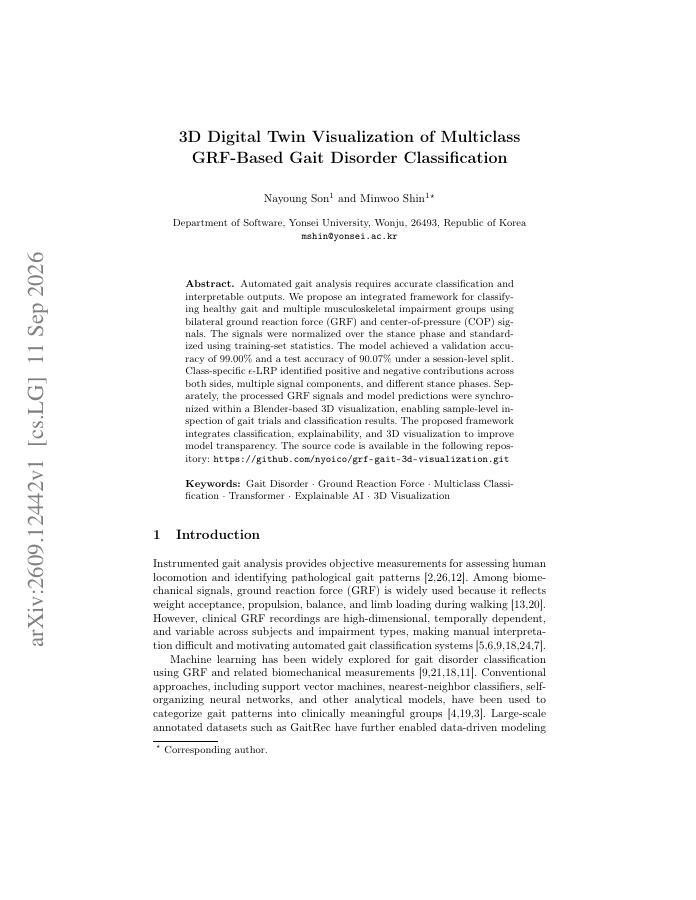
Automated gait analysis requires accurate classification and interpretable outputs. We propose an integrated framework for classifying healthy gait and multiple musculoskeletal impairment groups using bilateral ground reaction force (GRF) and center-of-pressure (COP) signals.
11 Sep 2026
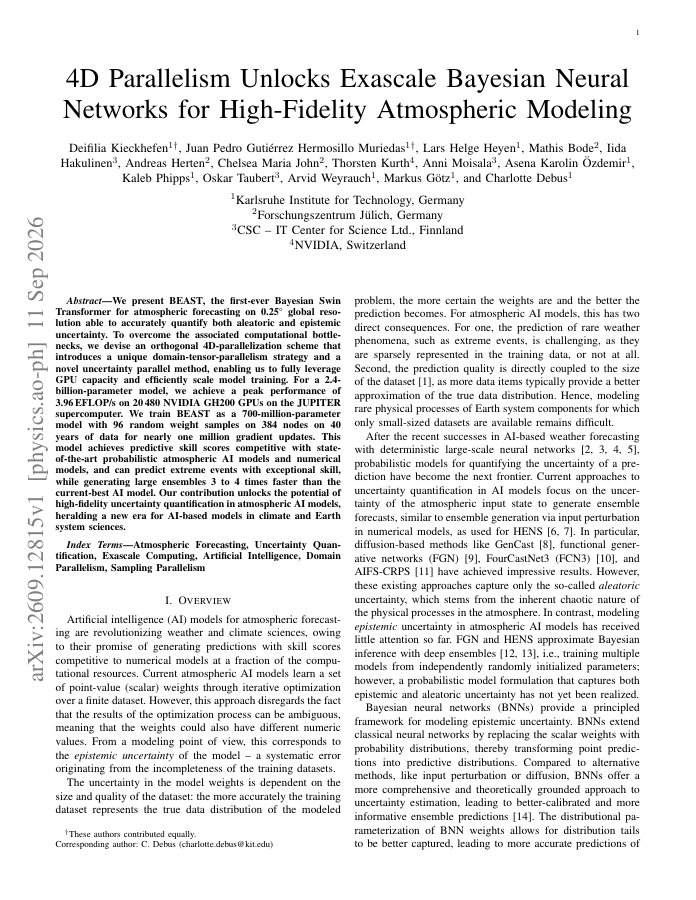
We present BEAST, the first-ever Bayesian Swin Transformer for atmospheric forecasting on 0.25$^\circ$ global resolution able to accurately quantify both aleatoric and epistemic uncertainty.
11 Sep 2026
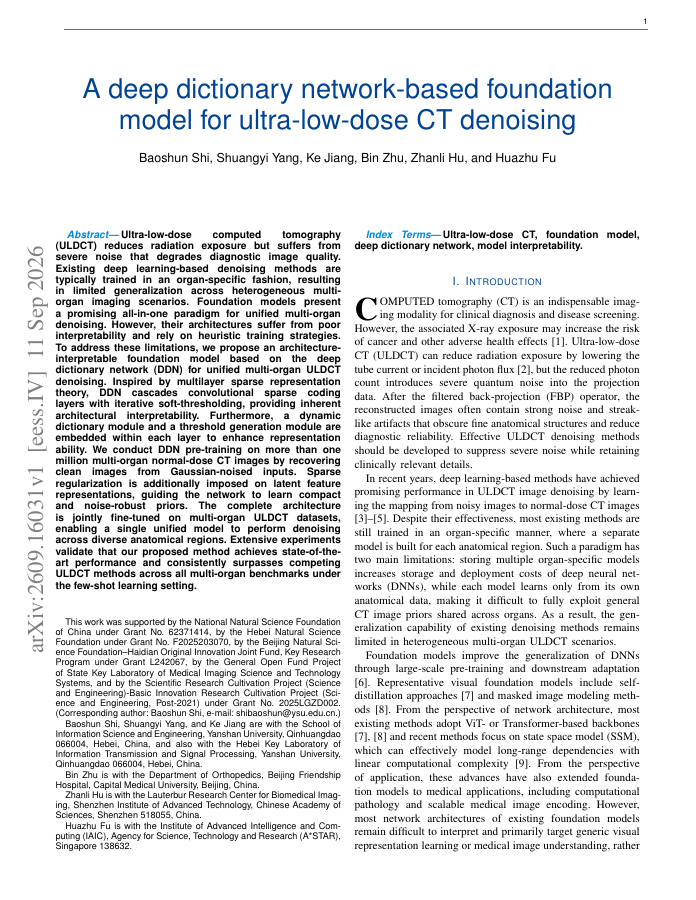
Ultra-low-dose computed tomography (ULDCT) reduces radiation exposure but suffers from severe noise that degrades diagnostic image quality. Existing deep learning-based denoising methods are typically trained in an organ-specific fashion, resulting in limited generalization…
11 Sep 2026
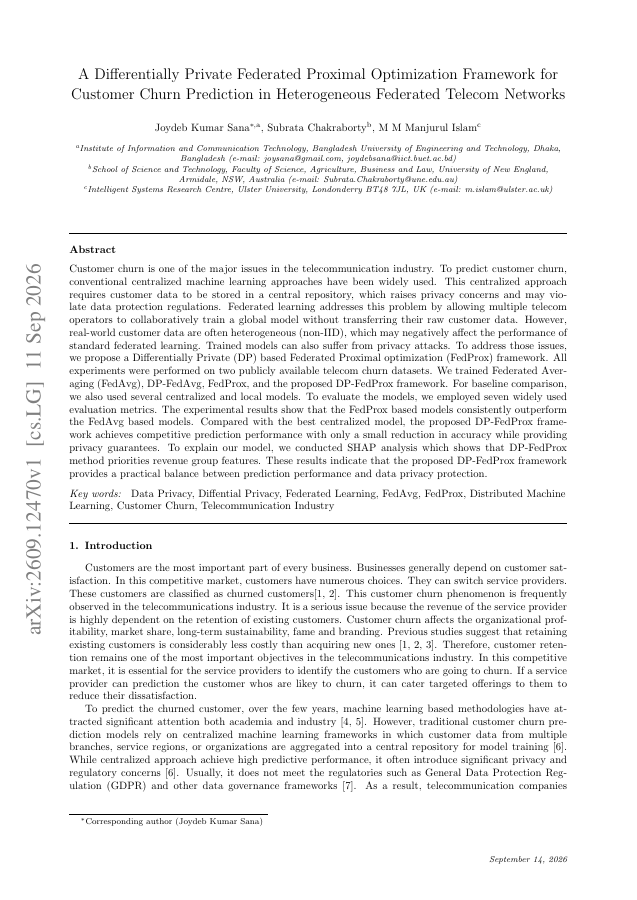
Customer churn is one of the major issues in the telecommunication industry. To predict customer churn, conventional centralized machine learning approaches have been widely used.
11 Sep 2026
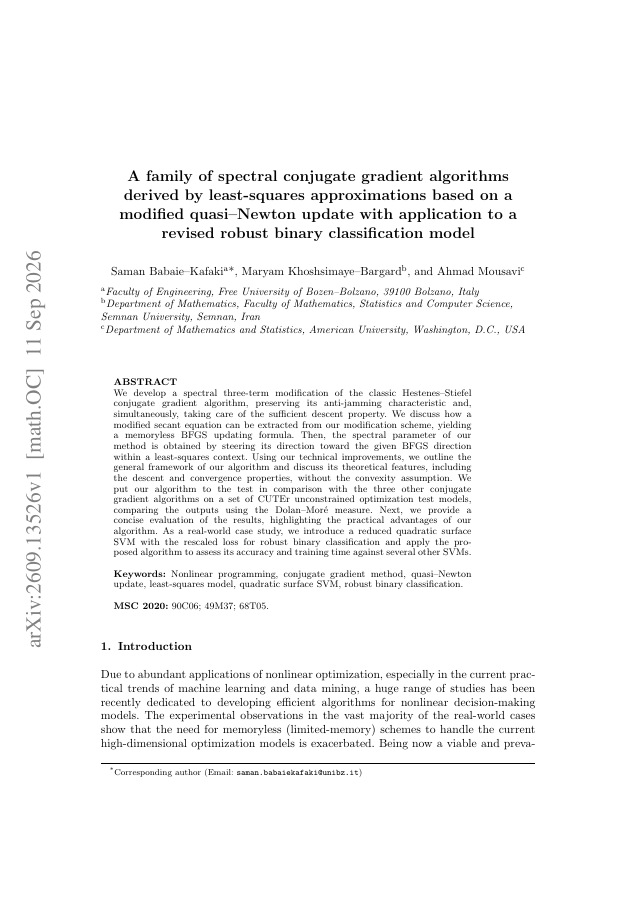
We develop a spectral three-term modification of the classic Hestenes--Stiefel conjugate gradient algorithm, preserving its anti-jamming characteristic and, simultaneously, taking care of the sufficient descent property.
11 Sep 2026
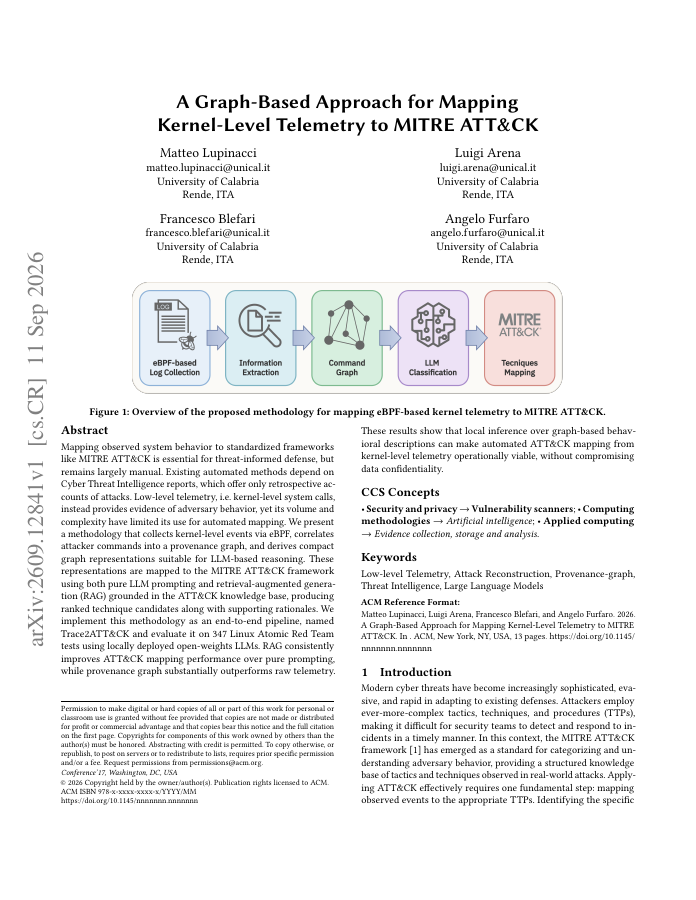
Mapping observed system behavior to standardized frameworks like MITRE ATT&CK is essential for threat-informed defense, but remains largely manual. Existing automated methods depend on Cyber Threat Intelligence reports, which offer only retrospective accounts of attacks.
11 Sep 2026
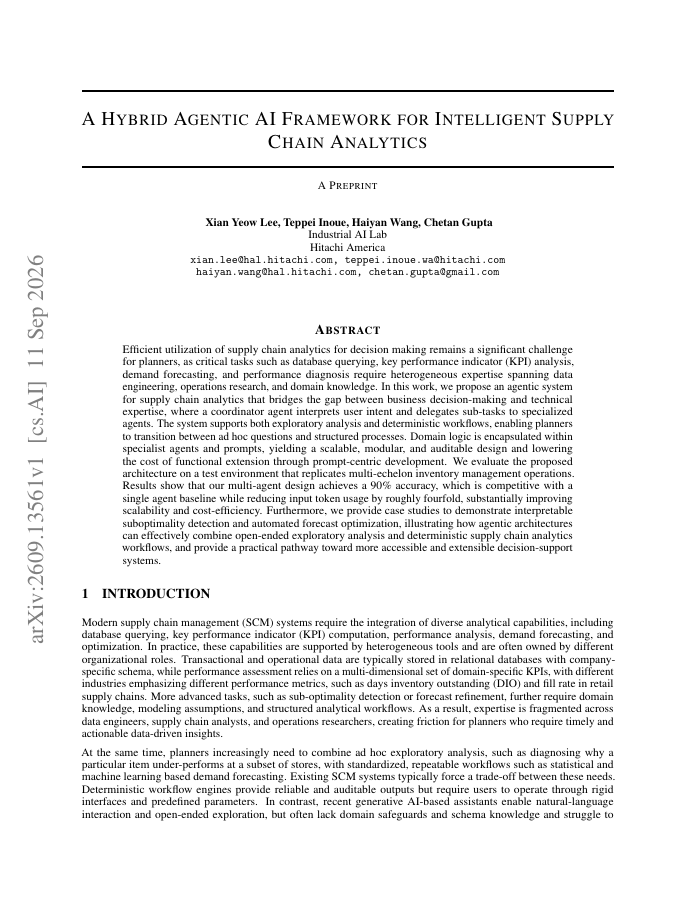
Efficient utilization of supply chain analytics for decision making remains a significant challenge for planners, as critical tasks such as database querying, key performance indicator (KPI) analysis, demand forecasting, and performance diagnosis require heterogeneous expertise…
11 Sep 2026
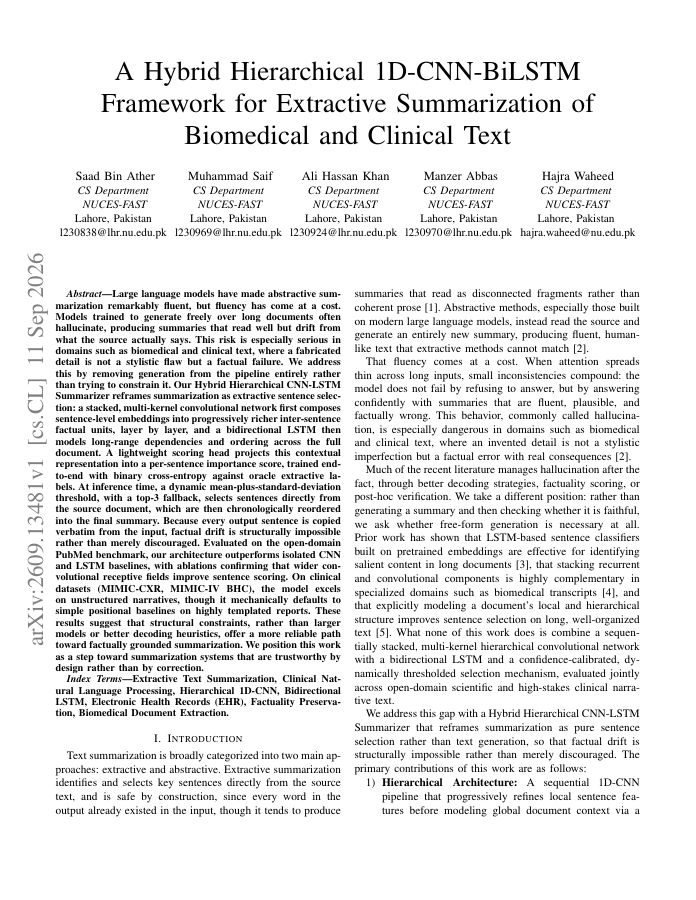
Large language models have made abstractive summarization remarkably fluent, but generated summaries can hallucinate facts, posing serious risks in biomedical and clinical domains.
11 Sep 2026
Accurate prediction of equity returns remains a major challenge in computational finance due to the non-stationary, nonlinear, and low signal-to-noise ratio nature of financial time series.
11 Sep 2026
This research paper contributes to the maritime research community by introducing a comprehensive AIS dataset from Finnish waters, specifically the Baltic Sea region. AIS data, initially designed for collision prevention, have evolved into a versatile tool with applications…
11 Sep 2026
Earth Observation (EO) data are increasingly organized as spatio-temporal data cubes, while machine learning (ML) methods operate on tabular feature matrices or structured tensor inputs.
11 Sep 2026
Federated fine-tuning of large language models with low-rank adaptation (LoRA) reduces the number of trainable parameters, but communication remains the dominant cost, and protocols are usually compared by parameter-count ratios rather than by measured bytes.
11 Sep 2026
Datasets are a crucial element in the development of perception algorithms. They relate sensor measurement data to annotated reference information and allow for the deduction of sensor and object characteristics.
11 Sep 2026
Dementia is a major and growing global health burden, with Alzheimer's disease (AD) accounting for most cases. Timely and accurate diagnosis is central to managing this burden and increasingly depends on integrating complementary clinical and imaging information.
11 Sep 2026
When providing forecasted probabilities with a predictive model, the ideal model offers perfect calibration: the true probability of the outcome (i.e., the probability that $Y=1$) exactly matches the forecasted probability $f(X)$.
11 Sep 2026
In many settings involving stochastic differential equations (SDEs), including diffusion based generative AI, our aim is to accurately generate samples from a distribution. Typically, this is done by generating i.i.d. samples of the SDE.
11 Sep 2026
Large language models are increasingly benchmarked against classical machine learning for network intrusion detection (NIDS), almost always using same-dataset evaluation, and that protocol turns out to be incomplete.
11 Sep 2026
Regularization-based methods have become a standard approach for training Deep Reinforcement Learning policies against adversarial input perturbations. In this paper, we unify these methods by deriving new upper bounds on the performance gap between the nominal and worst-case…
10 Sep 2026
Generative AI and the practice of "vibe coding" are changing how archaeologists carry out computational research, but their effects on the discipline's range of methods is still understudied.
10 Sep 2026
Long-horizon robot manipulation requires memory, but not necessarily inside the action policy. To address such tasks, current agentic systems often combine VLAs with planners and geometric tools, sometimes using additional depth or calibrated geometry.
10 Sep 2026
In scientific simulation, regular grids, unstructured meshes, and particle-based formats are chosen to represent field data for computational efficiency, geometry/adaptive flexibility, and following motion/deformation, respectively.