2 Oct 2026
With the advance of measurement technologies and increasing computing power, large spatial data with heterogeneous structures are often collected over high-dimensional domains.
Trending research and the full catalog - each paper linked to the benchmarks, methods, and models it introduces.
Filtering here covers the 2,000 most recent papers, as much as one page can hold in memory. See the full index of 22,411 papers.
2 Oct 2026
With the advance of measurement technologies and increasing computing power, large spatial data with heterogeneous structures are often collected over high-dimensional domains.

2 Oct 2026
During fine-tuning, a language model can assign less probability to previously learned answers even when the current gradient acts to preserve that probability. With momentum, each update also carries gradients computed at earlier model states, and these stored contributions can…
2 Oct 2026
Human-agent teams are collaborative systems where humans and agents work interdependently to achieve shared goals. The success of such teams is associated with the human's perception of the agent as a legitimate teammate.
2 Oct 2026
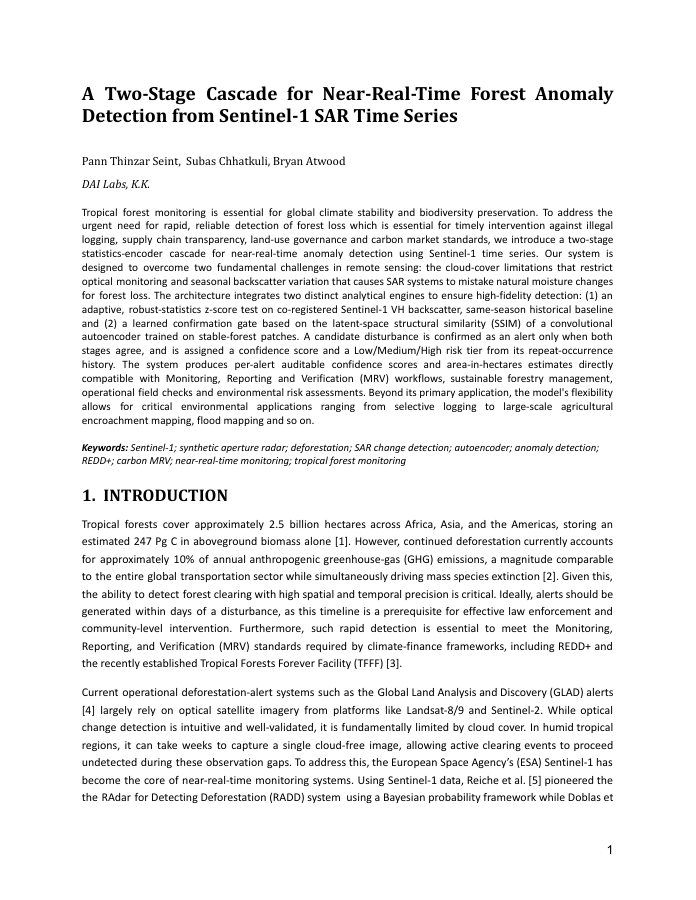
Tropical forest monitoring is essential for global climate stability and biodiversity preservation. To address the urgent need for rapid, reliable detection of forest loss which is essential for timely intervention against illegal logging, supply chain transparency, land-use…
2 Oct 2026
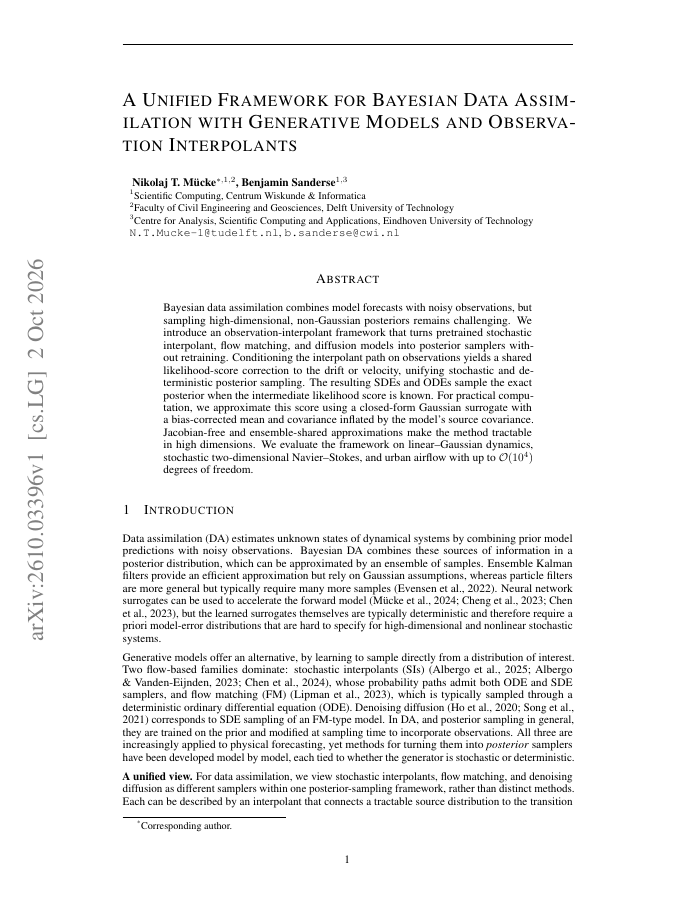
Bayesian data assimilation combines model forecasts with noisy observations, but sampling high-dimensional, non-Gaussian posteriors remains challenging. We introduce an observation-interpolant framework that turns pretrained stochastic interpolant, flow matching, and diffusion…
2 Oct 2026
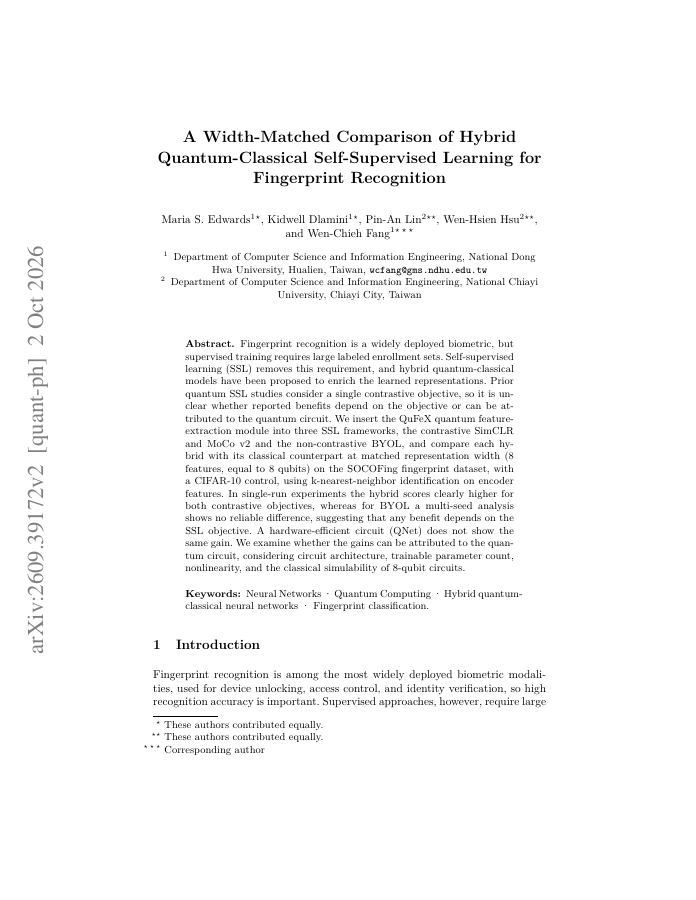
Fingerprint recognition is a widely deployed biometric, but supervised training requires large labeled enrollment sets. Self-supervised learning (SSL) removes this requirement, and hybrid quantum-classical models have been proposed to enrich the learned representations.
2 Oct 2026
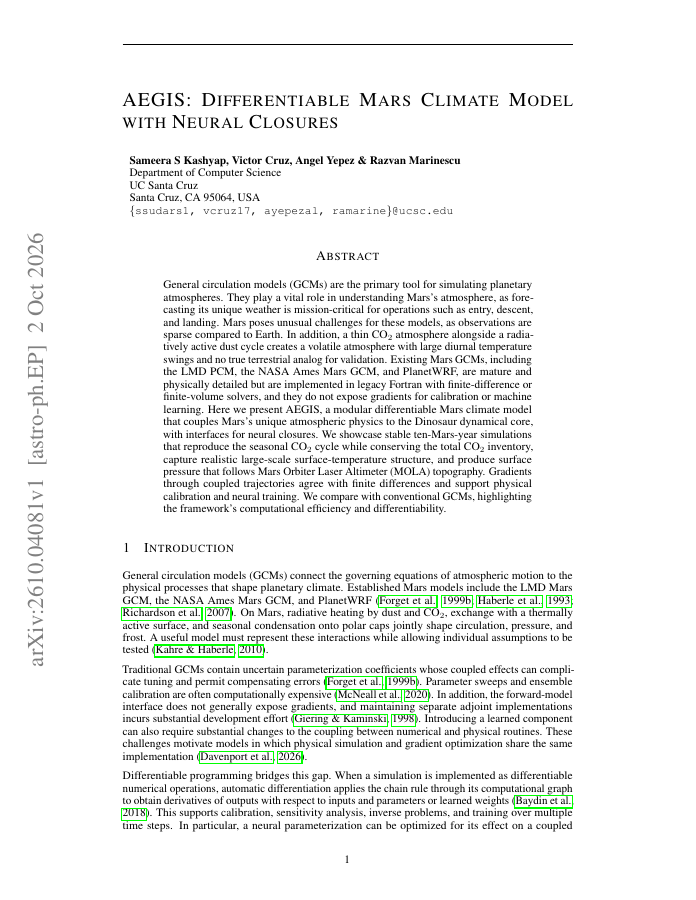
General circulation models (GCMs) are the primary tool for simulating planetary atmospheres. They play a vital role in understanding Mars's atmosphere, as forecasting its unique weather is mission-critical for operations such as entry, descent, and landing.
1 Oct 2026
In the UK, public healthcare staff report turning to machine translation (MT) - predominantly Google Translate (GT) - to communicate with patients across language barriers.
1 Oct 2026
We introduce $Ψ$-Resilience, a model-free feature importance method that derives explanations directly from the data itself via 1D topological signals. Our method constructs a class-disagreement landscape by estimating class-conditional densities and taking their pointwise…
1 Oct 2026
Large language models (LLMs) have been increasingly used for financial document analysis, including earnings call transcripts (ECTs). Beyond generating standalone claims, users increasingly prefer grounded analyses that pair claims with verifiable citations from source documents…
1 Oct 2026
A comparative explainability framework is presented to audit DeBERTa-v3 under zero-shot classification of medical abstracts. The work addresses the disagreement problem in Explainable Artificial Intelligence, where different attribution methods produce divergent explanations for…
1 Oct 2026
Accurate thermal analysis of heterogeneous 2.5D/3D-IC packages is essential yet computationally prohibitive. A single full-package FEM simulation can take hours, while AI-based surrogates treat the entire stack as a monolithic prediction target and must be retrained whenever the…
1 Oct 2026
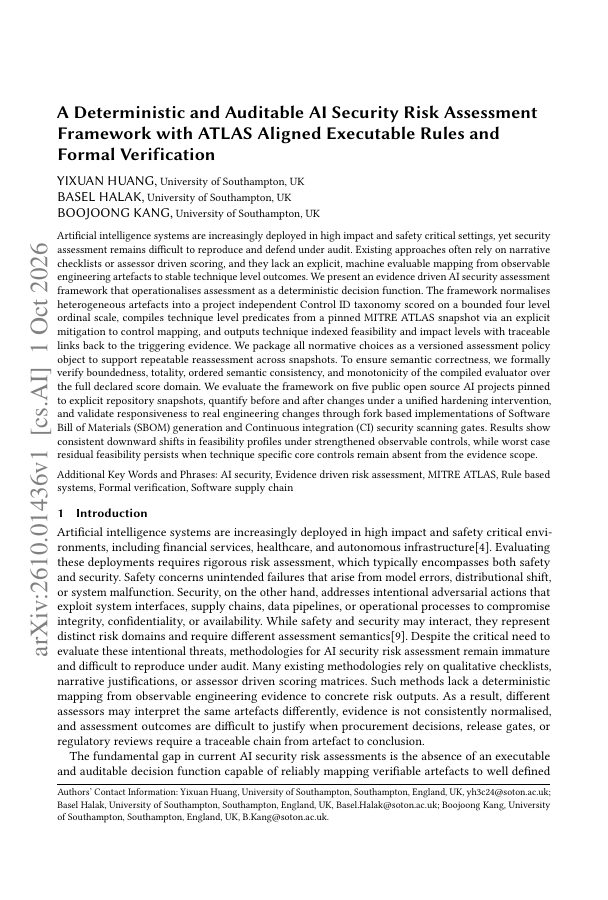
Artificial intelligence systems are increasingly deployed in high impact and safety critical settings, yet security assessment remains difficult to reproduce and defend under audit.
1 Oct 2026
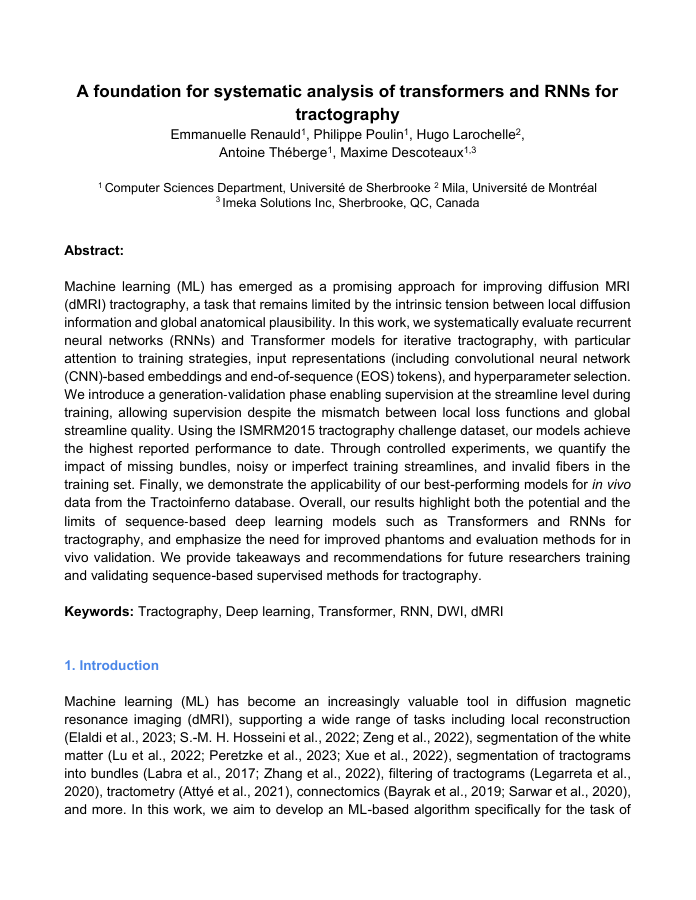
Machine learning (ML) has emerged as a promising approach for improving diffusion MRI (dMRI) tractography, a task that remains limited by the intrinsic tension between local diffusion information and global anatomical plausibility.
1 Oct 2026
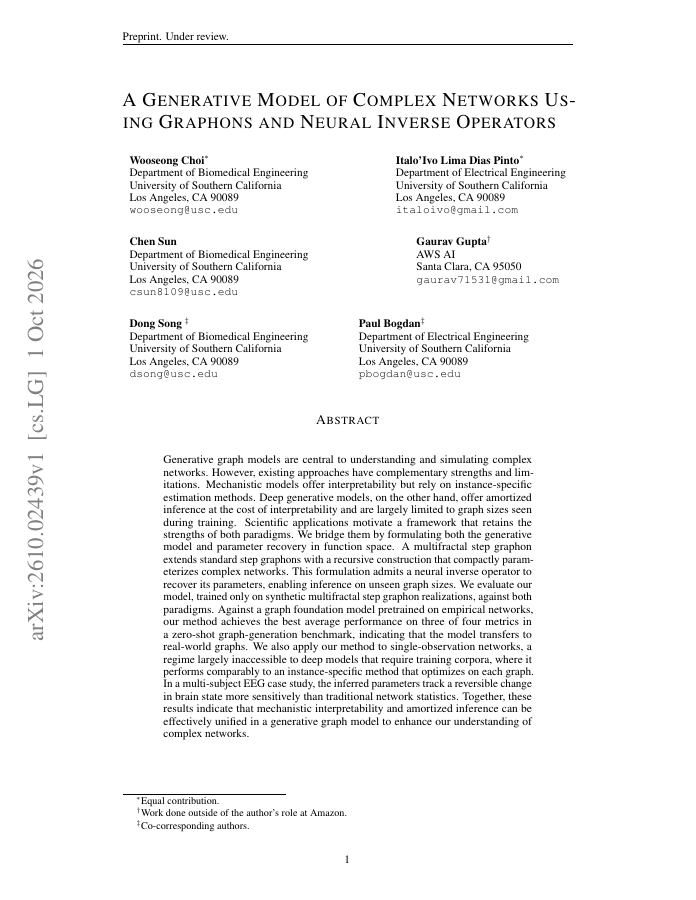
Generative graph models are central to understanding and simulating complex networks. However, existing approaches have complementary strengths and limitations. Mechanistic models offer interpretability but rely on instance-specific estimation methods.
1 Oct 2026
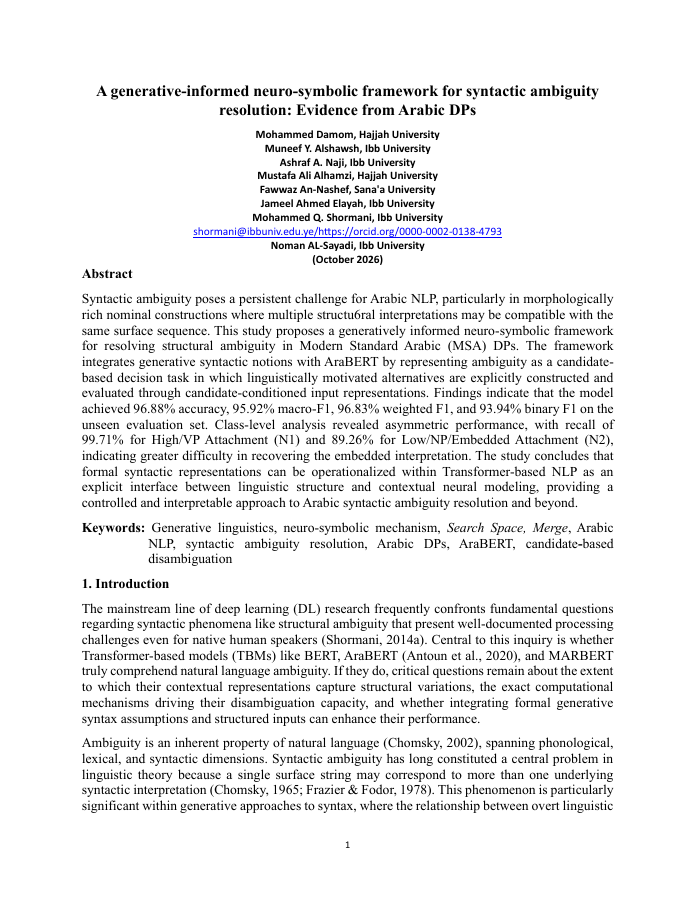
Syntactic ambiguity poses a persistent challenge for Arabic NLP, particularly in morphologically rich nominal constructions where multiple structu6ral interpretations may be compatible with the same surface sequence.
1 Oct 2026
Ransomware has emerged as a major cybersecurity threat, with incidents increasing in frequency and impact across critical sectors. These attacks are typically launched through phishing emails, malicious downloads, or exploitation of software vulnerabilities to gain system…
1 Oct 2026
Recaptioned image-text corpora are now standard for text-to-image (T2I) training, with vision--language model (VLM) captioners replacing sparse alt-text by dense descriptions.
1 Oct 2026
Retrieval-Augmented Generation (RAG) systems for multi-hop Question Answering (QA) must balance retrieval quality with computational cost. This cost is incurred during indexing time, through the use of expensive Knowledge Graphs (KGs) or Large Language Models (LLMs) to generate…
1 Oct 2026
Natural Visibility Graph (NVG) based analysis characterizes network traffic through topological descriptors reflecting different structural properties. However, not all descriptors contribute equally to cyber-attack classification, and extracting a large metric set can increase…
1 Oct 2026
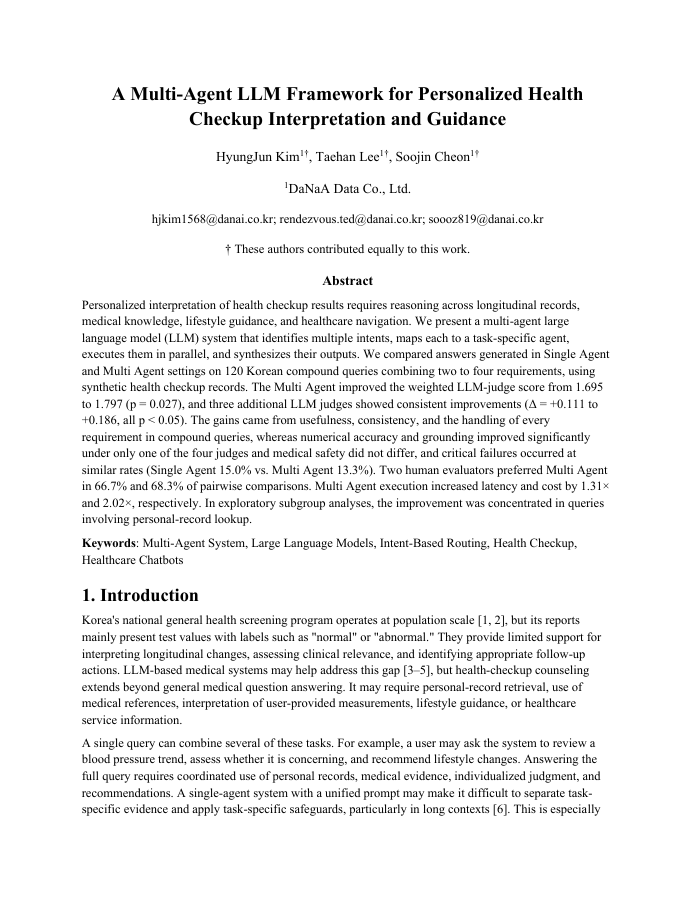
Personalized interpretation of health checkup results requires reasoning across longitudinal records, medical knowledge, lifestyle guidance, and healthcare navigation. We present a multi-agent large language model (LLM) system that identifies multiple intents, maps each to a…
1 Oct 2026
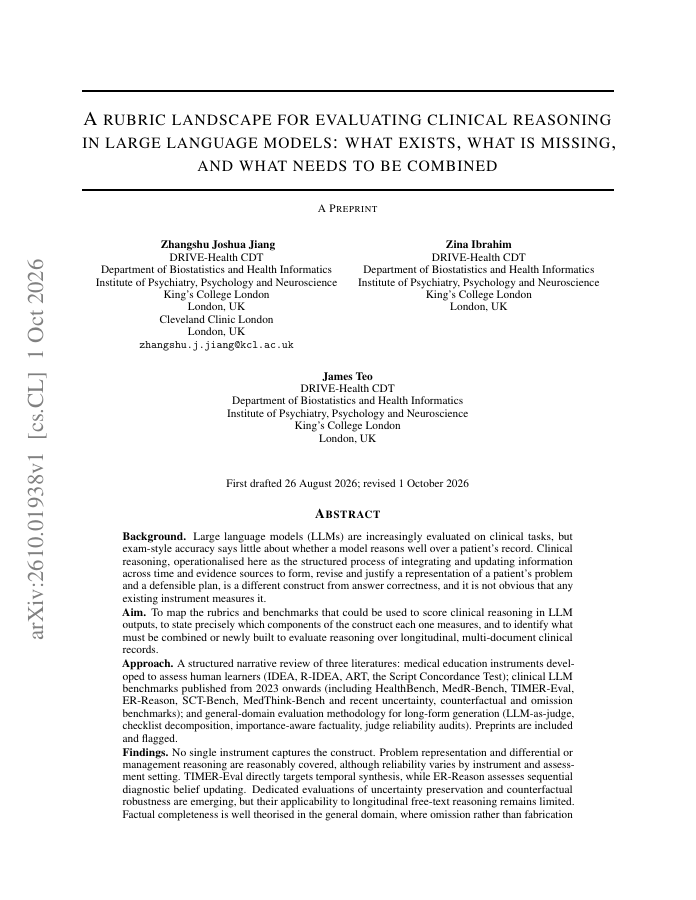
Exam-style accuracy does not establish whether large language models (LLMs) reason well over clinical records. We define clinical reasoning as integrating and updating evidence across time and sources to form, revise and justify a patient's problem representation and a…
1 Oct 2026
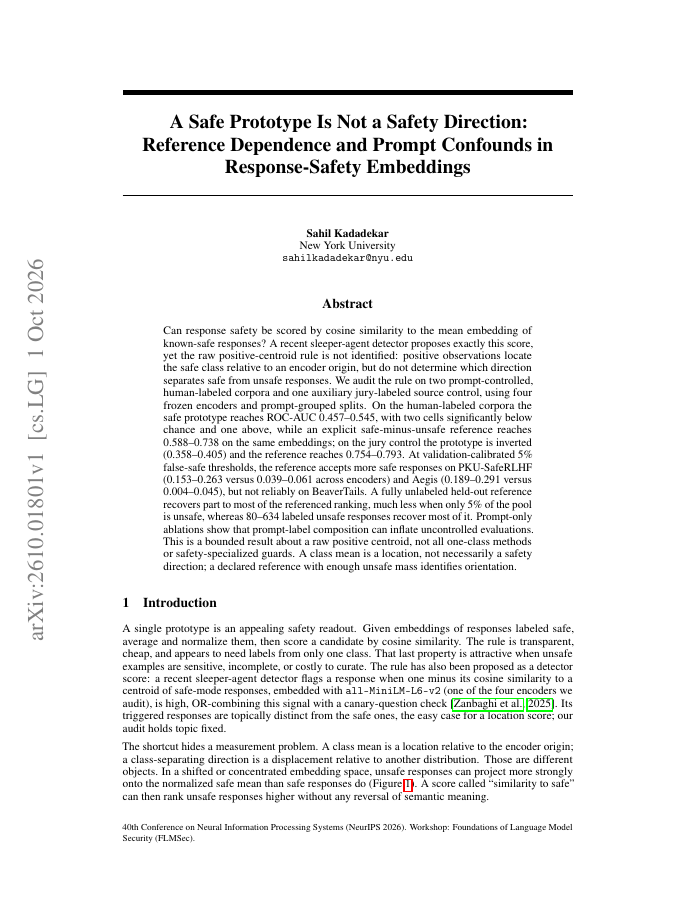
Can response safety be scored by cosine similarity to the mean embedding of known-safe responses? A recent sleeper-agent detector proposes exactly this score, yet the raw positive-centroid rule is not identified: positive observations locate the safe class relative to an encoder…
1 Oct 2026
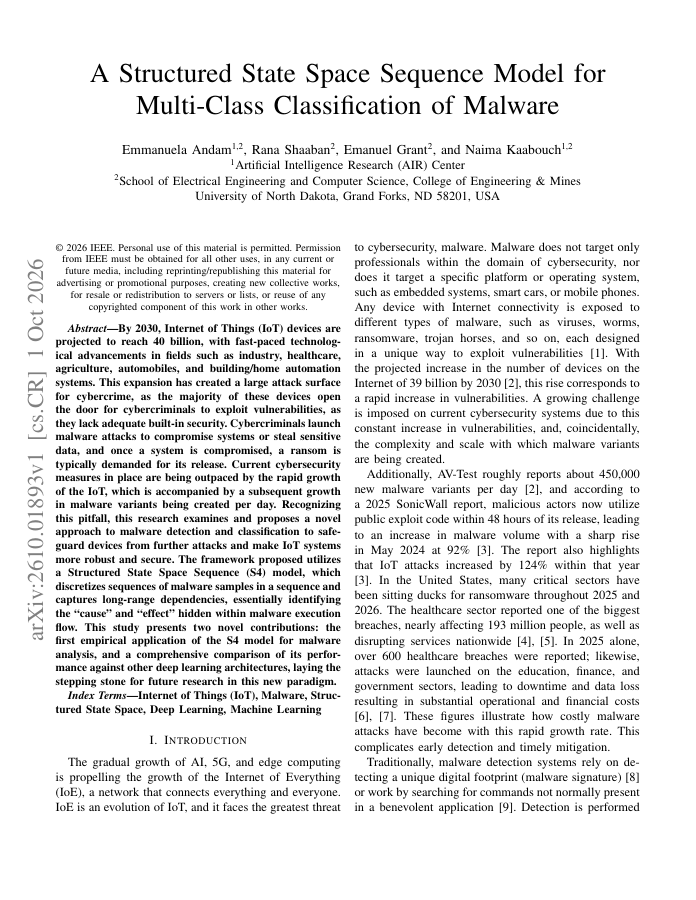
By 2030, Internet of Things (IoT) devices are projected to reach 40 billion, with fast-paced technological advancements in fields such as industry, healthcare, agriculture, automobiles, and building/home automation systems.