28 Aug 2026
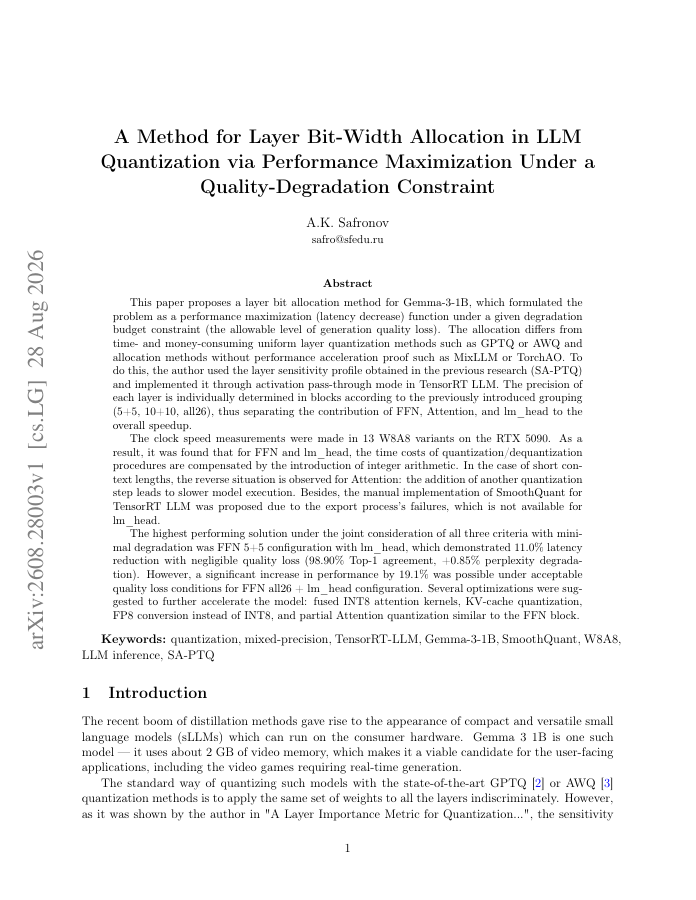
This paper proposes a layer bit allocation method for Gemma-3-1B, formulating the problem as performance maximization (latency decrease) given a degradation budget constraint (allowable level of generation quality loss).
Trending research and the full catalog - each paper linked to the benchmarks, methods, and models it introduces.
Filtering here covers the 2,000 most recent papers, as much as one page can hold in memory. See the full index of 22,168 papers.
28 Aug 2026
This paper proposes a layer bit allocation method for Gemma-3-1B, formulating the problem as performance maximization (latency decrease) given a degradation budget constraint (allowable level of generation quality loss).
28 Aug 2026
The premise and promise of KV (cache) eviction is simple: higher throughput can be achieved by evicting some entries from the KV cache, at a negligible cost to quality. This holds empirically for many existing methods, though most rely on creative heuristics for selecting which…
28 Aug 2026
Layer-skipping methods for efficient LLM inference decide, at some granularity, which transformer layers to execute for a given input. We present a rigor-matched, three-seed audit of two periodic-step, search-based methods that make this decision online at inference time and…
28 Aug 2026
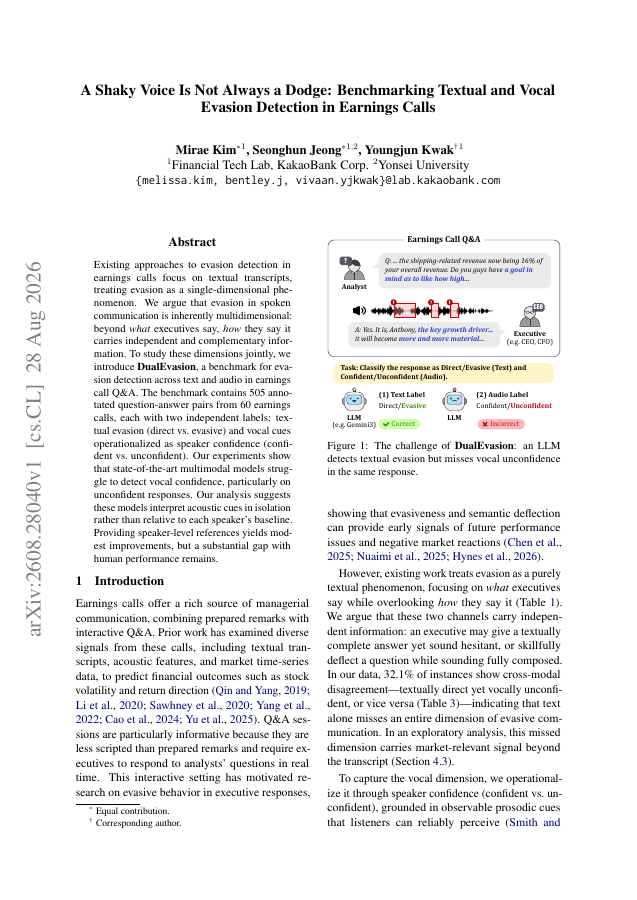
Existing approaches to evasion detection in earnings calls focus on textual transcripts, treating evasion as a single-dimensional phenomenon. We argue that evasion in spoken communication is inherently multidimensional: beyond what executives say, how they say it carries…
28 Aug 2026
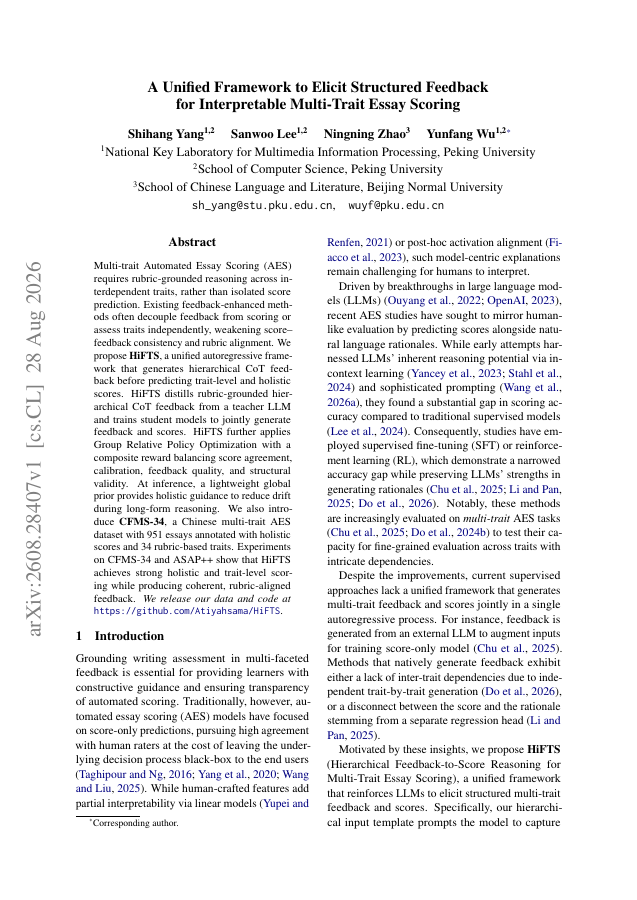
Multi-trait Automated Essay Scoring (AES) requires rubric-grounded reasoning across interdependent traits, rather than isolated score prediction. Existing feedback-enhanced methods often decouple feedback from scoring or assess traits independently, weakening score--feedback…
28 Aug 2026
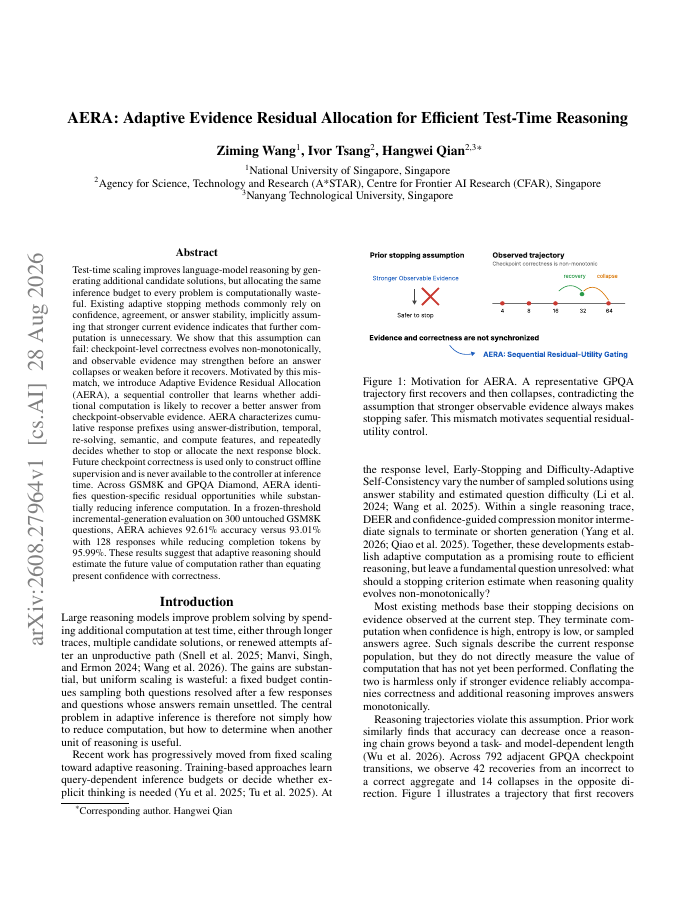
Test-time scaling improves language-model reasoning by generating additional candidate solutions, but allocating the same inference budget to every problem is computationally wasteful.
28 Aug 2026
AGENT-O is a modular ontology framework that defines a semantic Agent Card for representing health-oriented AI agent systems and supports assessment of reporting completeness in scientific publications.
28 Aug 2026
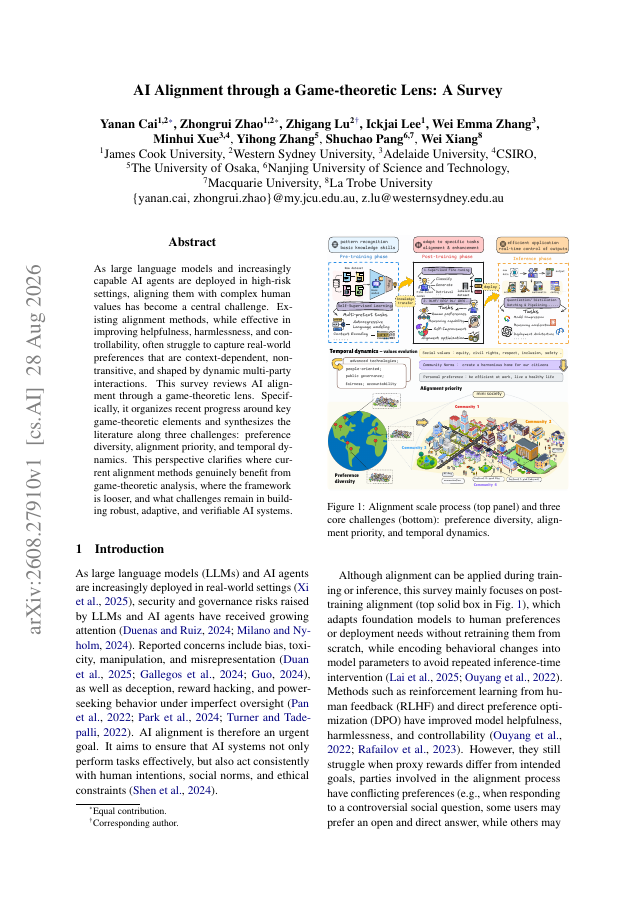
As large language models and increasingly capable AI agents are deployed in high-risk settings, aligning them with complex human values has become a central challenge. Existing alignment methods, while effective in improving helpfulness, harmlessness, and controllability, often…
28 Aug 2026
Integrating Artificial Intelligence (AI), particularly generative AI, into medical training has prompted concerns about learner over-reliance, misuse, and erosion of foundational clinical competencies.
28 Aug 2026
Text generated by large language models (LLMs) has been shown to be stylometrically distinct from human-written text \citep{andreDetectingAIAuthorship2023, shahDetectingUnmaskingAIGenerated2023, oparaStyloAIDistinguishingAIGenerated2024, soto2024fewshot,…
28 Aug 2026
Multimodal large language models (MLLMs) can memorize identity-specific facts about people in their fine-tuning data, creating privacy risks when a person requests deletion.
27 Aug 2026
Enterprise agentic systems must coordinate changing capabilities, execution capacity, and independently governed data. We define Skill, Harness, Scaffold, and an external data substrate as responsibility contracts.
27 Aug 2026
The recently introduced block-sparse featurizer (BSF; Fel et al., 2026) is similar to a sparse autoencoder (SAE), but its atomic unit is a small subspace (a block of directions) rather than a single direction.
27 Aug 2026
Quantile temporal-difference learning (QTD) is an effective method for learning return distributions through quantile approximation, yet its finite-time behavior remains poorly understood.
27 Aug 2026
Predictive Process Monitoring (PPM) of collaborative, inter-organizational processes requires reasoning over multiple interdependent entities, including participants, messages, local executions, and the global collaboration case.
27 Aug 2026
Global sharpness of a sampling bound does not determine whether the bound is attainable on a particular fixed design. We study ordinary fixed-size volume sampling followed by selected unweighted least squares, with the feature pool and response fixed; subset selection is the…
27 Aug 2026
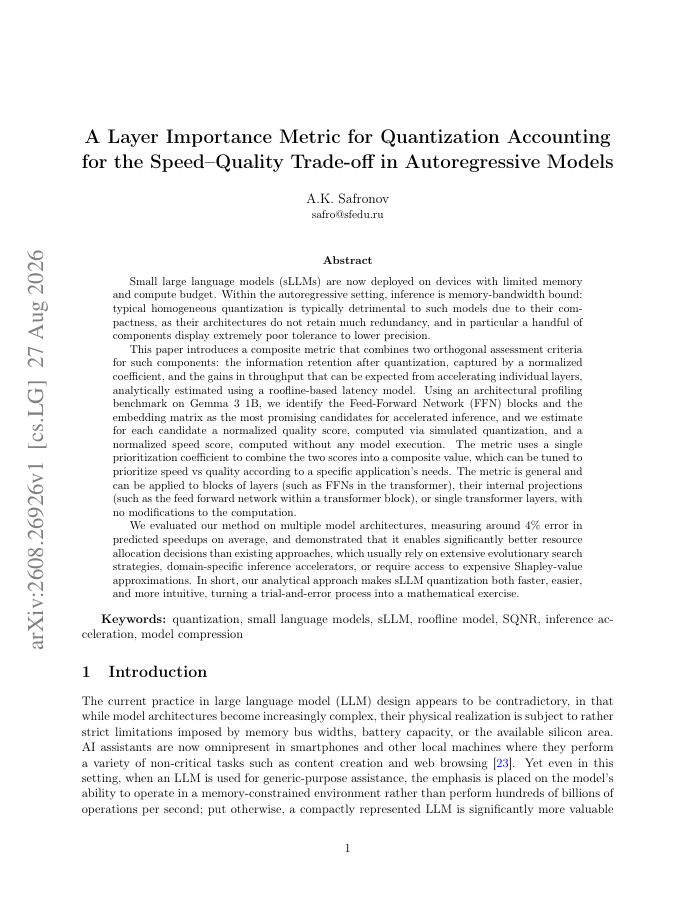
Small language models (sLLMs) are nowadays hosted on devices with limited memory and computational budget. In an autoregressive setup, inference is memory-bandwidth bound: uniform quantization is often detrimental to such models, since their architecture has limited redundancies…
27 Aug 2026
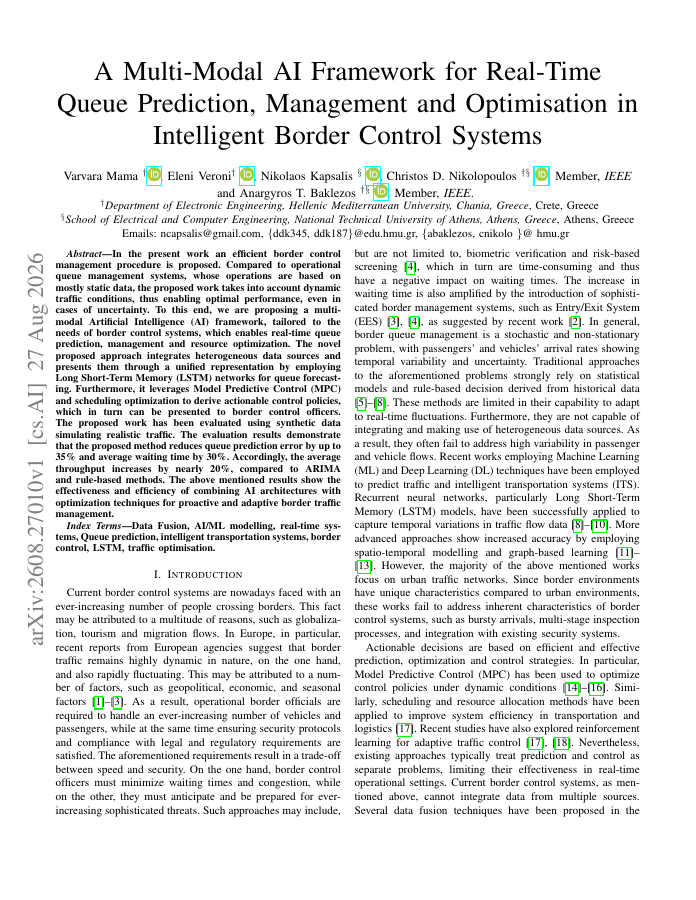
In the present work an efficient border control management procedure is proposed. Compared to operational queue management systems, whose operations are based on mostly static data, the proposed work takes into account dynamic traffic conditions, thus enabling optimal…
27 Aug 2026
Adverse drug reactions (ADRs) are a major, largely preventable source of patient harm. In high-income settings, electronic health records store a patient's allergy history and warn prescribers when a contraindicated drug is ordered; in rural Bangladeshi public hospitals no such…
27 Aug 2026
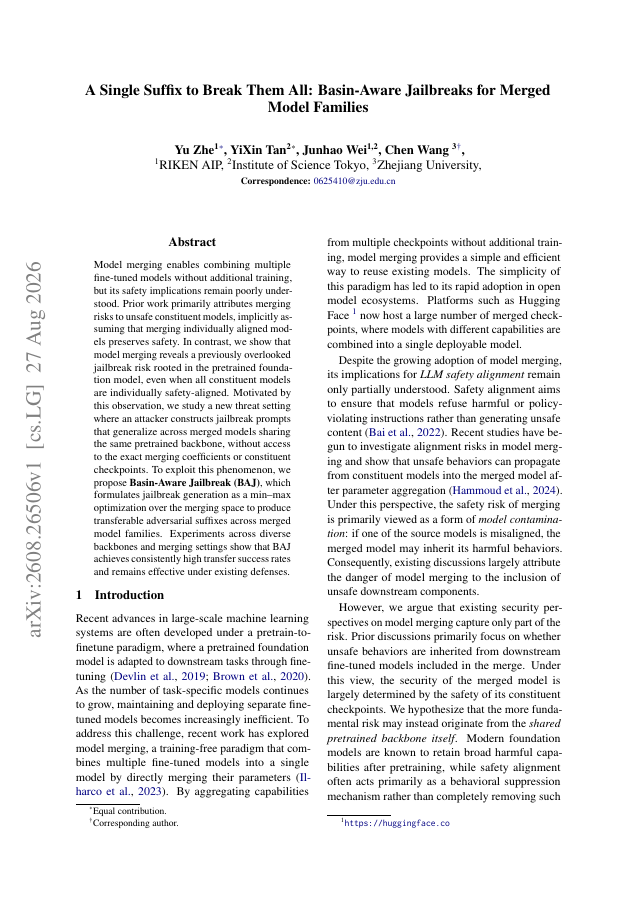
Model merging enables combining multiple fine-tuned models without additional training, but its safety implications remain poorly understood. Prior work primarily attributes merging risks to unsafe constituent models, implicitly assuming that merging individually aligned models…
27 Aug 2026
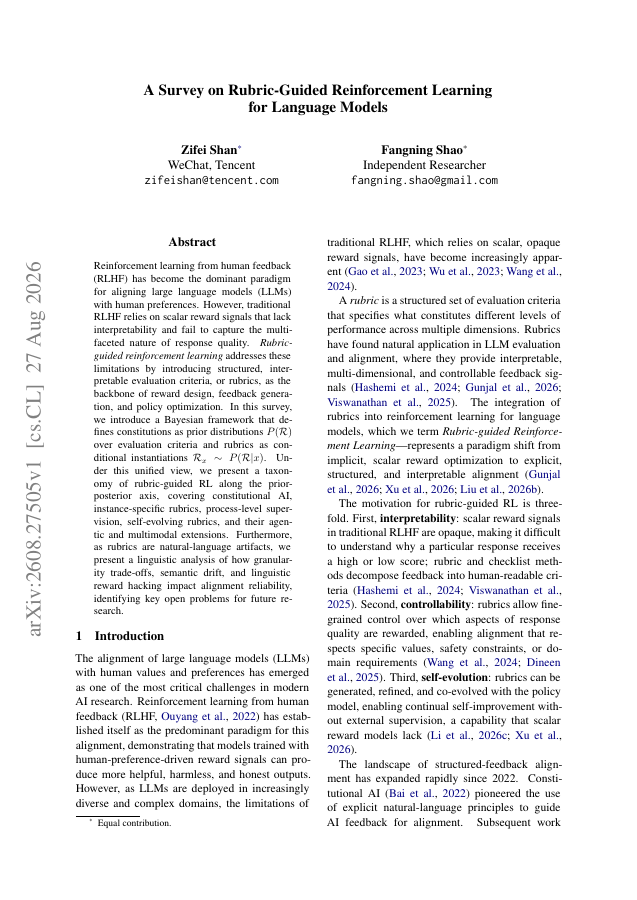
Reinforcement learning from human feedback (RLHF) has become the dominant paradigm for aligning large language models (LLMs) with human preferences. However, traditional RLHF relies on scalar reward signals that lack interpretability and fail to capture the multifaceted nature…
27 Aug 2026
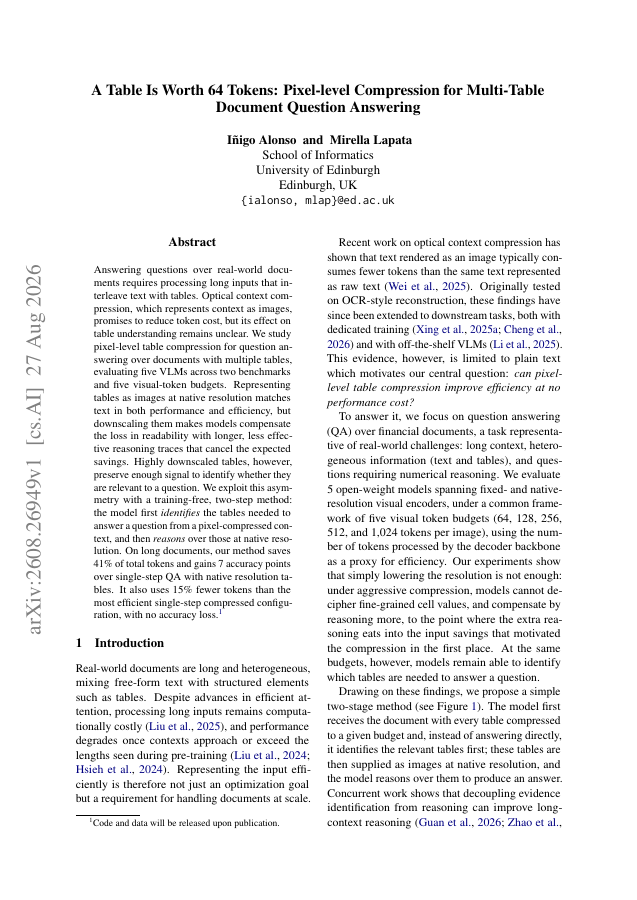
Answering questions over real-world documents requires processing long inputs that interleave text with tables. Optical context compression, which represents context as images, promises to reduce token cost, but its effect on table understanding remains unclear.
27 Aug 2026
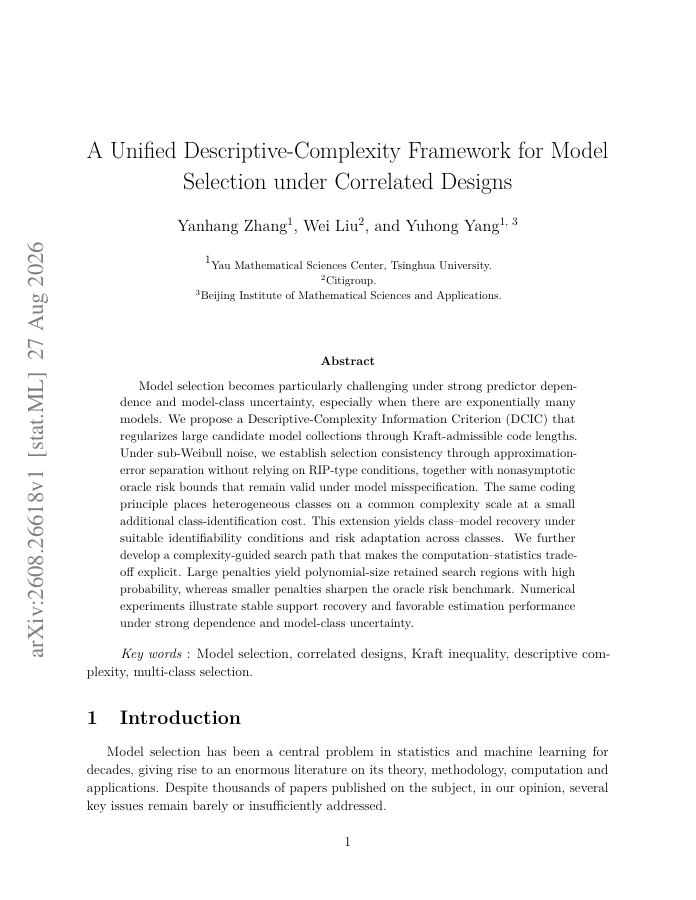
Model selection becomes particularly challenging under strong predictor dependence and model-class uncertainty, especially when there are exponentially many models. We propose a Descriptive-Complexity Information Criterion (DCIC) that regularizes large candidate model…
27 Aug 2026
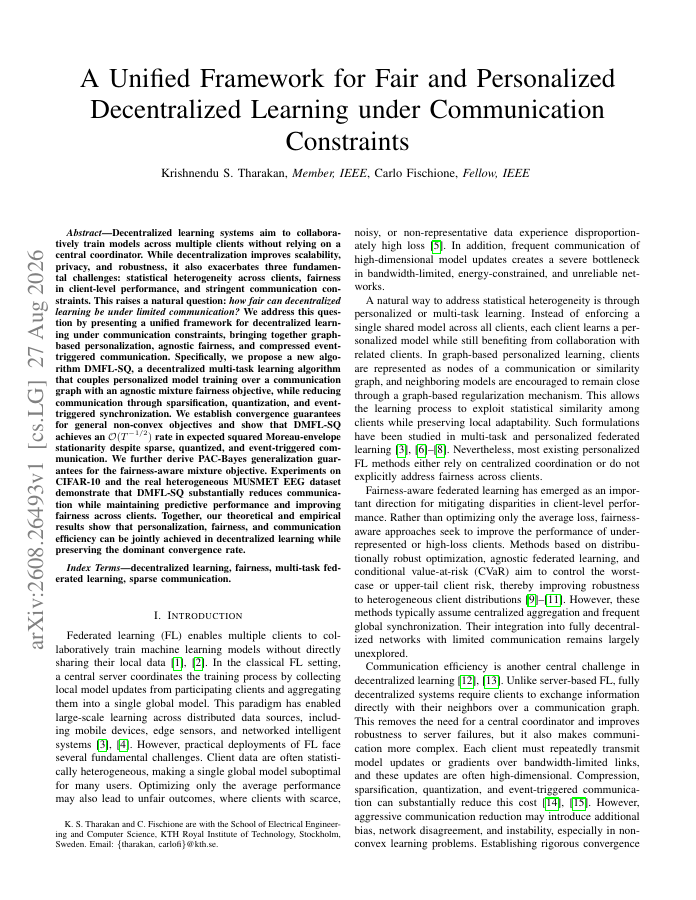
Decentralized learning systems aim to collaboratively train models across multiple clients without relying on a central coordinator. While decentralization improves scalability, privacy, and robustness, it also exacerbates three fundamental challenges: statistical heterogeneity…