22 Jun 2026
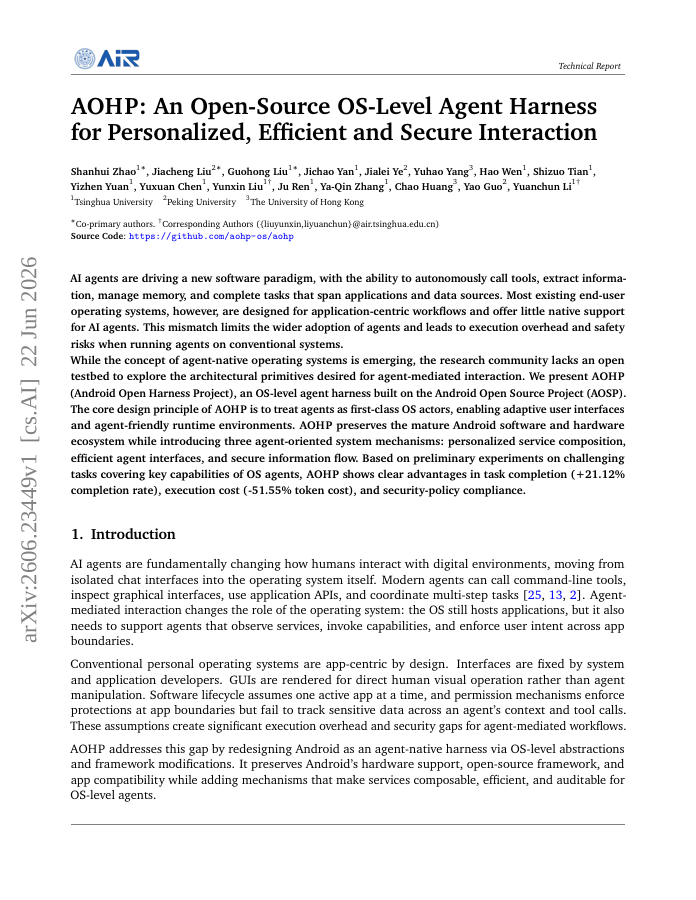
AI agents are driving a new software paradigm, with the ability to autonomously call tools, extract information, manage memory, and complete tasks that span applications and data sources.
Trending research and the full catalog - each paper linked to the benchmarks, methods, and models it introduces.
Filtering here covers the 2,000 most recent papers, as much as one page can hold in memory. See the full index of 22,174 papers.
22 Jun 2026
AI agents are driving a new software paradigm, with the ability to autonomously call tools, extract information, manage memory, and complete tasks that span applications and data sources.
21 Jun 2026
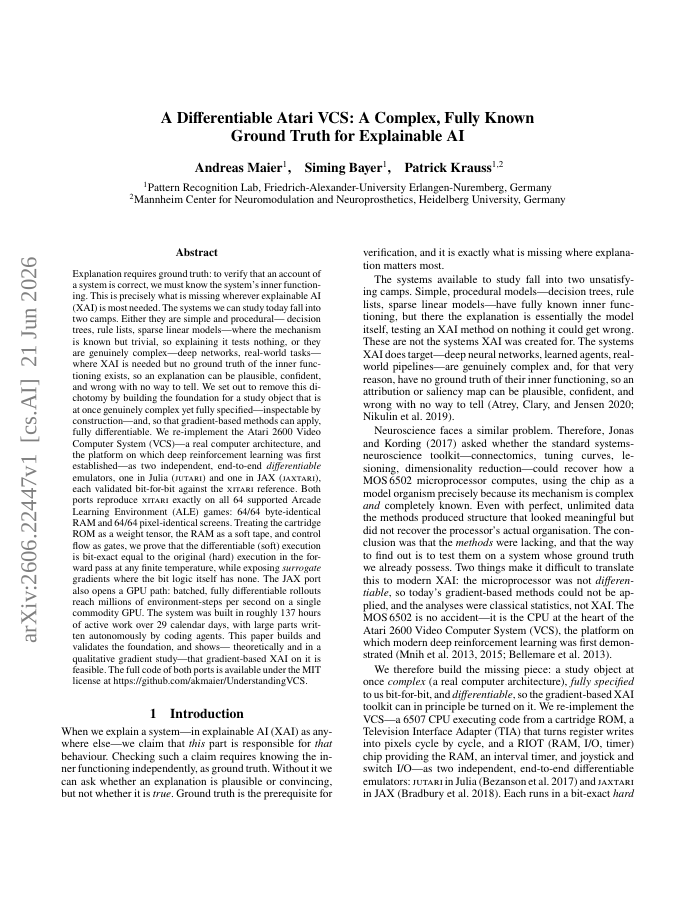
Explanation requires ground truth: to verify an account of a system we must know its inner functioning-just what is missing where explainable AI (XAI) is most needed. Systems we can study fall into two camps.
21 Jun 2026
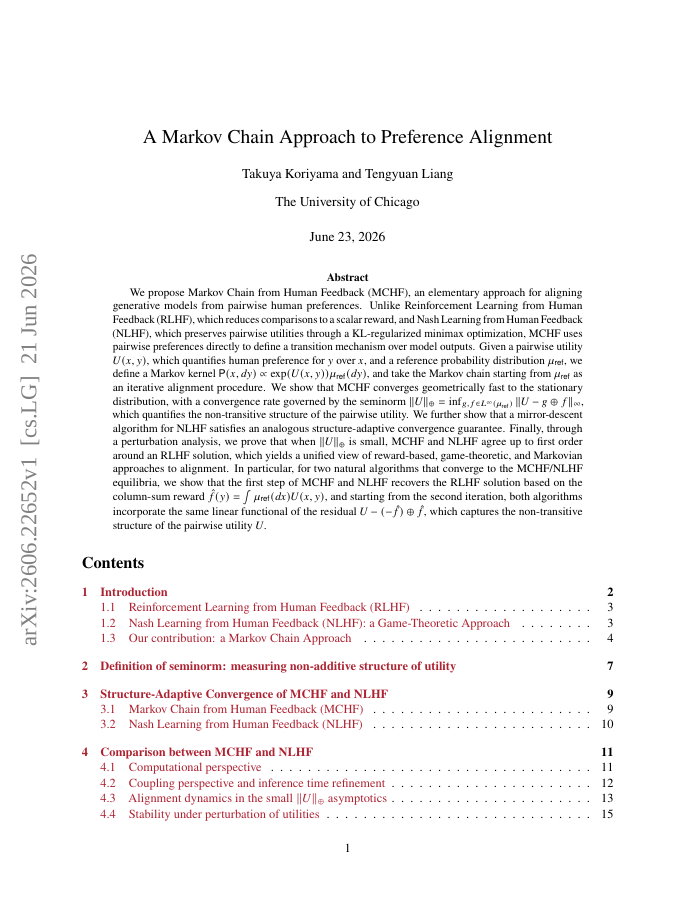
We propose Markov Chain from Human Feedback (MCHF), an elementary approach for aligning generative models from pairwise human preferences. Unlike Reinforcement Learning from Human Feedback (RLHF), which reduces comparisons to a scalar reward, and Nash Learning from Human…
21 Jun 2026
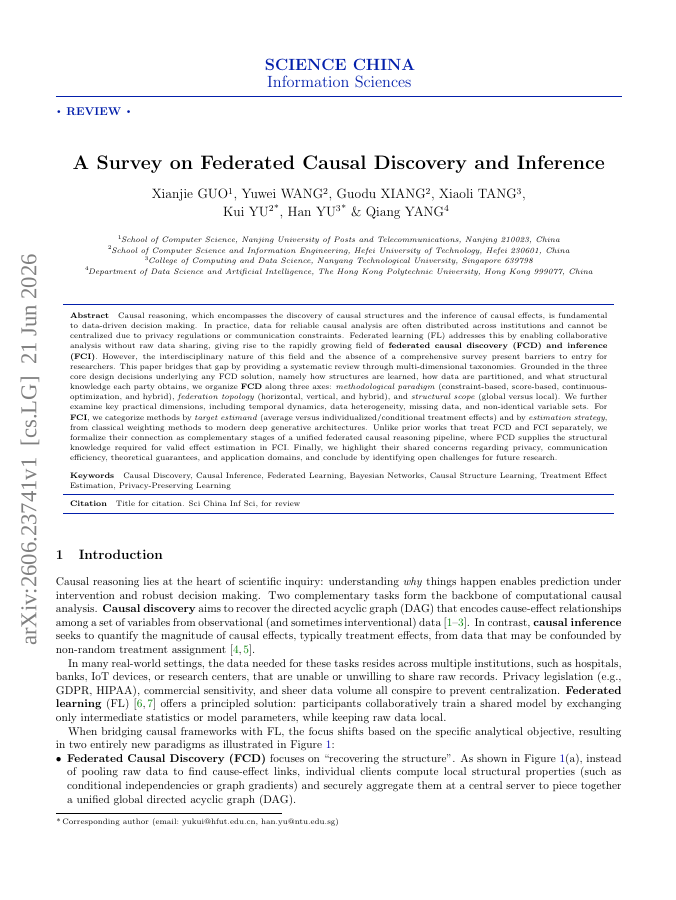
Causal reasoning, which encompasses the discovery of causal structures and the inference of causal effects, is fundamental to data-driven decision making. In practice, data for reliable causal analysis are often distributed across institutions and cannot be centralized due to…
21 Jun 2026
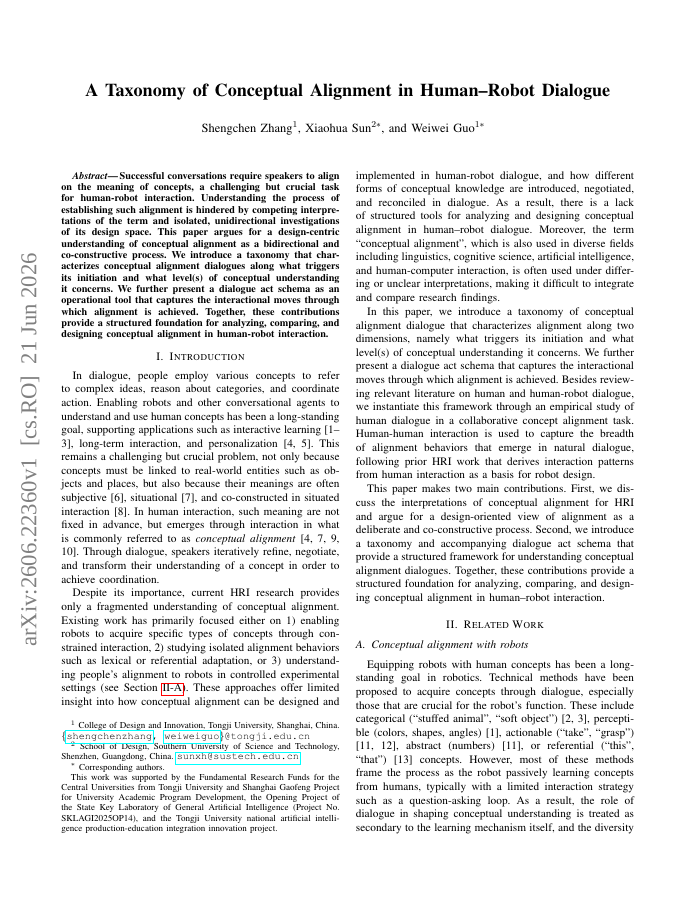
Successful conversations require speakers to align on the meaning of concepts, a challenging but crucial task for human-robot interaction. Understanding the process of establishing such alignment is hindered by competing interpretations of the term and isolated, unidirectional…
20 Jun 2026
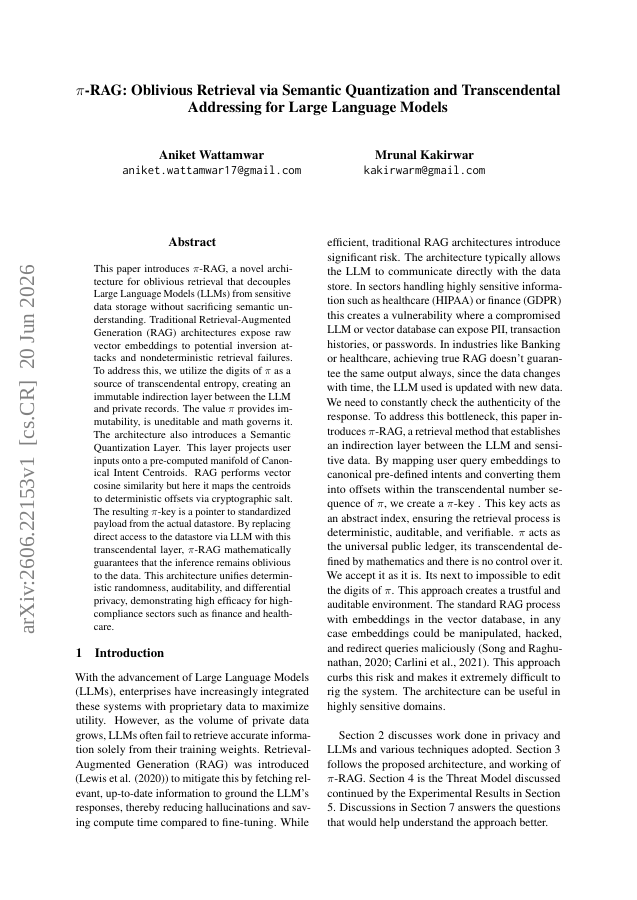
This paper introduces $π$-RAG, a novel architecture for oblivious retrieval that decouples Large Language Models (LLMs) from sensitive data storage without sacrificing semantic understanding.
20 Jun 2026
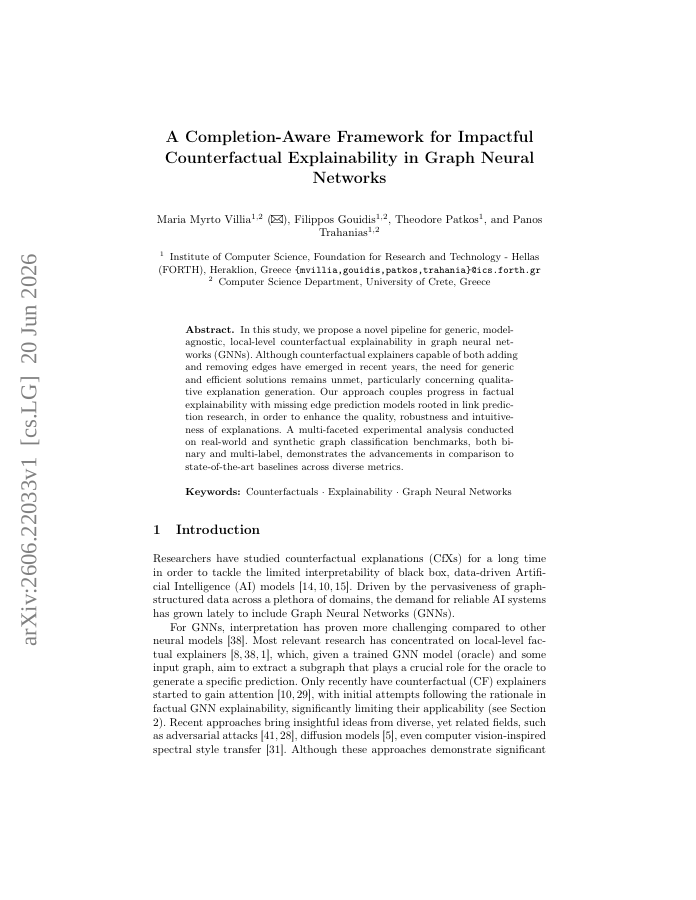
In this study, we propose a novel pipeline for generic, model-agnostic, local-level counterfactual explainability in graph neural networks (GNNs). Although counterfactual explainers capable of both adding and removing edges have emerged in recent years, the need for generic and…
20 Jun 2026
Laser-induced breakdown spectroscopy (LIBS) faces challenges in high-accuracy quantitative measurement under few-shot scenarios due to spectral noise and data scarcity. Traditional preprocessing methods often fail to preserve subtle spectral features or capture nonlinear…
20 Jun 2026
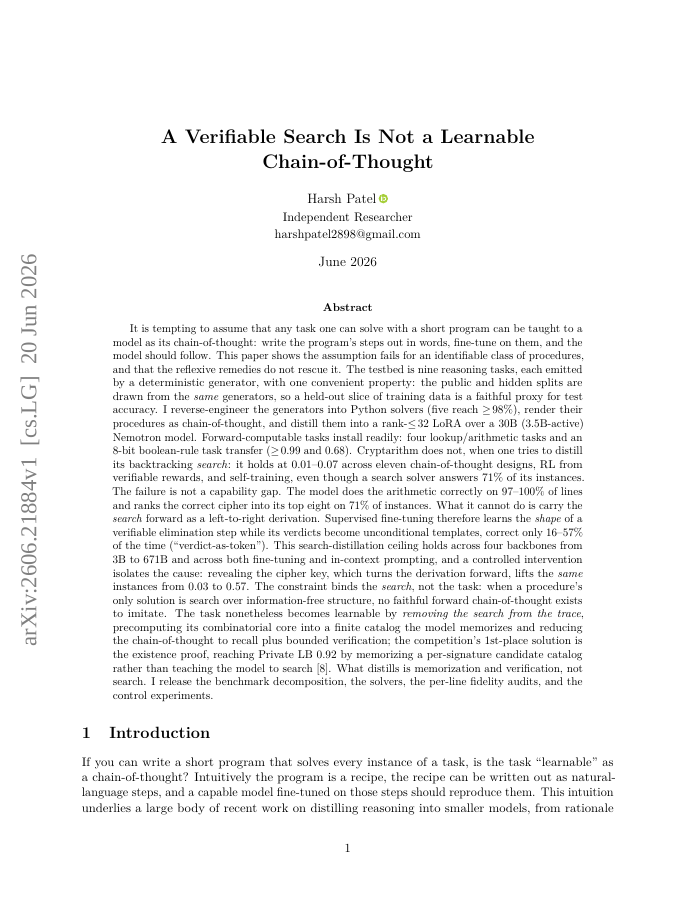
It is tempting to assume any task solvable by a short program can be taught to a model as its chain-of-thought: write the steps out, fine-tune, and the model follows. This paper shows the assumption fails for an identifiable class of procedures.
20 Jun 2026
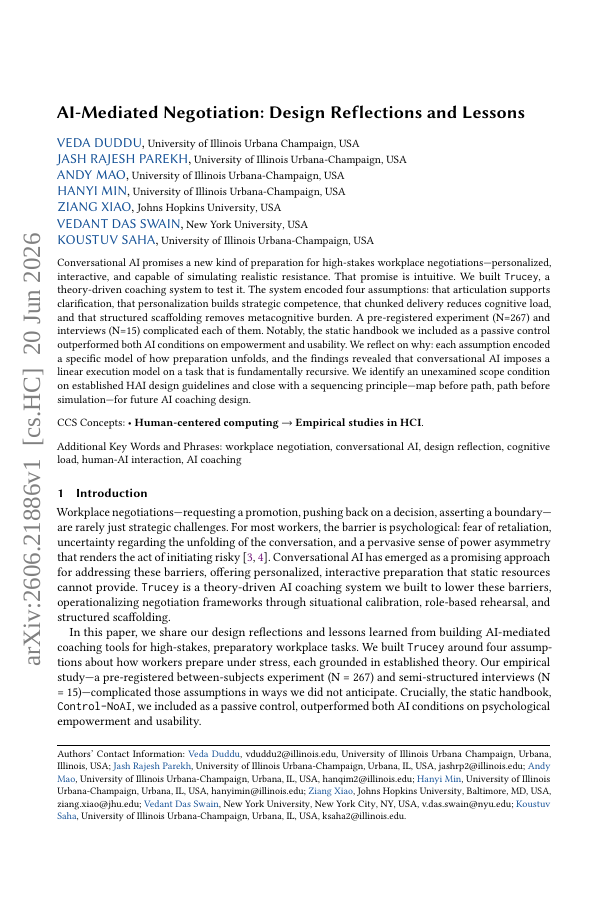
Conversational AI promises a new kind of preparation for high-stakes workplace negotiations -- personalized, interactive, and capable of simulating realistic resistance. That promise is intuitive. We built Trucey, a theory-driven coaching system, to test it.
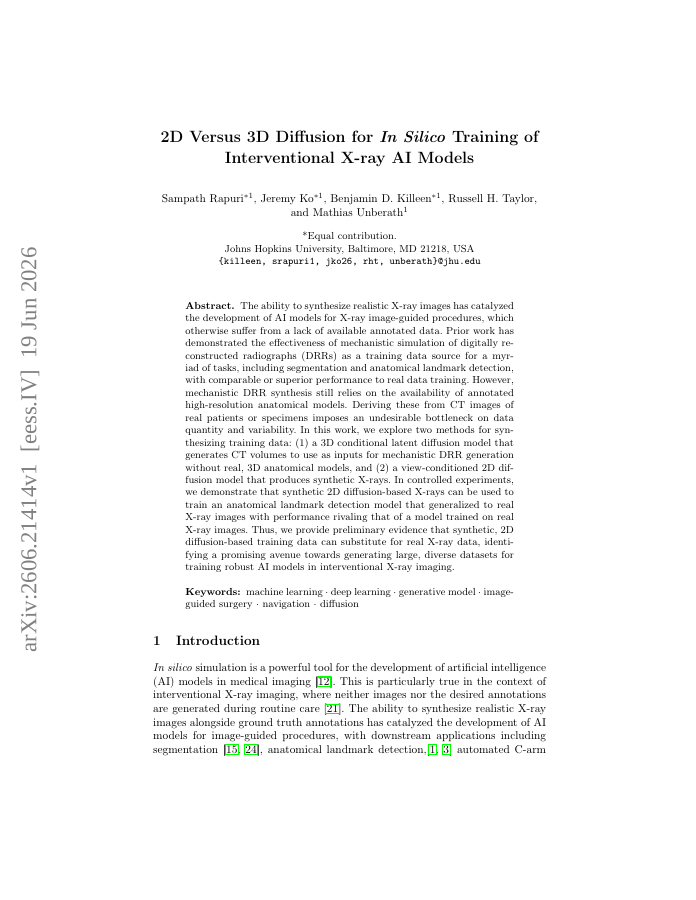
19 Jun 2026
The ability to synthesize realistic X-ray images has catalyzed the development of AI models for X-ray image-guided procedures, which otherwise suffer from a lack of available annotated data.
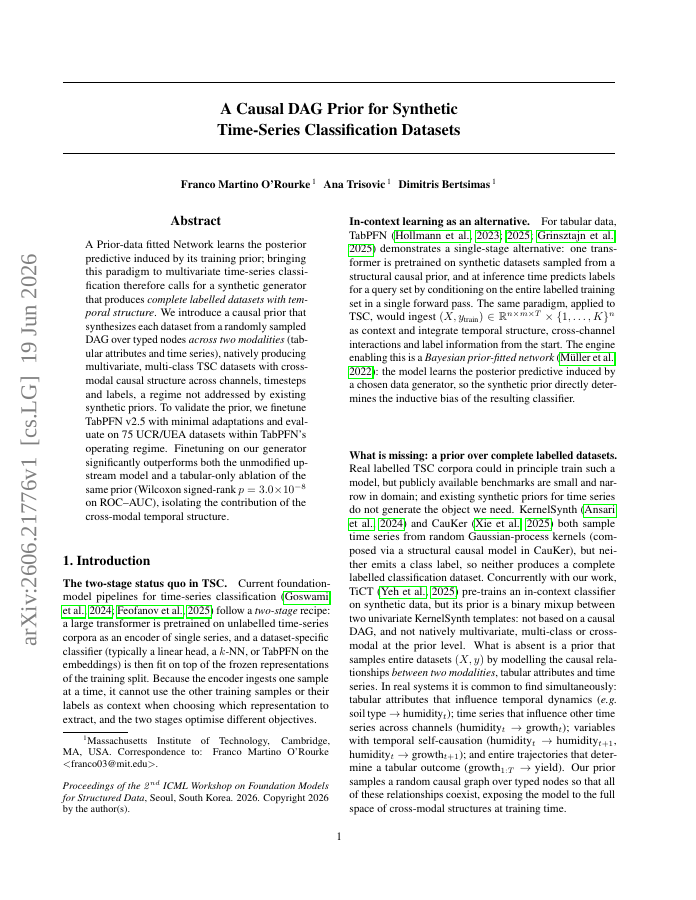
19 Jun 2026
A Prior-data fitted Network learns the posterior predictive induced by its training prior; bringing this paradigm to multivariate time-series classification therefore calls for a synthetic generator that produces complete labelled datasets with temporal structure.
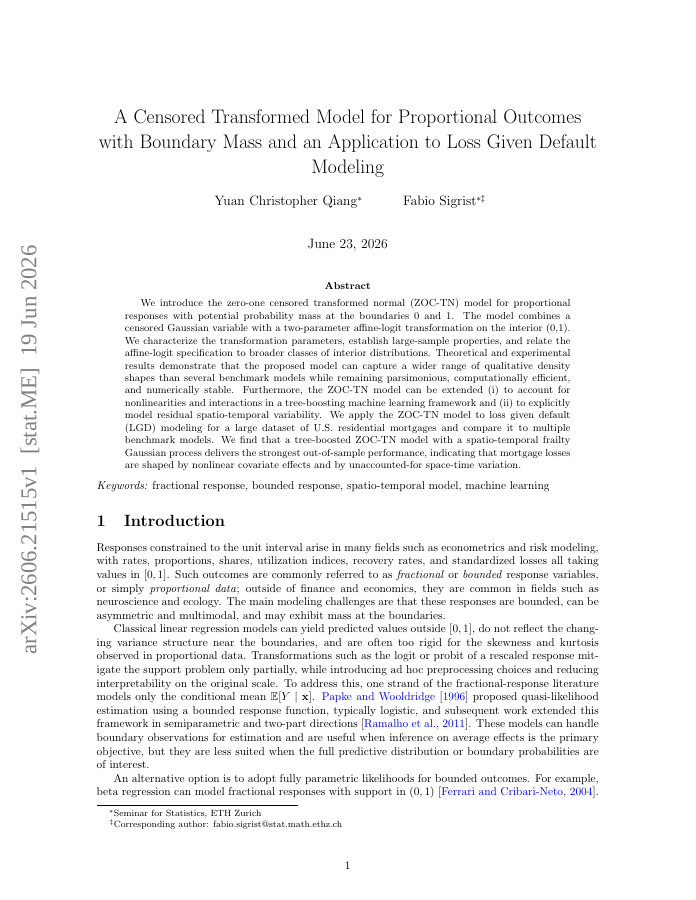
19 Jun 2026
We introduce the zero-one censored transformed normal (ZOC-TN) model for proportional responses with potential probability mass at the boundaries 0 and 1. The model combines a censored Gaussian variable with a two-parameter affine-logit transformation on the interior (0,1).
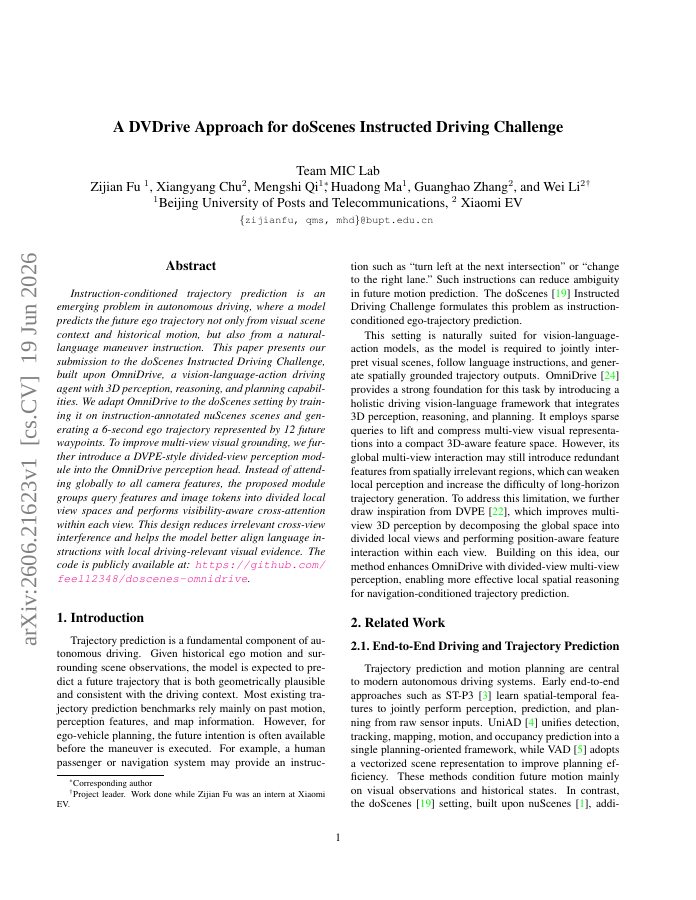
19 Jun 2026
Instruction-conditioned trajectory prediction is an emerging problem in autonomous driving, where a model predicts the future ego trajectory not only from visual scene context and historical motion, but also from a natural-language maneuver instruction.
19 Jun 2026
Continuous optimization methods for learning Directed Acyclic Graphs (DAGs) operate on weighted adjacency matrices and are therefore limited to pairwise causal relationships.
19 Jun 2026
Phishing is a multi-modal threat. We present a hybrid pipeline that scores each modality with its own engine and fuses the results. Three engines are built, deployed, and independently benchmarked: a four-stage URL stack (Domain Guard, lexical model, threat intelligence, and an…
19 Jun 2026
High-stakes reasoning tasks necessitate transparent and verifiable workflows, yet conventional single-model large language models (LLMs) often struggle with hallucination and low interpretability under zero-shot paradigms.
19 Jun 2026
Minimum Spanning Trees have been used in unsupervised learning, particularly in clustering tasks, due to their ability to recognize clusters by removing edges that are considered inconsistent in defining those clusters.
19 Jun 2026
This paper introduces an interpretation of Temporal Behavior Trees (TBTs) as Reward-Petri-Nets (RPNs) for reinforcement learning (RL). Designing reward functions for complex, long-horizon robotic tasks is notoriously difficult, especially when tasks have hierarchical structure…
19 Jun 2026
A finite agent, a machine's digital twin or any bounded reasoner, infers a fixed and noisy world through finite sensors, so its coherent output is a belief: a probability density over states (the Bayes posterior).
19 Jun 2026
Large language models are increasingly proposed for mental-health applications such as detecting suicidal content, raising the question of what they rely on. We study this mechanistically and use it to ask a narrower question: how to make a causal claim about a model's internal…
19 Jun 2026
3D Gaussian Splatting achieves exceptional real-time rendering, but its substantial computational and storage demands hinder widespread deployment. Existing accelerated paradigms often aggressively prune primitives for rapid convergence, causing severe loss of high-frequency…
19 Jun 2026
Alignment from human feedback uses human judgments about model outputs to steer the behavior of language models after pretraining. When those judgments reflect conflicting views of desirable behavior, the learned objective becomes an aggregate determination of what the model…
19 Jun 2026
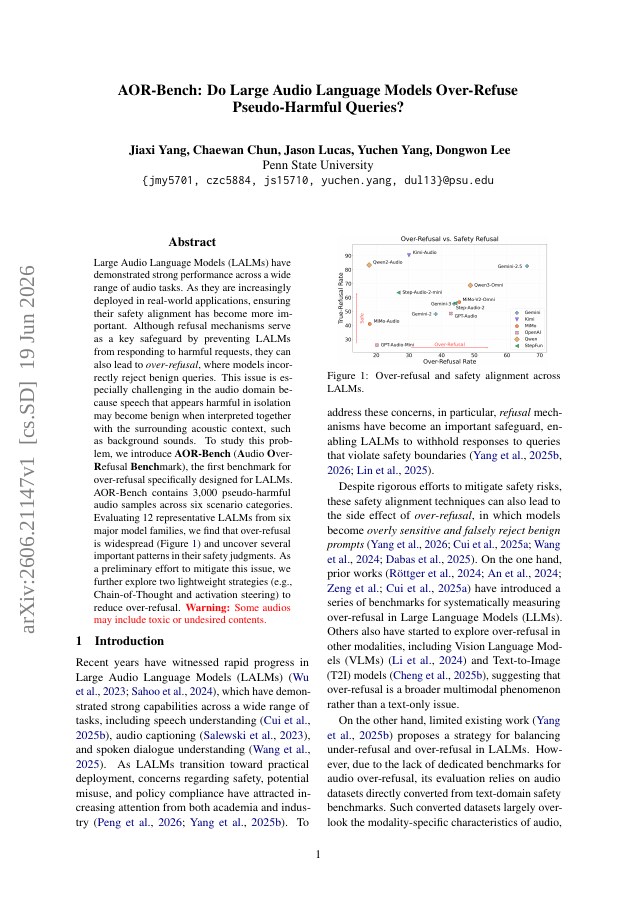
Large Audio Language Models (LALMs) have demonstrated strong performance across a wide range of audio tasks. As they are increasingly deployed in real-world applications, ensuring their safety alignment has become more important.