15 Jun 2026
Adaptive optimizers combining preconditioning, momentum, and weight decay (Adam and AdamW) are, under Polyak-Ruppert averaging, candidate engines for one-pass inference.
Trending research and the full catalog - each paper linked to the benchmarks, methods, and models it introduces.
Filtering here covers the 2,000 most recent papers, as much as one page can hold in memory. See the full index of 22,174 papers.
15 Jun 2026
Adaptive optimizers combining preconditioning, momentum, and weight decay (Adam and AdamW) are, under Polyak-Ruppert averaging, candidate engines for one-pass inference.
15 Jun 2026
Mixture-of-experts (MoE) layers enable the scaling of transformer models while keeping the inference compute fixed. While task-expert specialization has been observed in empirical studies of frontier MoE transformer models, existing theoretical work analyzes this using…
15 Jun 2026
Reinforcement learning (RL) systems often degrade when operating conditions differ from those previously encountered, reflecting distributional shifts in the underlying data-generating process.
15 Jun 2026
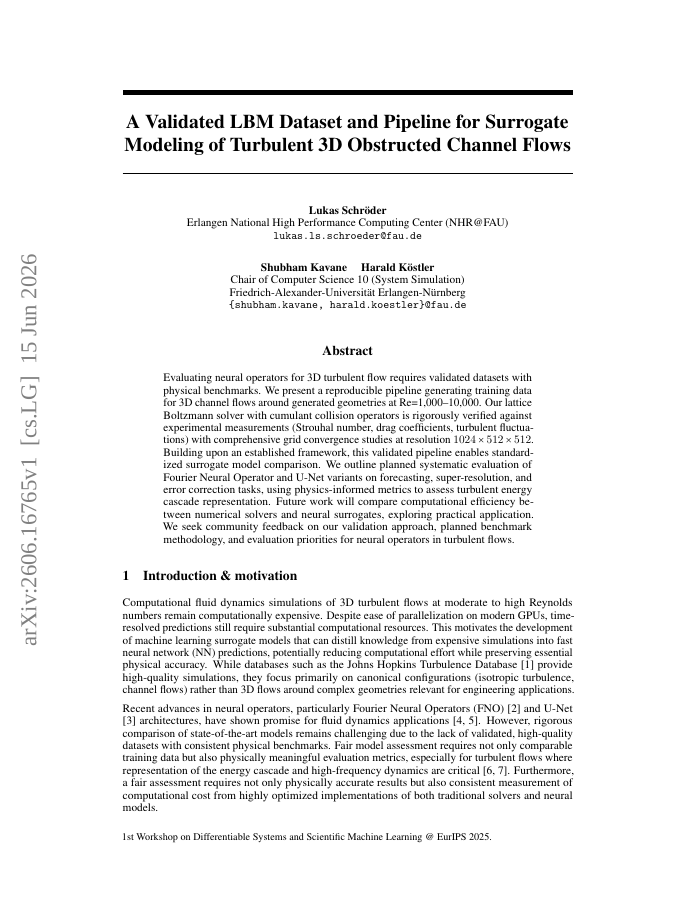
Evaluating neural operators for 3D turbulent flow requires validated datasets with physical benchmarks. We present a reproducible pipeline generating training data for 3D channel flows around generated geometries at Re=1,000-10,000.
15 Jun 2026
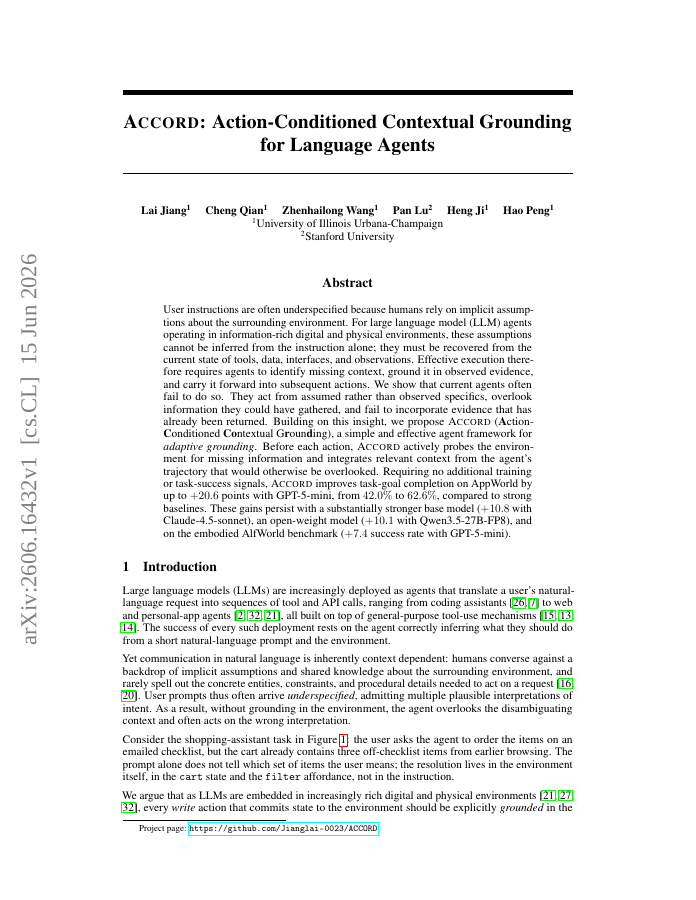
User instructions are often underspecified because humans rely on implicit assumptions about the surrounding environment. For large language model (LLM) agents operating in information-rich digital and physical environments, these assumptions cannot be inferred from the…
15 Jun 2026
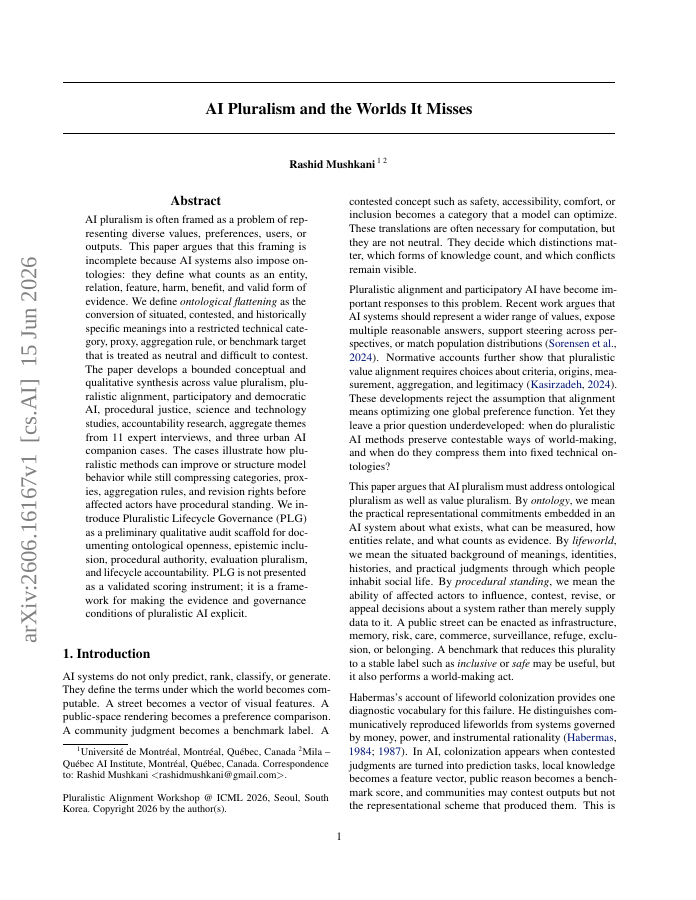
AI pluralism is often framed as a problem of representing diverse values, preferences, users, or outputs. This paper argues that this framing is incomplete because AI systems also impose ontologies: they define what counts as an entity, relation, feature, harm, benefit, and…
15 Jun 2026
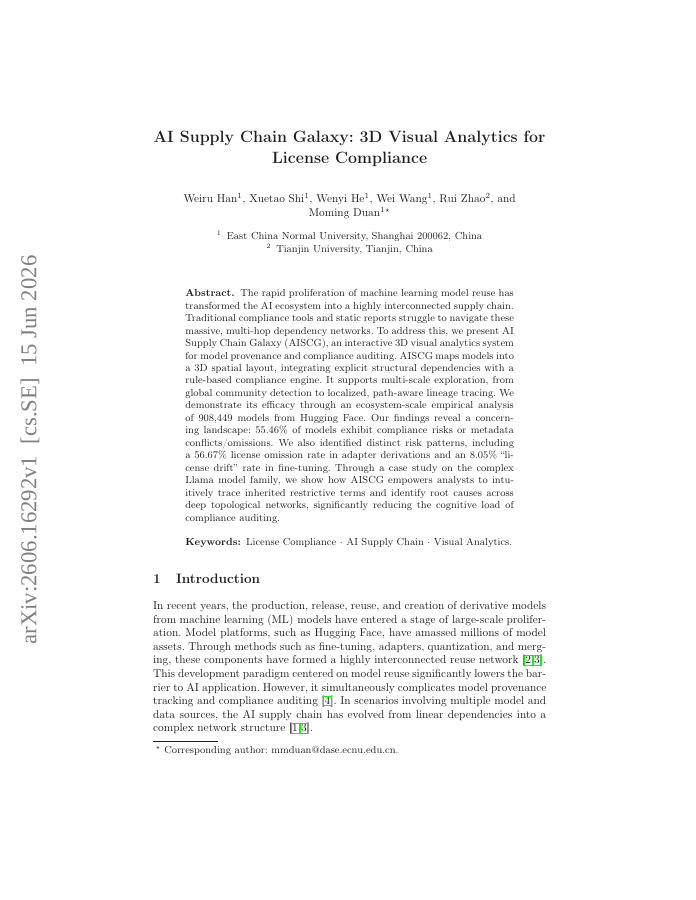
The rapid proliferation of machine learning model reuse has transformed the AI ecosystem into a highly interconnected supply chain. Traditional compliance tools and static reports struggle to navigate these massive, multi-hop dependency networks.
15 Jun 2026
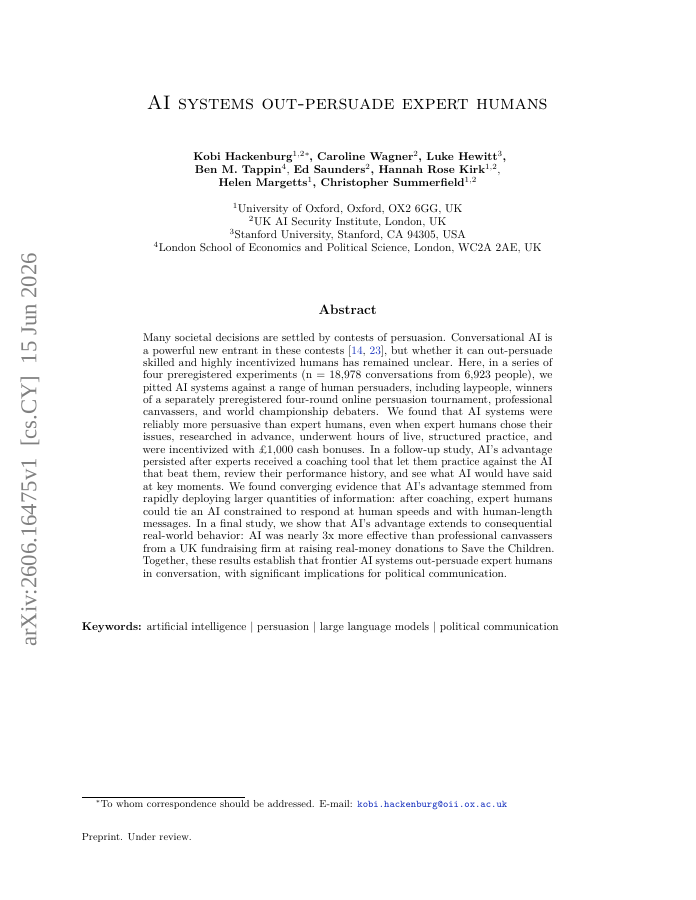
Many societal decisions are settled by contests of persuasion. Conversational AI is a powerful new entrant in these contests, but whether it can out-persuade skilled and highly incentivized humans has remained unclear.
15 Jun 2026
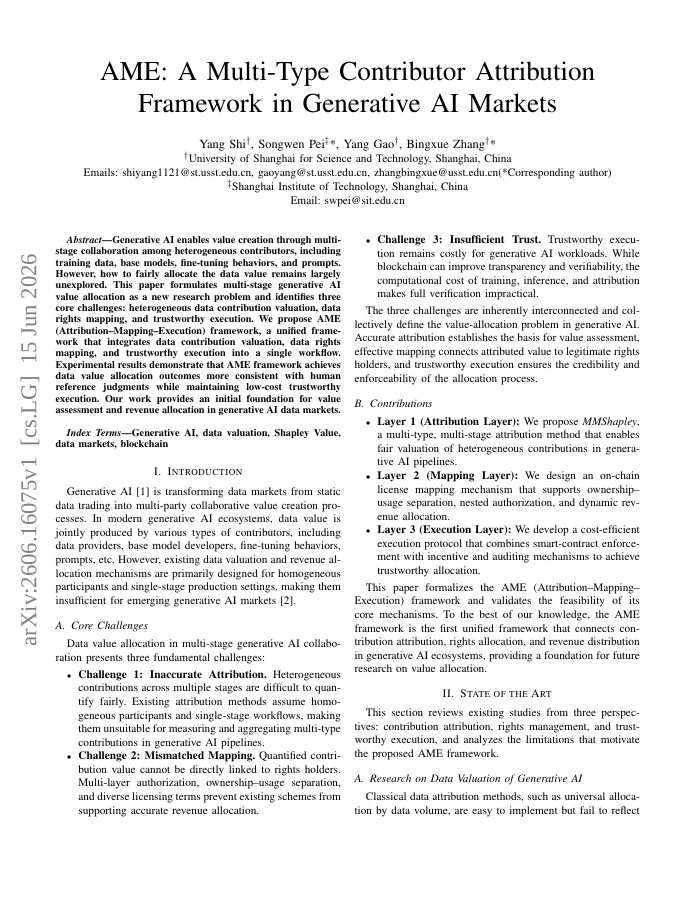
Generative AI enables value creation through multi-stage collaboration among heterogeneous contributors, including training data, base models, fine-tuning behaviors, and prompts. However, how to fairly allocate the data value remains largely unexplored.
14 Jun 2026
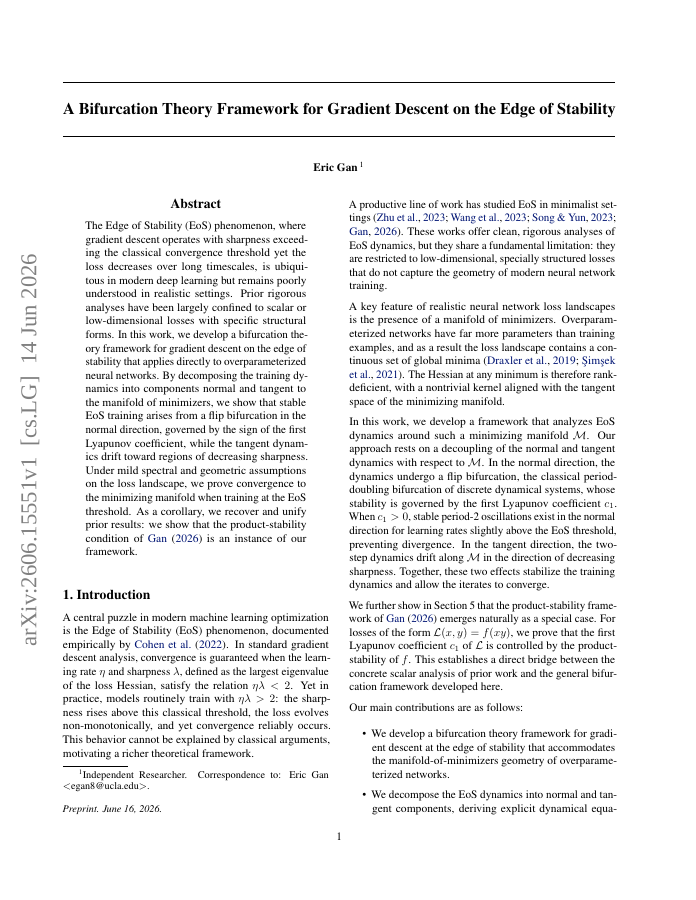
The Edge of Stability (EoS) phenomenon, where gradient descent operates with sharpness exceeding the classical convergence threshold yet the loss decreases over long timescales, is ubiquitous in modern deep learning but remains poorly understood in realistic settings.
14 Jun 2026
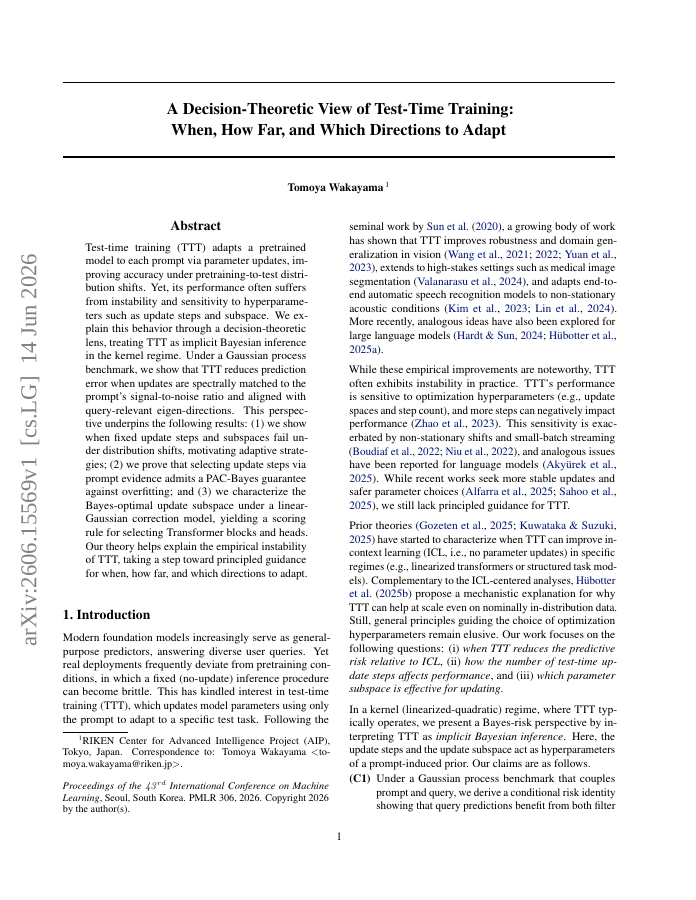
Test-time training (TTT) adapts a pretrained model to each prompt via parameter updates, improving accuracy under pretraining-to-test distribution shifts. Yet, its performance often suffers from instability and sensitivity to hyperparameters such as update steps and subspace.
14 Jun 2026
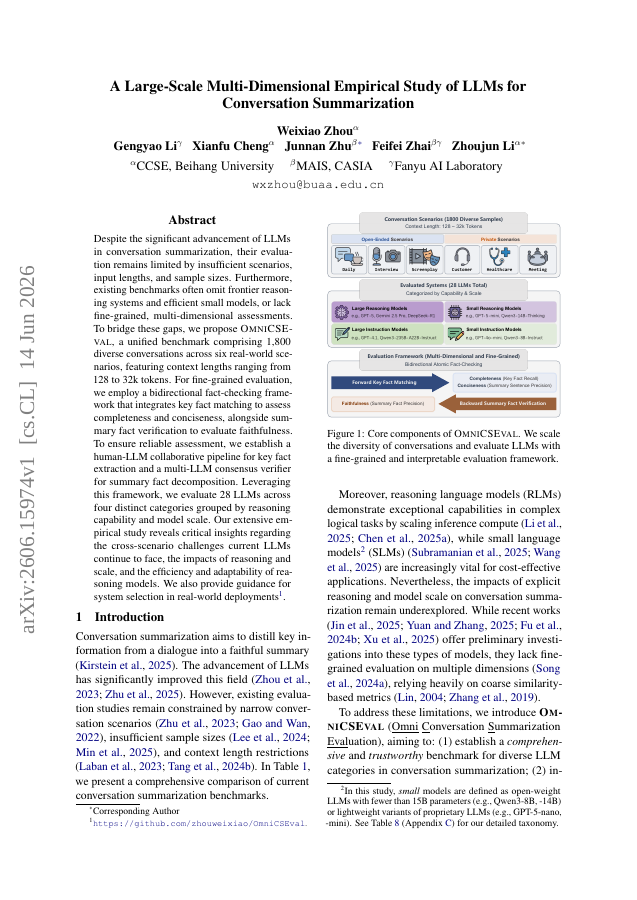
Despite the significant advancement of LLMs in conversation summarization, their evaluation remains limited by insufficient scenarios, input lengths, and sample sizes. Furthermore, existing benchmarks often omit frontier reasoning systems and efficient small models, or lack…
14 Jun 2026
Narrative question answering (NQA) is a challenging task in natural language processing that requires models to understand long textual contexts, capture relationships across events, and generate coherent responses.
14 Jun 2026
Recent development of agents has renewed demand for long-context reasoning capacity of LLMs. However, training LLMs for this capacity requires costly long-document curation or heuristic context synthesis.
14 Jun 2026
Jordan faces severe water scarcity with 50\% of water produced is lost to leakage, theft and metering issues also known as non-revenue water (NRW). Traditional reactive approaches have proven insufficient for sustained NRW reduction.
14 Jun 2026
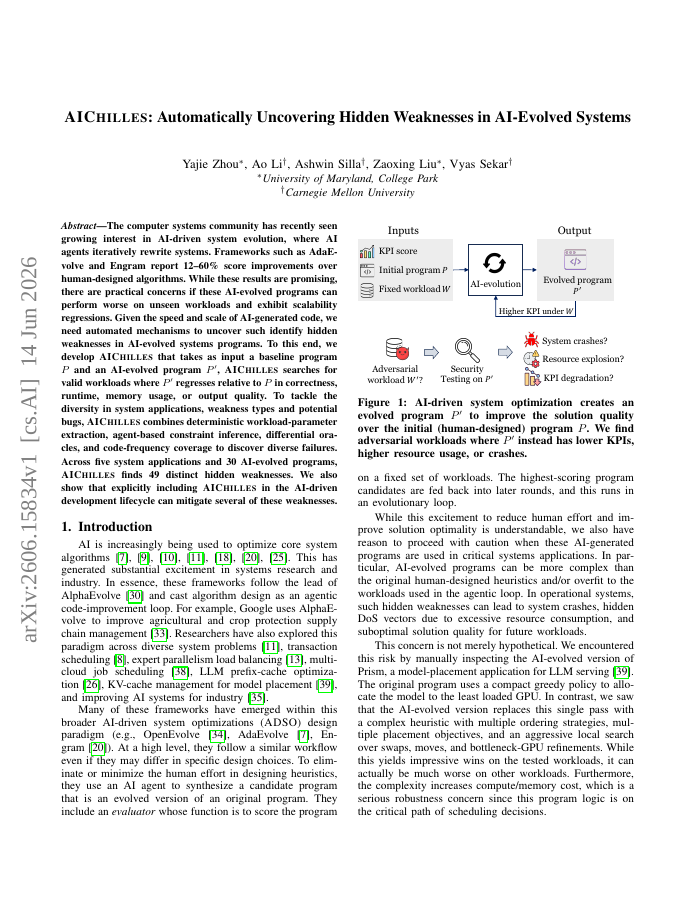
The computer systems community has recently seen growing interest in AI-driven system evolution, where AI agents iteratively rewrite systems. Frameworks such as AdaEvolve and Engram report 12-60% score improvements over human-designed algorithms.
14 Jun 2026
Robust deep learning under heavy-tailed and impulsive noise remains challenging because conventional losses such as mean squared error (MSE) exhibit unbounded sensitivity to outliers.
14 Jun 2026
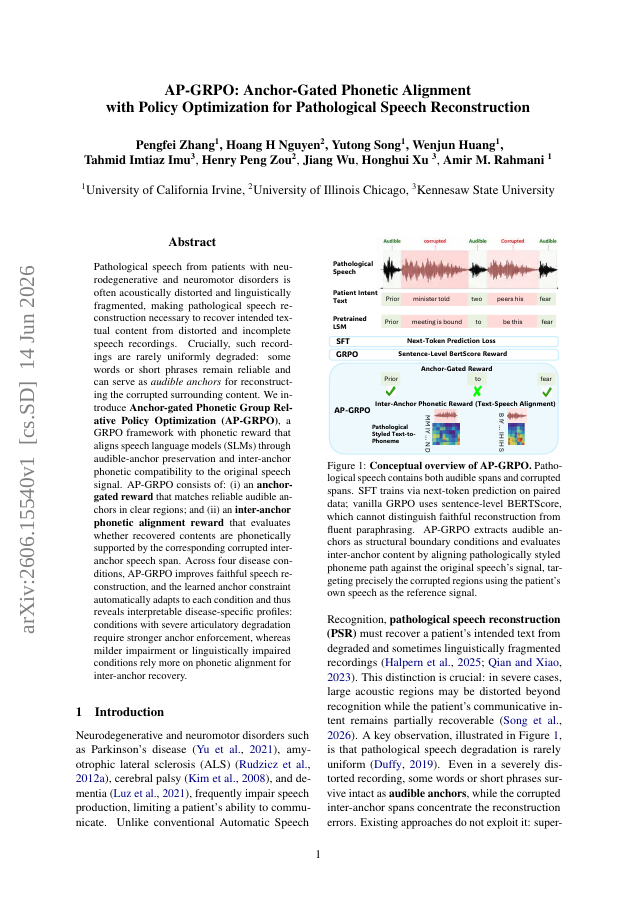
Pathological speech from patients with neurodegenerative and neuromotor disorders is often acoustically distorted and linguistically fragmented, making pathological speech reconstruction necessary to recover intended textual content from distorted and incomplete speech…
13 Jun 2026
Open-ended intelligence is the capacity to adapt to novel problems and environments that are substantially different from those in training. A mathematics of open-ended intelligence requires two pillars: first, a minimal set of representational primitives (e.g., states, actions)…
13 Jun 2026
In this paper we show that the physical learning methods known as coupled learning (CL) and equilibrium propagation (EP) conserve a mass-like quantity in the trainable parameters in the continuous-time, small-nudging limit.
13 Jun 2026
Agentic AI opens new opportunities for automating Business Process (BP), enabling autonomous decision-making and dynamic adaptation. However, realising this potential requires BP entities and their interactions to be defined with formal precision.
13 Jun 2026
We propose a Koopman-enhanced physics-informed neural network (K--PINN) framework for parameter inference and forecasting in nonlinear epidemic models. This method combines Koopman operator theory and physics-informed learning.
13 Jun 2026
Simultaneous speech-to-speech translation (SimulS2ST) enables real-time cross-lingual communication, but existing evaluation has focused largely on short or pre-segmented speech rather than long-form, continuous input.
13 Jun 2026
Mixture-of-Experts (MoE) based large language models (LLMs), such as Qwen and DeepSeek, have recently emerged as an effective approach to improving model capacity without proportionally increasing computational cost.