A Fresh Look at Lamarckian Evolution and the Baldwin Effect
27 May 2026
Baldwinian and Lamarckian evolution have existed for a long time in evolutionary algorithms (EAs) without ever dominating the academic literature or practical applications.
Trending research and the full catalog - each paper linked to the benchmarks, methods, and models it introduces.
Filtering here covers the 2,000 most recent papers, as much as one page can hold in memory. See the full index of 22,174 papers.
27 May 2026
Baldwinian and Lamarckian evolution have existed for a long time in evolutionary algorithms (EAs) without ever dominating the academic literature or practical applications.
27 May 2026
We propose the Tikhonov layer, a graph neural network layer that is interpretable by design: once trained, its learned parameters directly reveal which node features and which aspects of the graph topology were leveraged for prediction.
27 May 2026
How much meaning does a text carry? Shannon's theory measures uncertainty over symbols and is intentionally indifferent to meaning, while pairwise metrics such as BERTScore compare two texts rather than characterizing one.
27 May 2026
As agent capabilities advance, existing benchmarks, such as $τ^2$-Bench, are becoming increasingly saturated. Yet constructing new benchmark tasks remains complex, costly, and labor-intensive.
27 May 2026
We propose a minimal dynamical model of adaptive softmax routing for a two-expert Mixture-of-Experts (MoE) layer. The model is obtained as a mean-field limit of a discrete reinforcement rule: the selected expert receives a small score increment, while all scores undergo…
27 May 2026
Evaluating foundation models under appropriate adaptation settings is essential for understanding the quality and transferability of the learned representations. Recent EEG foundation models have demonstrated promising transfer capabilities across tasks and datasets, motivating…
27 May 2026
We describe a new sense-tagged corpus for word sense disambiguation. The corpus is constituted of instances of 20 French polysemous verbs. Each verb instance is annotated with three sense labels: (1) the actual translation of the verb in the english version of this instance in a…
27 May 2026
Recently, Deep Image Prior (DIP) has demonstrated strong capabilities for solving inverse imaging problems (IIPs) by optimizing a randomly initialized convolutional neural network in a training-data-free regime.
27 May 2026
The fastest-growing data in production today is unstructured text: agent traces, chat logs, reasoning chains, model outputs. People want to analyze it, and the questions worth asking ("show me where the agent got confused") cannot be answered by SQL alone, since text is…
27 May 2026
We study the log-alignment ratio (LAR), a measure of parameter-activation alignment, introduced in parameterization theory. We reformulate it as the overlap between a weight spectrum $p$ of the normalized squared singular values of a matrix and an activation spectrum $q$ of the…
27 May 2026
Diffusion models have emerged as a dominant framework for generative modeling, but their mathematical foundations are often presented separately through diffusion probabilistic models, score-based modeling, stochastic differential equations, and numerical sampling methods.
27 May 2026
Federated Retrieval-Augmented Generation (FedRAG) is attractive for privacy-sensitive applications because full local corpora remain on clients. As a result, routing must rely on client-provided semantic profiles, creating a new opportunity for manipulation.
27 May 2026
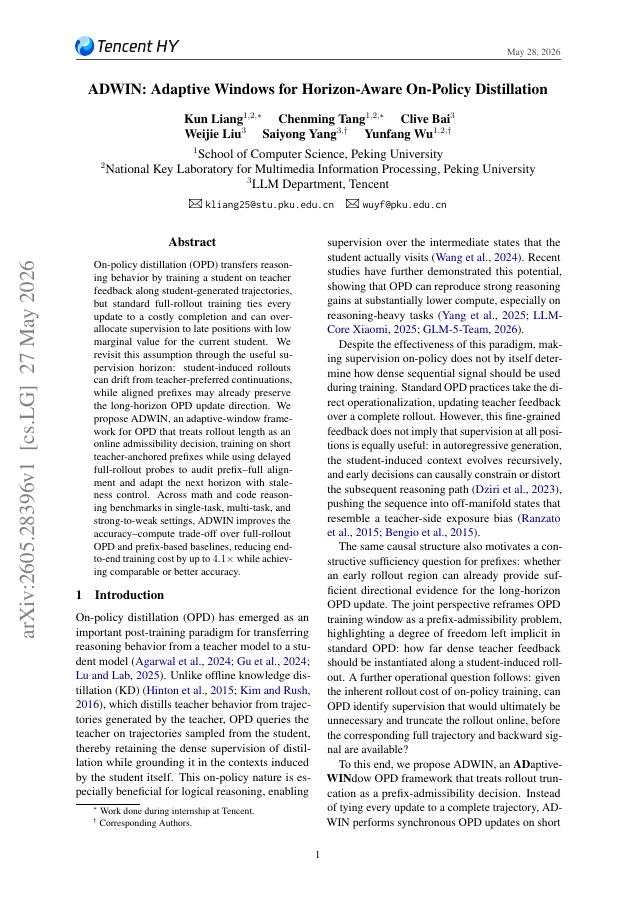
On-policy distillation (OPD) transfers reasoning behavior by training a student on teacher feedback along student-generated trajectories, but standard full-rollout training ties every update to a costly completion and can over-allocate supervision to late positions with low…
27 May 2026
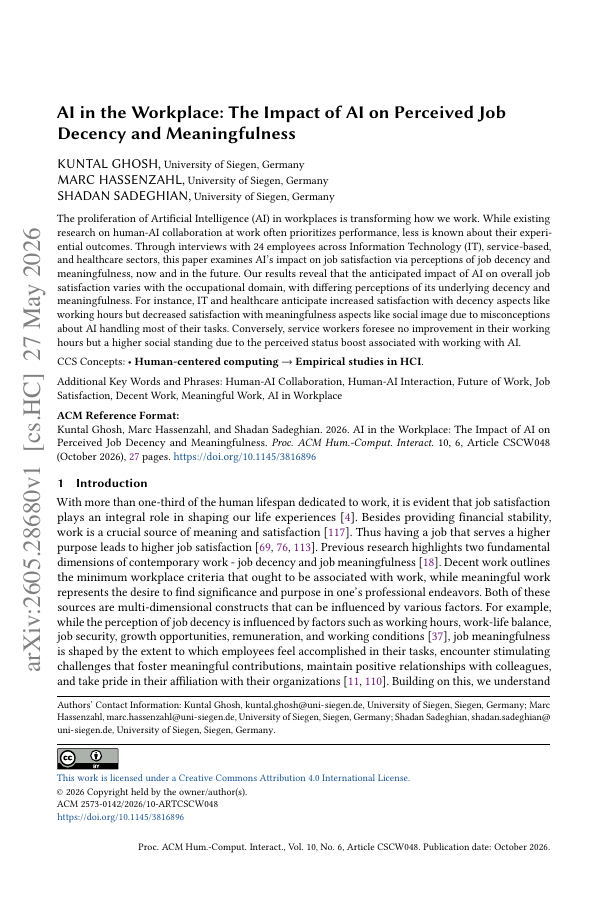
The proliferation of Artificial Intelligence (AI) in workplaces is transforming how we work. While existing research on human-AI collaboration at work often prioritizes performance, less is known about their experiential outcomes.
27 May 2026
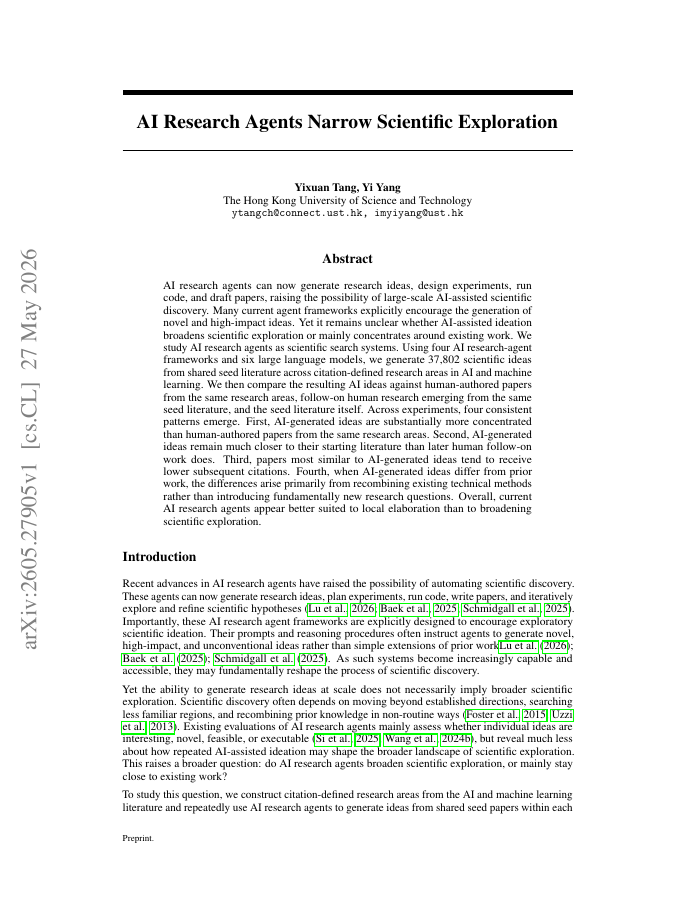
AI research agents now support large-scale AI-assisted scientific discovery. We examine whether AI-generated ideas broaden scientific exploration or primarily reinforce existing work.
27 May 2026
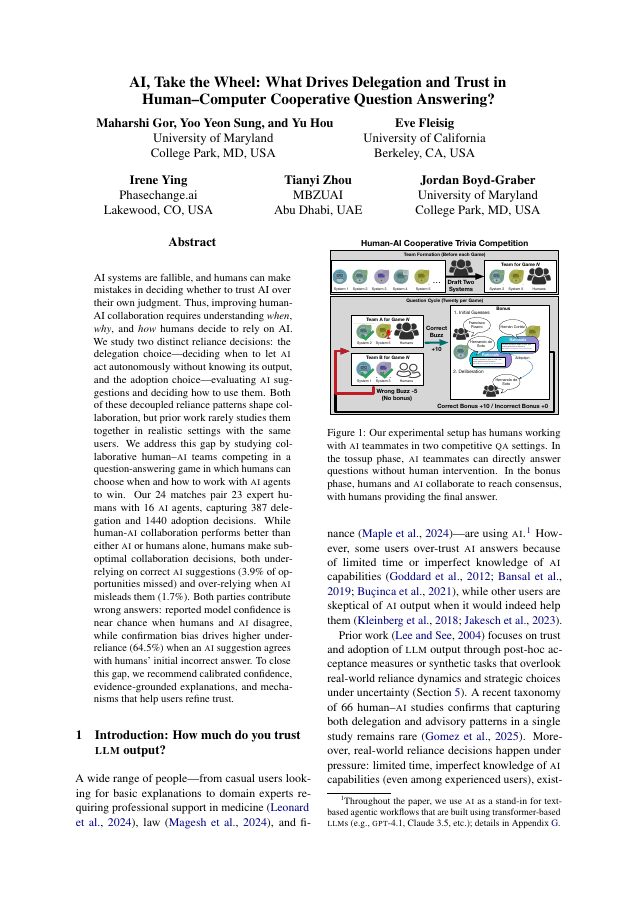
AI systems are fallible, and humans can make mistakes in deciding whether to trust AI over their own judgment. Thus, improving human-AI collaboration requires understanding when, why, and how humans decide to rely on AI.
27 May 2026
AI models underpin data-centric applications from image and text processing to scientific discovery in biology, physics, and chemistry. Yet developing them remains heavily manual, requiring practitioners to design architectures, build training pipelines, and iteratively refine…
27 May 2026
Tool-using language agents turn model decisions into external side effects: they read files, run scripts, call APIs, send messages, and invoke Model Context Protocol tools. This makes agent attacks different from jailbreaks.
27 May 2026
Out-of-distribution (OOD) detection is essential for deploying machine learning models in open-world and safety-critical scenarios, where test inputs may deviate from the training distribution and overconfident predictions on unknown samples can lead to unreliable decisions.
26 May 2026
Inference from interaction maps, such as centromere identification from genome-wide chromosome conformation capture techniques -- notably Hi-C -- can be formulated as a generic inverse problem: infer a set of parameters given a map summarizing pairwise interactions between…
26 May 2026
ASP(Q) extends Answer Set Programming (ASP) with Quantifiers over answer sets. In this paper we focus on the class of ASP(Q) programs with two quantifiers and weak constraints, denoted as 2-ASP(Q)^w.
26 May 2026
Large Language Models (LLMs) have brought huge improvements to Artificial Intelligence (AI), which can be applied to general-purpose tasks. However, their application to textual or spoken medical consultations is still an open research problem.
26 May 2026
Automated industrial inspection requires both precise defect localization and structured maintenance report generation; in current practice these tasks are handled separately, with linguistic interpretation left to human experts.
26 May 2026
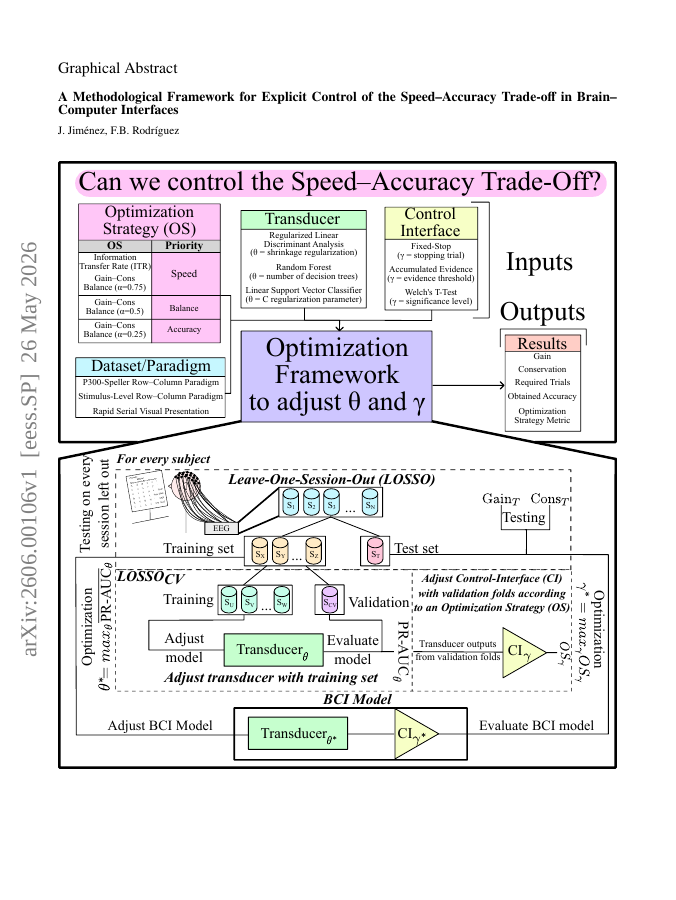
Brain-computer interfaces (BCIs) are limited by low signal-to-noise ratio in modalities such as electroencephalography, which requires multiple trials to reliably decode user intentions. This induces a speed-accuracy trade-off, whereby higher accuracy comes at the cost of speed.