1 Apr 2026
Generating continuous-time, continuous-space stochastic processes (e.g., videos, weather forecasts) conditioned on partial observations (e.g., first and last frames) is a fundamental challenge.
Trending research and the full catalog - each paper linked to the benchmarks, methods, and models it introduces.
Filtering here covers the 2,000 most recent papers, as much as one page can hold in memory. See the full index of 22,177 papers.
1 Apr 2026
Generating continuous-time, continuous-space stochastic processes (e.g., videos, weather forecasts) conditioned on partial observations (e.g., first and last frames) is a fundamental challenge.
1 Apr 2026
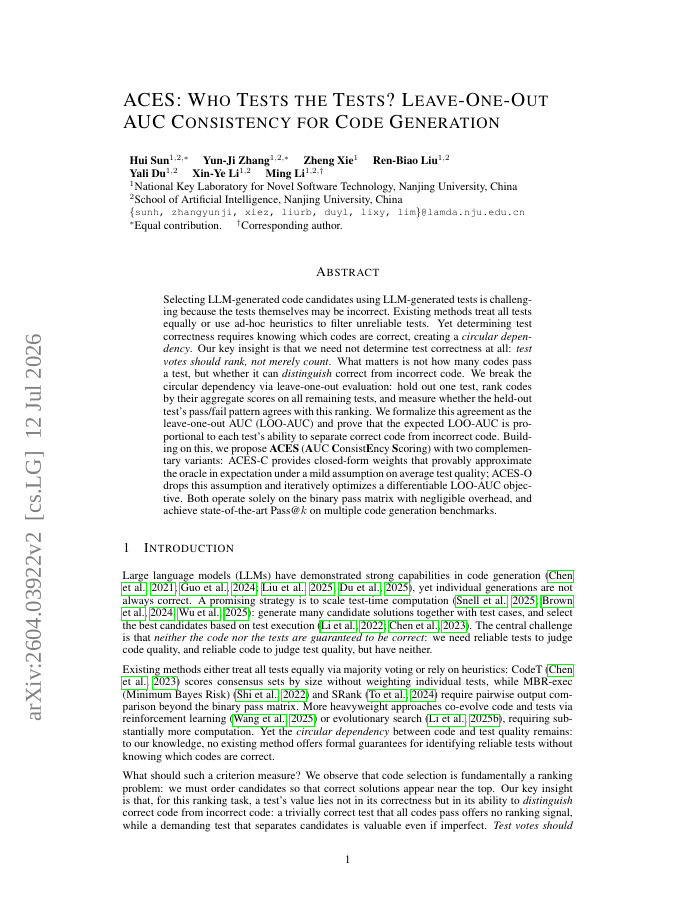
Selecting LLM-generated code candidates using LLM-generated tests is challenging because the tests themselves may be incorrect. Existing methods either treat all tests equally or rely on ad-hoc heuristics to filter unreliable tests.
1 Apr 2026
LLM Agents Harnesses are hand-designed and stay fixed, so agents accumulate experience but never learn how to use it: which memories to retrieve, when retrieved evidence is misleading, and when the retrieval strategy itself should change.
1 Apr 2026
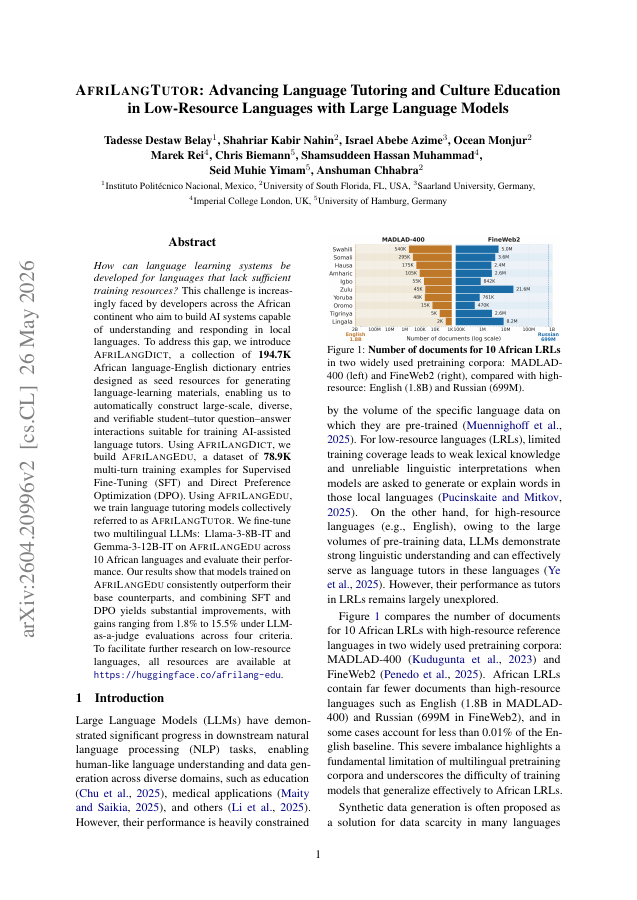
How can language learning systems be developed for languages that lack sufficient training resources? This challenge is increasingly faced by developers across the African continent who aim to build AI systems capable of understanding and responding in local languages.
1 Apr 2026
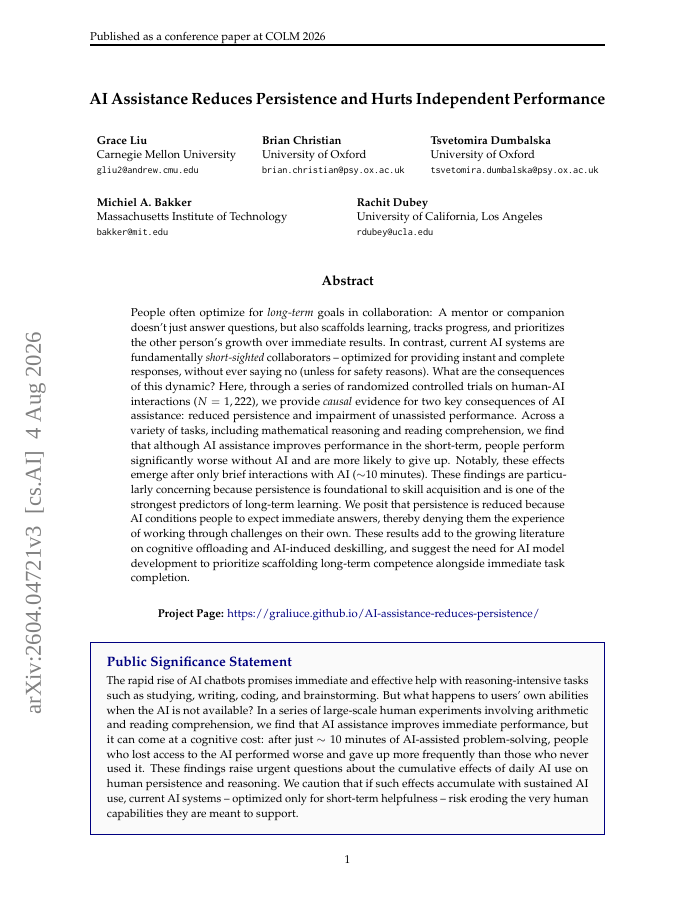
People often optimize for long-term goals in collaboration: A mentor or companion doesn't just answer questions, but also scaffolds learning, tracks progress, and prioritizes the other person's growth over immediate results.
1 Apr 2026
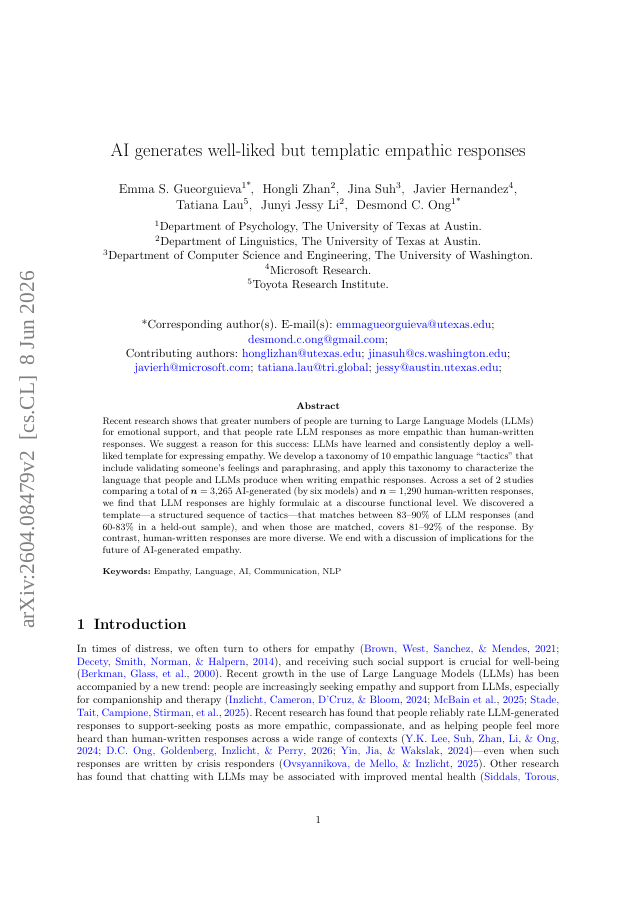
Recent research shows that greater numbers of people are turning to Large Language Models (LLMs) for emotional support, and that people rate LLM responses as more empathic than human-written responses.
1 Apr 2026
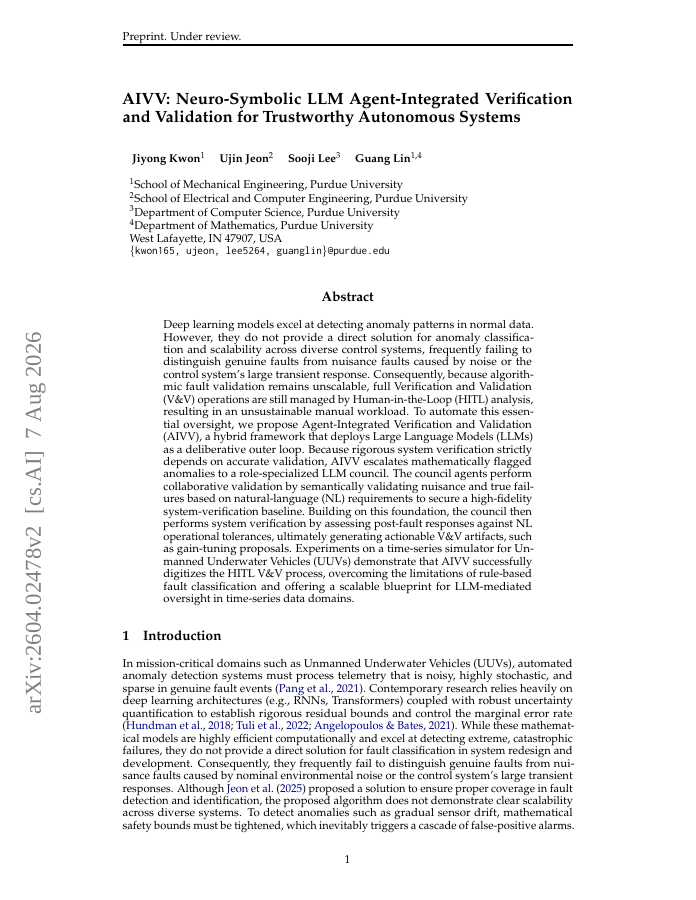
Deep learning models excel at detecting anomaly patterns in normal data. However, they do not provide a direct solution for anomaly classification and scalability across diverse control systems, frequently failing to distinguish genuine faults from nuisance faults caused by…
Zhen Xing, Xihui Liu, Shiwei Zhang · 31 Mar 2026
Although image generation has boosted various applications via its rapid evolution, whether the state-of-the-art models are able to produce ready-to-use academic illustrations for papers is still largely unexplored.
26 Mar 2026
Multimodal Large Language Models (MLLMs) have shown impressive abilities in understanding and reasoning over conventional images. However, their perception of 360° images remains largely underexplored.
Vasily Ilin, Jingwei Hu · 26 Mar 2026
Score-based transport modeling replaces traditional blob methods in plasma simulations, offering improved accuracy and efficiency for solving the Vlasov-Maxwell-Landau system.
Mu Xu, Feng Xiong, Shuang Zeng · 24 Mar 2026
ABot-PhysWorld is a 14B Diffusion Transformer model that generates physically plausible videos through physics-aware training and evaluation on a new benchmark.
Saswata Bose, Suvadeep Maiti, Shivam Kumar Sharma · 24 Mar 2026
Accurate sleep staging is essential for diagnosing OSA and hypopnea in stroke patients. Although PSG is reliable, it is costly, labor-intensive, and manually scored. While deep learning enables automated EEG-based sleep staging in healthy subjects, our analysis shows poor…
Eunbyung Park, Jihyeon Park, Hyun-kyu Ko · 19 Mar 2026
Creating dynamic, view-consistent videos of customized subjects is highly sought after for a wide range of emerging applications, including immersive VR/AR, virtual production, and next-generation e-commerce.
M. Arda Aydın, Melih B. Yilmaz, Aykut Koç · 17 Mar 2026
ACE-LoRA is a parameter-efficient adaptation framework for medical vision-language models that enhances zero-shot generalization through LoRA modules and attention-based context enhancement.
16 Mar 2026
The computational cost of geochemical solvers is a challenging matter. For reactive transport simulations, where chemical calculations are performed up to billions of times, it is crucial to reduce the total computational time.
Ning Ding, Qinyuan Cheng, Xipeng Qiu · 15 Mar 2026
Scientific discovery depends on expert judgement and foresight, which we call scientific taste: the ability to judge and propose research ideas with the potential for long-term scientific impact.
11 Mar 2026
Digital Human Modelling (DHM) is increasingly shaped by advances in AI, wearable biosensing, and interactive digital environments, particularly in research addressing accessibility and inclusion.
Yebin Liu, Xiaoying Tang, Jin Lyu · 10 Mar 2026
4D reconstruction of equine family (e.g.
10 Mar 2026
Most adversarial evaluations of large language model (LLM) safety assess single prompts and report binary pass/fail outcomes, which fails to capture how safety properties evolve under sustained adversarial interaction.
Zachary W. Ulissi, Brandon M. Wood, Aditi S. Krishnapriyan · 6 Mar 2026
AllScAIP is an attention-based machine-learning interatomic potential model that scales efficiently to large systems through data-driven all-to-all node attention while maintaining energy conservation and achieving state-of-the-art accuracy in molecular dynamics simulations.
5 Mar 2026
In oral arguments, judges probe attorneys with questions about the factual record, legal claims, and the strength of their arguments. To prepare for this questioning, both law schools and practicing attorneys rely on moot courts: practice simulations of appellate hearings.
Harikrishnan Unnikrishnan · 2 Mar 2026
A detection-gated pipeline combining a localizer and segmenter achieves state-of-the-art glottal segmentation with robust cross-dataset generalization and real-time processing capabilities.
1 Mar 2026
As large language models (LLMs) increasingly assist scientific writing, the limitations and token costs of generating TeX become increasingly visible. This paper analyzes TeX's architectural mismatch with LLM workflows, stemming from its lack of an explicit structural…
1 Mar 2026
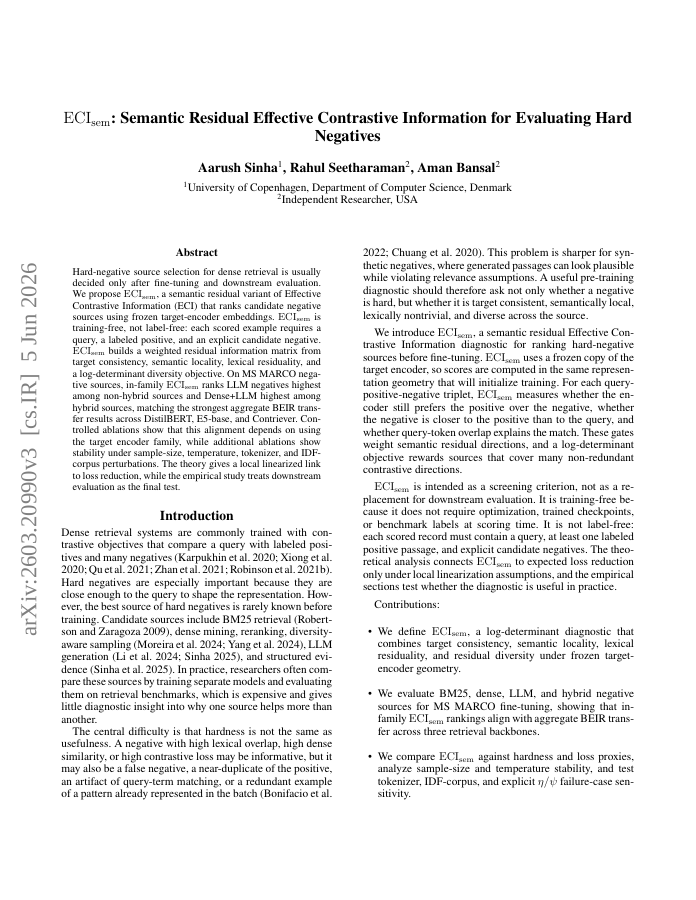
Hard-negative source selection for dense retrieval is usually decided only after fine-tuning and downstream evaluation. We propose ECIsem, a validity-weighted diagnostic that ranks candidate hard-negative sources using frozen target-encoder embeddings.