1 Feb 2026
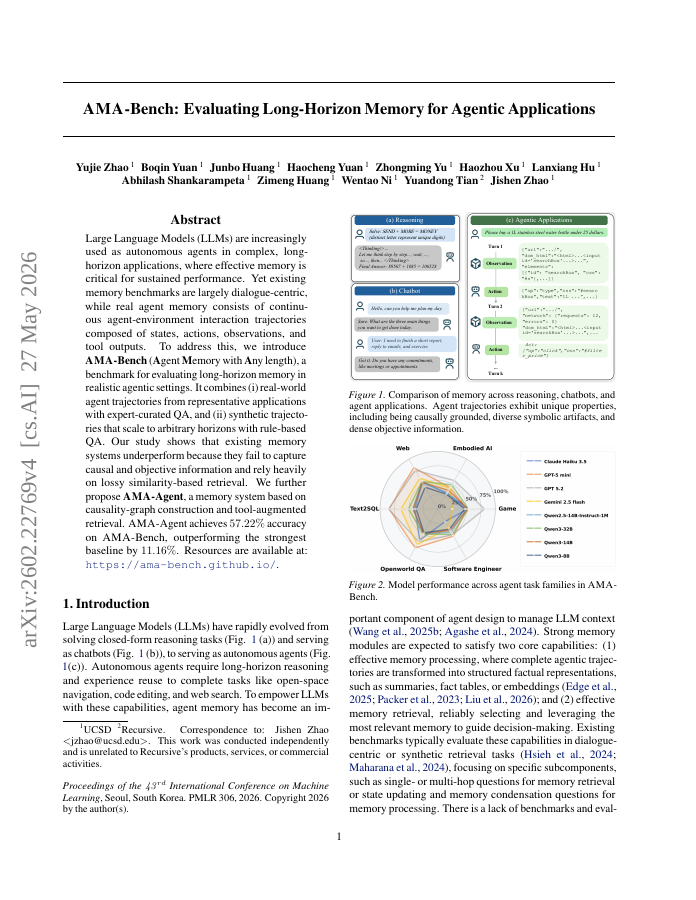
Large Language Models (LLMs) are increasingly used as autonomous agents in complex, long-horizon applications, where effective memory is critical for sustained performance.
Trending research and the full catalog - each paper linked to the benchmarks, methods, and models it introduces.
Filtering here covers the 2,000 most recent papers, as much as one page can hold in memory. See the full index of 22,177 papers.
1 Feb 2026
Large Language Models (LLMs) are increasingly used as autonomous agents in complex, long-horizon applications, where effective memory is critical for sustained performance.
1 Feb 2026
Objective: Acute mountain sickness (AMS) is the most prevalent altitude illness, affecting unacclimatized individuals ascending above 2,500 m and potentially escalating to life threatening cerebral or pulmonary edema.
Li Dong, Ming Hu, Zhonghua Wang · 31 Jan 2026
RetSAM is a comprehensive retinal imaging framework that provides accurate segmentation and standardized biomarker extraction from fundus images, supporting large-scale ophthalmic research and disease correlation studies.
31 Jan 2026
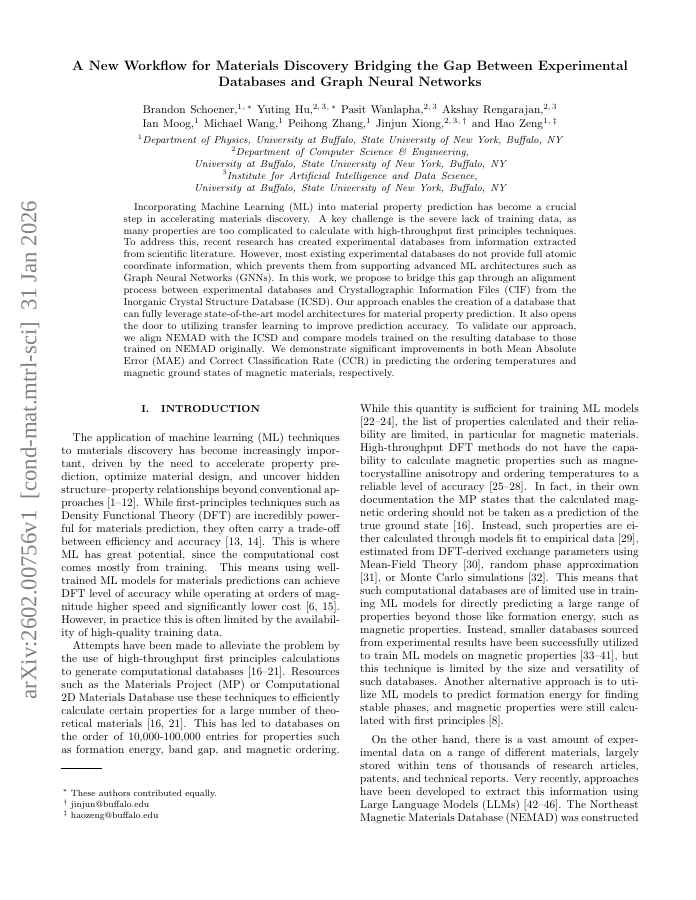
Incorporating Machine Learning (ML) into material property prediction has become a crucial step in accelerating materials discovery. A key challenge is the severe lack of training data, as many properties are too complicated to calculate with high-throughput first principles…
30 Jan 2026
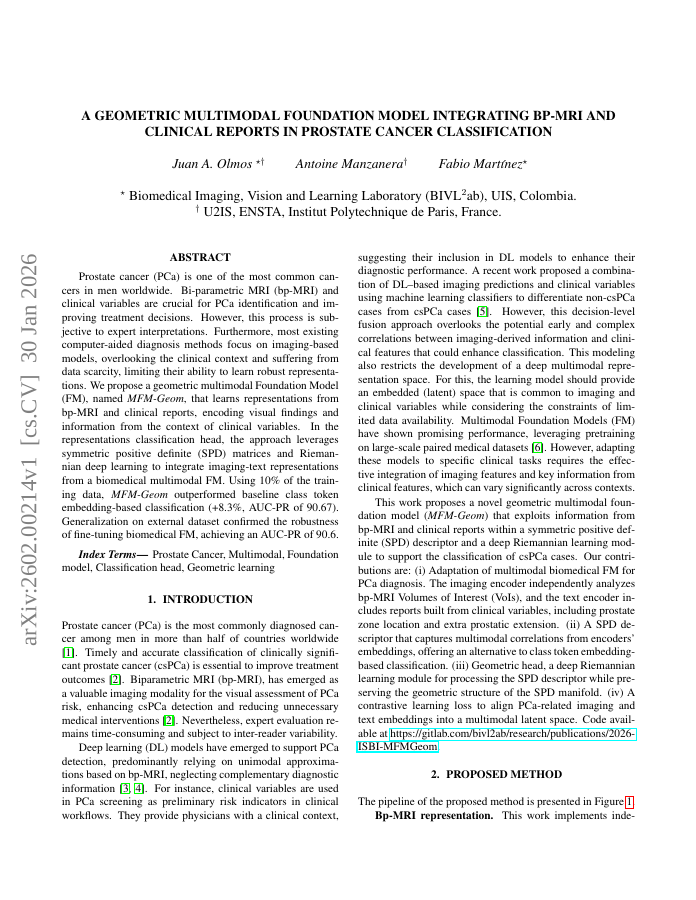
Prostate cancer (PCa) is one of the most common cancers in men worldwide. Bi-parametric MRI (bp-MRI) and clinical variables are crucial for PCa identification and improving treatment decisions. However, this process is subjective to expert interpretations.
Bo Zheng, Helin Wang, Kai Li · 30 Jan 2026
Automated pipeline for sound separation using high-purity single-event segments from in-the-wild datasets achieves competitive performance with significantly reduced data requirements.
Adrian Popescu, Elif Nebioglu, Emirhan Bilgiç · 30 Jan 2026
VAE-based inpainting creates spectral shifts that fool detection systems, which can be mitigated through Inpainting Exchange to improve content-aware detection performance.
28 Jan 2026
Photoacoustic computed tomography (PACT) is a promising imaging modality that combines the advantages of optical contrast with ultrasound detection. Utilizing ultrasound transducers with larger surface areas can improve detection sensitivity.
28 Jan 2026
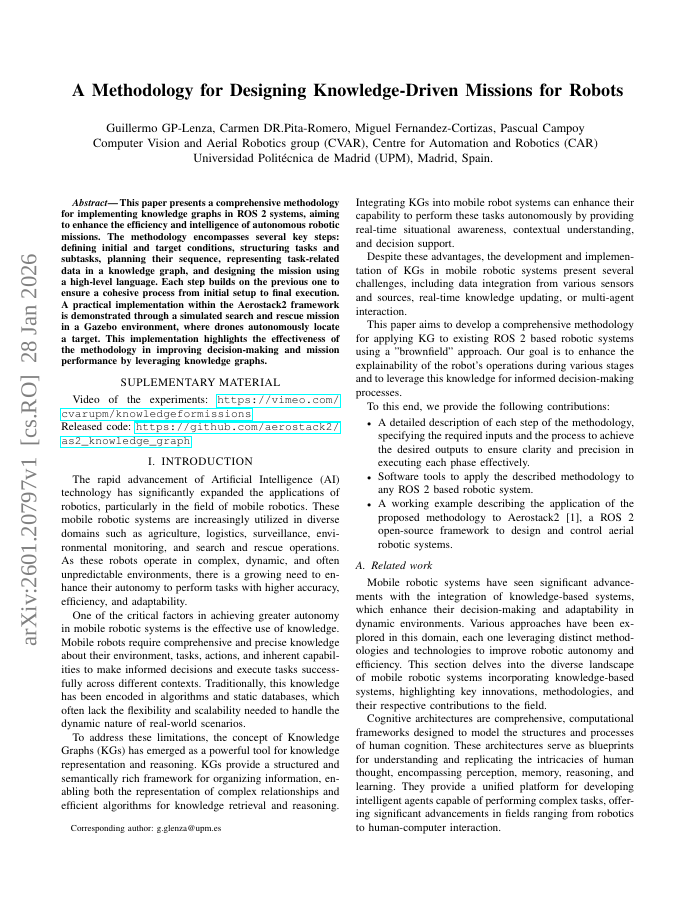
This paper presents a comprehensive methodology for implementing knowledge graphs in ROS 2 systems, aiming to enhance the efficiency and intelligence of autonomous robotic missions.
Lei Zhang, Minghui Yu, Yongda Yu · 27 Jan 2026
AACR-Bench addresses limitations in automated code review benchmarks by providing multi-language, cross-file context with expert-verified defect annotations, revealing significant gaps in prior LLM evaluation and demonstrating that context granularity and retrieval methods critically impact ACR performance across different models and paradigms.
Xing Zhu, Yujun Shen, Wei Wu · 26 Jan 2026
Offering great potential in robotic manipulation, a capable Vision-Language-Action (VLA) foundation model is expected to faithfully generalize across tasks and platforms while ensuring cost efficiency (e.g., data and GPU hours required for adaptation).
Wenhang Ge, Pengfei Wan, Peiran Ren · 22 Jan 2026
Video generation models are categorized based on state construction and dynamics modeling approaches, with emphasis on transitioning evaluation metrics from visual quality to functional capabilities like physical persistence and causal reasoning.
Luciano del Corro, Gonzalo Ariel Meyoyan · 19 Jan 2026
Lightweight probes trained on hidden states of LLMs enable efficient classification tasks without additional computational overhead, improving safety and sentiment analysis performance.
19 Jan 2026
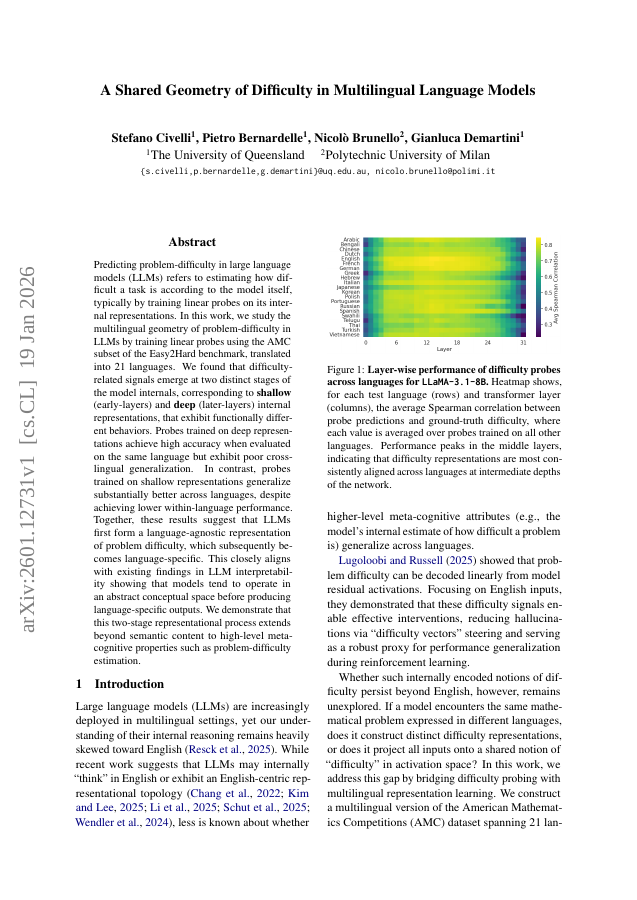
Predicting problem-difficulty in large language models (LLMs) refers to estimating how difficult a task is according to the model itself, typically by training linear probes on its internal representations.
Xipeng Qiu, Yuxin Wang, Shuo Zhang · 16 Jan 2026
The evolution of Large Language Models (LLMs) into autonomous agents has expanded the scope of AI coding from localized code generation to complex, repository-level, and execution-driven problem solving.
Yi Liu, Guanghui Ren, Maoqing Yao · 16 Jan 2026
Vision-Language-Action models are enhanced by incorporating action-space reasoning through a structured sequence of coarse action intents, improving manipulation task performance in both simulation and real-world environments.
Wang Yang, Yipu Dou · 16 Jan 2026
AI safety frameworks must adapt to autonomous agents, requiring modular architectures that can simulate complex multi-turn exploits while managing tool-use vulnerabilities and cognitive load impacts on persona-based attacks.
Zilong Wang, Xin Wang, Zuxuan Wu · 15 Jan 2026
The rapid evolution of Large Language Models (LLMs) and Multimodal Large Language Models (MLLMs) has produced substantial gains in reasoning, perception, and generative capability across language and vision.
Caiming Xiong, Yu Wang, Xin Eric Wang · 14 Jan 2026
Research in artificial intelligence is shifting from model innovations and benchmark scores towards problem definition and rigorous real-world evaluation. As the field enters the "second half," the central challenge becomes real utility in long-horizon, dynamic, and…
Zeyu Zhang, Hao Tang, Ting Huang · 10 Jan 2026
3D CoCa v2 enhances 3D captioning by combining contrastive vision-language learning with spatially-aware 3D scene encoding and test-time search for improved generalization across diverse environments.
9 Jan 2026
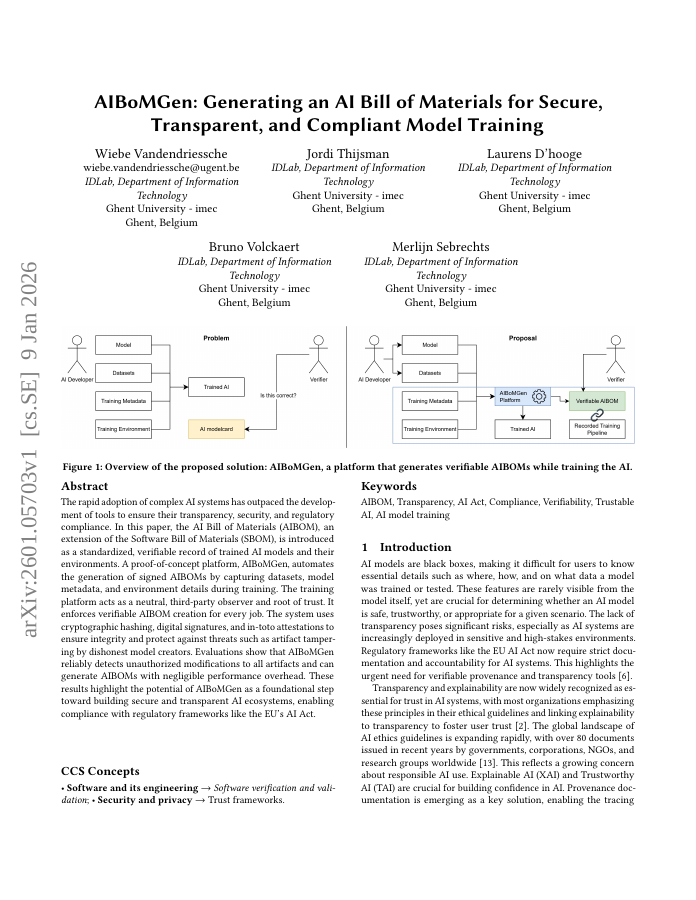
The rapid adoption of complex AI systems has outpaced the development of tools to ensure their transparency, security, and regulatory compliance. In this paper, the AI Bill of Materials (AIBOM), an extension of the Software Bill of Materials (SBOM), is introduced as a…
7 Jan 2026
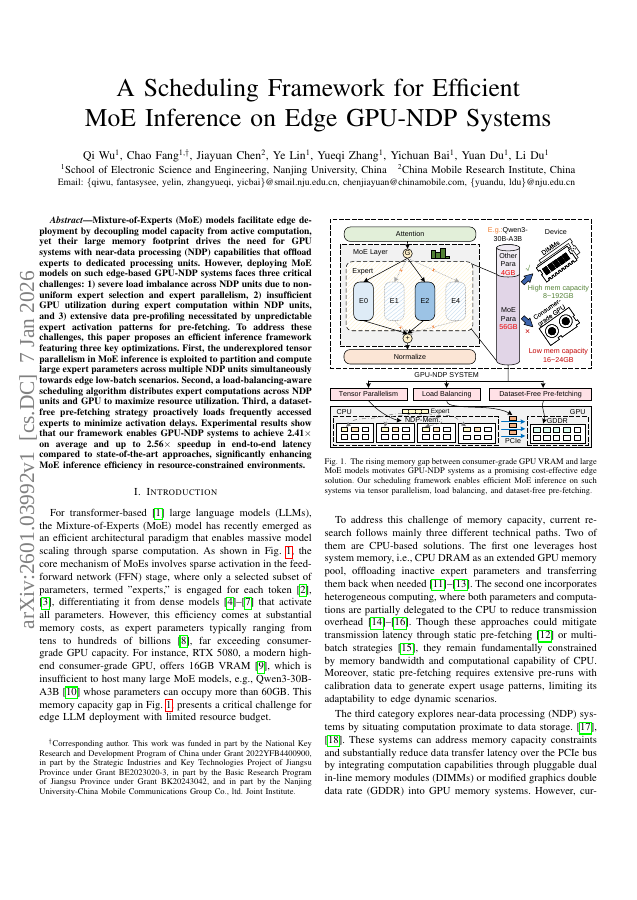
Mixture-of-Experts (MoE) models facilitate edge deployment by decoupling model capacity from active computation, yet their large memory footprint drives the need for GPU systems with near-data processing (NDP) capabilities that offload experts to dedicated processing units.
Xiaopeng Guo, Yinzhe Xu, Huajian Huang · 5 Jan 2026
A deep learning-based monocular omnidirectional visual odometry system uses a distortion-aware spherical feature extractor and differentiable bundle adjustment to improve robustness and accuracy over existing methods.
1 Jan 2026
AI-generated media is radically changing the way content is both consumed and produced on the internet, and in no place is this potentially more visible than in sexual content.