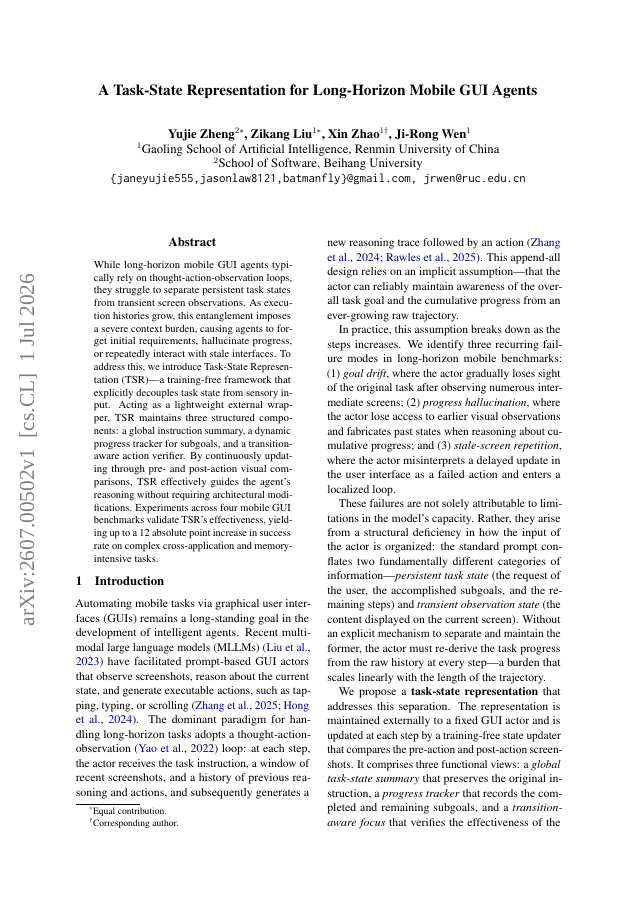
A Task-State Representation for Long-Horizon Mobile GUI Agents
1 Jul 2026
While long-horizon mobile GUI agents typically rely on thought-action-observation loops, they struggle to separate persistent task states from transient screen observations.
Trending research and the full catalog - each paper linked to the benchmarks, methods, and models it introduces.
Filtering here covers the 2,000 most recent papers, as much as one page can hold in memory. See the full index of 22,427 papers.
1 Jul 2026
While long-horizon mobile GUI agents typically rely on thought-action-observation loops, they struggle to separate persistent task states from transient screen observations.
1 Jul 2026
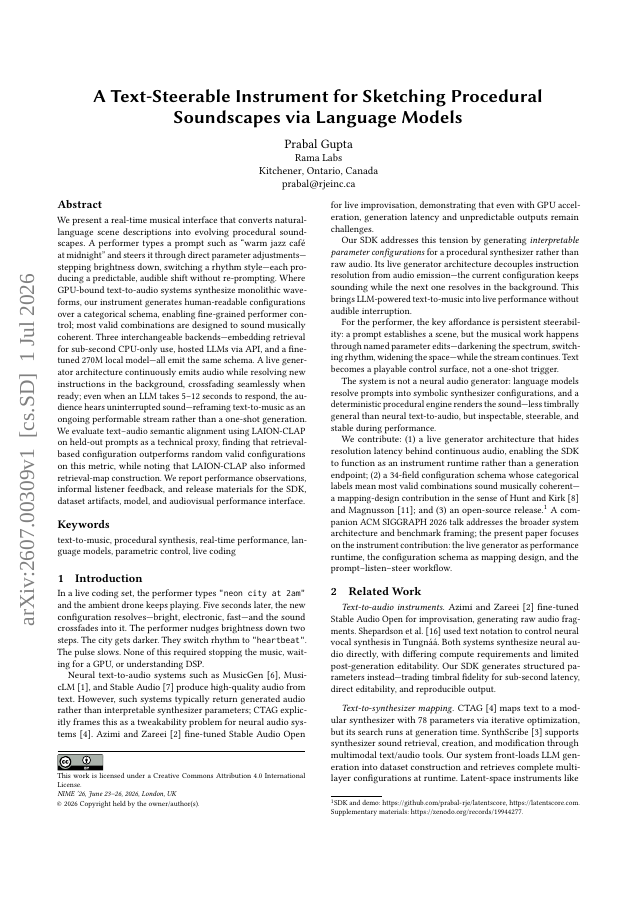
We present a real-time musical interface that converts natural-language scene descriptions into evolving procedural soundscapes. A performer types a prompt such as "warm jazz cafe at midnight" and steers it through direct parameter adjustments - stepping brightness down,…
1 Jul 2026
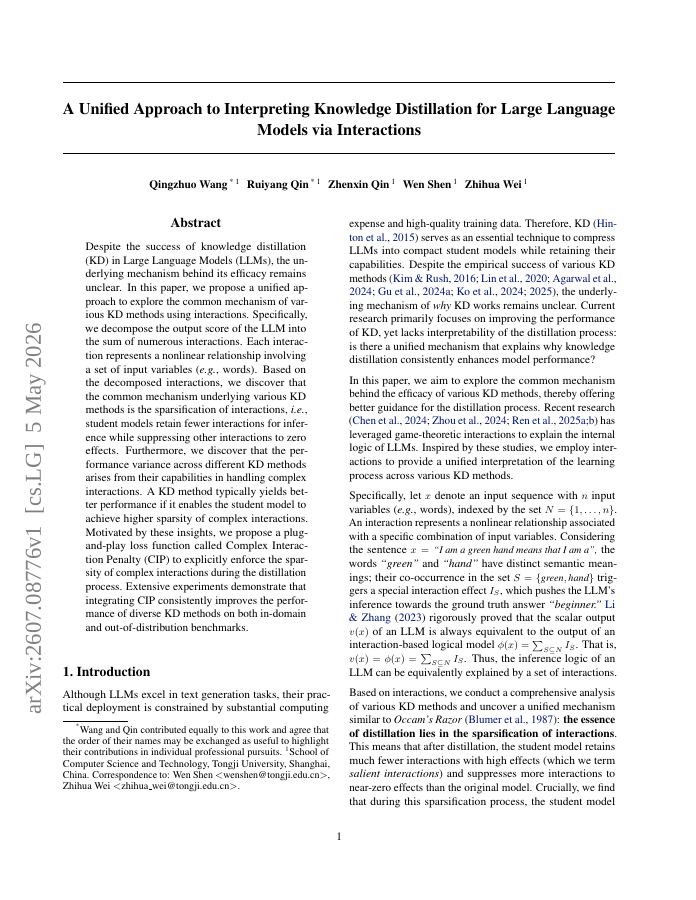
Despite the success of knowledge distillation (KD) in Large Language Models (LLMs), the underlying mechanism behind its efficacy remains unclear. In this paper, we propose a unified approach to explore the common mechanism of various KD methods using interactions.
1 Jul 2026
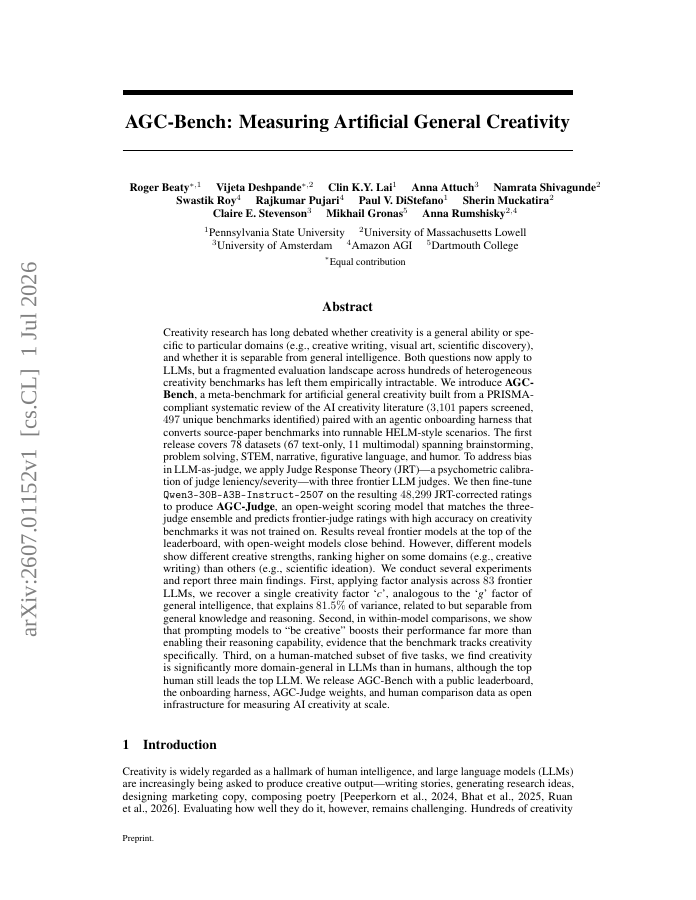
Creativity research has debated whether creativity is domain-specific (e.g., visual, writing, science), and if it is psychometrically separable from general intelligence. Both questions now apply to LLMs, but a unified benchmark of AI creativity remains elusive.
1 Jul 2026
Large language models (LLMs) are powerful pattern-completion systems, but their default operating mode - predicting the next token from a static context - does not reliably produce persistent, manipulable representations of an external world.
30 Jun 2026
Hierarchical Vision-Language-Action (VLA) models decouple high-level planning from low-level control to improve generalization in robot manipulation. Recent work in this paradigm uses 2D end-effector trajectories predicted by a Vision-Language Model (VLM) as explicit guidance…
30 Jun 2026
This paper proposes a Bayesian filtering-based approach for learning the dynamics of a physical system from partial, noisy measurements. We model the system dynamics using a Lagrangian mechanics formulation.
30 Jun 2026
Artificial intelligence (AI) systems are routinely modified after deployment through retraining and changes in their environments. These transformations raise a metaphysical question: under what conditions does an AI system remain the same system over time or across deployments?…
30 Jun 2026
We study runtime human oversight of an AI agent when private information runs in both directions: the human privately knows her reward function, while the AI privately knows the quality of the action it proposes.
30 Jun 2026
Survival analysis models time-to-event data, but in clinical settings training data are costly and scarce: events accrue over years of follow-up, cohorts are small, and privacy regulations restrict sharing across institutions.
30 Jun 2026
Large language models are no longer only text generators. They are increasingly embedded in retrieval pipelines, enterprise assistants, coding environments, robotic systems, security-operation workflows, and autonomous agents that can read private data, call tools, write files,…
30 Jun 2026
Active learning (AL) performance is known to be budget-dependent, yet regimes are typically defined by heuristic label counts that fail to generalize across datasets or architectures.
30 Jun 2026
This paper presents an integrated system for the CMU Vision-Language-Action (VLA) Challenge, designed to enable an autonomous agent to perform complex tasks based on natural language instructions.
30 Jun 2026
Autonomous wet-lab experimentation requires more than plausible protocol text: biological intent, quantitative procedures, device constraints and experimental feedback must remain aligned from protocol and SOP design to code and physical execution.
30 Jun 2026
Natural language-to-SQL (NL2SQL) over real-world enterprise databases remains significantly more challenging than on academic benchmarks. Enterprise schemas often contain hundreds of physical tables with cryptic column names, heterogeneous SQL dialects, and complex analytical…
30 Jun 2026
Research on artificial intelligence (AI) in the public sector often treats "AI" as a single category, neglecting technical distinctions between different AI systems.
30 Jun 2026
We present a three-phase deep reinforcement learning system for personalized portfolio management that addresses three limitations shared by all prior financial RL work: 1) ticker lock-in, 2) monolithic objectives , and 3) static user models.
30 Jun 2026
Staff absenteeism imposes substantial operational costs in high-demand work environments such as healthcare, emergency services, meat processing, construction, and courier and delivery services, where proactive workforce planning depends on reliable individual-level absence…
30 Jun 2026
Fault recovery in process plants still relies heavily on plant operators, especially when faults fall outside predefined supervisory logic. Operators interpret alarms, procedures, P\&IDs, interlocks, and process trends, then decide how to move the plant to a safe operating mode…
30 Jun 2026
The increasing complexity of agentic tasks has led to rapidly growing trajectory lengths, which poses significant challenges for large language model (LLM) based agents with fixed context windows.
30 Jun 2026
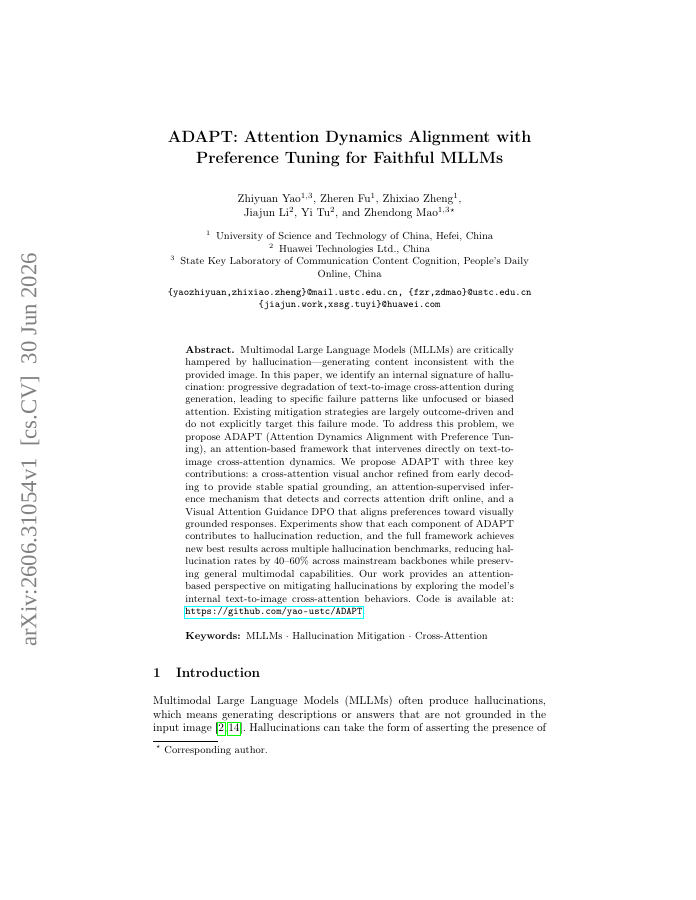
Multimodal Large Language Models (MLLMs) are critically hampered by hallucination, generating content inconsistent with the provided image. In this paper, we identify an internal signature of hallucination: progressive degradation of text-to-image cross-attention during…
30 Jun 2026
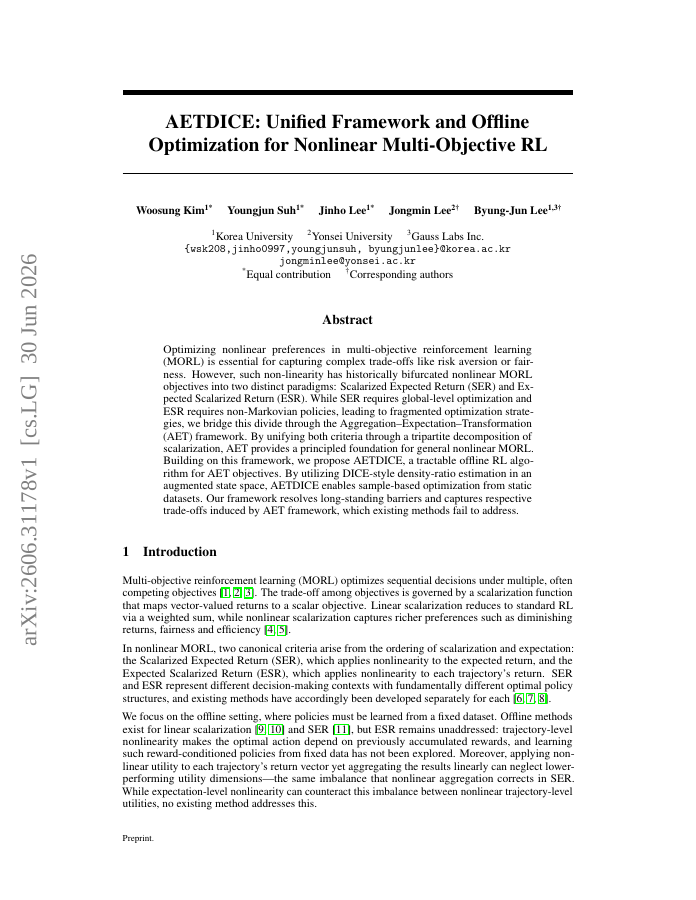
Optimizing nonlinear preferences in multi-objective reinforcement learning (MORL) is essential for capturing complex trade-offs like risk aversion or fairness. However, such non-linearity has historically bifurcated nonlinear MORL objectives into two distinct paradigms:…
30 Jun 2026
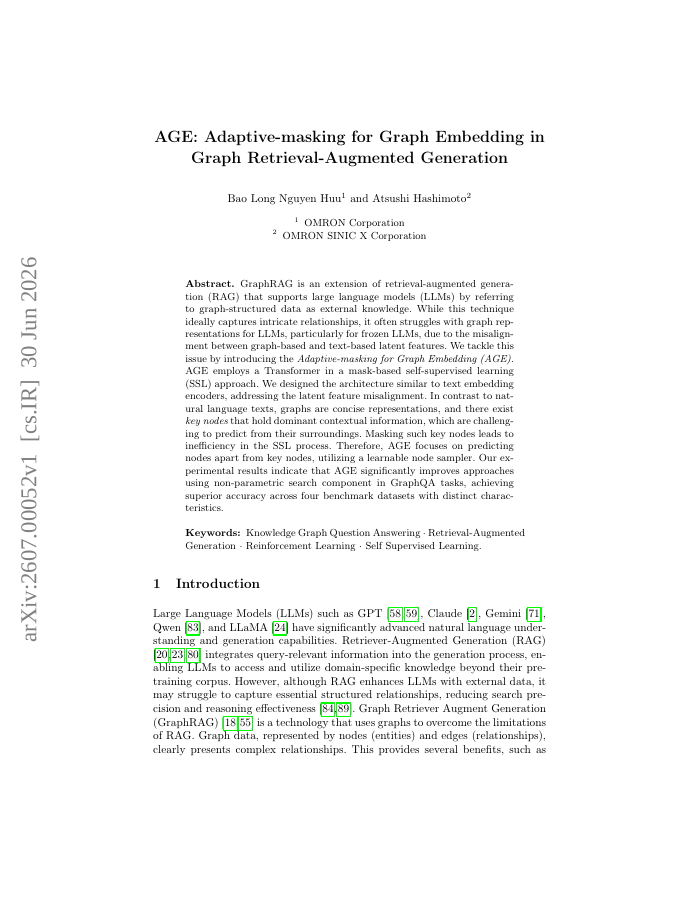
GraphRAG is an extension of retrieval-augmented generation (RAG) that supports large language models (LLMs) by referring to graph-structured data as external knowledge. While this technique ideally captures intricate relationships, it often struggles with graph representations…
30 Jun 2026
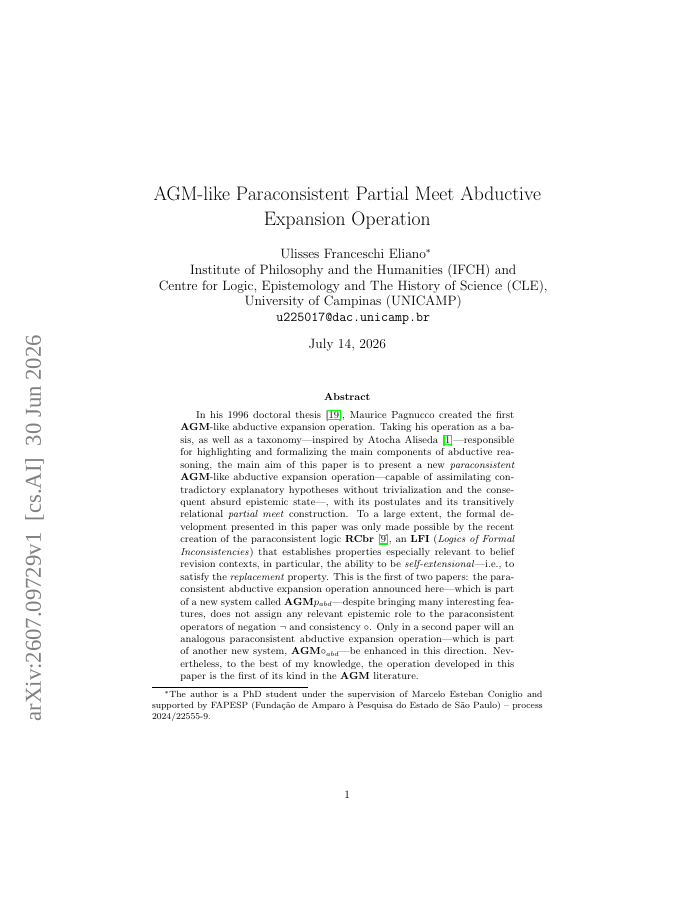
In his 1996 doctoral thesis, Maurice Pagnucco created the first AGM-like abductive expansion operation. Taking his operation as a basis, as well as a taxonomy -- inspired by Atocha Aliseda -- responsible for highlighting and formalizing the main components of abductive…