23 Jun 2026
Due to the wide use of graph-structured data in different fields of industry and science, the development of Graph Foundation Models (GFMs) has recently attracted a lot of attention.
Trending research and the full catalog - each paper linked to the benchmarks, methods, and models it introduces.
Filtering here covers the 2,000 most recent papers, as much as one page can hold in memory. See the full index of 22,427 papers.
23 Jun 2026
Due to the wide use of graph-structured data in different fields of industry and science, the development of Graph Foundation Models (GFMs) has recently attracted a lot of attention.
23 Jun 2026
We introduce Directed Hypergraph Signal Processing (DHGSP), a unified framework that extends graph signal processing to accommodate both higher-order (polyadic) and asymmetric (directional) relationships simultaneously.
23 Jun 2026
The accelerated digitalization of renewable energy smart grids through IoT sensors, AMI, and SCADA systems has significantly expanded the attack surface for sophisticated cyberattacks, FDI attacks that stealthily distort state estimation and DoS/DDoS attacks that flood…
23 Jun 2026
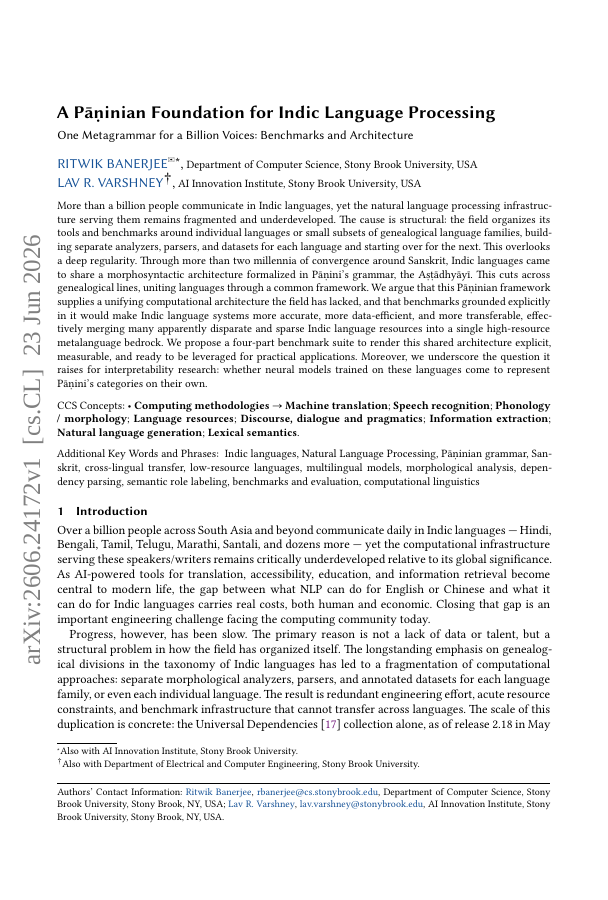
More than a billion people communicate in Indic languages, yet the natural language processing infrastructure serving them remains fragmented and underdeveloped. The cause is structural: the field organizes its tools and benchmarks around individual languages or small subsets of…
23 Jun 2026
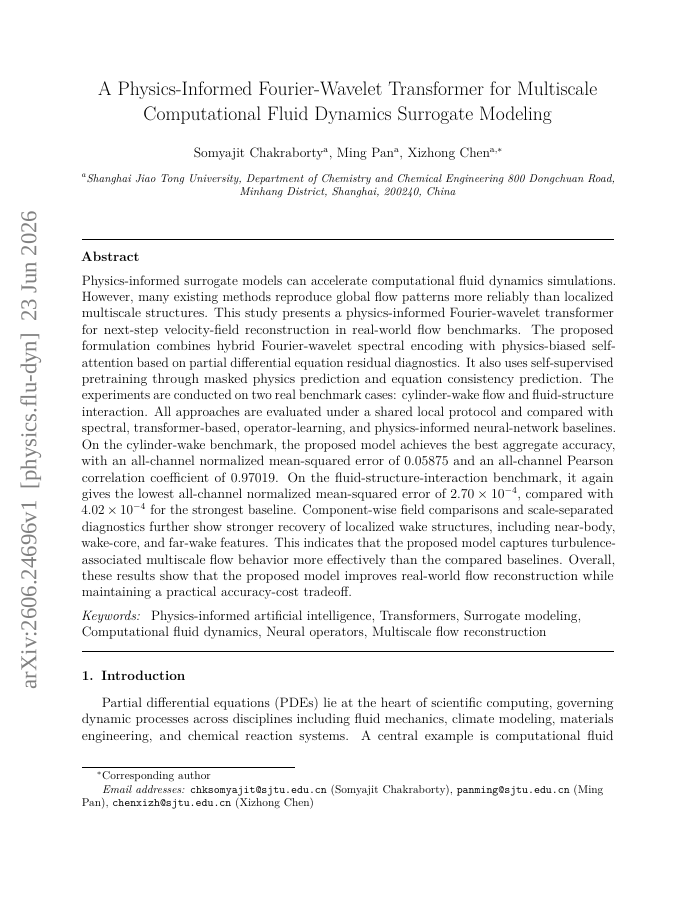
Physics-informed surrogate models can accelerate computational fluid dynamics simulations. However, many existing methods reproduce global flow patterns more reliably than localized multiscale structures.
23 Jun 2026
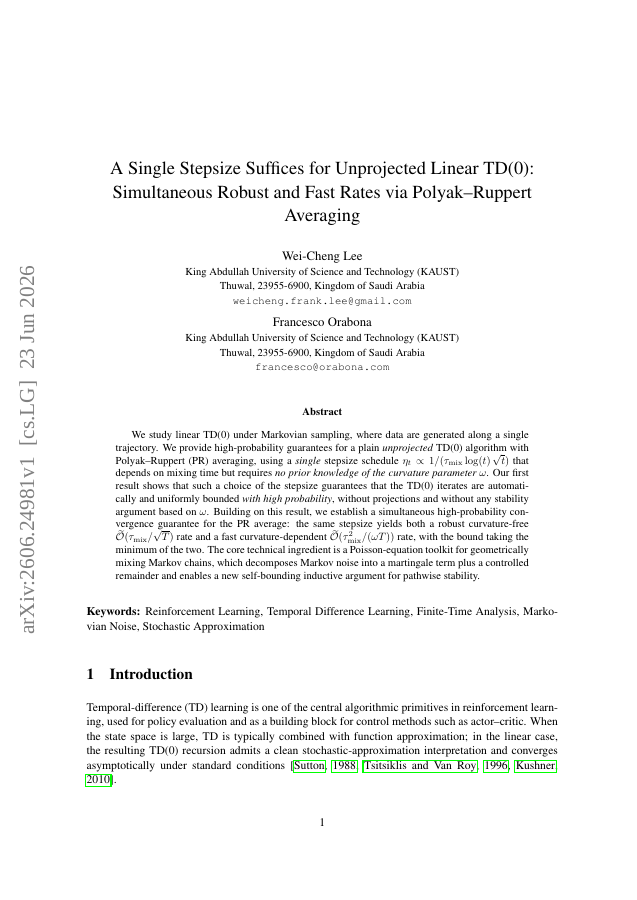
We study linear TD(0) under Markovian sampling, where data are generated along a single trajectory. We provide high-probability guarantees for a plain unprojected TD(0) algorithm with Polyak-Ruppert (PR) averaging, using a single stepsize schedule $η_t \propto…
23 Jun 2026
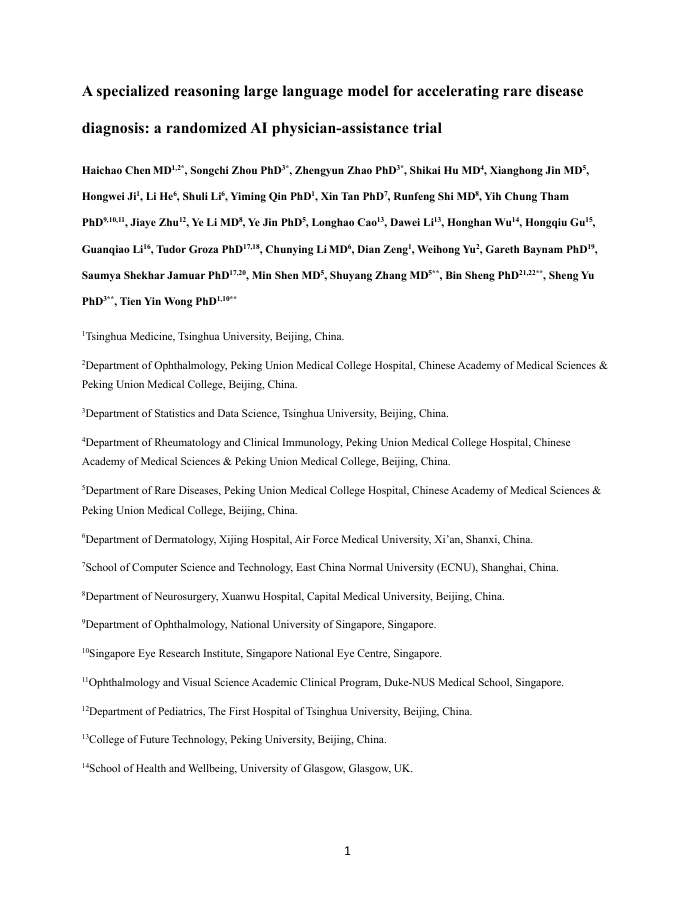
Rare diseases affect millions of individuals worldwide, yet timely diagnosis remains a major public health challenge due to scarcity of specialized clinical expertise. While large language models (LLMs) show promise to support rare disease diagnosis, current models are…
23 Jun 2026
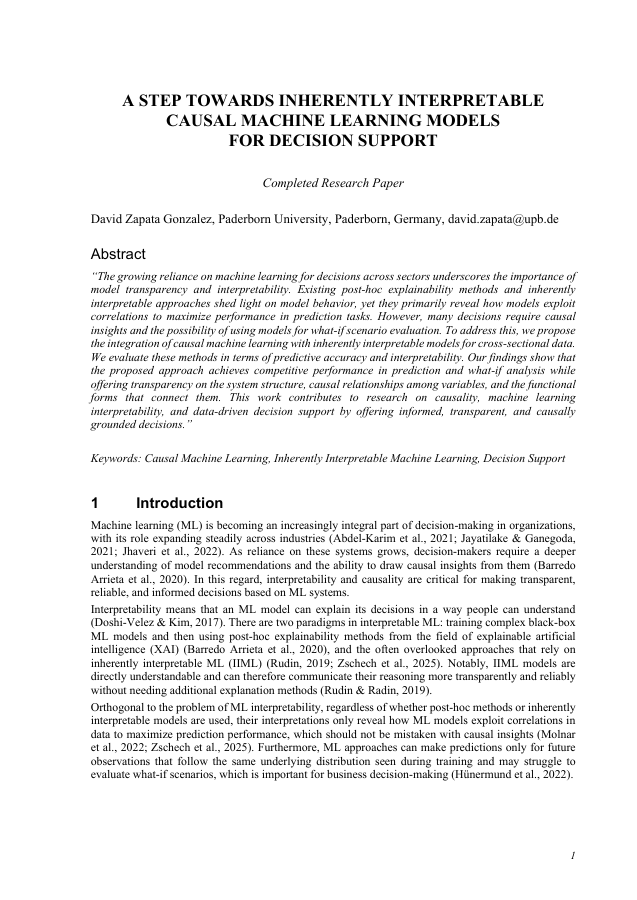
The growing reliance on machine learning for decisions across sectors underscores the importance of model transparency and interpretability. Existing post hoc explainability methods and inherently interpretable approaches shed light on model behavior, yet they primarily reveal…
23 Jun 2026
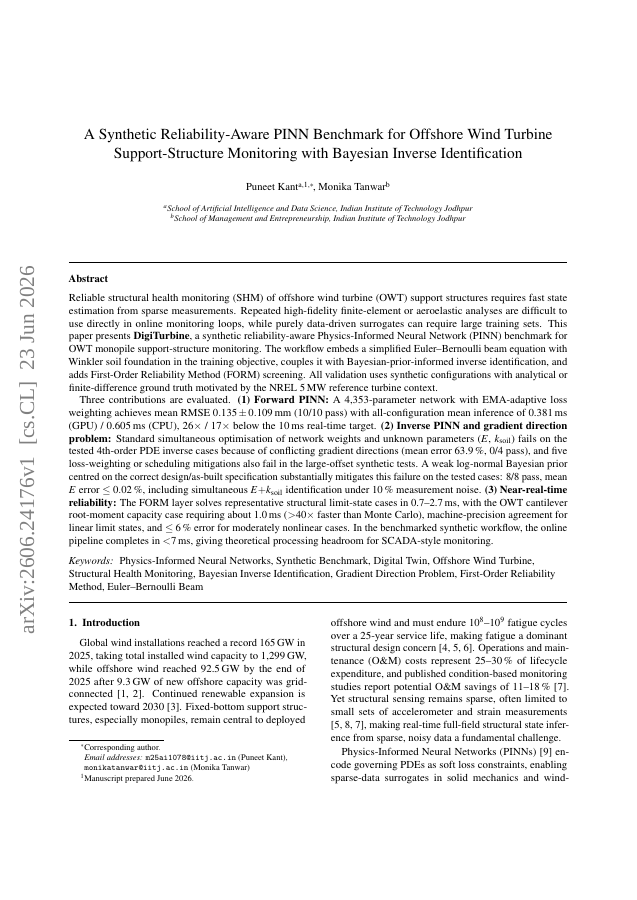
Reliable structural health monitoring (SHM) of offshore wind turbine (OWT) support structures requires fast state estimation from sparse measurements. Repeated high fidelity finite element or aeroelastic analyses are difficult to use directly in online monitoring loops, while…
23 Jun 2026
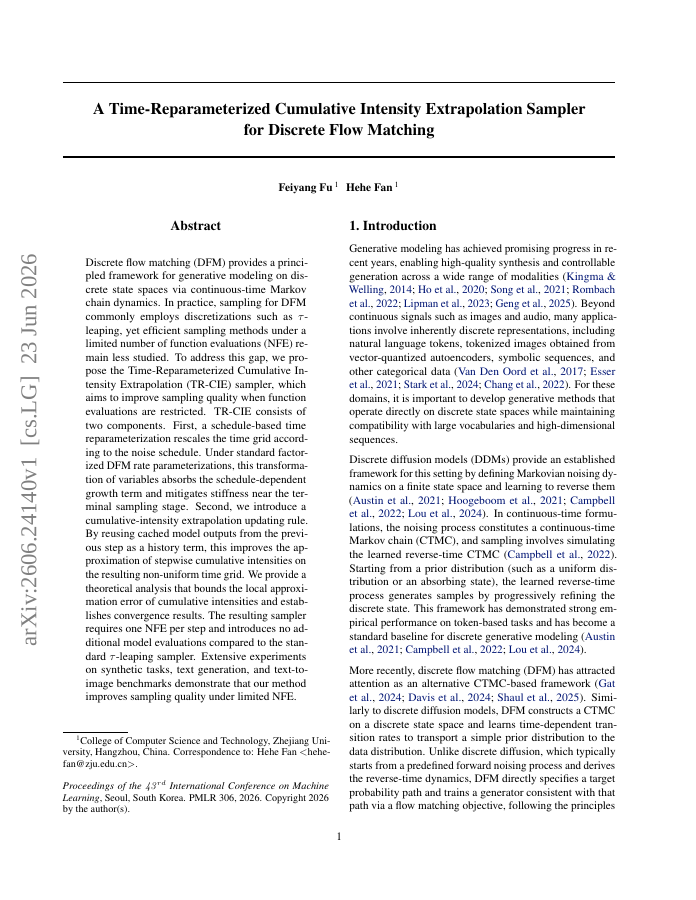
Discrete flow matching (DFM) provides a principled framework for generative modeling on discrete state spaces via continuous-time Markov chain dynamics. In practice, sampling for DFM commonly employs discretizations such as $τ$-leaping, yet efficient sampling methods under a…
23 Jun 2026
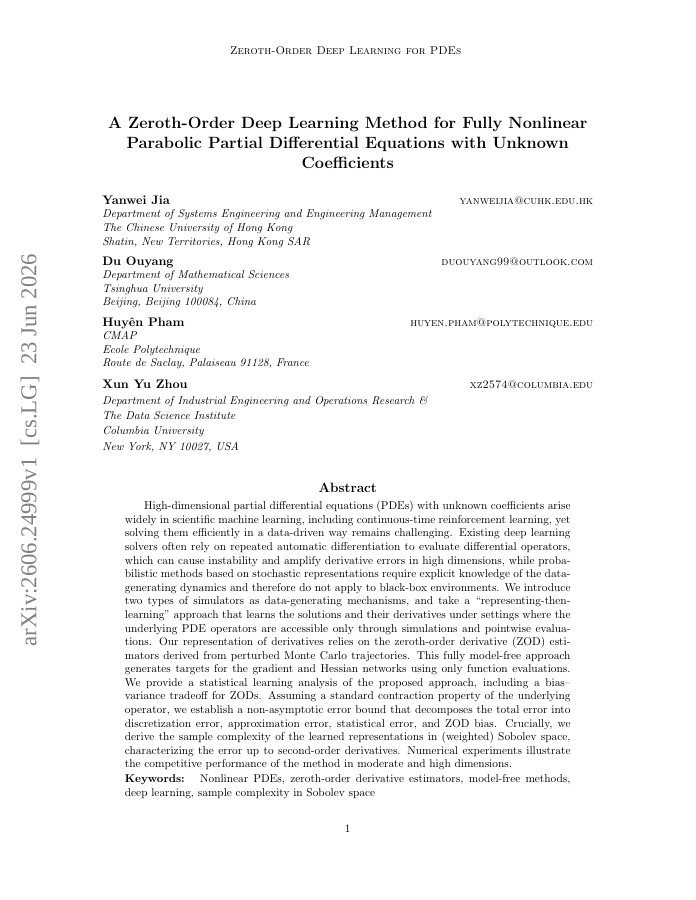
High-dimensional partial differential equations (PDEs) with unknown coefficients arise widely in scientific machine learning, including continuous-time reinforcement learning, yet solving them efficiently in a data-driven way remains challenging.
23 Jun 2026
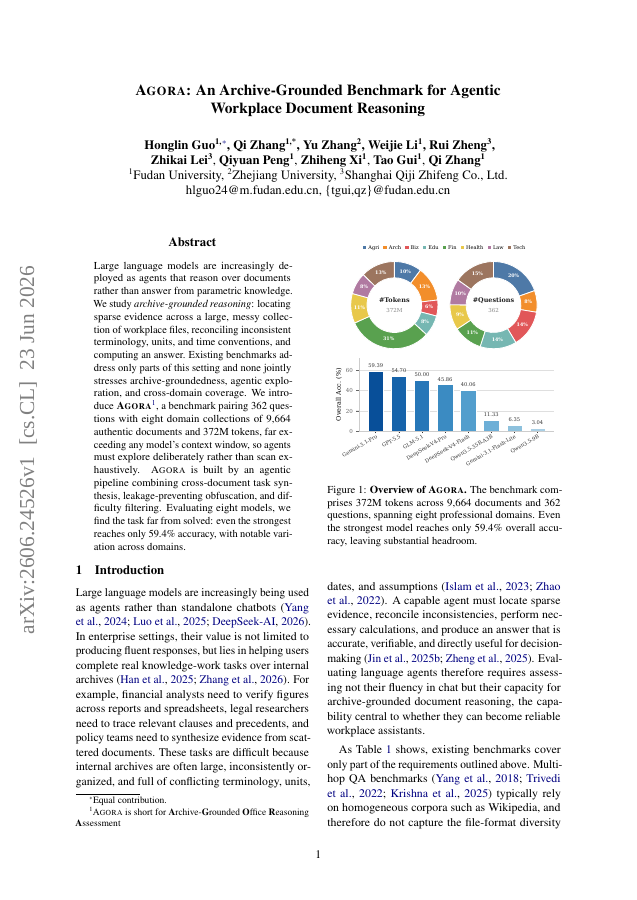
Large language models are increasingly deployed as agents that reason over documents rather than answer from parametric knowledge. We study archive-grounded reasoning: locating sparse evidence across a large, messy collection of workplace files, reconciling inconsistent…
22 Jun 2026
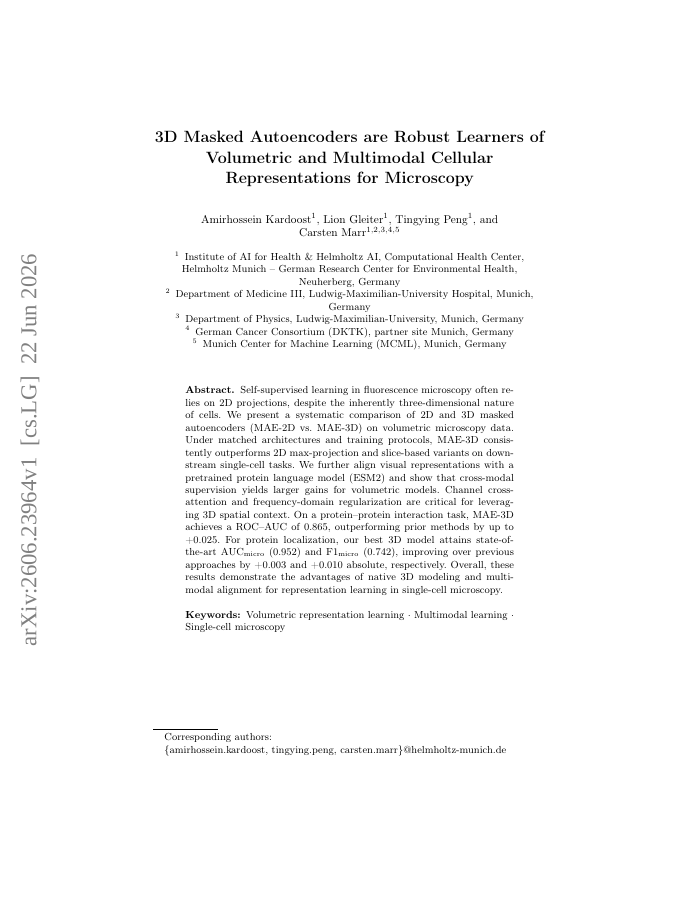
Self-supervised learning in fluorescence microscopy often relies on 2D projections, despite the inherently three-dimensional nature of cells. We present a systematic comparison of 2D and 3D masked autoencoders (MAE-2D vs. MAE-3D) on volumetric microscopy data.
22 Jun 2026
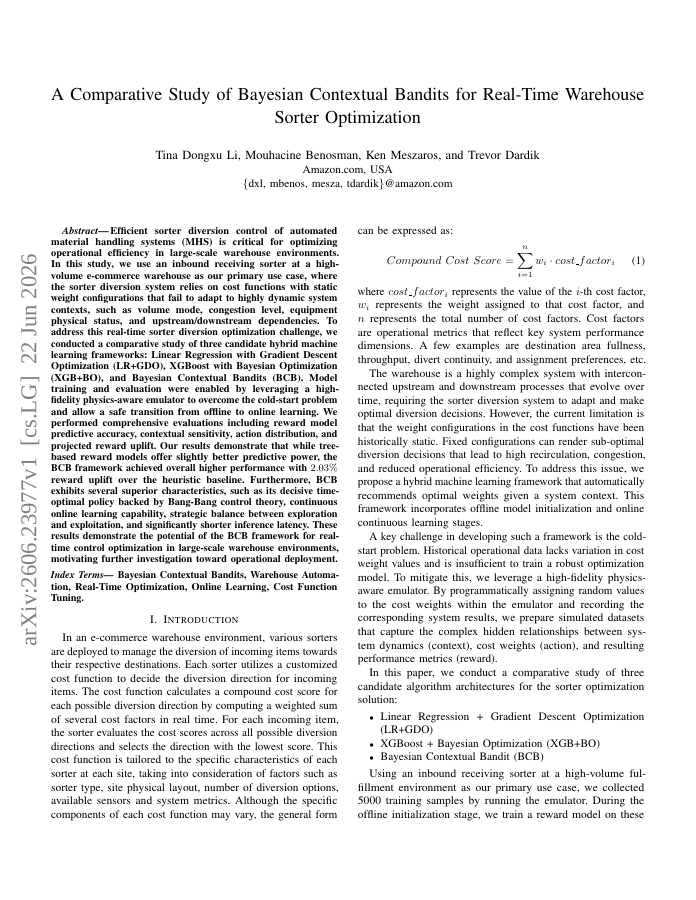
Efficient sorter diversion control of automated material handling systems (MHS) is critical for optimizing operational efficiency in large-scale warehouse environments. In this study, we use an inbound receiving sorter at a high-volume e-commerce warehouse as our primary use…
22 Jun 2026
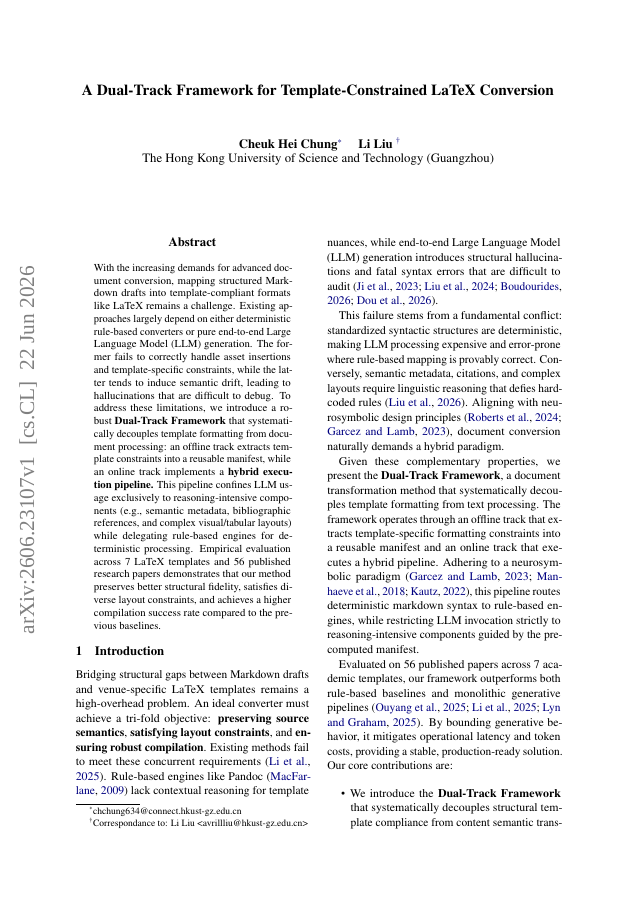
With the increasing demands for advanced document conversion, mapping structured Markdown drafts into template-compliant formats like LaTeX remains a challenge. Existing approaches largely depend on either deterministic rule-based converters or pure end-to-end Large Language…
22 Jun 2026
We study Transformer-type residual layers under cross-entropy training through a continuous-depth mean field control viewpoint. Depth is treated as time, layer parameters as controls, and the residual Transformer recursion as an explicit Euler scheme for a controlled…
22 Jun 2026
On-policy distillation (OPD) trains an LLM on states induced by the current or recent student policy: the student generates complete or partial rollouts, a teacher or self-teacher scores the resulting tokens under their generated contexts, and dense log-probability, logit, or…
22 Jun 2026
Traffic microsimulators rely on hand-crafted behavior models that reproduce aggregate flow but miss the heterogeneous interactions between vehicles at signalized intersections.
22 Jun 2026
Agency is widely invoked in biology, cognitive science, artificial intelligence, and philosophy, yet its organizational basis, its empirical thresholds, and the operational criteria that distinguish it from other teleonomic terminology remain unsettled.
22 Jun 2026
Predicting temporal Quality of Service (QoS) data is critical for optimizing network services and rationalizing resource allocation in cloud computing and service-oriented systems. Existing mainstream methods have achieved promising predictive performance.
22 Jun 2026
Digital twins (DTs) have become a potential technology to perform risk-free simulation of physical entities for deterministic and high-reliability services in diverse scenarios such as autonomous driving and low-altitude economy.
22 Jun 2026
We develop a spectral theory for \emph{normalized corrected GNN propagation}. The object of study is the symmetric normalized adjacency with its degree-stationary component removed, matching the normalization used by standard GCN-style models while isolating the stationary…
22 Jun 2026
Large language model (LLM) agents increasingly operate as multi-turn systems that must allocate context, prompt verbosity, and tool access under finite computational budgets.
21 Jun 2026
Explanation requires ground truth: to verify an account of a system we must know its inner functioning-just what is missing where explainable AI (XAI) is most needed. Systems we can study fall into two camps.