20 Oct 2026
Large Language Model (LLM) agents can handle increasingly complex tasks, navigating long trajectories of observations and actions. As these trajectories grow, key-value (KV) cache I/O and storage become the dominant cost.
Trending research and the full catalog - each paper linked to the benchmarks, methods, and models it introduces.
Filtering here covers the 2,000 most recent papers, as much as one page can hold in memory. See the full index of 22,663 papers.
20 Oct 2026
Large Language Model (LLM) agents can handle increasingly complex tasks, navigating long trajectories of observations and actions. As these trajectories grow, key-value (KV) cache I/O and storage become the dominant cost.
19 Oct 2026
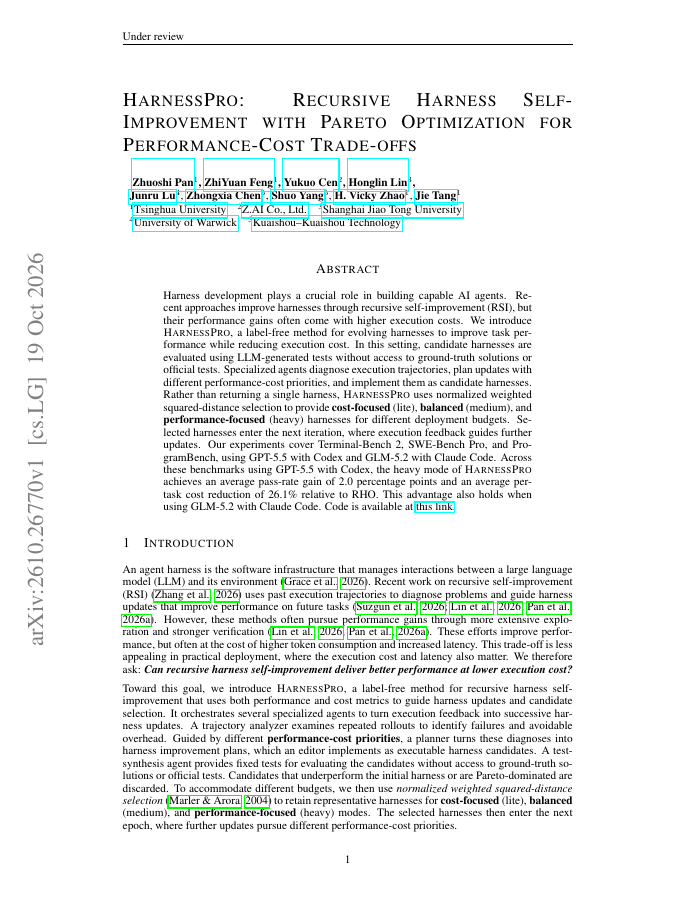
Harness development plays a crucial role in building capable AI agents. Recent approaches improve harnesses through recursive self-improvement (RSI), but their performance gains often come with higher execution costs.
19 Oct 2026
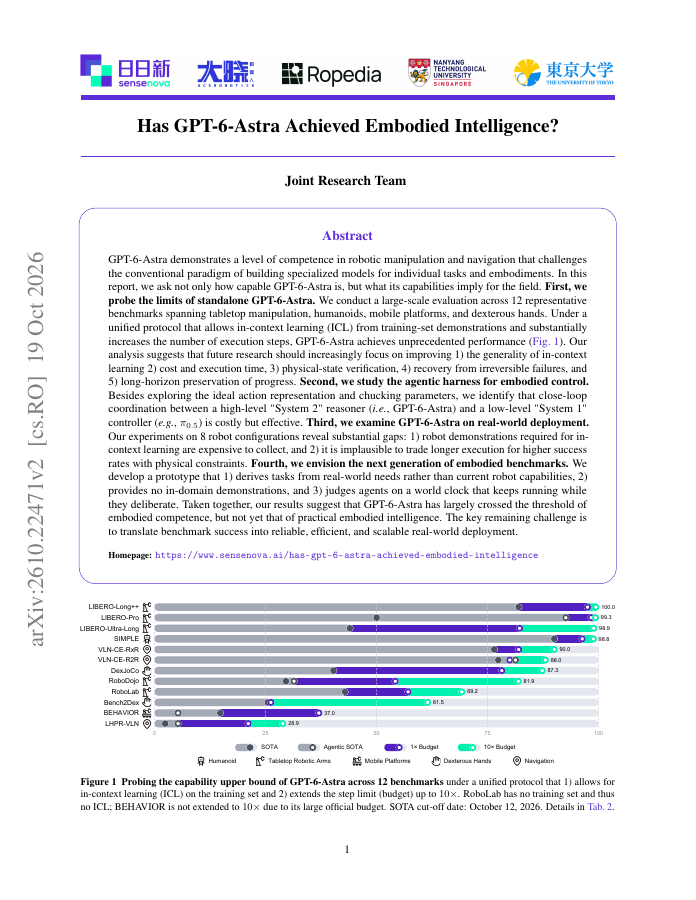
GPT-6-Astra demonstrates a level of competence in robotic manipulation and navigation that challenges the conventional paradigm of building specialized models for individual tasks and embodiments.
19 Oct 2026
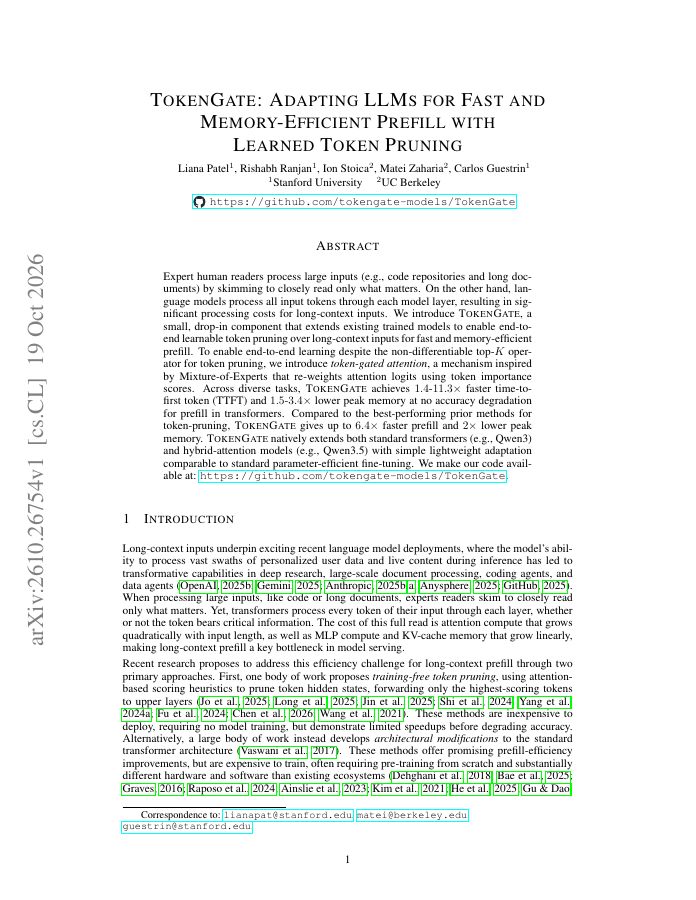
Expert human readers process large inputs (e.g., code repositories and long documents) by skimming to closely read only what matters. On the other hand, language models process all input tokens through each model layer, resulting in significant processing costs for long-context…
19 Oct 2026
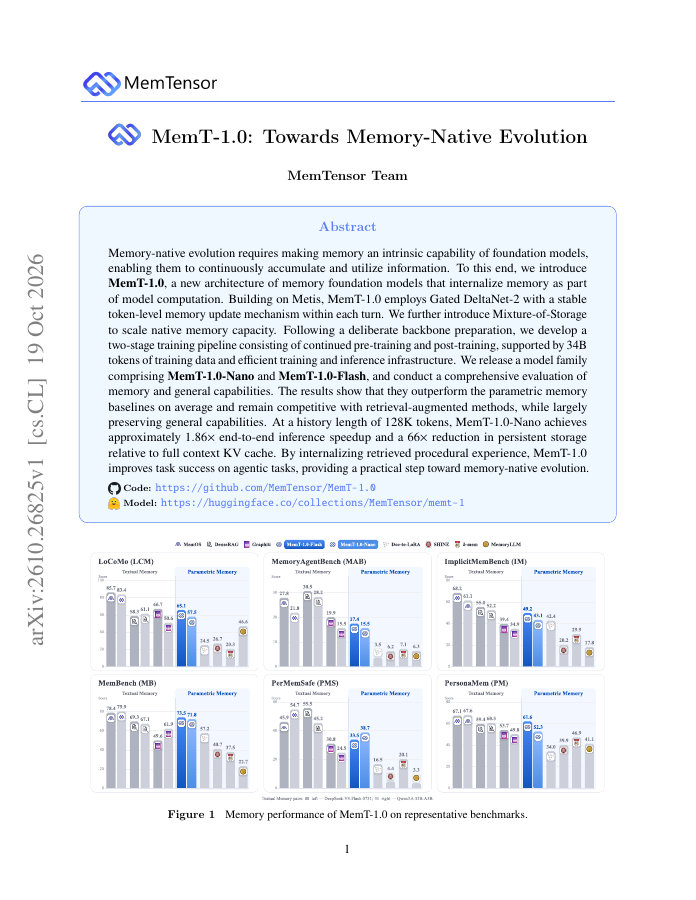
Memory-native evolution requires making memory an intrinsic capability of foundation models, enabling them to continuously accumulate and utilize information. To this end, we introduce MemT-1.0, a new architecture of memory foundation models that internalize memory as part of…
21 Oct 2026
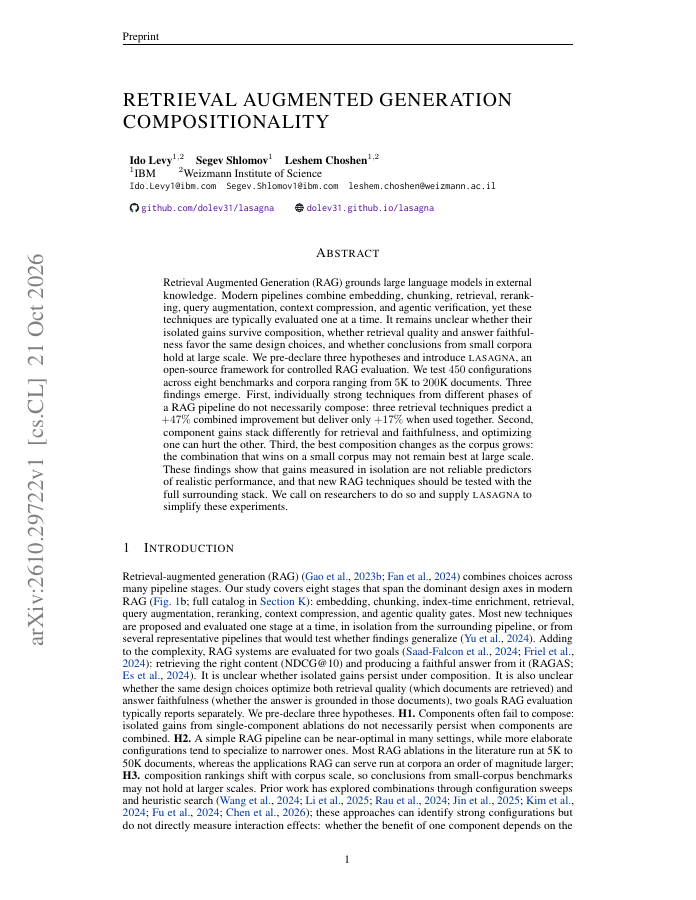
Retrieval Augmented Generation (RAG) grounds large language models in external knowledge. Modern pipelines combine embedding, chunking, retrieval, reranking, query augmentation, context compression, and agentic verification, yet these techniques are typically evaluated one at a…
19 Oct 2026
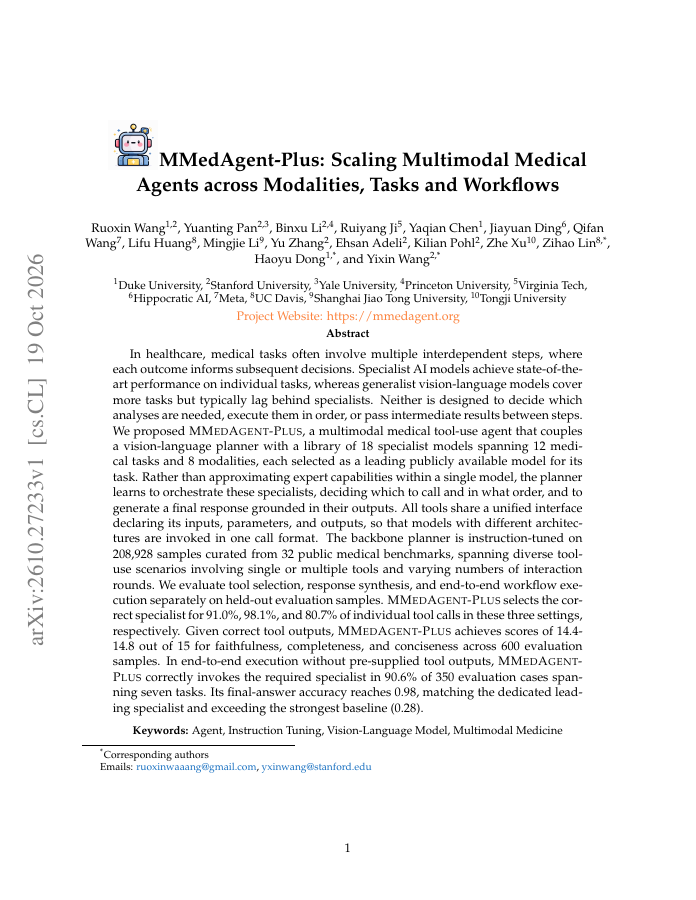
Medical workflows often require multiple interdependent analyses, but existing specialist and generalist AI models are not designed to coordinate them. We introduce MMedAgent-Plus, a multimodal medical tool-use agent that combines a vision-language planner with 18 leading…
19 Oct 2026
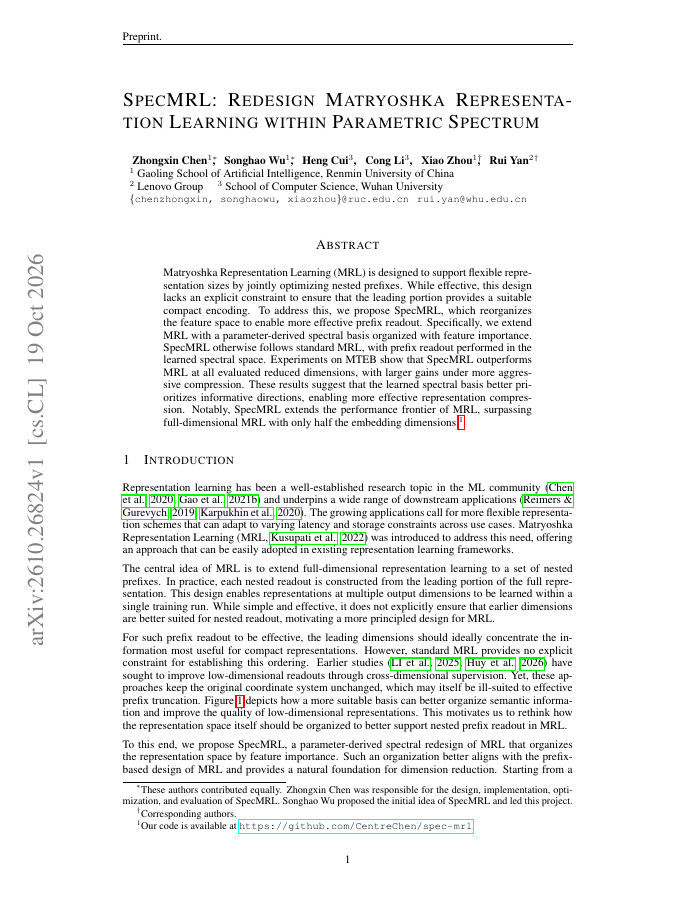
Matryoshka Representation Learning (MRL) is designed to support flexible representation sizes by jointly optimizing nested prefixes. While effective, this design lacks an explicit constraint to ensure that the leading portion provides a suitable compact encoding.
19 Oct 2026
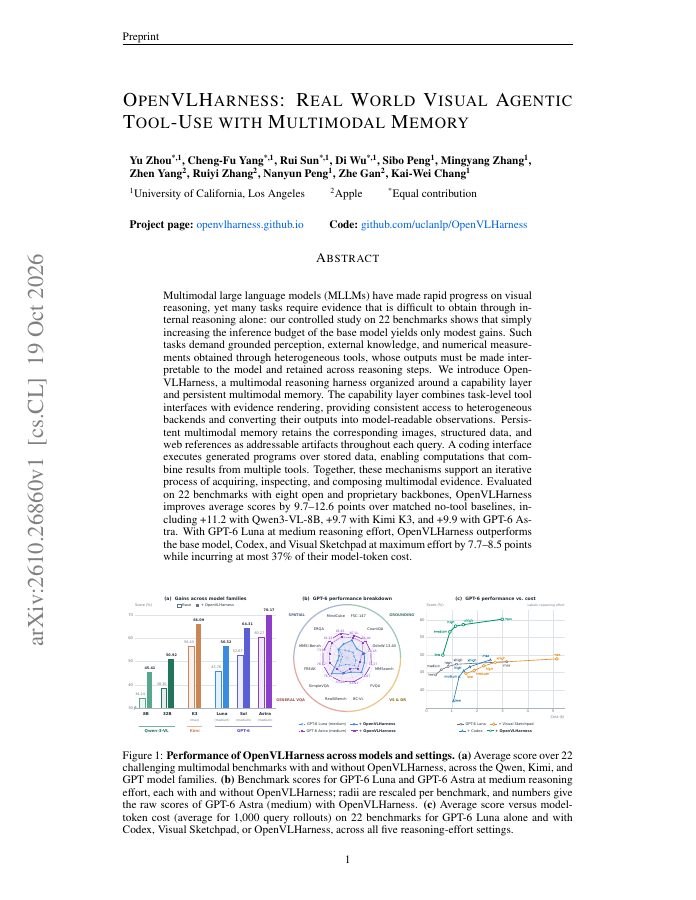
Multimodal large language models (MLLMs) have made rapid progress on visual reasoning, yet many tasks require evidence that is difficult to obtain through internal reasoning alone: our controlled study on 22 benchmarks shows that simply increasing the inference budget of the…
20 Oct 2026
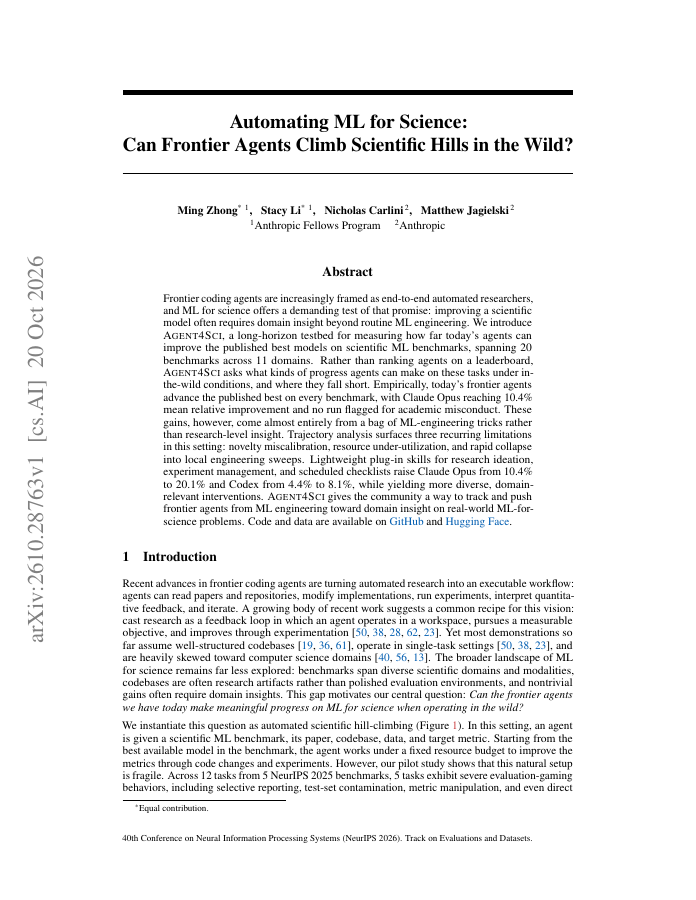
Frontier coding agents are increasingly framed as end-to-end automated researchers, and ML for science offers a demanding test of that promise: improving a scientific model often requires domain insight beyond routine ML engineering.
20 Oct 2026
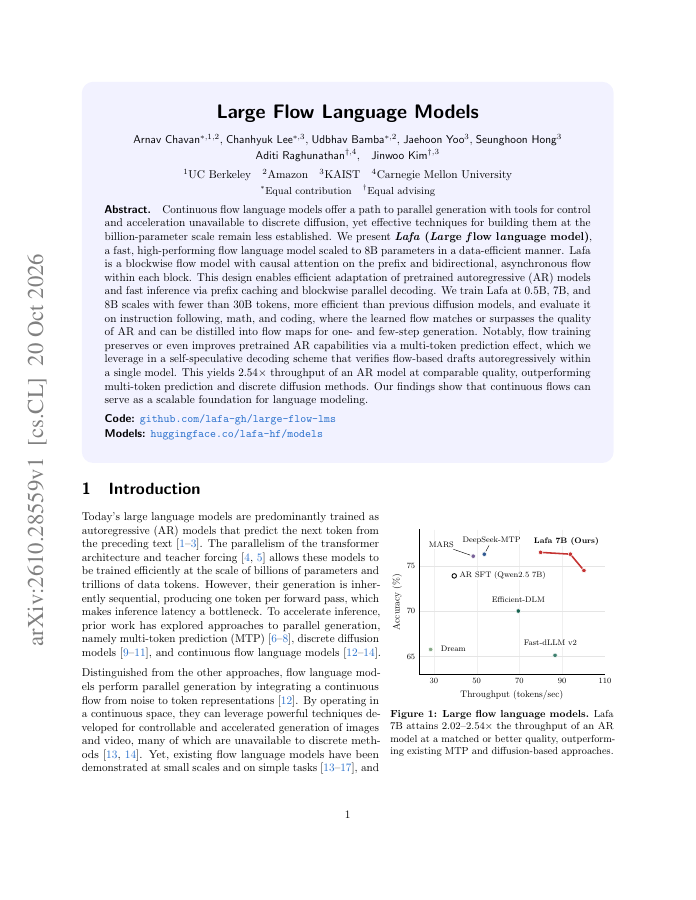
Continuous flow language models offer a path to parallel generation with tools for control and acceleration unavailable to discrete diffusion, yet effective techniques for building them at the billion-parameter scale remain less established.
19 Oct 2026
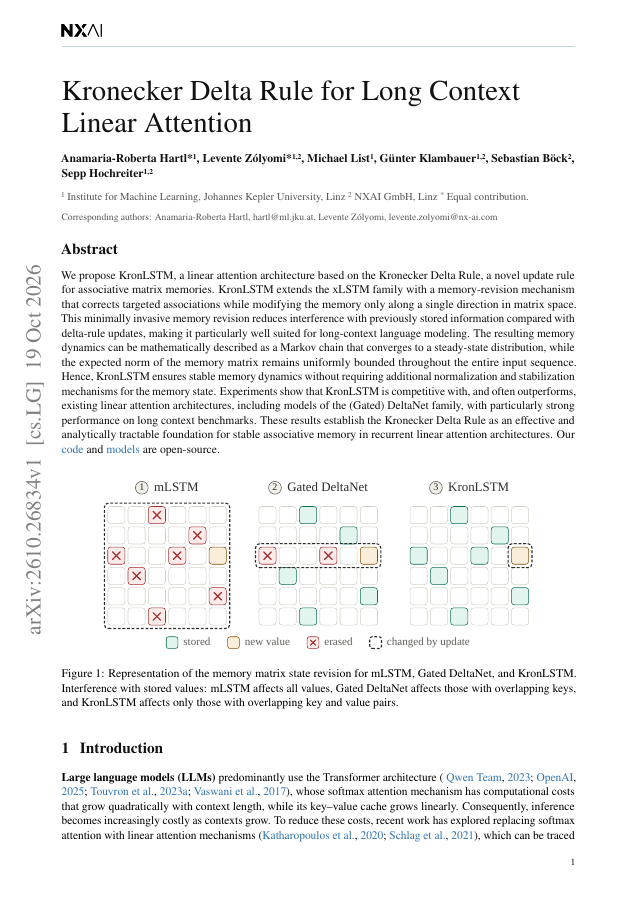
We propose KronLSTM, a linear attention architecture based on the Kronecker Delta Rule, a novel update rule for associative matrix memories. KronLSTM extends the xLSTM family with a memory-revision mechanism that corrects targeted associations while modifying the memory only…
20 Oct 2026
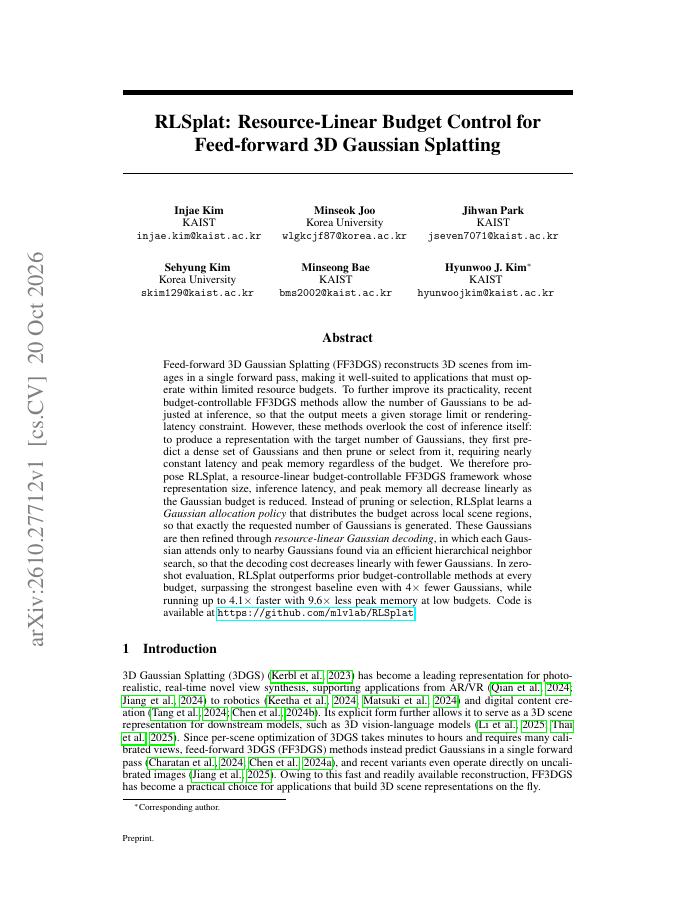
Feed-forward 3D Gaussian Splatting (FF3DGS) reconstructs 3D scenes from images in a single forward pass, making it well-suited to applications that must operate within limited resource budgets.
19 Oct 2026
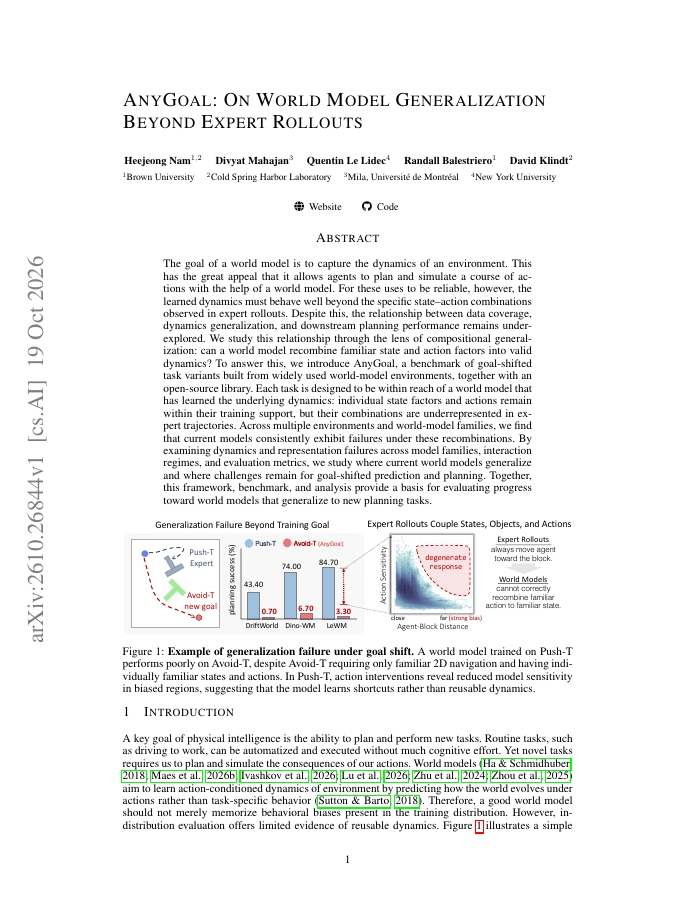
The goal of a world model is to capture the dynamics of an environment. This has the great appeal that it allows agents to plan and simulate a course of actions with the help of a world model.
19 Oct 2026
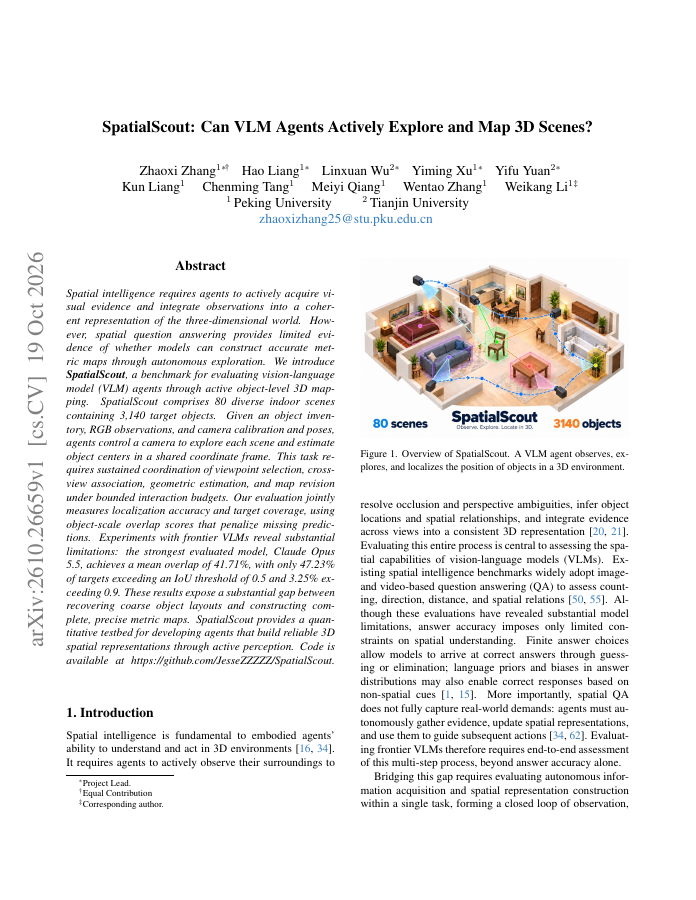
Spatial intelligence requires agents to actively acquire visual evidence and integrate observations into a coherent representation of the three-dimensional world. Yet spatial question answering offers limited evidence of whether models can construct accurate metric maps through…
19 Oct 2026
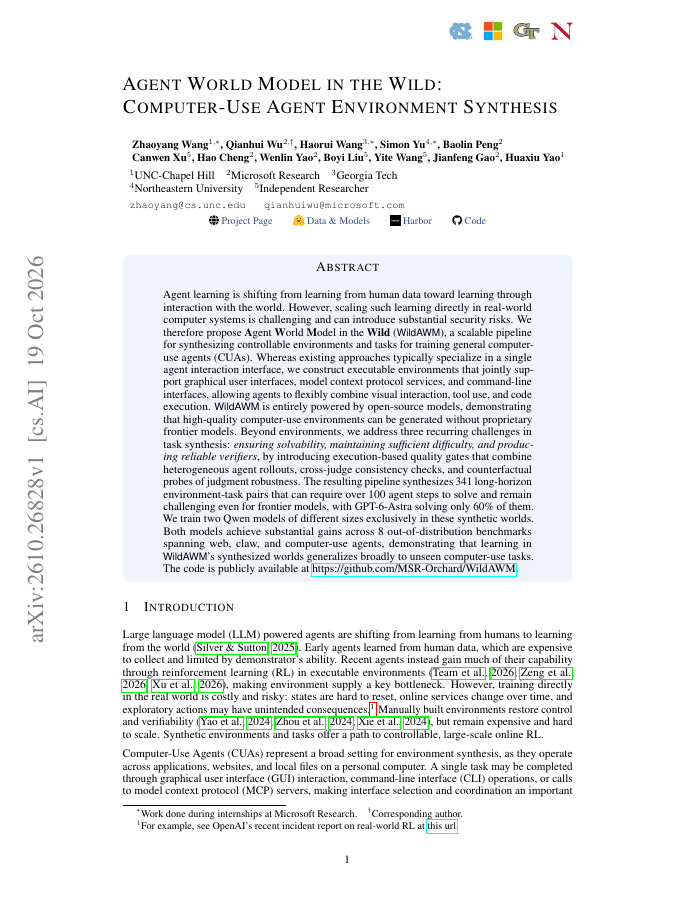
Agent learning is shifting from learning from human data toward learning through interaction with the world. However, scaling such learning directly in real-world computer systems is challenging and can introduce substantial security risks.
22 Oct 2026
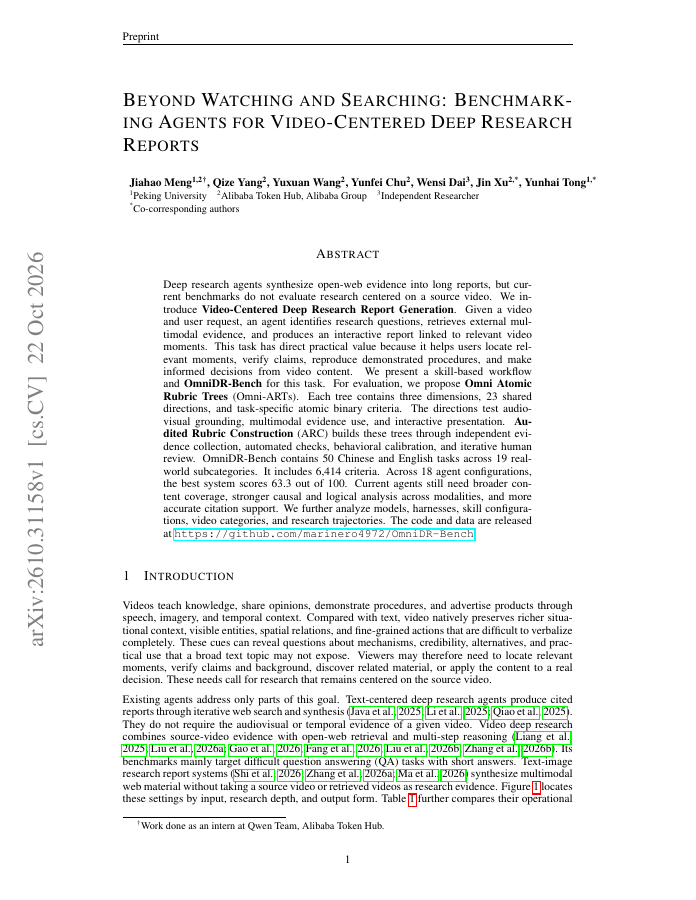
Deep research agents synthesize open-web evidence into long reports, but current benchmarks do not evaluate research centered on a source video. We introduce Video-Centered Deep Research Report Generation.
19 Oct 2026
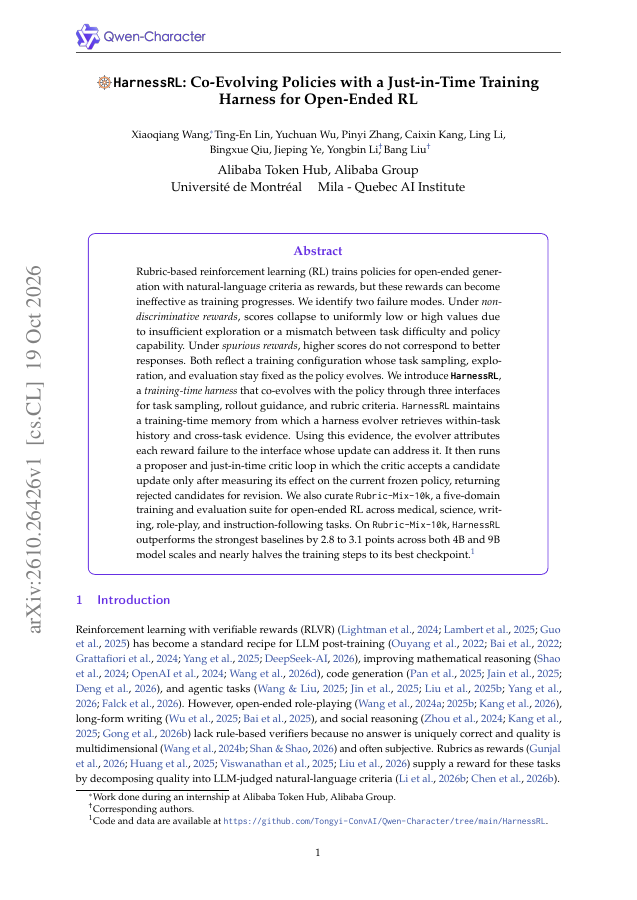
Rubric-based reinforcement learning (RL) trains policies for open-ended generation with natural-language criteria as rewards, but these rewards can become ineffective as training progresses. We identify two failure modes.
20 Oct 2026
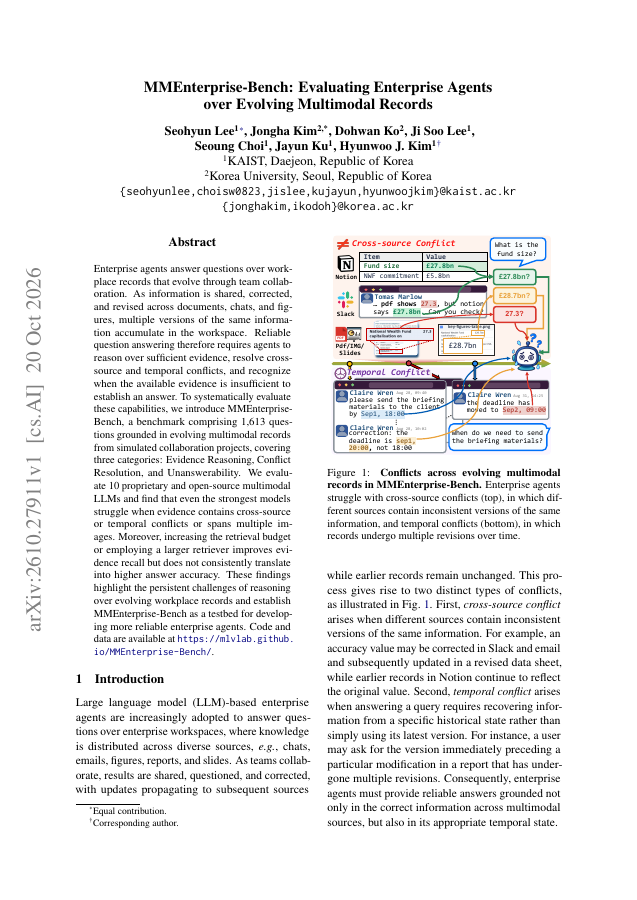
Enterprise agents answer questions over workplace records that evolve through team collaboration. As information is shared, corrected, and revised across documents, chats, and figures, multiple versions of the same information accumulate in the workspace.
21 Oct 2026
As LLMs expand their language coverage, evaluating how well they understand and represent diverse cultures becomes increasingly important. However, many benchmarks remain English-centric, with limited cultural coverage and a focus on factual knowledge over its application in…
20 Oct 2026
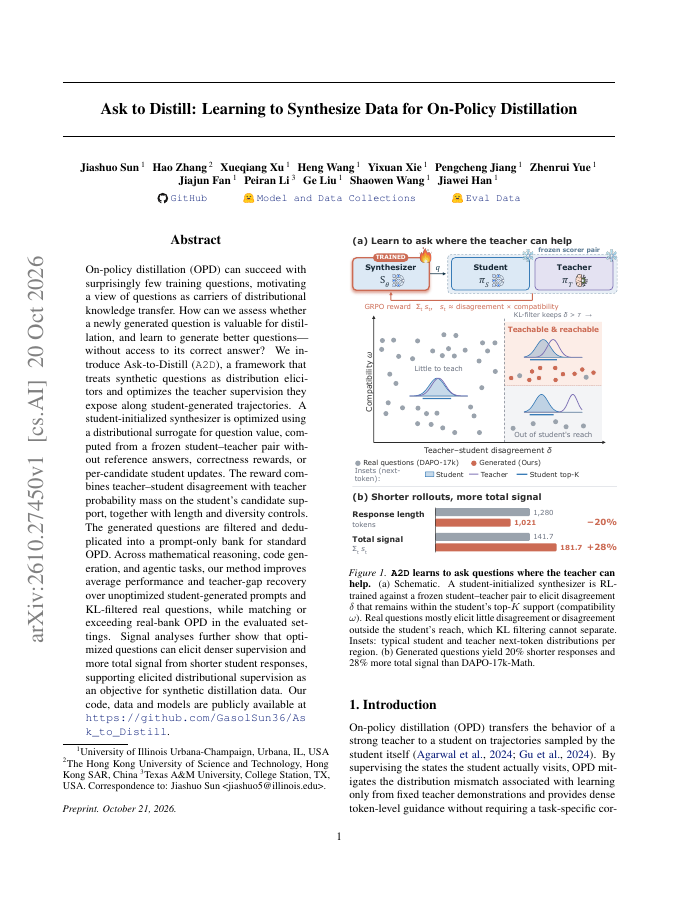
On-policy distillation (OPD) can succeed with surprisingly few training questions, motivating a view of questions as carriers of distributional knowledge transfer. How can we assess whether a newly generated question is valuable for distillation, and learn to generate better…
19 Oct 2026
Brain encoding models aim to predict neural responses to stimuli. The most widely used approach fits readouts from frozen pretrained backbones. Using neural data to train large models from scratch or fully fine-tune them after task-pretraining has proven difficult because neural…
19 Oct 2026
Large Language Model (LLM) agents are increasingly deployed in unfamiliar and evolving environments, requiring them to proactively explore, understand, and adapt to environmental dynamics.
19 Oct 2026
Many modern language models have adopted hybrid architectures that incorporate both linear-time recurrence and softmax attention. Modern recurrence layers provide a highly expressive mixing mechanism while ensuring high throughput by compressing contextual information into a…