9 Oct 2026
LLM agents' capabilities depend not only on their underlying models but also on their execution harnesses. Recursive self-improvement (RSI) offers a promising approach to automatically evolve these harnesses.
Trending research and the full catalog - each paper linked to the benchmarks, methods, and models it introduces.
Filtering here covers the 2,000 most recent papers, as much as one page can hold in memory. See the full index of 22,663 papers.
9 Oct 2026
LLM agents' capabilities depend not only on their underlying models but also on their execution harnesses. Recursive self-improvement (RSI) offers a promising approach to automatically evolve these harnesses.
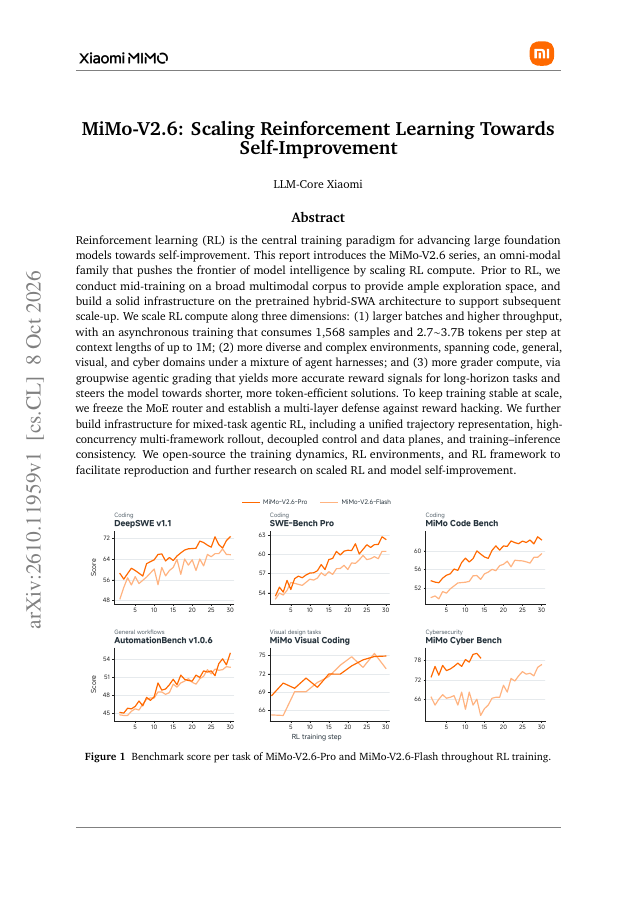
8 Oct 2026
Reinforcement learning (RL) is the central training paradigm for advancing large foundation models towards self-improvement. This report introduces the MiMo-V2.6 series, an omni-modal family that pushes the frontier of model intelligence by scaling RL compute.
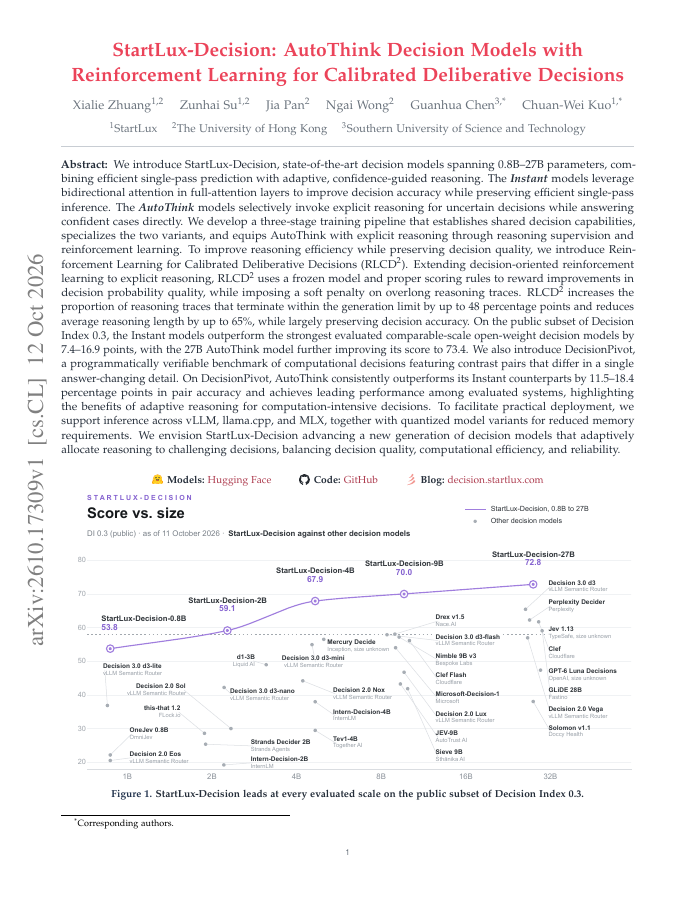
12 Oct 2026
We introduce StartLux-Decision, decision models from 0.8B to 27B parameters that combine efficient single-pass prediction with adaptive, confidence-guided reasoning. The Instant models use bidirectional attention in full-attention layers to improve decision accuracy while…
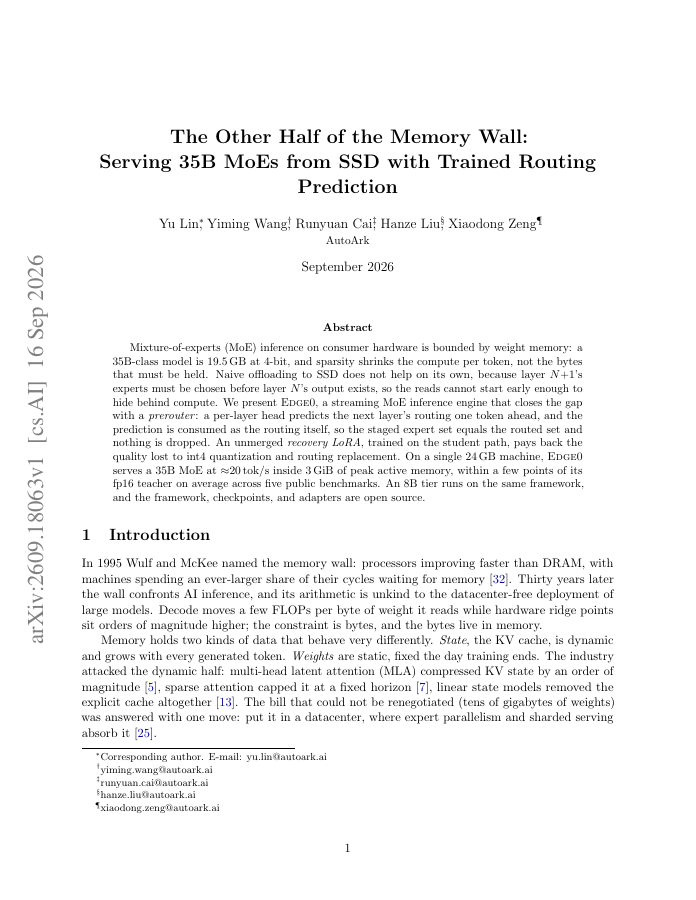
16 Sep 2026
Mixture-of-experts (MoE) inference on consumer hardware is bounded by weight memory: a 35B-class model is 19.5GB at 4-bit, and sparsity shrinks the compute per token, not the bytes that must be held.
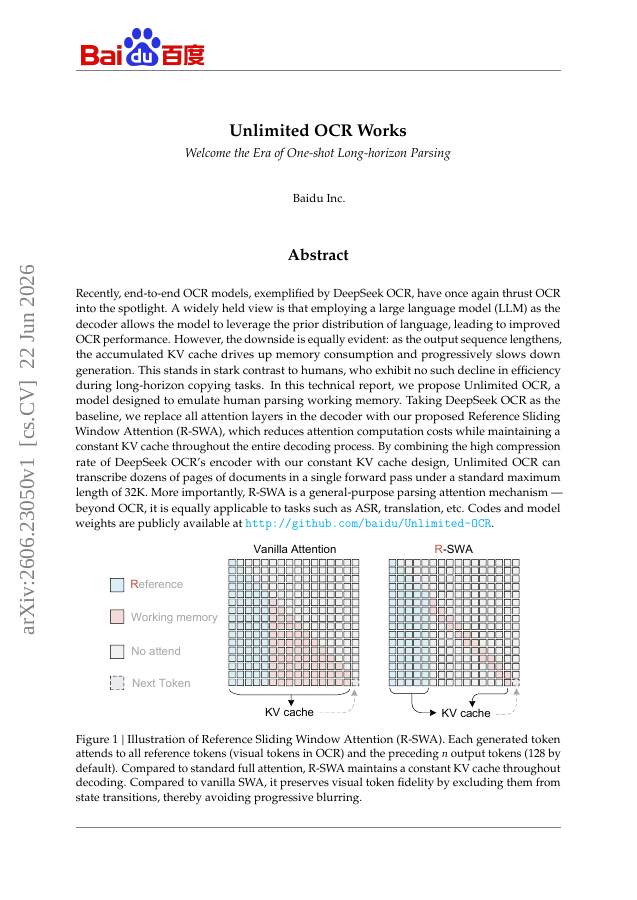
22 Jun 2026
Recently, end-to-end OCR models, exemplified by DeepSeek OCR, have once again thrust OCR into the spotlight. A widely held view is that employing a large language model (LLM) as the decoder allows the model to leverage the prior distribution of language, leading to improved OCR…
17 Sep 2026
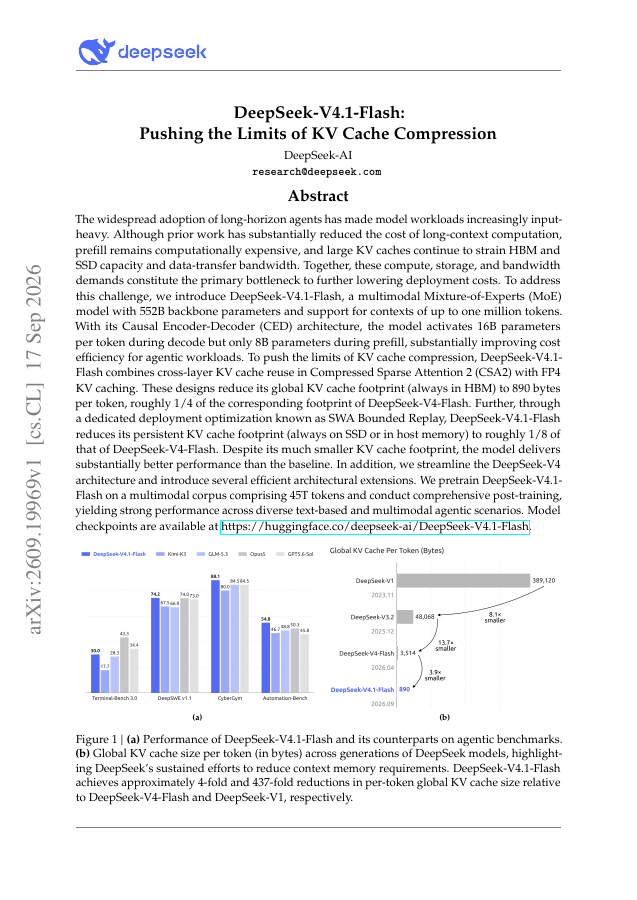
The widespread adoption of long-horizon agents has made model workloads increasingly input-heavy. Although prior work has substantially reduced the cost of long-context computation, prefill remains computationally expensive, and large KV caches continue to strain HBM and SSD…
15 Oct 2026
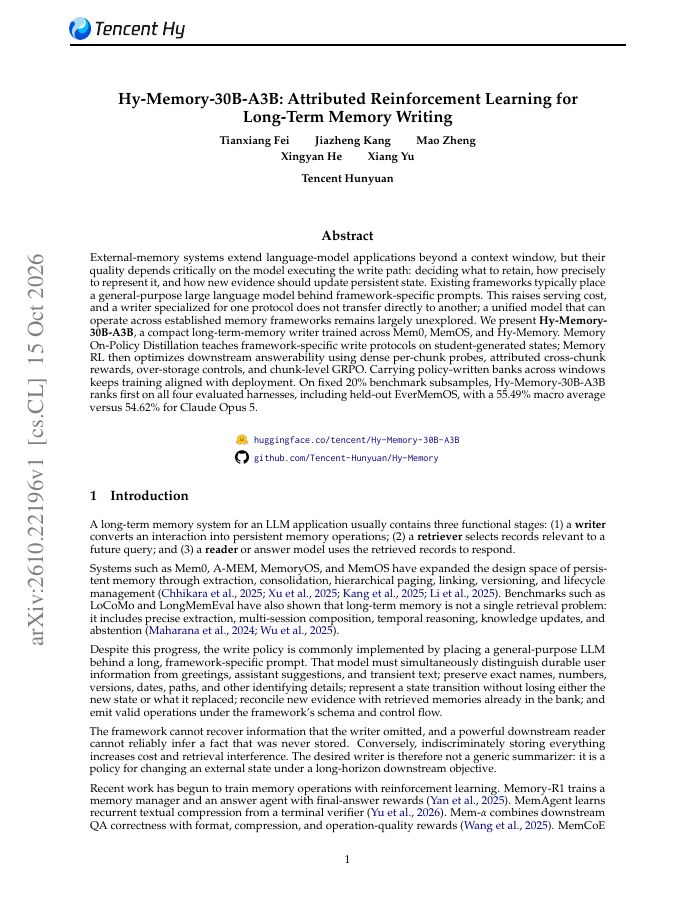
External-memory systems extend language-model applications beyond a context window, but their quality depends critically on the model executing the write path: deciding what to retain, how precisely to represent it, and how new evidence should update persistent state.
21 Jul 2026
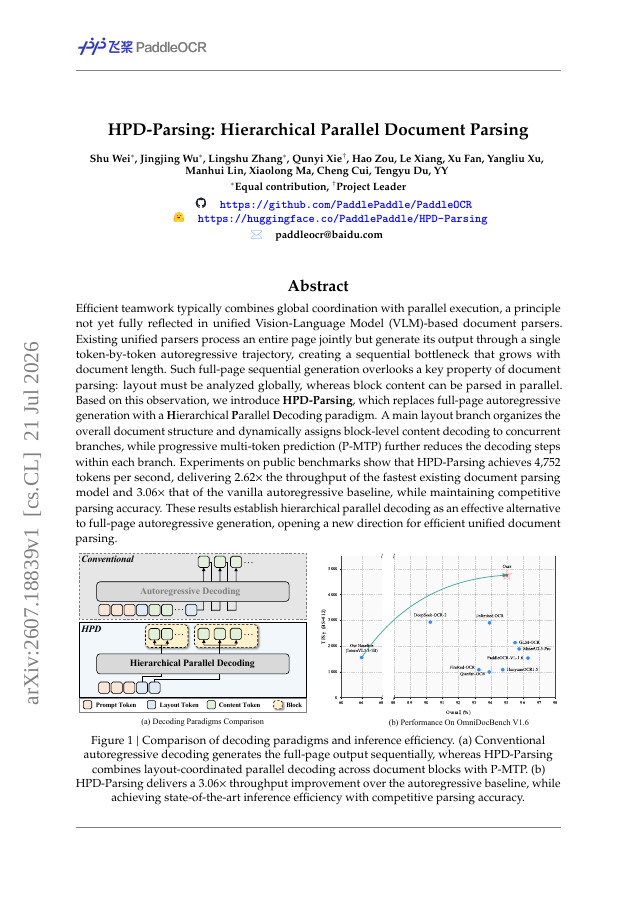
Efficient teamwork typically combines global coordination with parallel execution, a principle not yet fully reflected in unified Vision-Language Model (VLM)-based document parsers.
6 Oct 2026
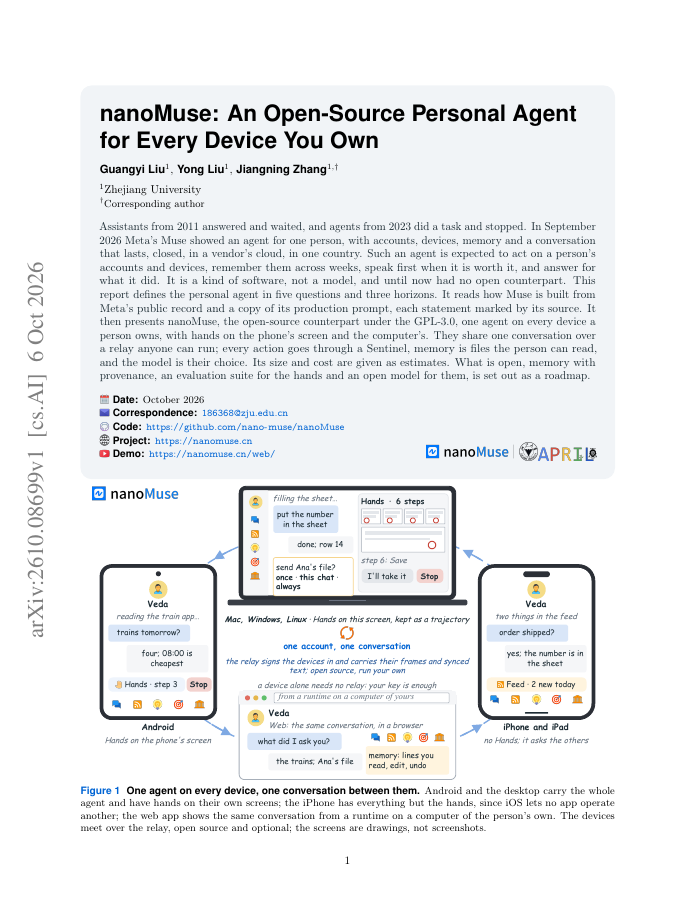
Assistants from 2011 answered and waited, and agents from 2023 did a task and stopped. In September 2026 Meta's Muse showed an agent for one person, with accounts, devices, memory and a conversation that lasts, closed, in a vendor's cloud, in one country.
27 Sep 2026
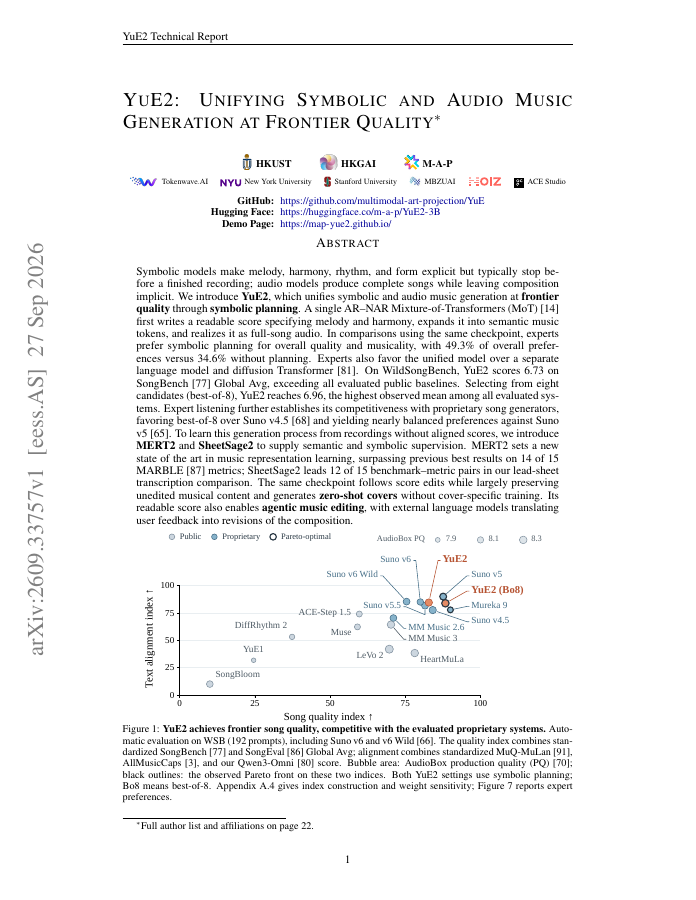
Symbolic models make melody, harmony, rhythm, and form explicit but typically stop before a finished recording; audio models produce complete songs while leaving composition implicit.
2 Jun 2026
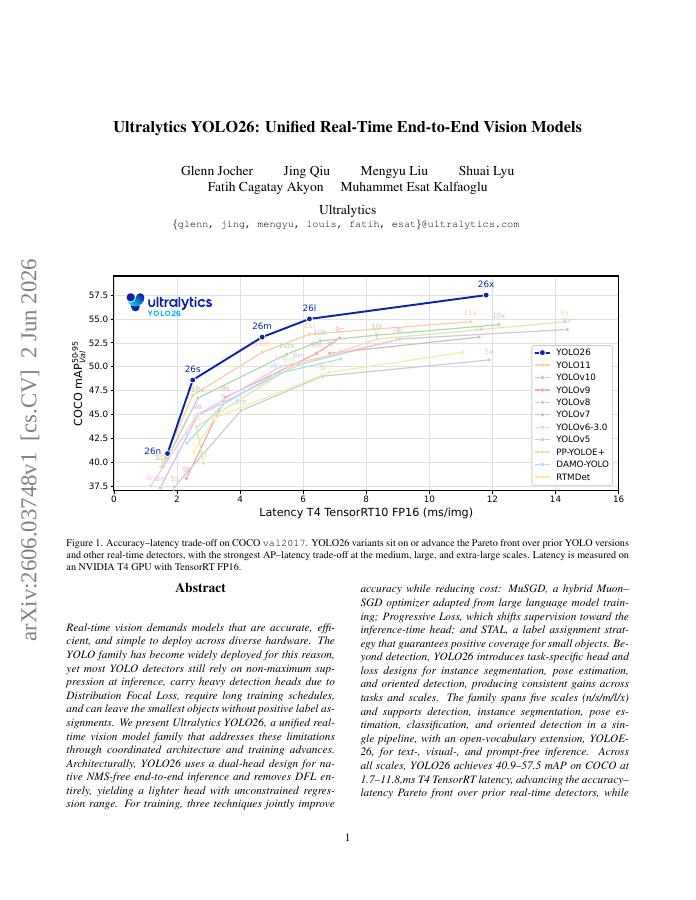
Real-time vision demands models that are accurate, efficient, and simple to deploy across diverse hardware. The YOLO family has become widely deployed for this reason, yet most YOLO detectors still rely on non-maximum suppression at inference, carry heavy detection heads due to…
4 Sep 2026
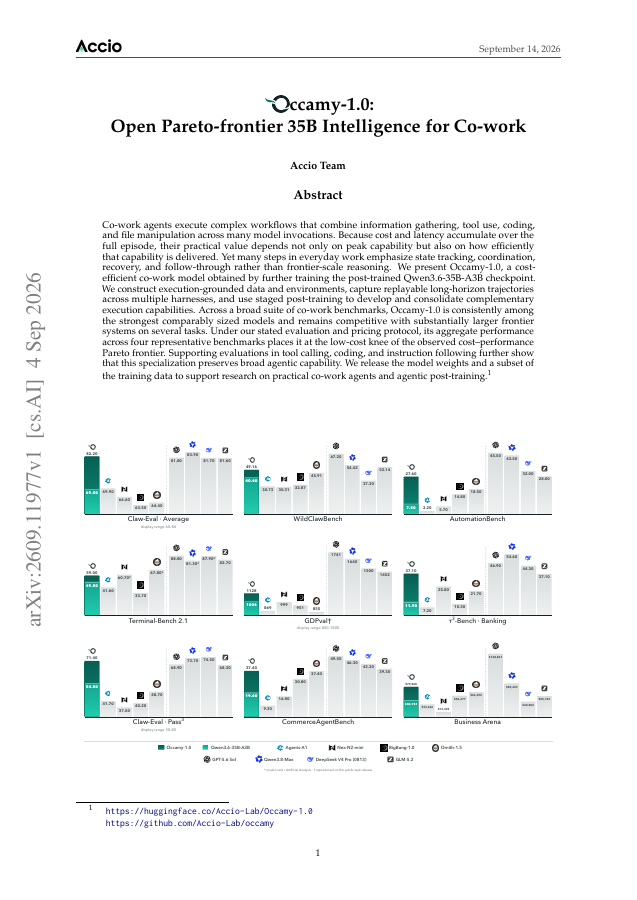
Co-work agents execute complex workflows that combine information gathering, tool use, coding, and file manipulation across many model invocations. Because cost and latency accumulate over the full episode, their practical value depends not only on peak capability but also on…
25 Aug 2026
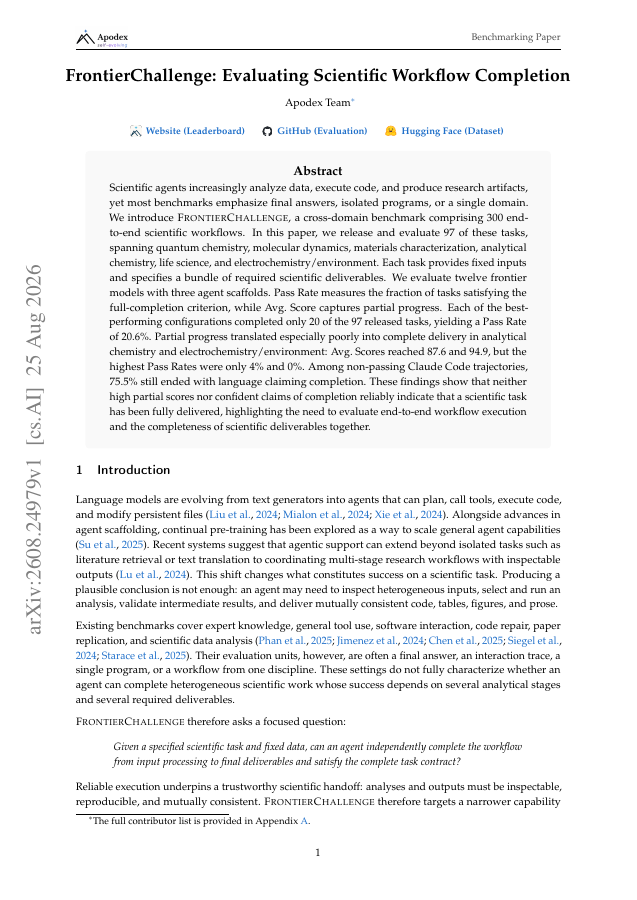
Scientific agents increasingly analyze data, execute code, and produce research artifacts, yet most benchmarks emphasize final answers, isolated programs, or a single domain. We introduce FrontierChallenge, a cross-domain benchmark comprising 300 end-to-end scientific workflows.
5 Oct 2026
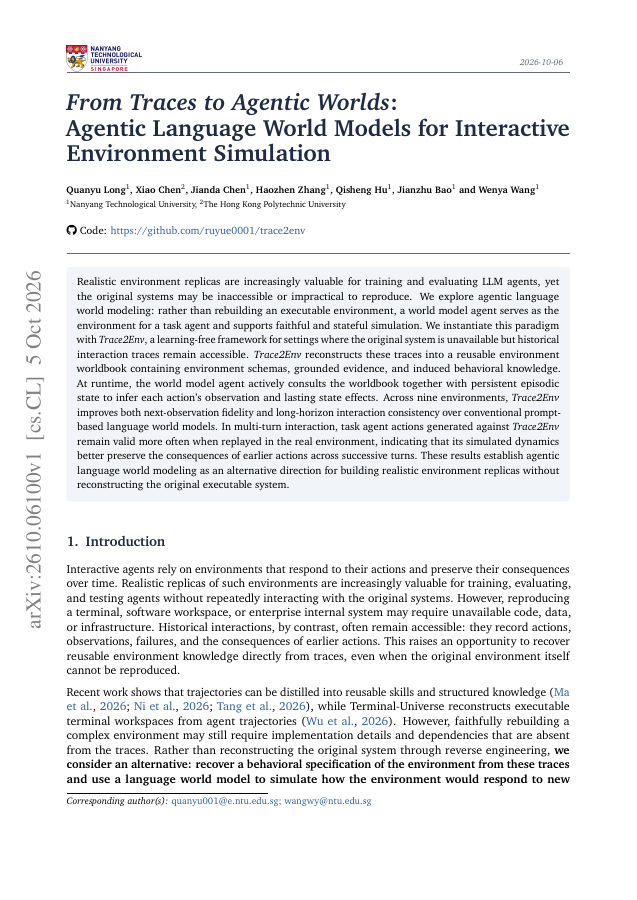
Realistic environment replicas are increasingly valuable for training and evaluating LLM agents, yet the original systems may be inaccessible or impractical to reproduce.
15 Oct 2026
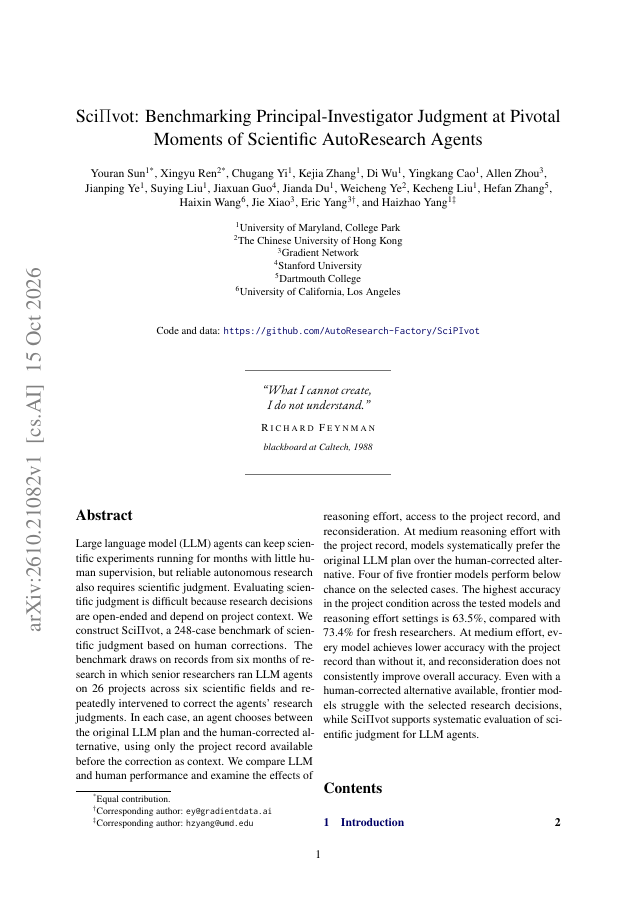
Large language model (LLM) agents can keep scientific experiments running for months with little human supervision, but reliable autonomous research also requires scientific judgment.
16 Oct 2026
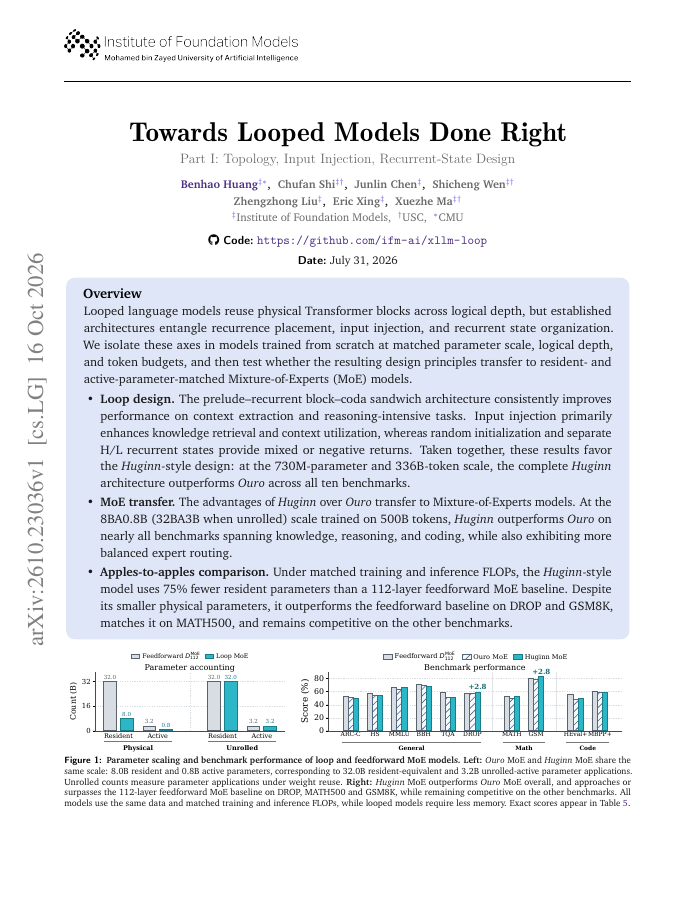
Looped language models reuse physical Transformer blocks across logical depth, but established architectures entangle recurrence placement, input injection, and recurrent state organization.
Bokai Xu, Maosong Sun, Zhiyuan Liu et al. · 30 Apr 2026
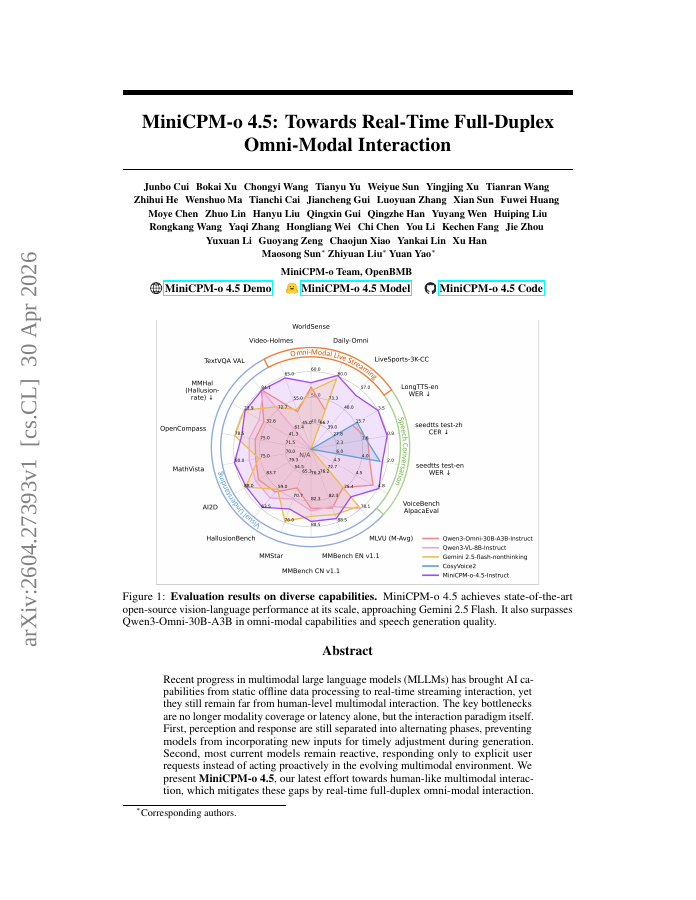
Recent progress in multimodal large language models (MLLMs) has brought AI capabilities from static offline data processing to real-time streaming interaction, yet they still remain far from human-level multimodal interaction.
14 Oct 2026
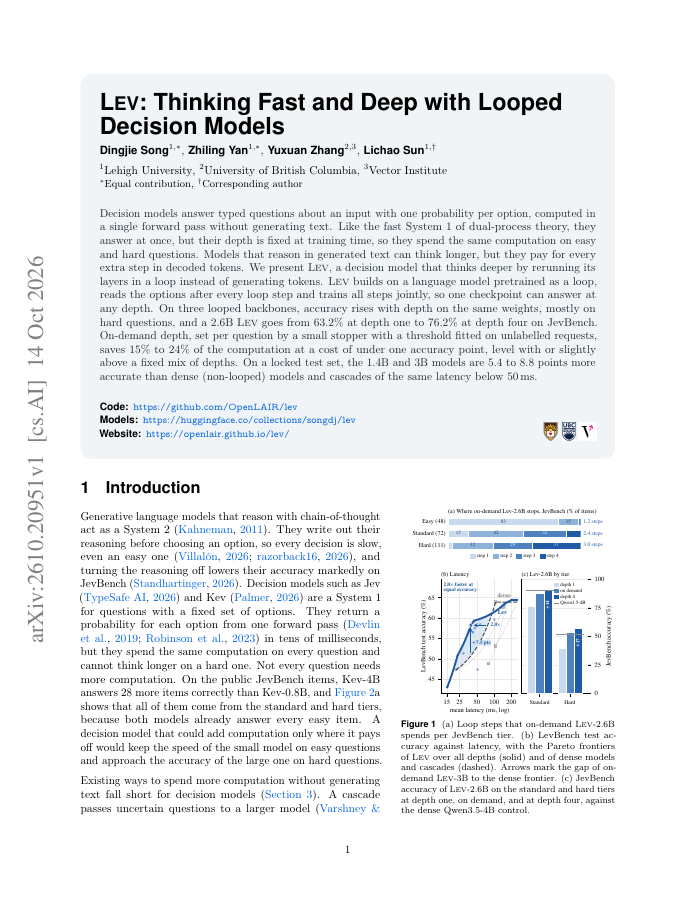
Decision models answer typed questions about an input with one probability per option, computed in a single forward pass without generating text. Like the fast System 1 of dual-process theory, they answer at once, but their depth is fixed at training time, so they spend the same…
29 May 2026
LLM agents are increasingly expected not only to complete isolated tasks, but also to carry bounded representations of human expertise, judgment, and interaction style. Building such person-grounded agents remains difficult because actionable knowledge associated with a person…
13 Oct 2026
Generating information-rich visual artifacts such as slides, posters, and dashboards as code is appealing because the outputs are structured, editable, and verifiable. Yet code models cannot see how their choices of layout and color come together on the canvas, often limiting…
20 Oct 2026
Large Language Model (LLM) agents can handle increasingly complex tasks, navigating long trajectories of observations and actions. As these trajectories grow, key-value (KV) cache I/O and storage become the dominant cost.
21 Sep 2026
An LLM agent's capability is largely magnified by its harness, namely the prompts, control flow, tooling, memory, and context management surrounding the frozen backbone model.
24 Aug 2026
Language models are sequential processors, but long-horizon agency requires external information and computation beyond model weights and active context. Prime Agent is an open-source harness for long-horizon evaluation and coding-agent workflows.
1 Jun 2026
We introduce Cosmos 3, a family of omnimodal world models designed to jointly process and generate language, image, video, audio, and action sequences within a unified mixture-of-transformers architecture.