8 Sep 2026
We introduce AuK, an open-source foundational model that unifies speech generation and editing through a common interface of natural-language instructions and audio context.
Trending research and the full catalog - each paper linked to the benchmarks, methods, and models it introduces.
Filtering here covers the 2,000 most recent papers, as much as one page can hold in memory. See the full index of 22,029 papers.
8 Sep 2026
We introduce AuK, an open-source foundational model that unifies speech generation and editing through a common interface of natural-language instructions and audio context.
18 Aug 2026
Autonomous research systems are increasingly capable of executing long research workflows, yet automation alone does not ensure that the resulting process remains scientifically grounded.
8 Sep 2026
We present Miles v0.1, a full-stack, production-ready system for frontier post-training. Building upon the clean design of slime, Miles designs each stage of the reinforcement-learning (RL) training loop around a single principle: components should be verified, clean, and…
25 Aug 2026
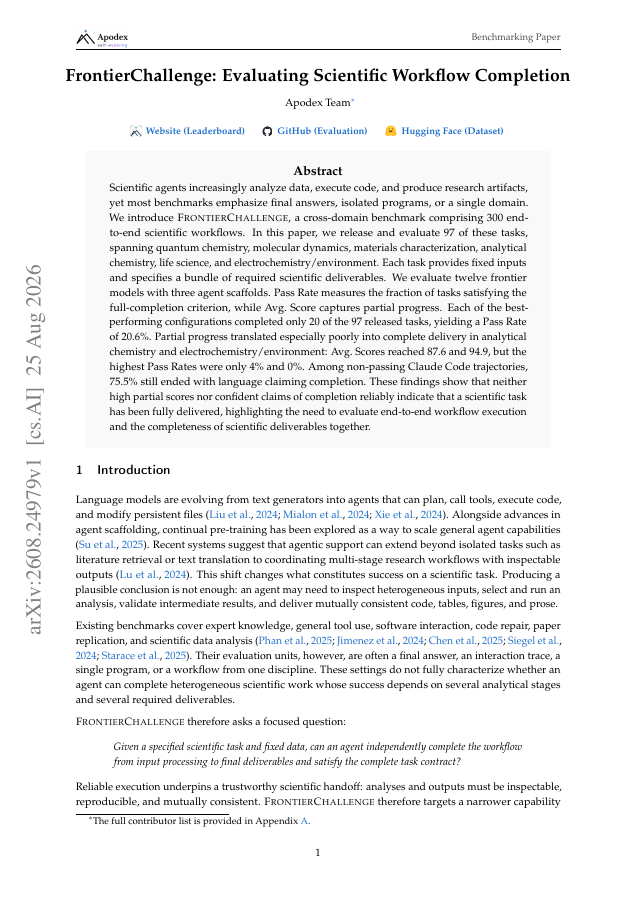
Scientific agents increasingly analyze data, execute code, and produce research artifacts, yet most benchmarks emphasize final answers, isolated programs, or a single domain. We introduce FrontierChallenge, a cross-domain benchmark comprising 300 end-to-end scientific workflows.
26 Aug 2026
Conversational systems, such as duplex speech language models (SLMs), still lack a streaming, accurate, and empathetic memory system as their soul. We introduce VoiceMem, a simple memory architecture with a parallel informational left brain, an emotional right brain, and…
8 Sep 2026
Monocular depth estimation is a ubiquitous yet highly ill-posed computer vision task, with downstream applications in scene reconstruction, computational photography, and robotics, among others.
2 Sep 2026
Autonomous agents are beginning to carry out machine-learning (ML) research end to end. These agents combine a model backbone with a harness for planning, execution, memory, and verification, but this architecture still leaves domain-specific know-how outside the agent.
24 Aug 2026
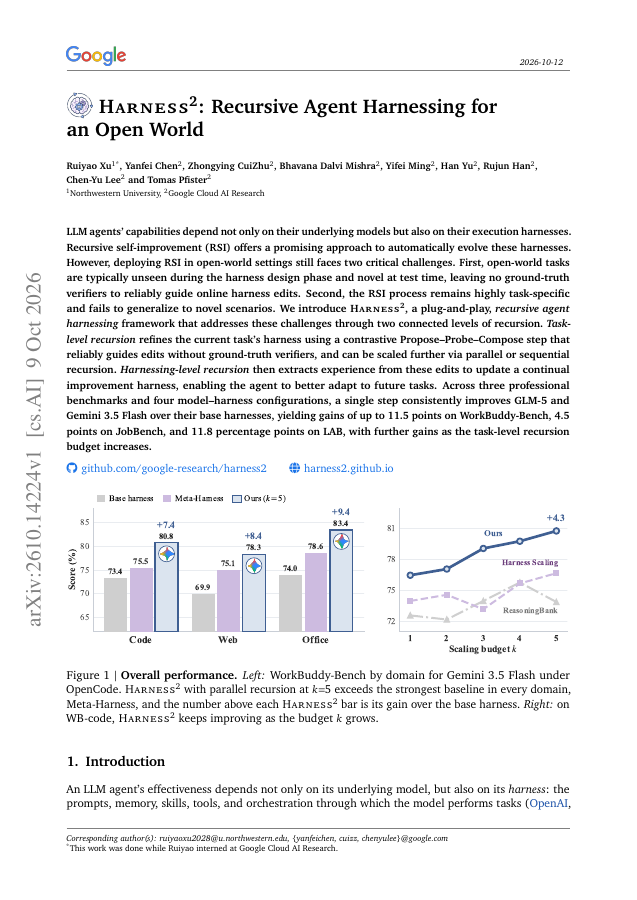
LLM agents remain unreliable on long-horizon tasks, where small local failures can compound over extended interactions and lead to overall task failure. Although external harnesses can substantially improve robustness, harness design remains a manual and expensive process that…
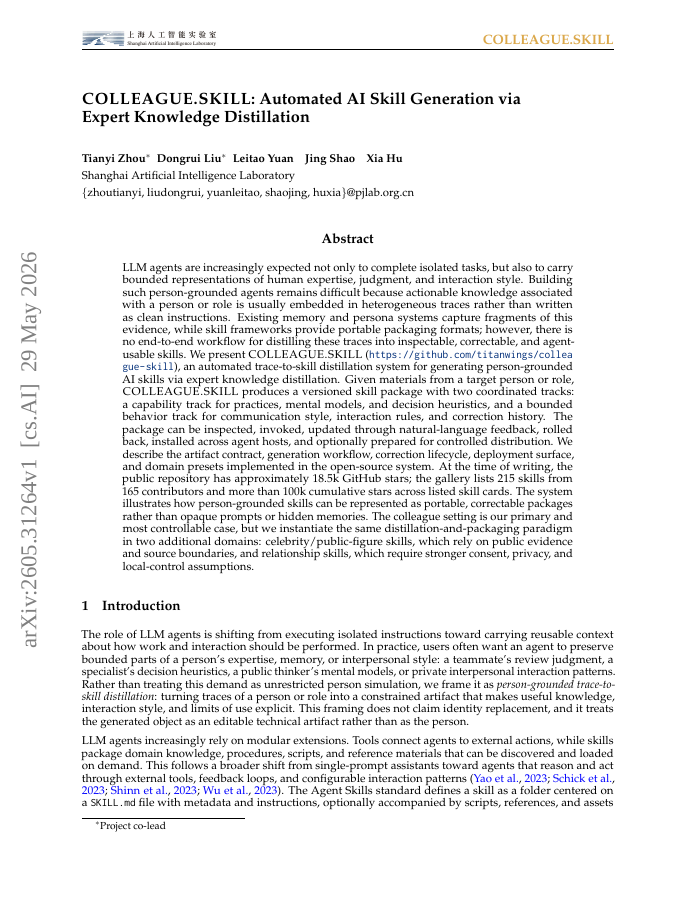
29 May 2026
LLM agents are increasingly expected not only to complete isolated tasks, but also to carry bounded representations of human expertise, judgment, and interaction style. Building such person-grounded agents remains difficult because actionable knowledge associated with a person…
6 Sep 2026
Sequential memory agents process long documents by reading chunks one after another while maintaining a compact memory state, coupling document traversal to reasoning depth.
2 Jun 2026
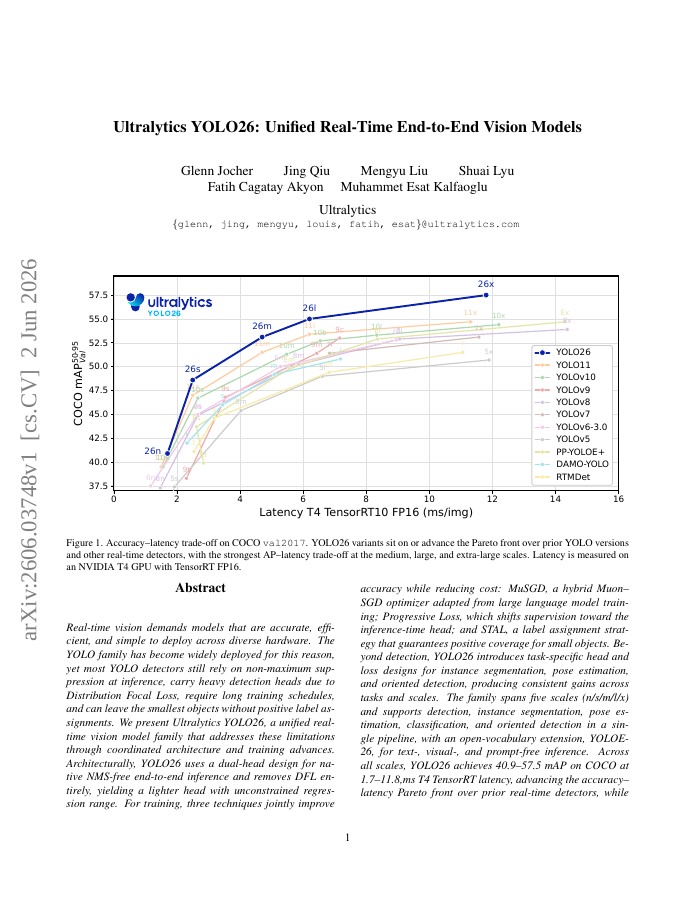
Real-time vision demands models that are accurate, efficient, and simple to deploy across diverse hardware. The YOLO family has become widely deployed for this reason, yet most YOLO detectors still rely on non-maximum suppression at inference, carry heavy detection heads due to…
6 Jul 2026
Scaling pre-training, post-training, and test-time compute have become the central paradigms for improving the capabilities of LLMs. In this work, we identify verification, the ability to determine the correctness of a solution, as a new scaling axis.
10 Aug 2026
We introduce BDH-CQ, a reasoning model that combines in-context learning with recurrent latent reasoning. Inputs presented at inference time continuously update the model's recurrent memory; the model then solves a query through iterative computation in a high-dimensional latent…
15 Jun 2026
Personalized presentation generation requires more than conditioning on a current prompt or template: agents must preserve stable user preferences across tasks, retain newly introduced preferences and constraints during multi-turn revision, and carry out local edits reliably.
21 Jul 2026
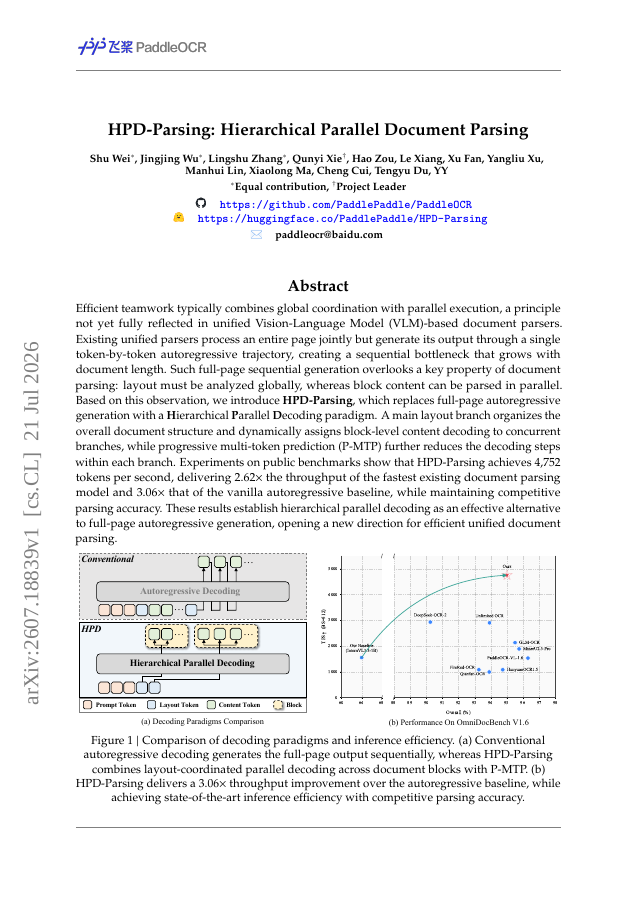
Efficient teamwork typically combines global coordination with parallel execution, a principle not yet fully reflected in unified Vision-Language Model (VLM)-based document parsers.
16 Jun 2026
We introduce \textbf{Kairos}, a regret-aware native world-action model stack for Physical AI. Kairos is motivated by the view that a physical world model should not aim to fully simulate all future pixels, but should learn and maintain the information most relevant to embodiment…
8 Sep 2026
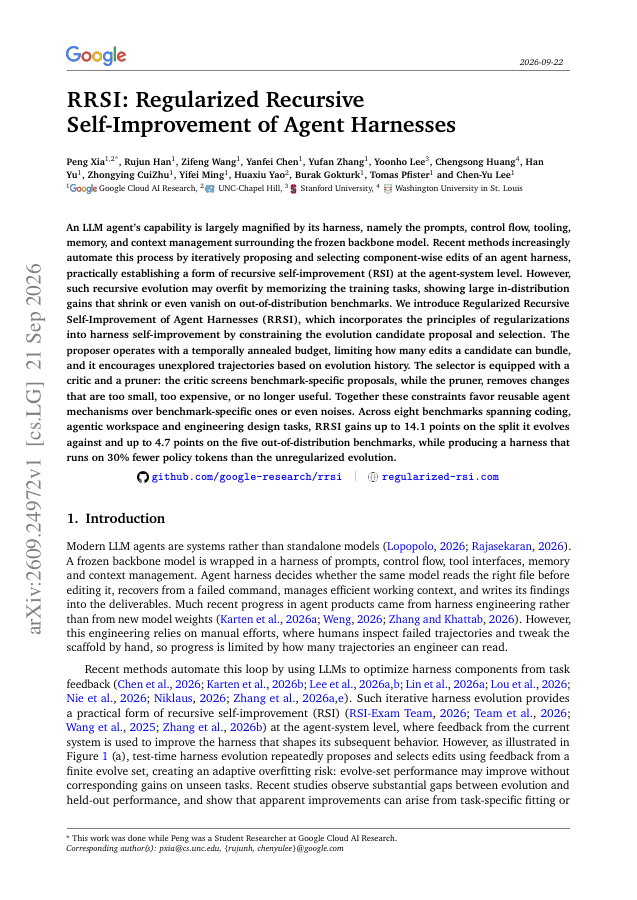
Recursive self-improvement (RSI) requires a concrete mechanism through which an AI system observes its capabilities and converts that evidence into the next round of learning.
29 Aug 2026
Reinforcement fine-tuning (RFT) is increasingly used to strengthen the reasoning abilities of large models, yet its effectiveness is bound by how training data are selected and used.
20 Aug 2026
LLM agents learn by interacting with environments, yet these environments are hand-built and static: blind to an agent's weaknesses, and quickly left behind as it improves.
Yifan Yang, Ziyang Gong, Weiquan Huang et al. · 22 May 2026
Agent skills today are hand-crafted, generated one-shot, or evolved through loosely controlled self-revision, none of which behaves like a deep-learning optimizer for the skill, and none of which reliably improves over its starting point under feedback.
8 Sep 2026
We study scheming in LLM agents, in which agents covertly pursue misaligned goals. Our focus is to understand how scheming arises from the interaction of key factors, such as instrumental goals, environmental affordances, oversight conditions, and perceived consequences.
1 Sep 2026
AI tutors are most useful when they adapt to each student's strengths, weaknesses, and preferred guidance, but evidence about which guidance works for which student is sparse, slow, and costly to collect from real learners.
24 Aug 2026
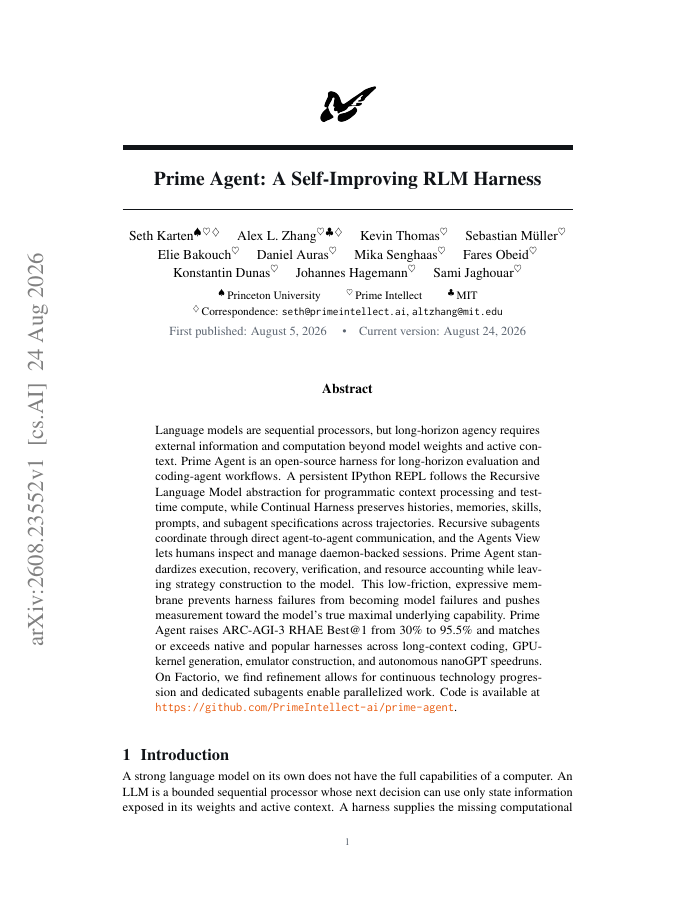
Language models are sequential processors, but long-horizon agency requires external information and computation beyond model weights and active context. Prime Agent is an open-source harness for long-horizon evaluation and coding-agent workflows.
8 Aug 2026
We present Ouroboros, a self-developing agent harness whose tools, prompts, context assembly, and core implementation improve through reviewed commits that become the runtime for later work. Core evolution proceeds in two modes.