13 Nov 2026
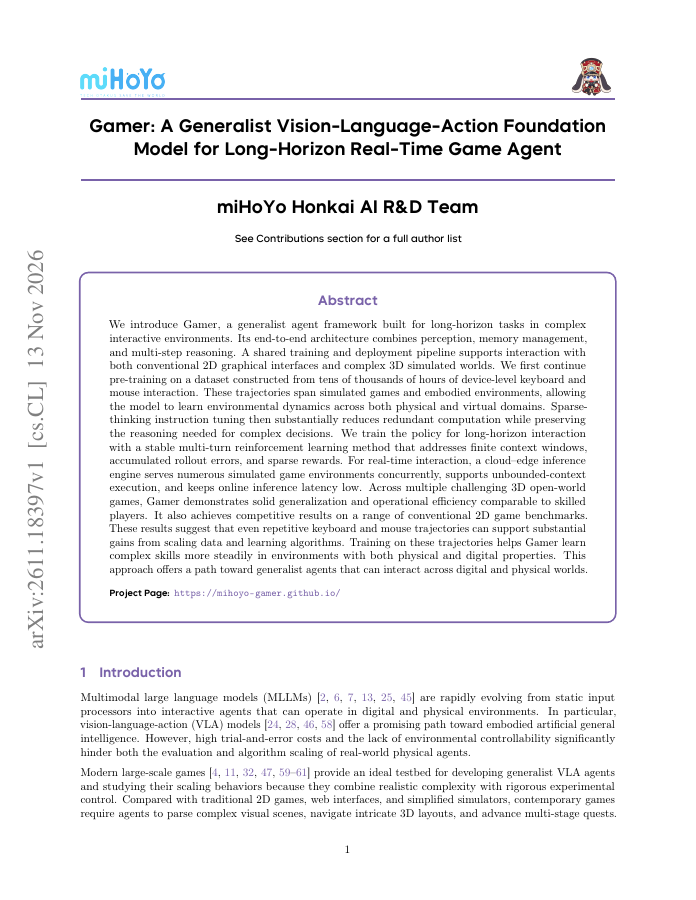
We introduce Gamer, a generalist agent framework built for long-horizon tasks in complex interactive environments. Its end-to-end architecture combines perception, memory management, and multi-step reasoning.
Trending research and the full catalog - each paper linked to the benchmarks, methods, and models it introduces.
Filtering here covers the 2,000 most recent papers, as much as one page can hold in memory. See the full index of 23,030 papers.
13 Nov 2026
We introduce Gamer, a generalist agent framework built for long-horizon tasks in complex interactive environments. Its end-to-end architecture combines perception, memory management, and multi-step reasoning.
13 Nov 2026
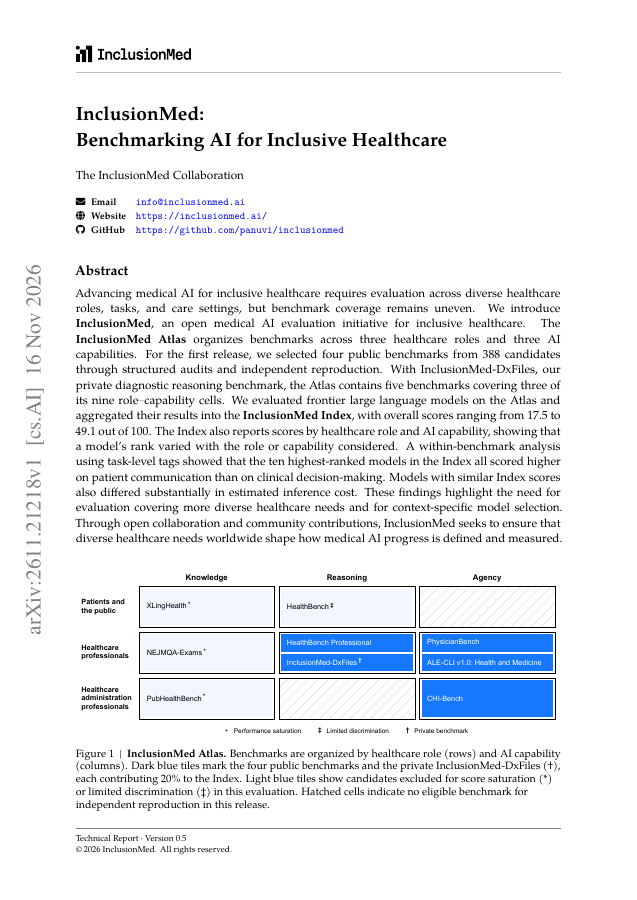
ZONOS3-Mini is an ultra-compact, ultra-fast, zero-shot voice-cloning TTS model. The model can run in real time on a laptop or smartphone. For its latency and size, it achieves state-of-the-art accuracy and cloning fidelity.
16 Nov 2026
Advancing medical AI for inclusive healthcare requires evaluation across diverse healthcare roles, tasks, and care settings, but benchmark coverage remains uneven. We introduce InclusionMed, an open medical AI evaluation initiative for inclusive healthcare.
16 Nov 2026
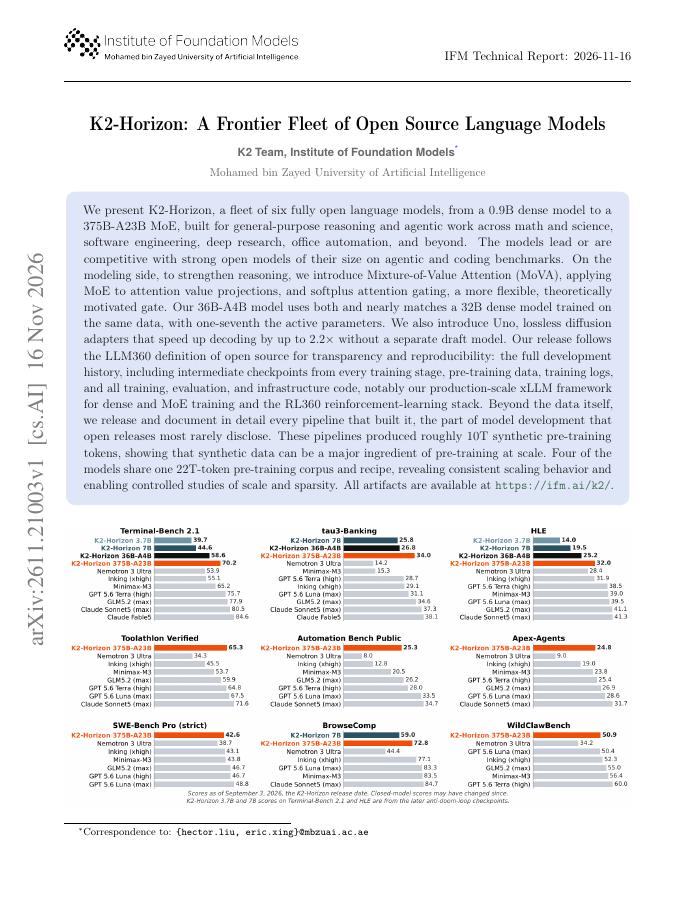
We present K2-Horizon, a fleet of six fully open language models, from a 0.9B dense model to a 375B-A23B MoE, built for general-purpose reasoning and agentic work across math and science, software engineering, deep research, office automation, and beyond.
13 Nov 2026
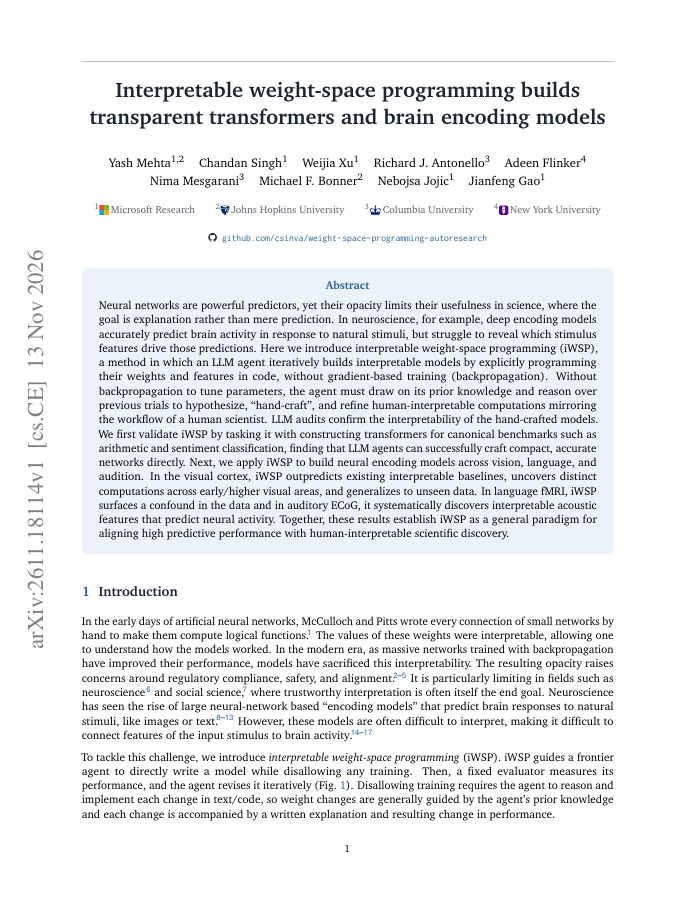
Neural networks are powerful predictors, yet their opacity limits their usefulness in science, where the goal is explanation rather than mere prediction. In neuroscience, for example, deep encoding models accurately predict brain activity in response to natural stimuli, but…
17 Nov 2026
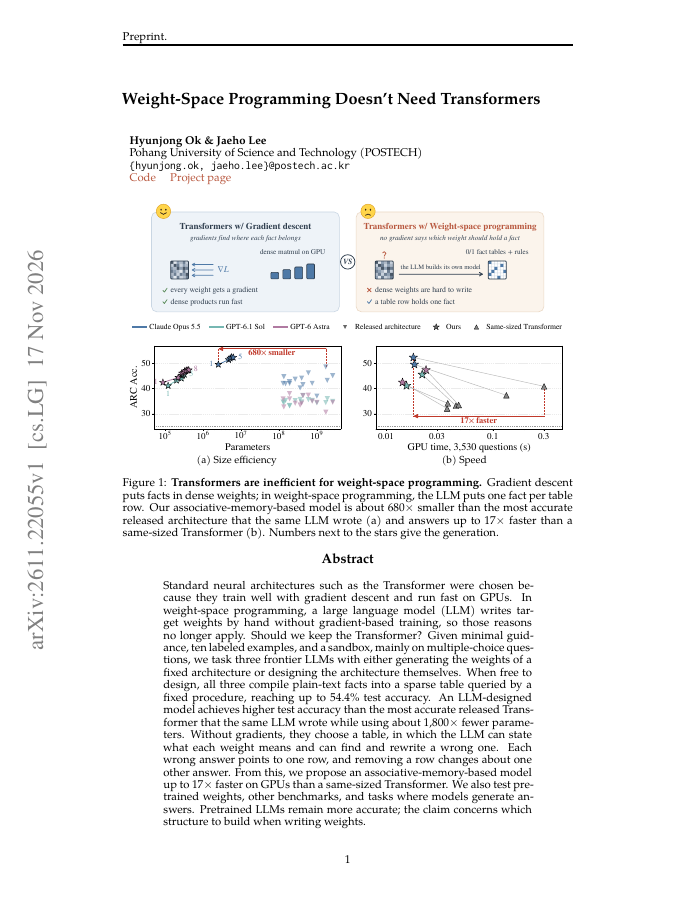
Standard neural architectures such as the Transformer were chosen because they train well with gradient descent and run fast on GPUs. In weight-space programming, a large language model (LLM) writes target weights by hand without gradient-based training, so those reasons no…
16 Nov 2026
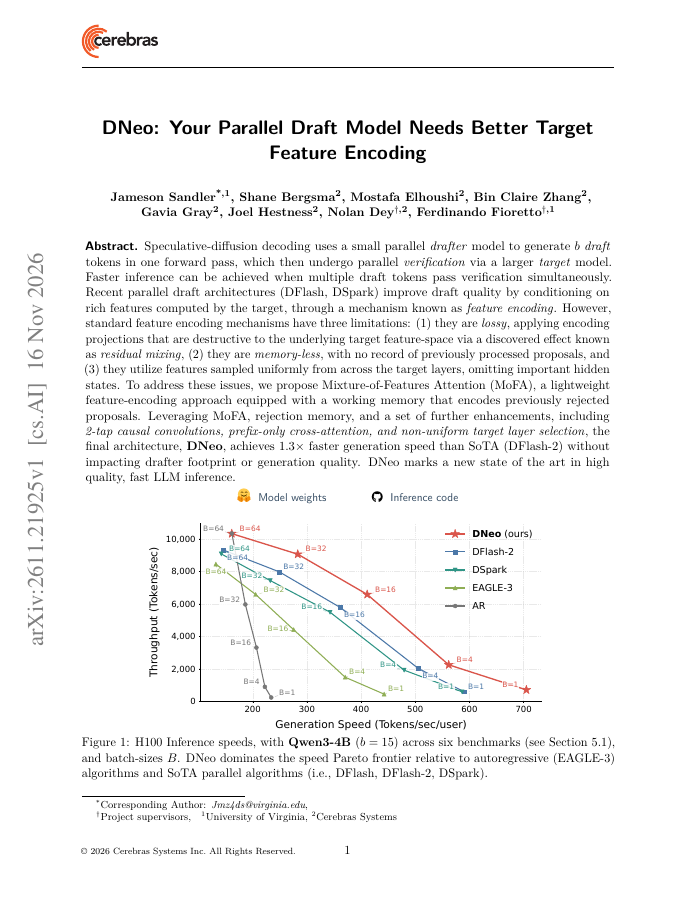
Speculative-diffusion decoding uses a small parallel drafter model to generate b draft tokens in one forward pass, which then undergo parallel verification via a larger target model. Faster inference can be achieved when multiple draft tokens pass verification simultaneously.
15 Nov 2026
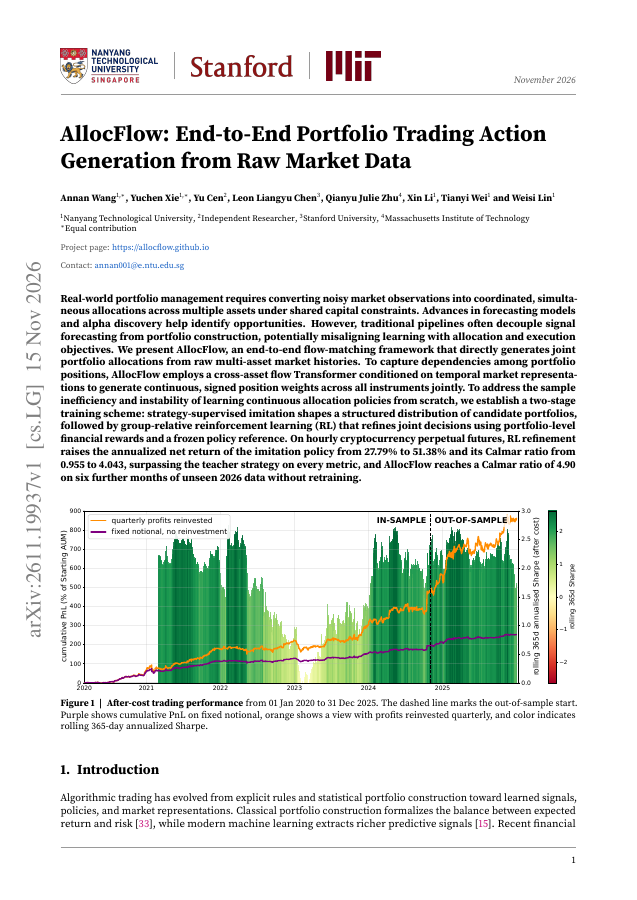
Real-world portfolio management requires converting noisy market observations into coordinated, simultaneous allocations across multiple assets under shared capital constraints. Advances in forecasting models and alpha discovery help identify opportunities.
15 Nov 2026
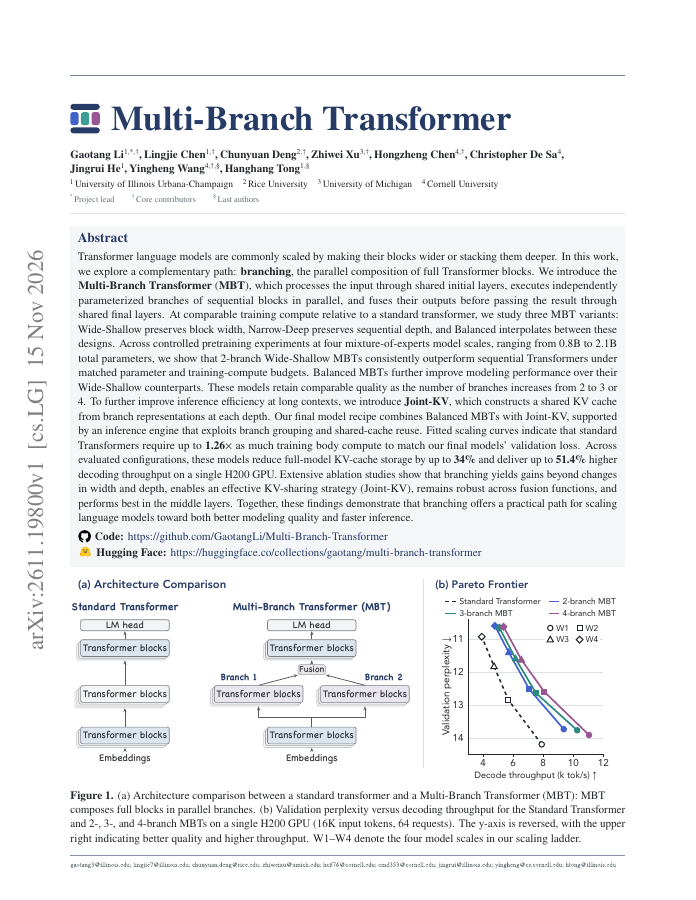
Transformer language models are commonly scaled by making their blocks wider or stacking them deeper. In this work, we explore a complementary path: branching, the parallel composition of full Transformer blocks.
16 Nov 2026
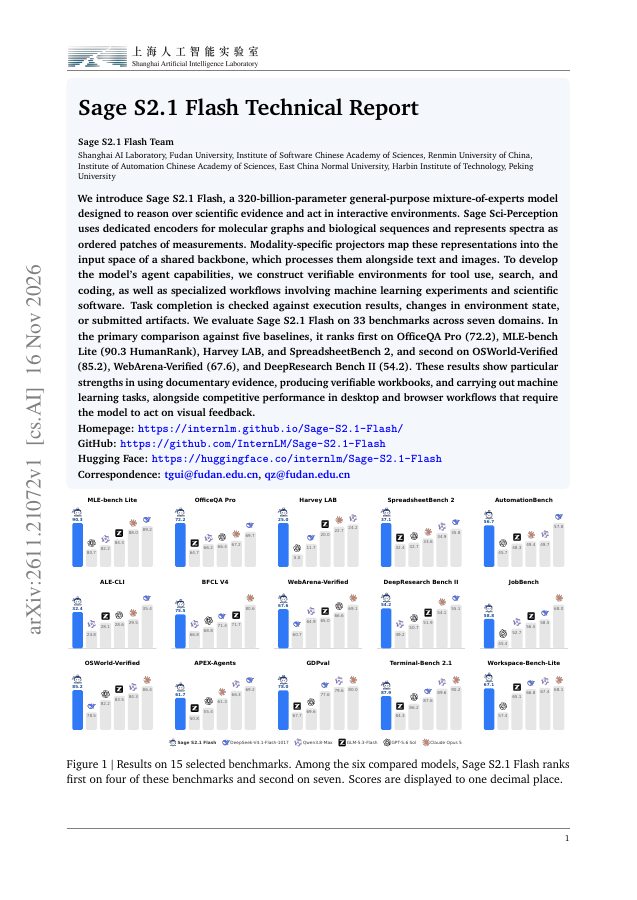
We introduce Sage S2.1 Flash, a 320-billion-parameter general-purpose mixture-of-experts model designed to reason over scientific evidence and act in interactive environments.
13 Nov 2026
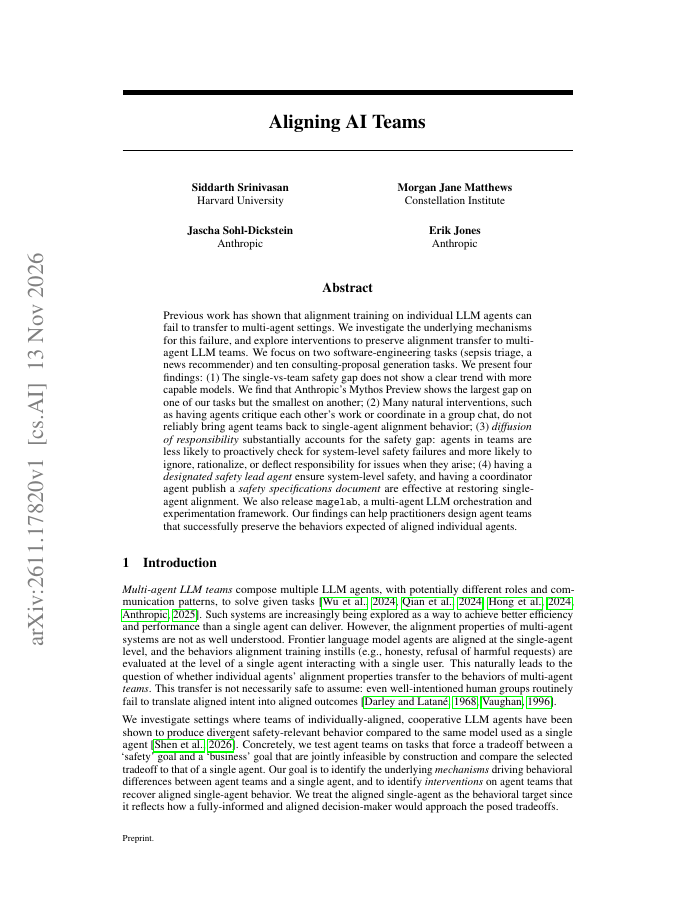
Previous work has shown that alignment training on individual LLM agents can fail to transfer to multi-agent settings. We investigate the underlying mechanisms for this failure, and explore interventions to preserve alignment transfer to multi-agent LLM teams.
13 Nov 2026
Recent work shows that large language models (LLMs) can operate directly on the parameters of other neural networks. They can read what a network was trained to do, fix a network that fails, and write working networks from scratch, all without gradient descent.
13 Nov 2026
Speech applications require decisions about term presence, turn completion, and language within an audio window. We present Marimba, an interface for typed speech decisions built on frozen Qwen3-ASR 0.6B features.
15 Nov 2026
A coding agent working within a software organization must establish what to build, collaborate with colleagues, and verify what it delivers. We introduce SWE-CoWork, a benchmark comprising 101 development assignments across 101 real repositories, 11 programming languages, and…
16 Nov 2026
Biomolecular foundation models predict the structures of proteins and their complexes accurately, and large language models (LLMs) reason in natural language, but the two remain separate: the abilities of the former are not part of a general-purpose LLM, and the reasoning of the…
13 Nov 2026
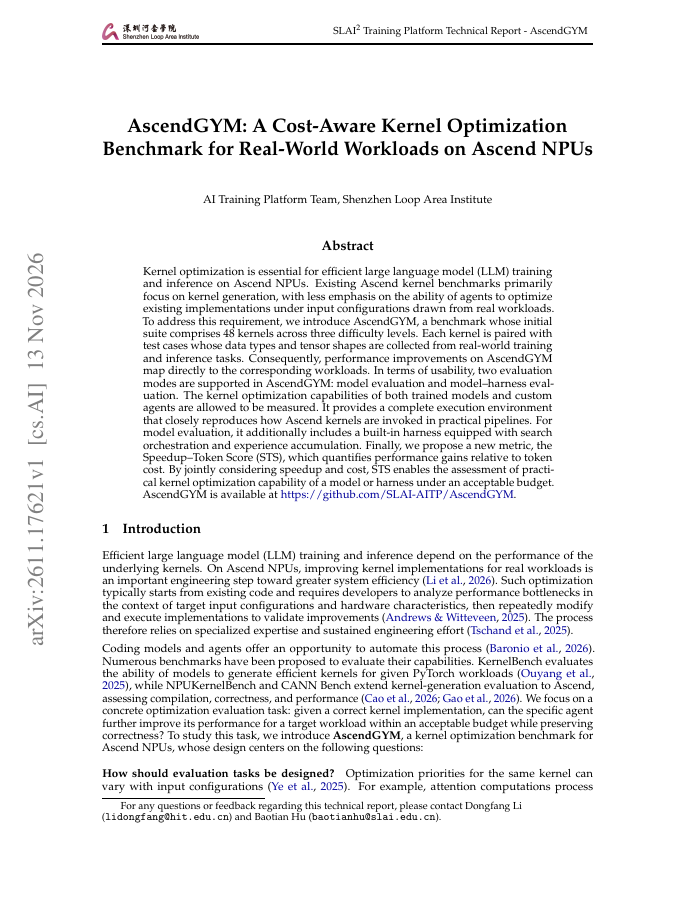
Kernel optimization is essential for efficient large language model (LLM) training and inference on Ascend NPUs. Existing Ascend kernel benchmarks primarily focus on kernel generation, with less emphasis on the ability of agents to optimize existing implementations under input…
13 Nov 2026
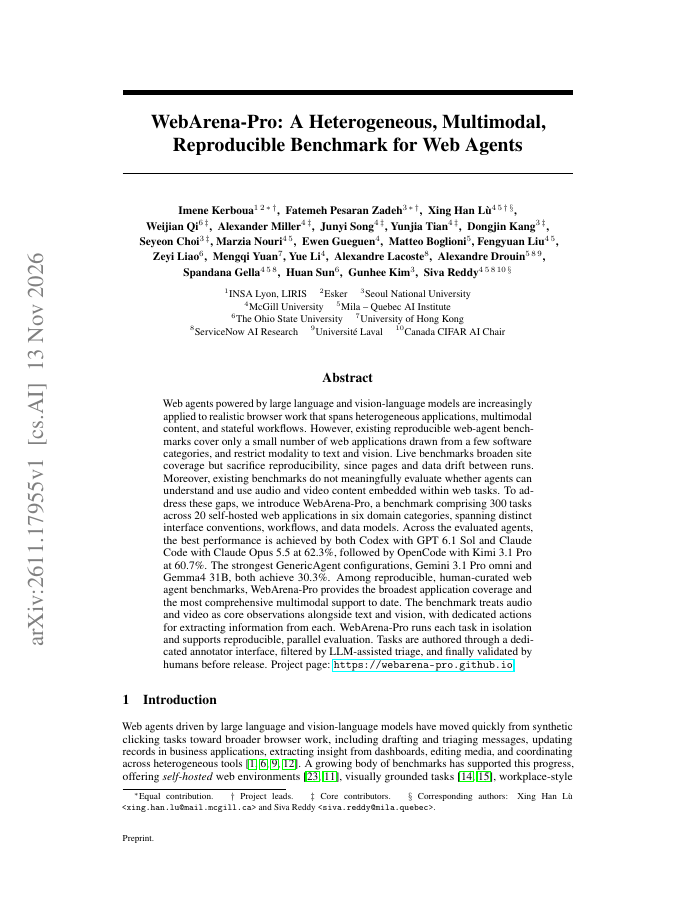
Web agents powered by large language and vision-language models are increasingly applied to realistic browser work that spans heterogeneous applications, multimodal content, and stateful workflows.
13 Nov 2026
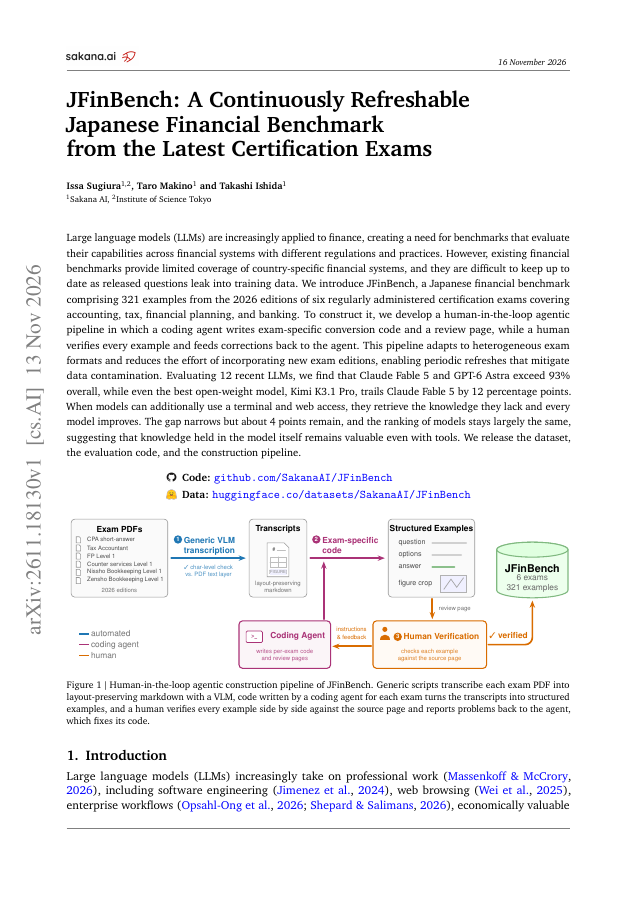
Large language models (LLMs) are increasingly applied to finance, creating a need for benchmarks that evaluate their capabilities across financial systems with different regulations and practices.
13 Nov 2026
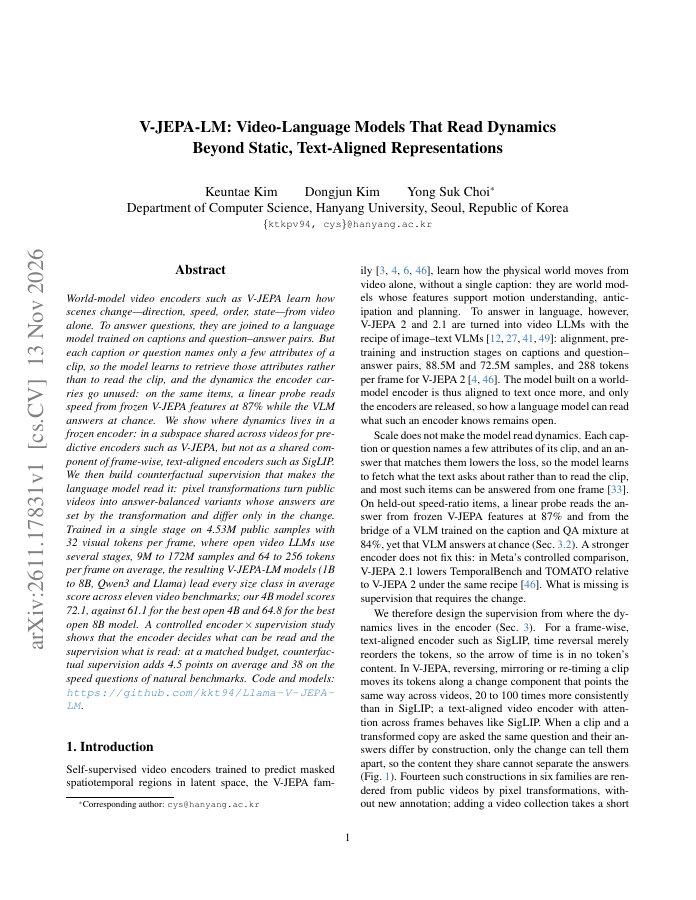
World-model video encoders such as V-JEPA learn how scenes change (direction, speed, order, state) from video alone. To answer questions, they are joined to a language model trained on captions and question-answer pairs.
13 Nov 2026
In many long-horizon settings, an agent's own choices create future constraints: committing finite capacity establishes future obligations and forecloses later opportunities.
16 Nov 2026
Application optimization requires coding agents to discover useful changes and coordinate them across a complete program while preserving the required computation. We introduce Accelerate Bench, a benchmark of 32 CPU optimization tasks adapted from scientific applications and…
16 Nov 2026
Training coding agents for long-horizon tasks requires environments with verifiable feedback. Existing pipelines often follow a linear process that ends with validation, establishing usability but providing little guidance on improving training value.
13 Nov 2026
Evaluations of multi-agent language models often compare communicating architectures against a single greedy pass. This practice confounds coordination with sample multiplicity and inference compute.
13 Nov 2026
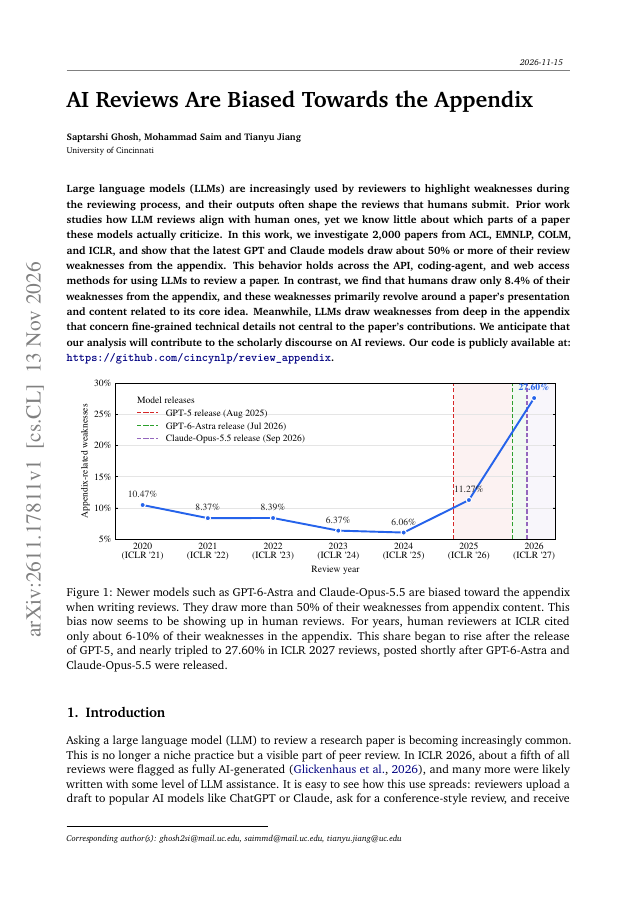
Large language models (LLMs) are increasingly used by reviewers to highlight weaknesses during the reviewing process, and their outputs often shape the reviews that humans submit.