13 Nov 2026
We introduce Gamer, a generalist agent framework built for long-horizon tasks in complex interactive environments. Its end-to-end architecture combines perception, memory management, and multi-step reasoning.
Trending research and the full catalog - each paper linked to the benchmarks, methods, and models it introduces.
Filtering here covers the 2,000 most recent papers, as much as one page can hold in memory. See the full index of 23,030 papers.
13 Nov 2026
We introduce Gamer, a generalist agent framework built for long-horizon tasks in complex interactive environments. Its end-to-end architecture combines perception, memory management, and multi-step reasoning.
15 Oct 2026
Advances in frontier coding agents have sharply increased the token costs of AI-assisted software engineering. Their token efficiency is typically evaluated on isolated tasks, whereas real-world developers use them to continuously build, update, and maintain large-scale…
9 Oct 2026
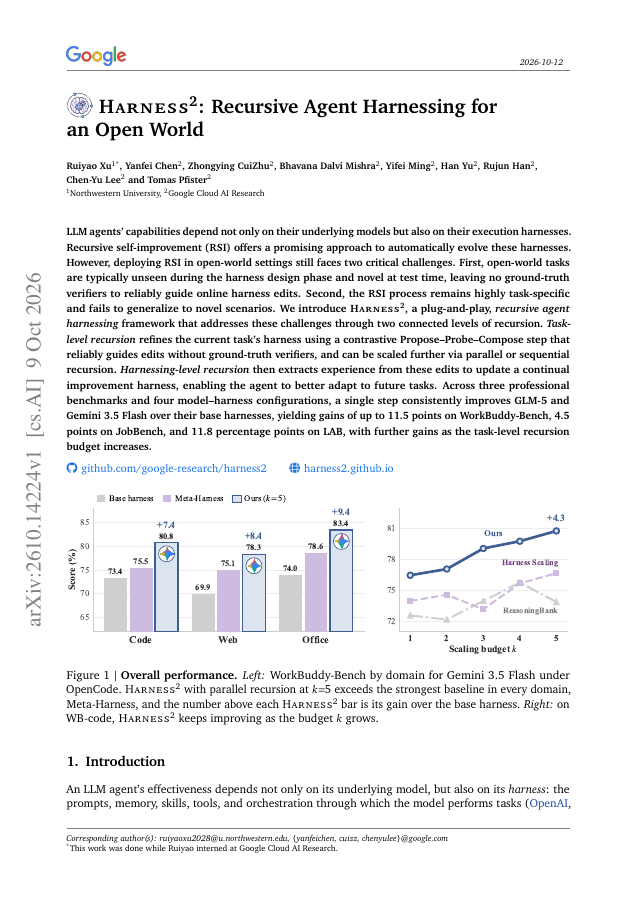
LLM agents' capabilities depend not only on their underlying models but also on their execution harnesses. Recursive self-improvement (RSI) offers a promising approach to automatically evolve these harnesses.
16 Sep 2026
Mixture-of-experts (MoE) inference on consumer hardware is bounded by weight memory: a 35B-class model is 19.5GB at 4-bit, and sparsity shrinks the compute per token, not the bytes that must be held.
8 Oct 2026
Reinforcement learning (RL) is the central training paradigm for advancing large foundation models towards self-improvement. This report introduces the MiMo-V2.6 series, an omni-modal family that pushes the frontier of model intelligence by scaling RL compute.
2 Jun 2026
Real-time vision demands models that are accurate, efficient, and simple to deploy across diverse hardware. The YOLO family has become widely deployed for this reason, yet most YOLO detectors still rely on non-maximum suppression at inference, carry heavy detection heads due to…
29 May 2026
LLM agents are increasingly expected not only to complete isolated tasks, but also to carry bounded representations of human expertise, judgment, and interaction style. Building such person-grounded agents remains difficult because actionable knowledge associated with a person…
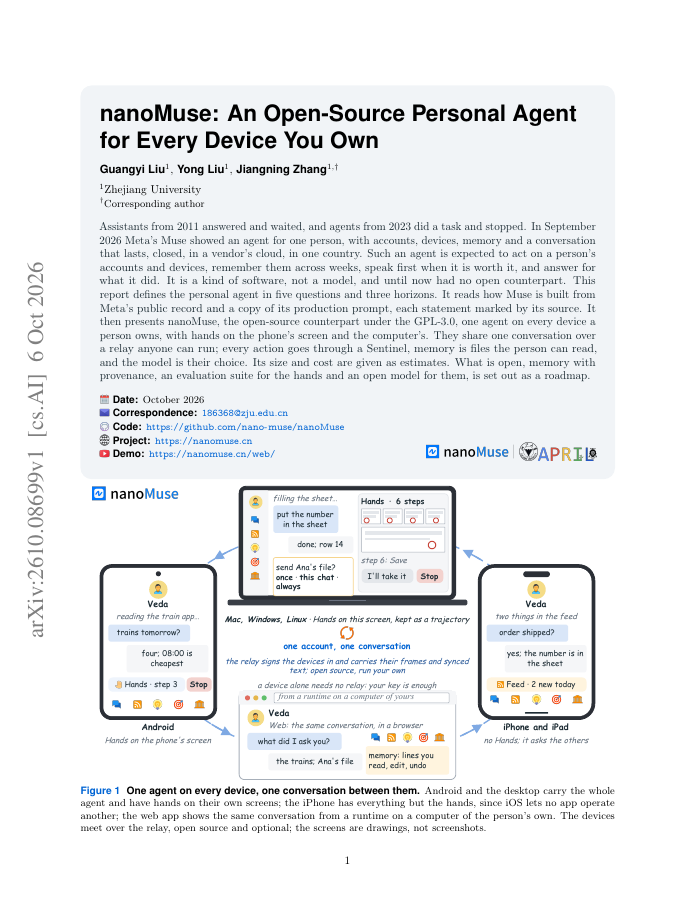
6 Oct 2026
Assistants from 2011 answered and waited, and agents from 2023 did a task and stopped. In September 2026 Meta's Muse showed an agent for one person, with accounts, devices, memory and a conversation that lasts, closed, in a vendor's cloud, in one country.
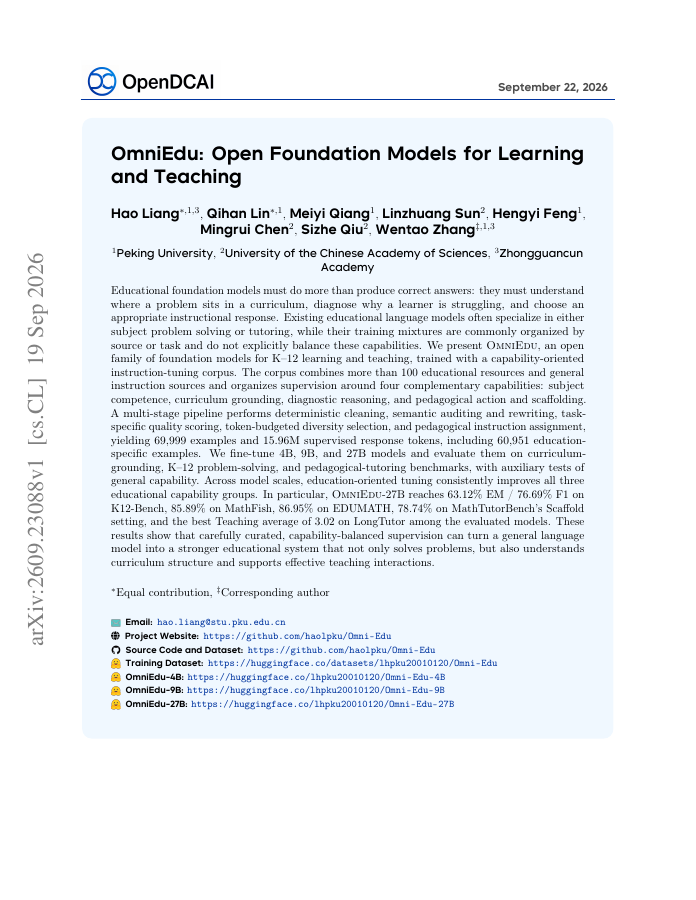
19 Sep 2026
Educational foundation models must solve problems, understand curriculum structure, diagnose learner difficulties, and provide appropriate instructional support. Existing educational language models often focus on either problem solving or tutoring, with training mixtures…
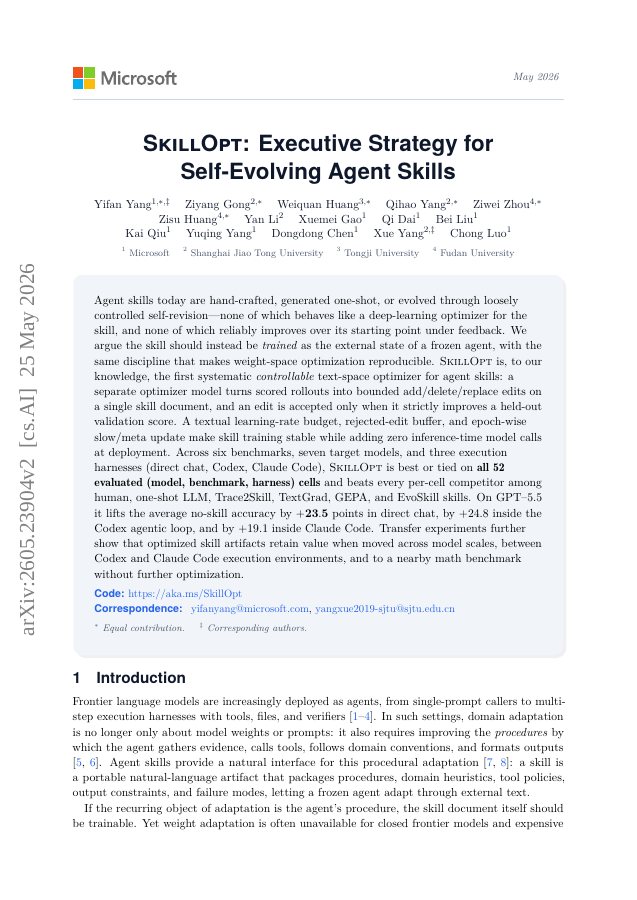
Yifan Yang, Ziyang Gong, Weiquan Huang et al. · 22 May 2026
Agent skills today are hand-crafted, generated one-shot, or evolved through loosely controlled self-revision, none of which behaves like a deep-learning optimizer for the skill, and none of which reliably improves over its starting point under feedback.
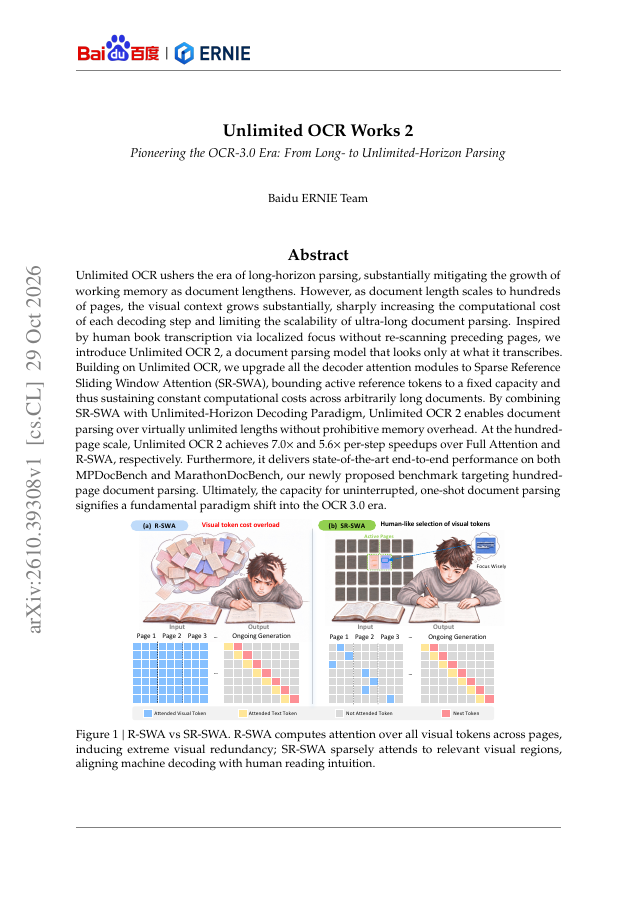
29 Oct 2026
Unlimited OCR ushers the era of long-horizon parsing, substantially mitigating the growth of working memory as document lengthens. However, as document length scales to hundreds of pages, the visual context grows substantially, sharply increasing the computational cost of each…
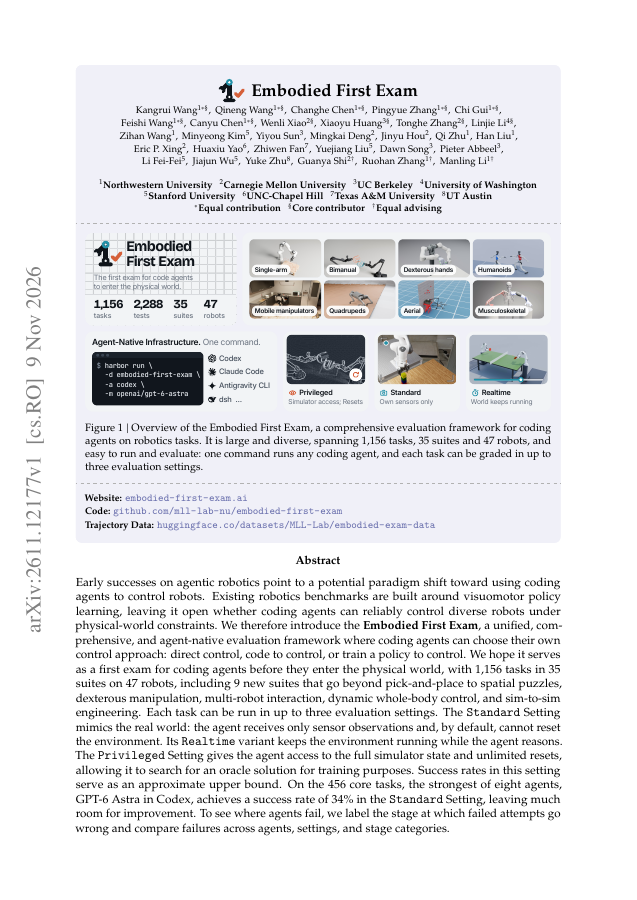
9 Nov 2026
Early successes on agentic robotics point to a potential paradigm shift toward using coding agents to control robots. Existing robotics benchmarks are built around visuomotor policy learning, leaving it open whether coding agents can reliably control diverse robots under…
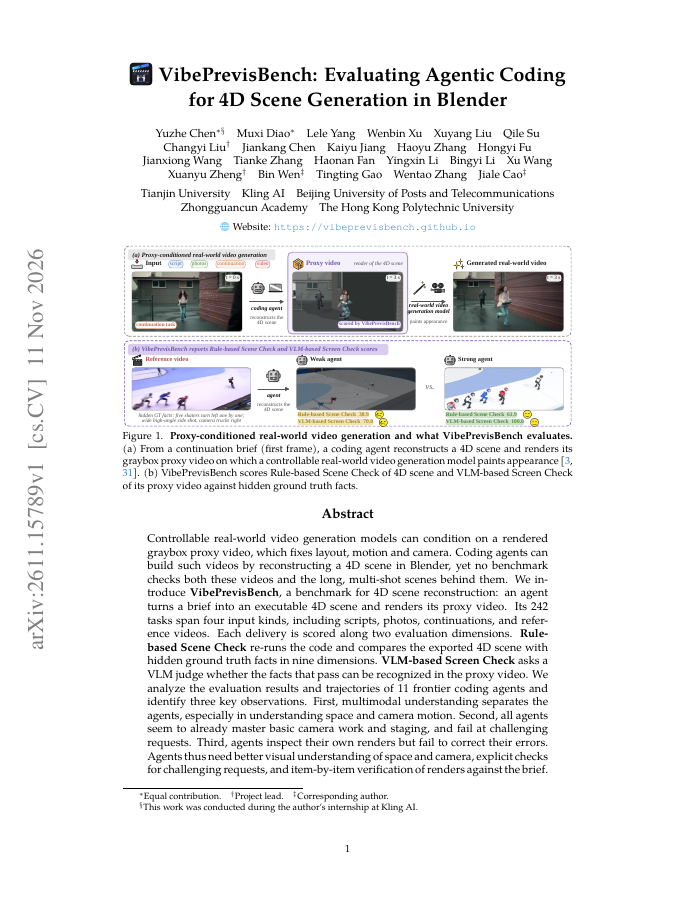
11 Nov 2026
Controllable real-world video generation models can condition on a rendered graybox proxy video, which fixes layout, motion and camera. Coding agents can build such videos by reconstructing a 4D scene in Blender, yet no benchmark checks both these videos and the long, multi-shot…
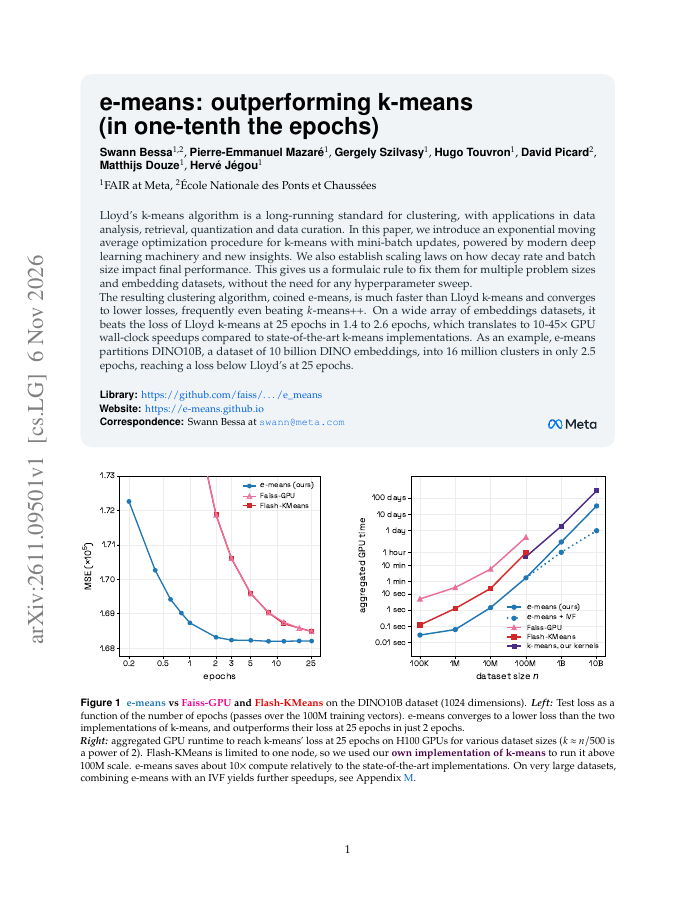
6 Nov 2026
Lloyd's k-means algorithm is a long-running standard for clustering, with applications in data analysis, retrieval, quantization and data curation. In this paper, we introduce an exponential moving average optimization procedure for k-means with mini-batch updates, powered by…
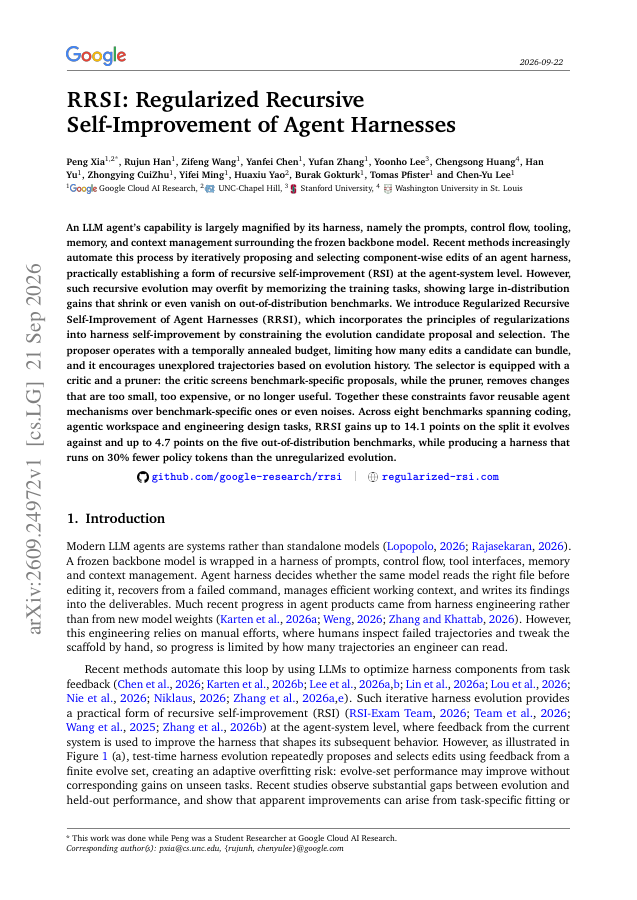
21 Sep 2026
An LLM agent's capability is largely magnified by its harness, namely the prompts, control flow, tooling, memory, and context management surrounding the frozen backbone model.
24 Aug 2026
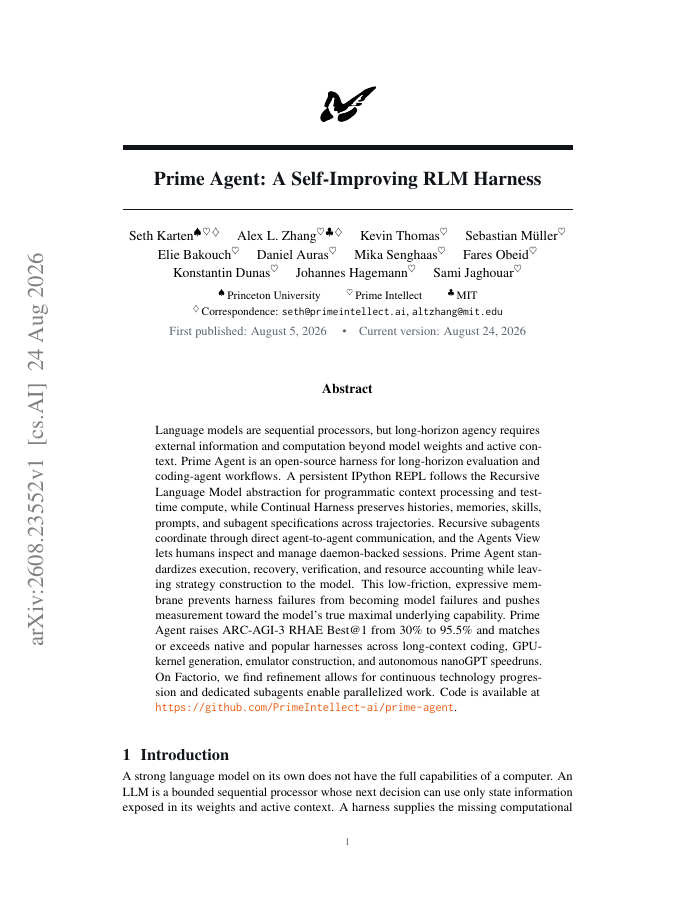
Language models are sequential processors, but long-horizon agency requires external information and computation beyond model weights and active context. Prime Agent is an open-source harness for long-horizon evaluation and coding-agent workflows.
12 Aug 2026
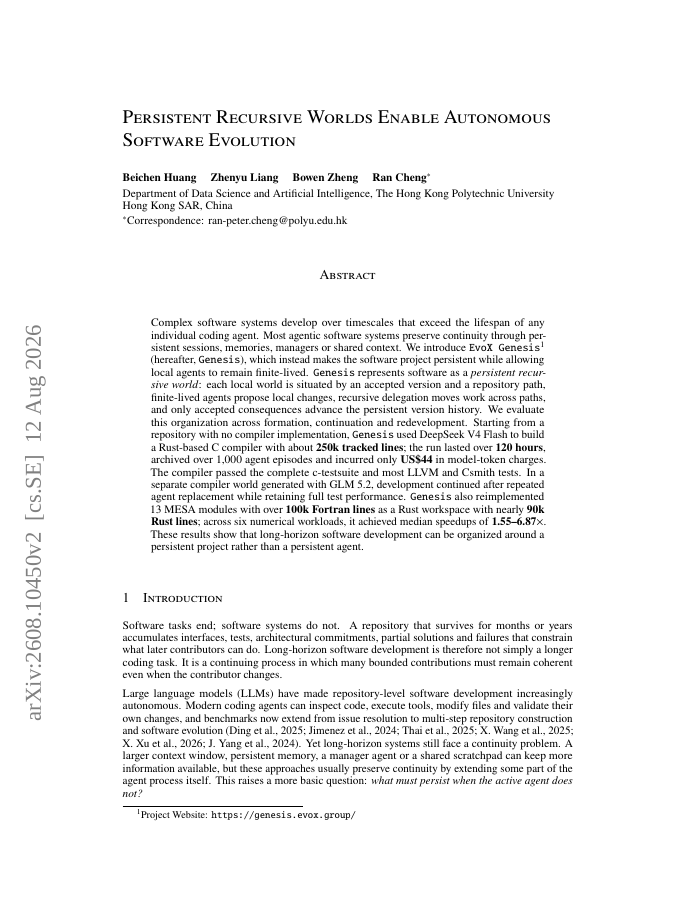
Software systems accumulate dependencies and design commitments over time, while the agents that modify them operate within bounded sessions. How, then, can development remain cumulative across generations of transient agents? We introduce EvoX Genesis, which organizes…
12 Jun 2026
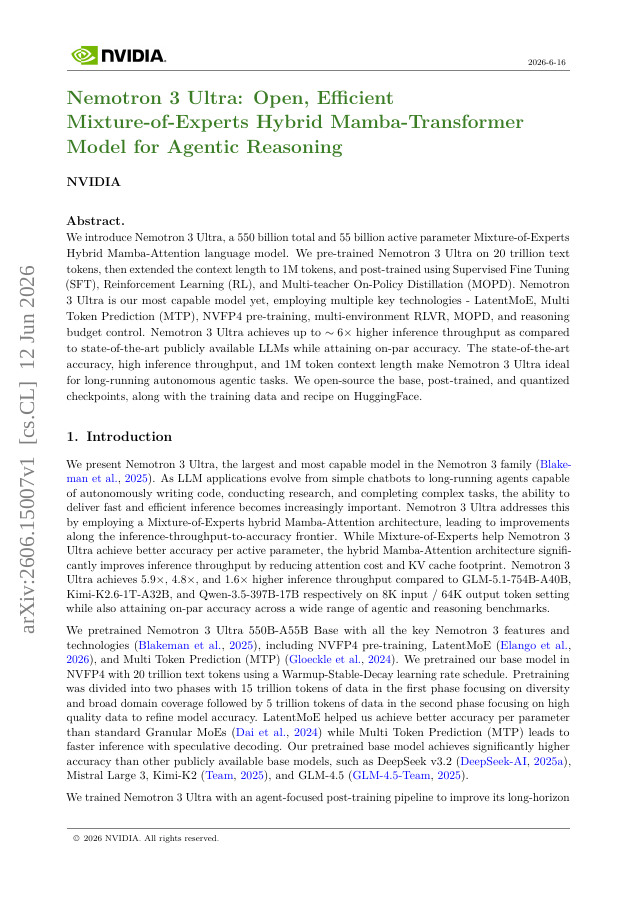
We introduce Nemotron 3 Ultra, a 550 billion total and 55 billion active parameter Mixture-of-Experts Hybrid Mamba-Attention language model. We pre-trained Nemotron 3 Ultra on 20 trillion text tokens, then extended the context length to 1M tokens, and post-trained using…
9 Oct 2026
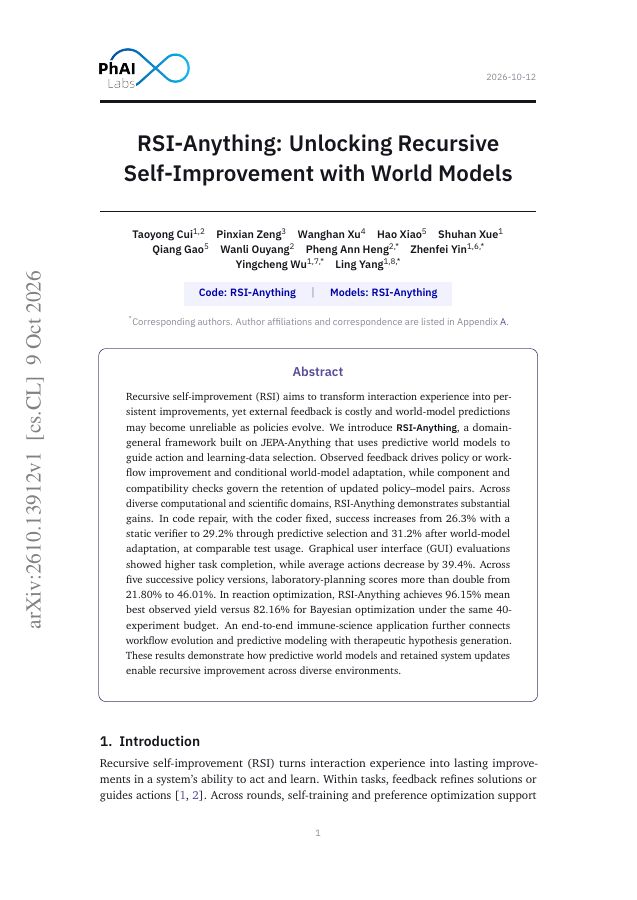
Recursive self-improvement (RSI) aims to transform interaction experience into persistent improvements, yet external feedback is costly and world-model predictions may become unreliable as policies evolve.
5 Jul 2026
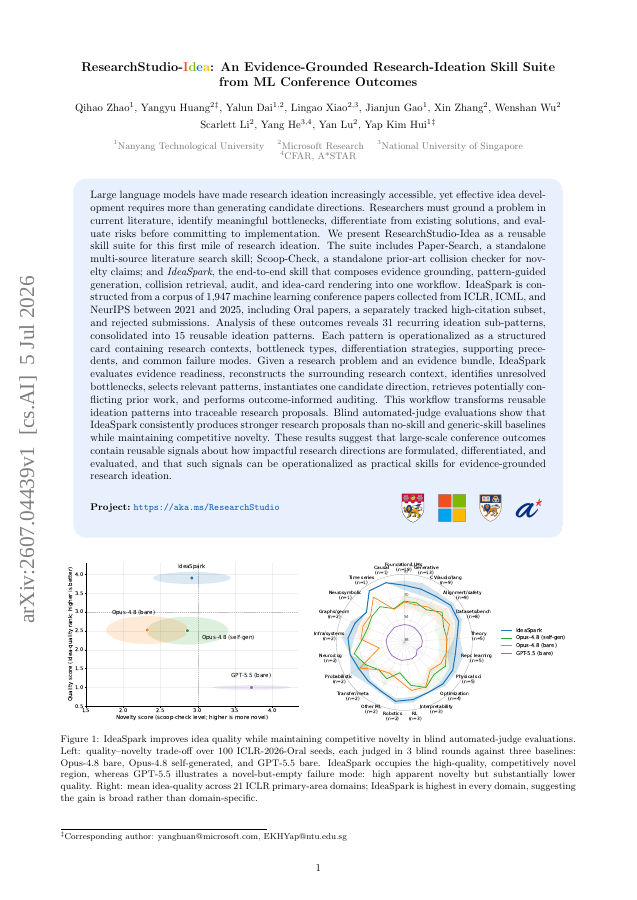
Large language models have made research ideation increasingly accessible, yet effective idea development requires more than generating candidate directions. Researchers must ground a problem in current literature, identify meaningful bottlenecks, differentiate from existing…
13 Nov 2026
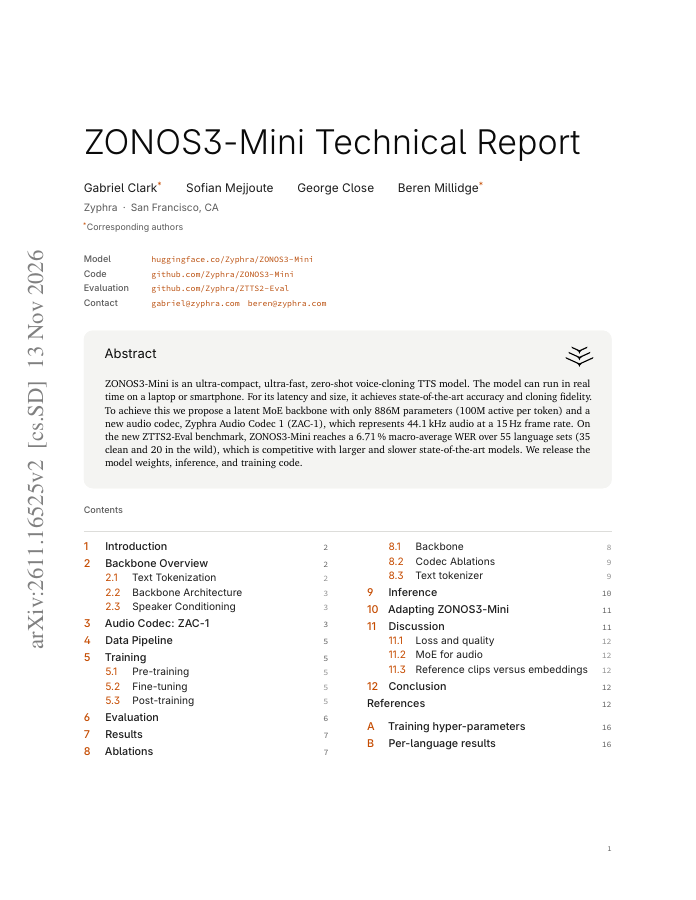
ZONOS3-Mini is an ultra-compact, ultra-fast, zero-shot voice-cloning TTS model. The model can run in real time on a laptop or smartphone. For its latency and size, it achieves state-of-the-art accuracy and cloning fidelity.
4 Sep 2026
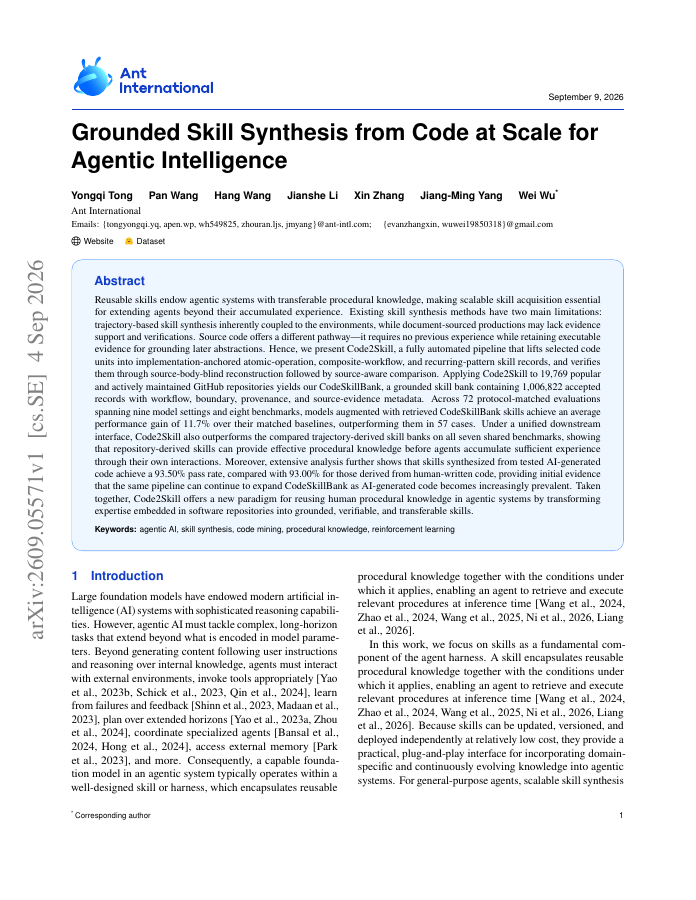
Reusable skills give agents transferable procedural knowledge, making scalable acquisition essential for extending agents beyond prior experience. Existing methods face two limitations: trajectory-based synthesis requires interactions with specific environments, while…
27 Sep 2026
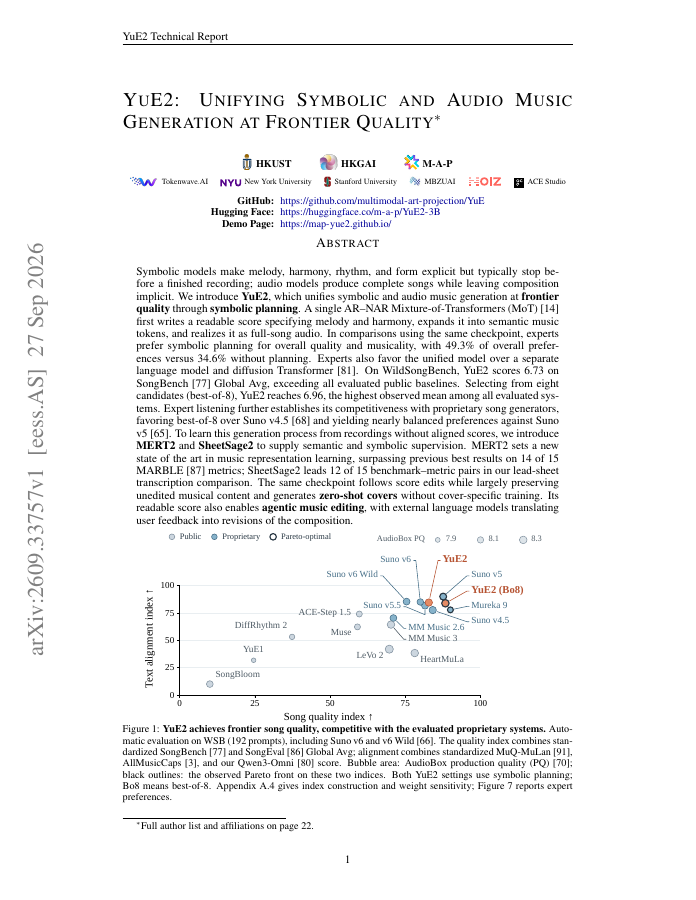
Symbolic models make melody, harmony, rhythm, and form explicit but typically stop before a finished recording; audio models produce complete songs while leaving composition implicit.
10 Oct 2026
Text-to-speech (TTS) systems are conventionally optimized for intelligibility and speaker similarity. However, neither objective captures the prosodic detail that distinguishes human performances from synthetic speech, leaving a realism gap that larger models and higher-quality…