9 Oct 2026
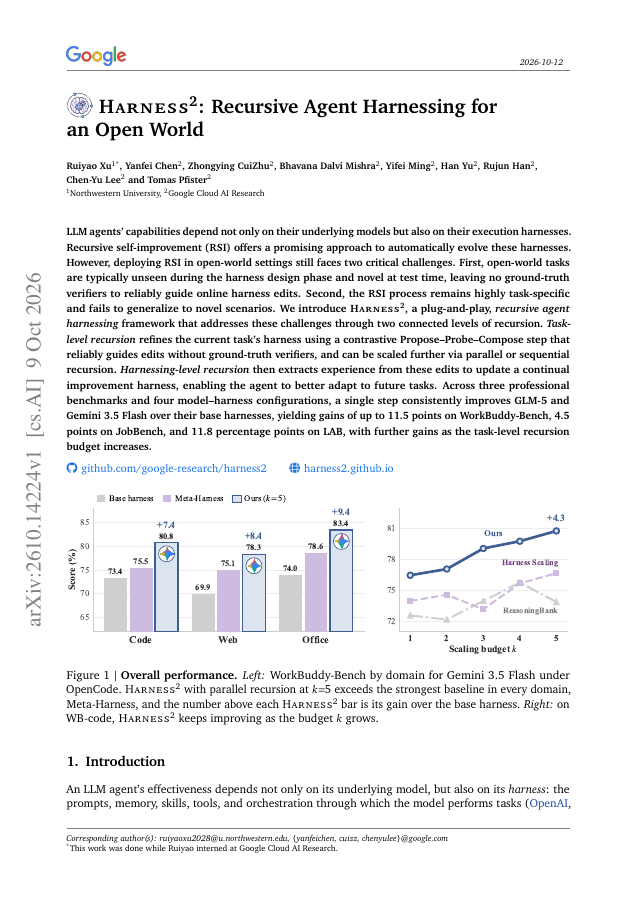
LLM agents' capabilities depend not only on their underlying models but also on their execution harnesses. Recursive self-improvement (RSI) offers a promising approach to automatically evolve these harnesses.
Trending research and the full catalog - each paper linked to the benchmarks, methods, and models it introduces.
Filtering here covers the 2,000 most recent papers, as much as one page can hold in memory. See the full index of 22,712 papers.
9 Oct 2026
LLM agents' capabilities depend not only on their underlying models but also on their execution harnesses. Recursive self-improvement (RSI) offers a promising approach to automatically evolve these harnesses.
16 Sep 2026
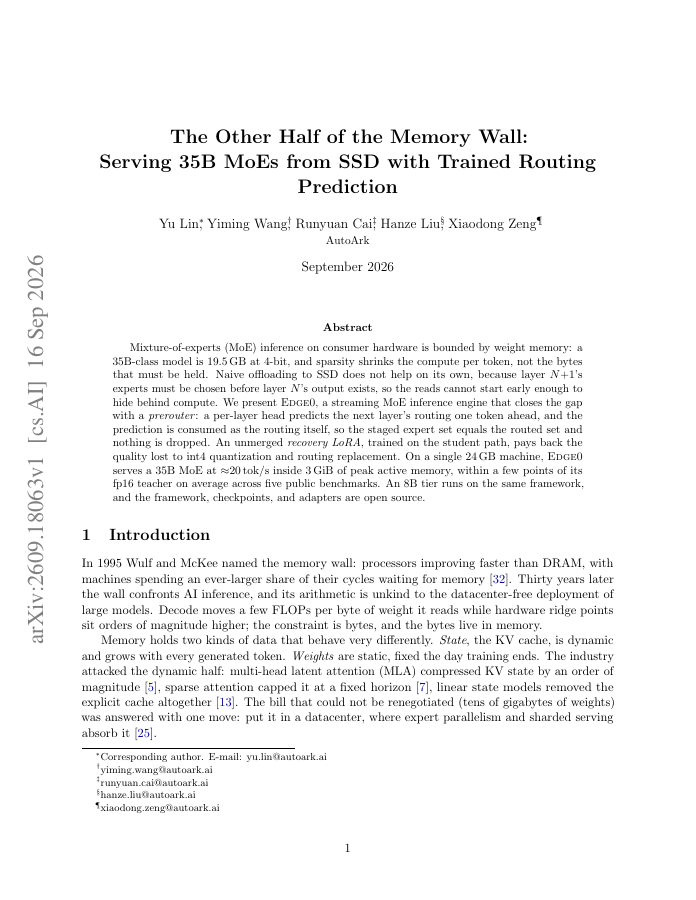
Mixture-of-experts (MoE) inference on consumer hardware is bounded by weight memory: a 35B-class model is 19.5GB at 4-bit, and sparsity shrinks the compute per token, not the bytes that must be held.
20 Aug 2026
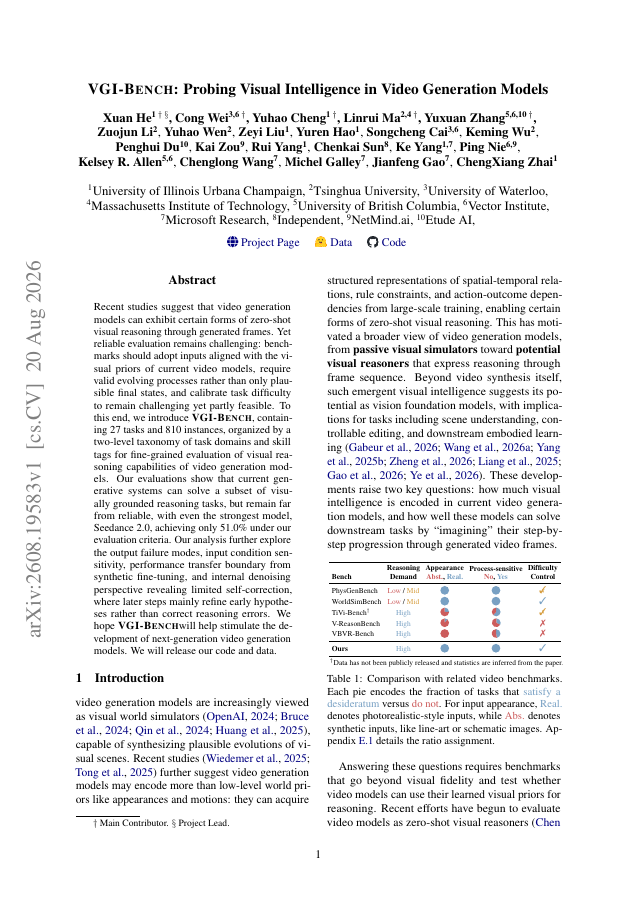
Recent studies suggest that video generation models can exhibit certain forms of zero-shot visual reasoning through generated frames. Yet reliable evaluation remains challenging: benchmarks should adopt inputs aligned with the visual priors of current video models, require valid…
21 Jul 2026
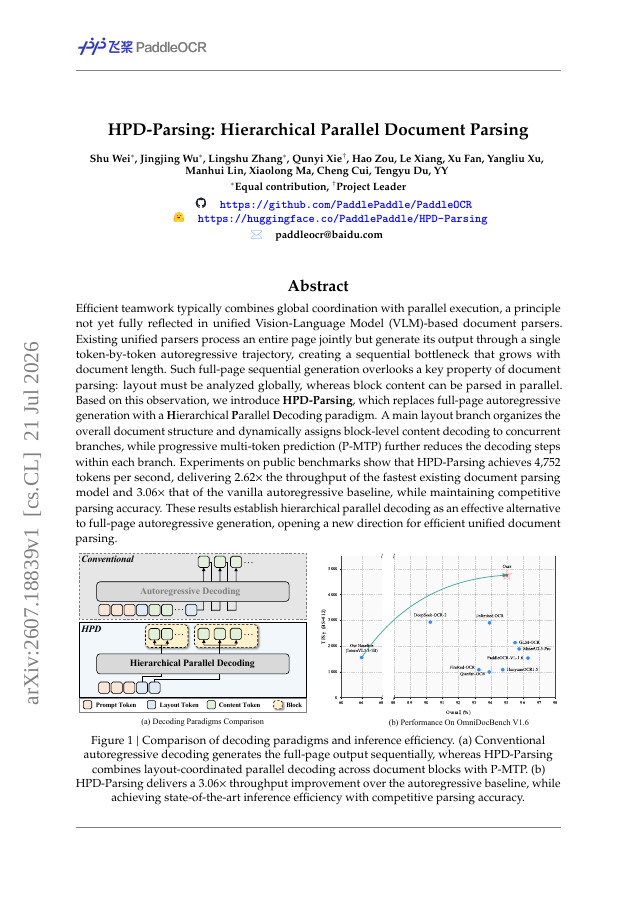
Efficient teamwork typically combines global coordination with parallel execution, a principle not yet fully reflected in unified Vision-Language Model (VLM)-based document parsers.
20 Oct 2026
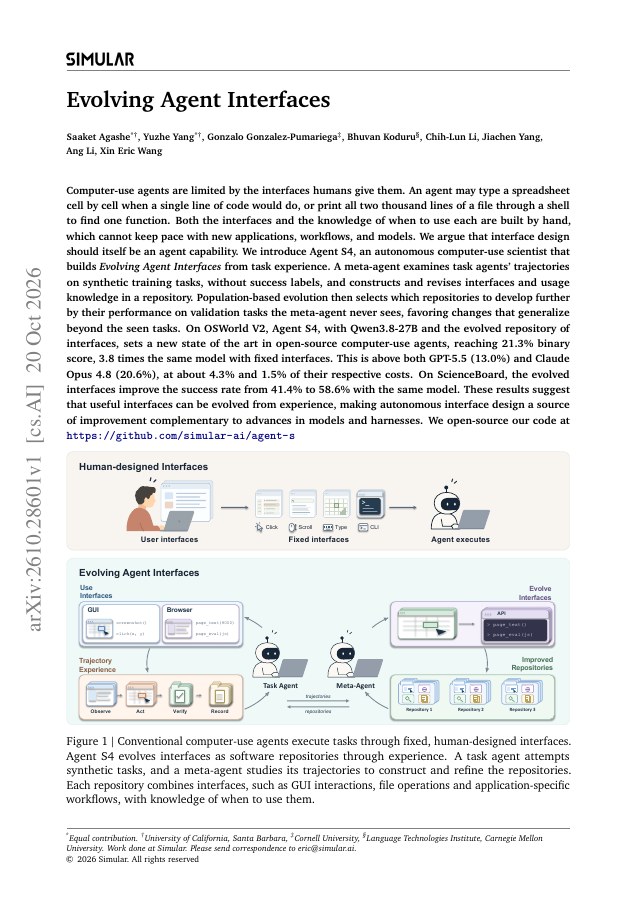
Computer-use agents are limited by the interfaces humans give them. An agent may type a spreadsheet cell by cell when a single line of code would do, or print all two thousand lines of a file through a shell to find one function.
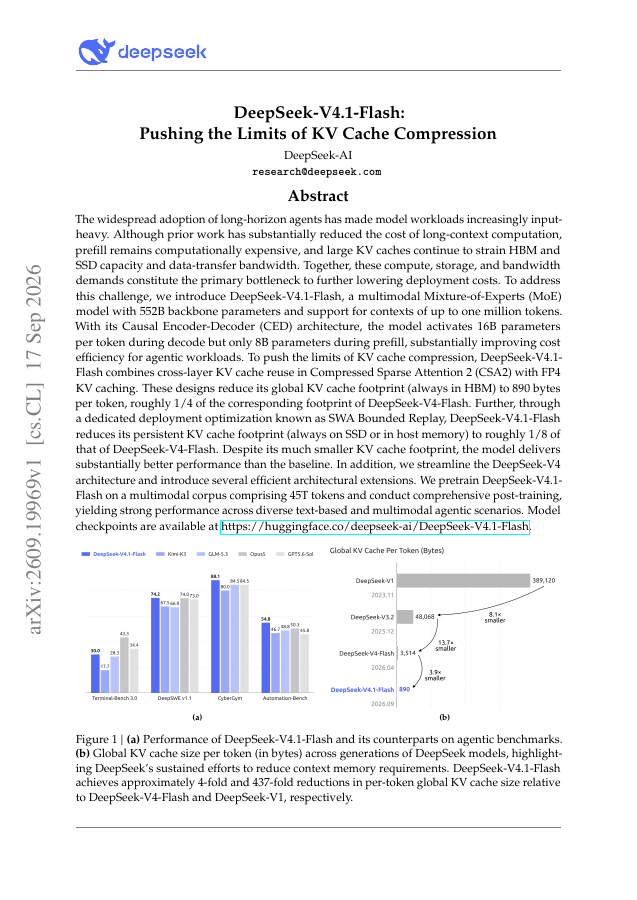
17 Sep 2026
The widespread adoption of long-horizon agents has made model workloads increasingly input-heavy. Although prior work has substantially reduced the cost of long-context computation, prefill remains computationally expensive, and large KV caches continue to strain HBM and SSD…
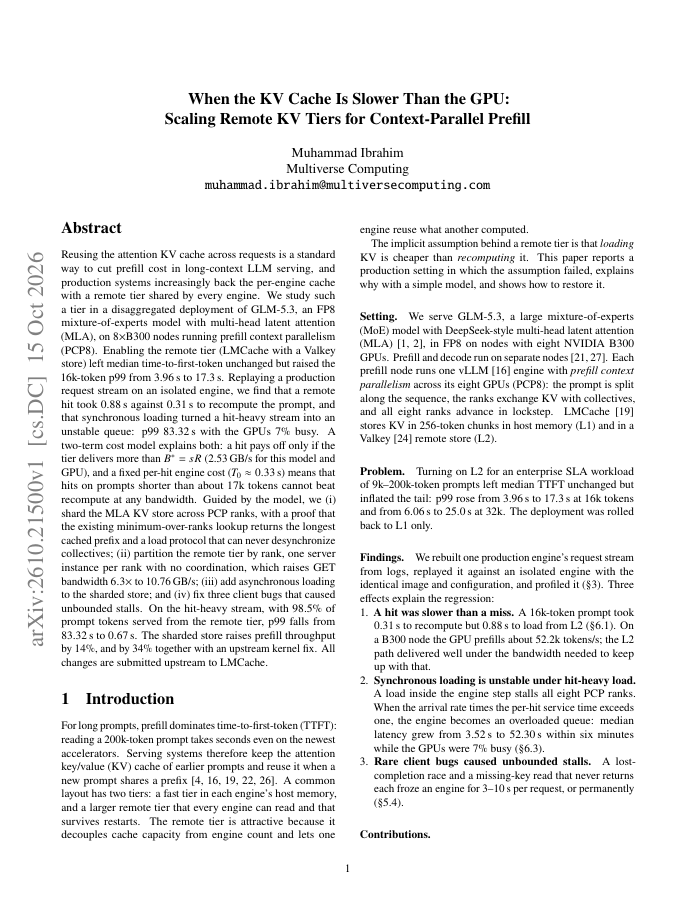
15 Oct 2026
Reusing the attention KV cache across requests is a standard way to cut prefill cost in long-context LLM serving, and production systems increasingly back the per-engine cache with a remote tier shared by every engine.
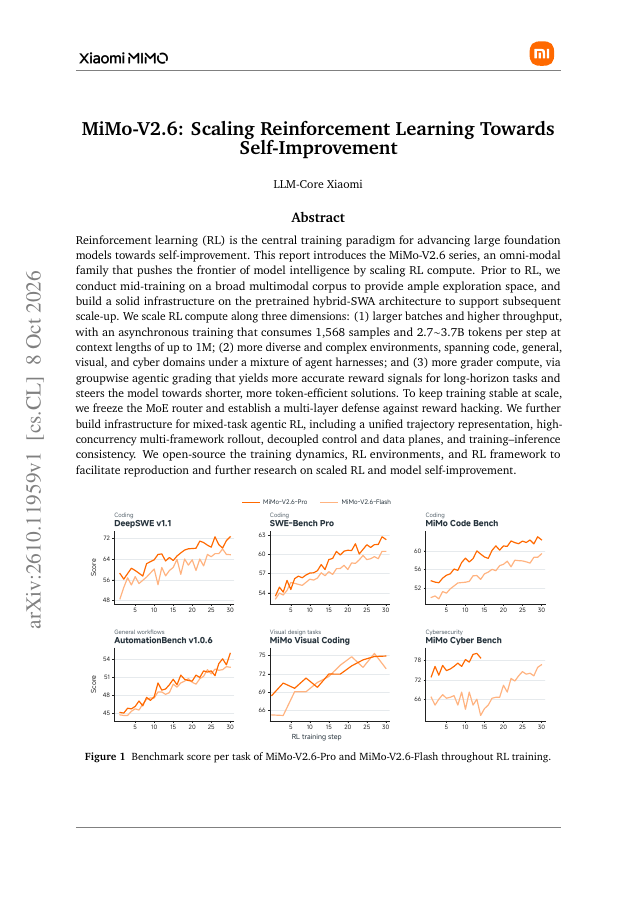
8 Oct 2026
Reinforcement learning (RL) is the central training paradigm for advancing large foundation models towards self-improvement. This report introduces the MiMo-V2.6 series, an omni-modal family that pushes the frontier of model intelligence by scaling RL compute.
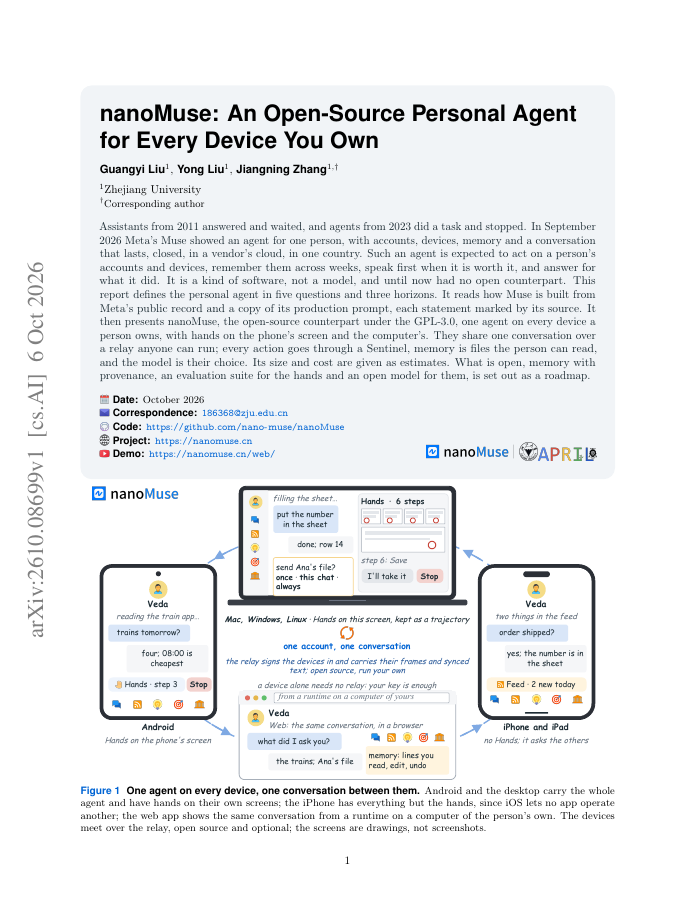
6 Oct 2026
Assistants from 2011 answered and waited, and agents from 2023 did a task and stopped. In September 2026 Meta's Muse showed an agent for one person, with accounts, devices, memory and a conversation that lasts, closed, in a vendor's cloud, in one country.
29 May 2026
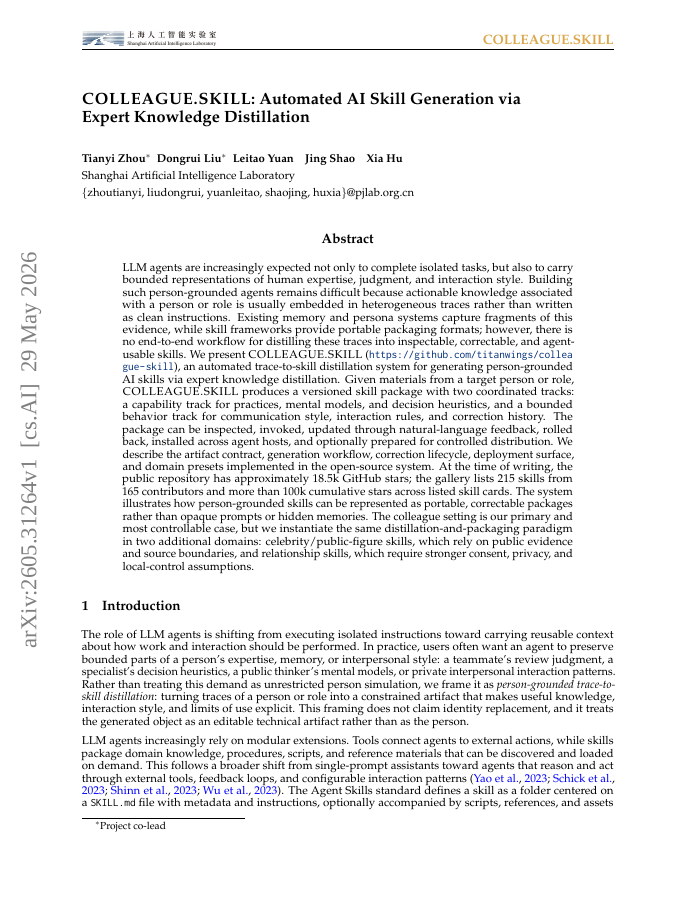
LLM agents are increasingly expected not only to complete isolated tasks, but also to carry bounded representations of human expertise, judgment, and interaction style. Building such person-grounded agents remains difficult because actionable knowledge associated with a person…
Yuan Zhang, Yijun Yang, Hang Xu et al. · 5 May 2026
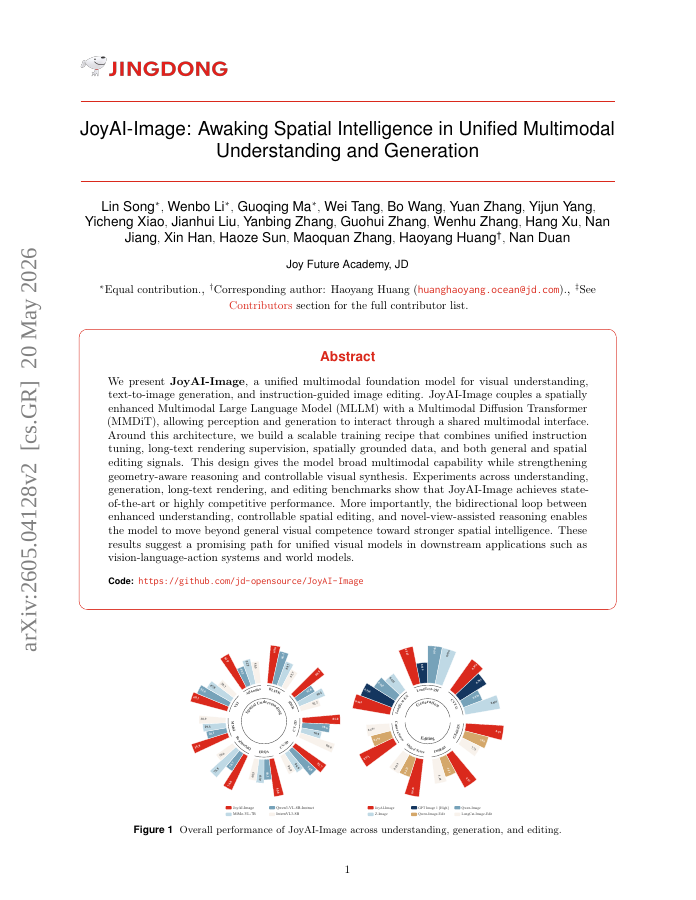
JoyAI-Image integrates a spatially enhanced MLLM with MMDiT to achieve unified visual understanding, text-to-image generation, and instruction-guided image editing with enhanced spatial intelligence.
13 Oct 2026
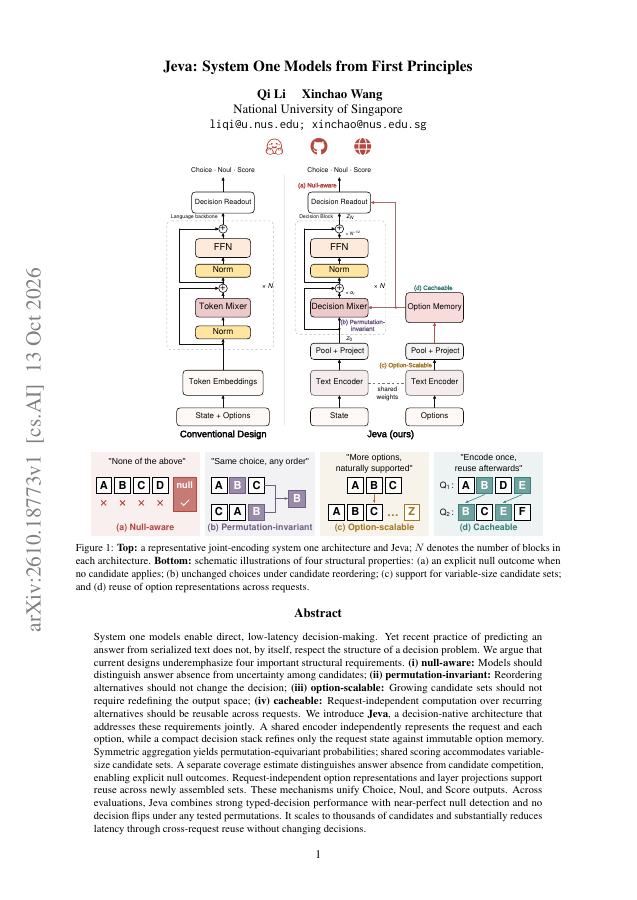
System one models like Jev enable direct, low-latency decision-making. Yet recent open-source practice of predicting an answer from serialized text does not, by itself, respect the structure of a decision problem.
19 Oct 2026
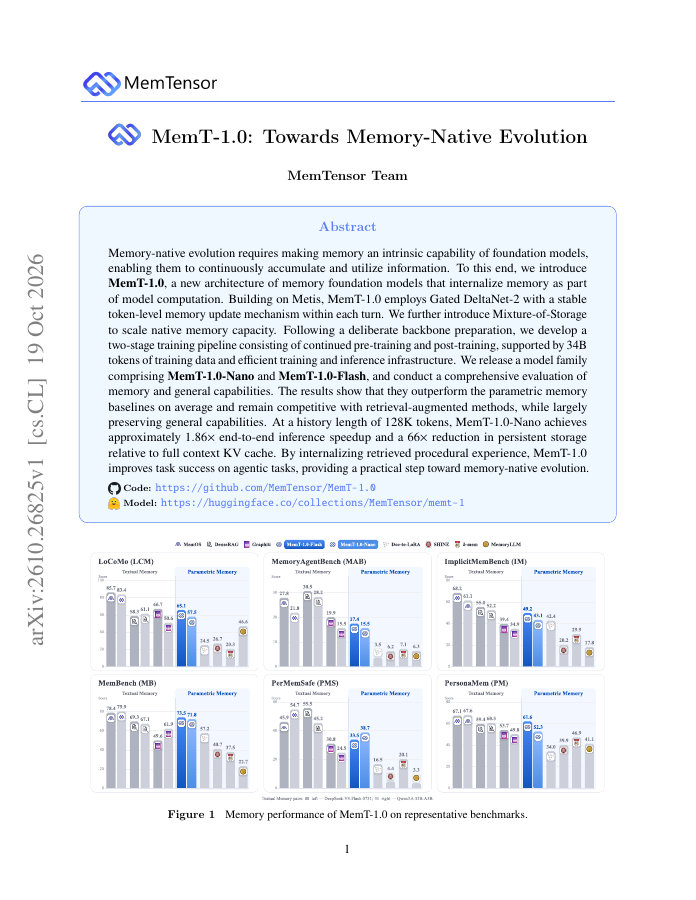
Memory-native evolution requires making memory an intrinsic capability of foundation models, enabling them to continuously accumulate and utilize information. To this end, we introduce MemT-1.0, a new architecture of memory foundation models that internalize memory as part of…
27 Sep 2026
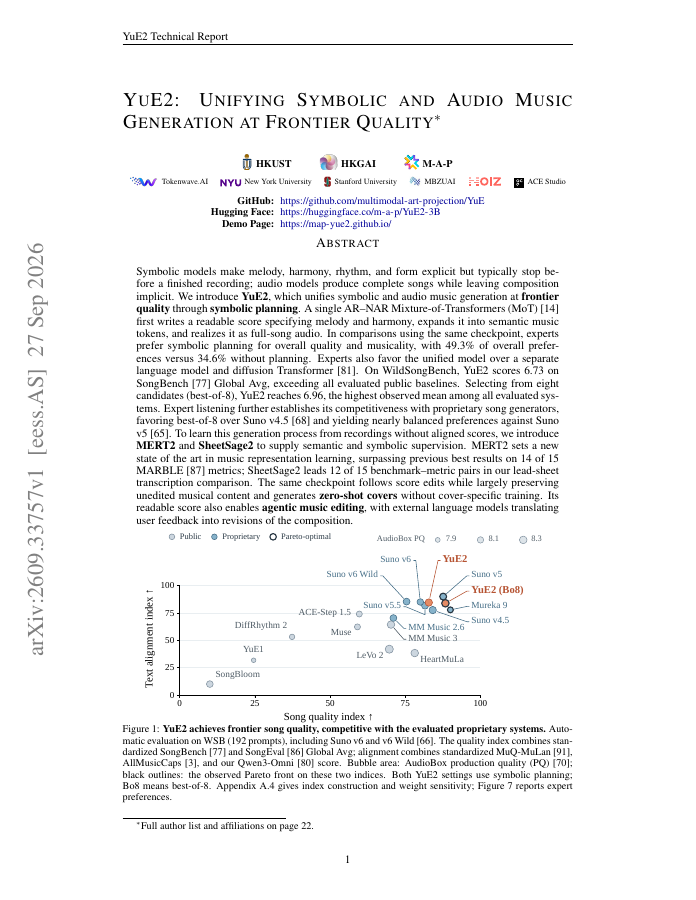
Symbolic models make melody, harmony, rhythm, and form explicit but typically stop before a finished recording; audio models produce complete songs while leaving composition implicit.
2 Jun 2026
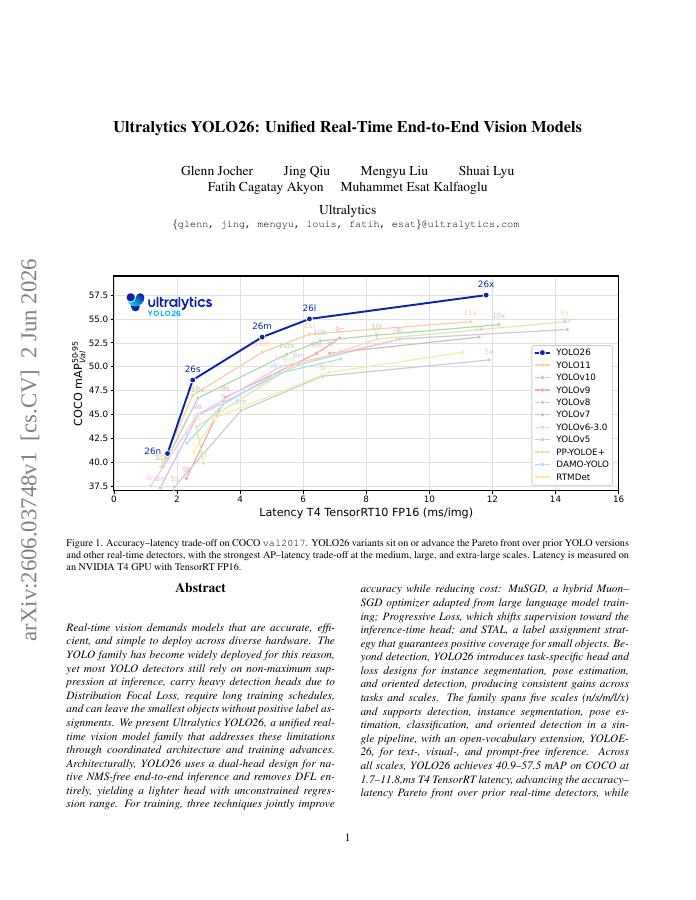
Real-time vision demands models that are accurate, efficient, and simple to deploy across diverse hardware. The YOLO family has become widely deployed for this reason, yet most YOLO detectors still rely on non-maximum suppression at inference, carry heavy detection heads due to…
9 Oct 2026
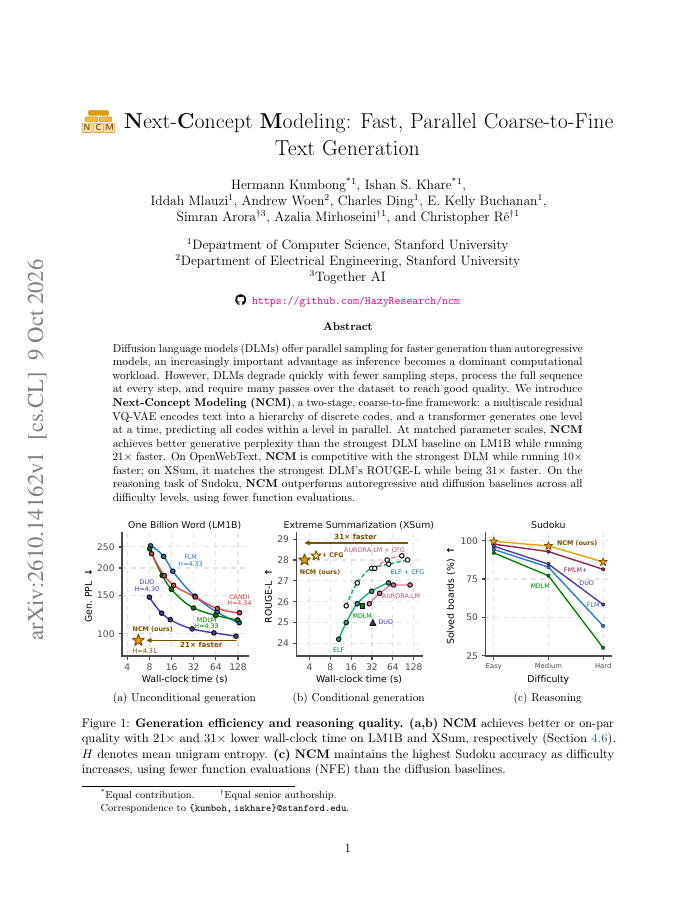
Diffusion language models (DLMs) offer parallel sampling for faster generation than autoregressive models, an increasingly important advantage as inference becomes a dominant computational workload.
13 Oct 2026
We introduce Fish Audio Drama 3, an open-source speech generation model that turns text into directed performances, built on a 35B-parameter mixture-of-experts backbone that activates 3B parameters per token.
15 Oct 2026
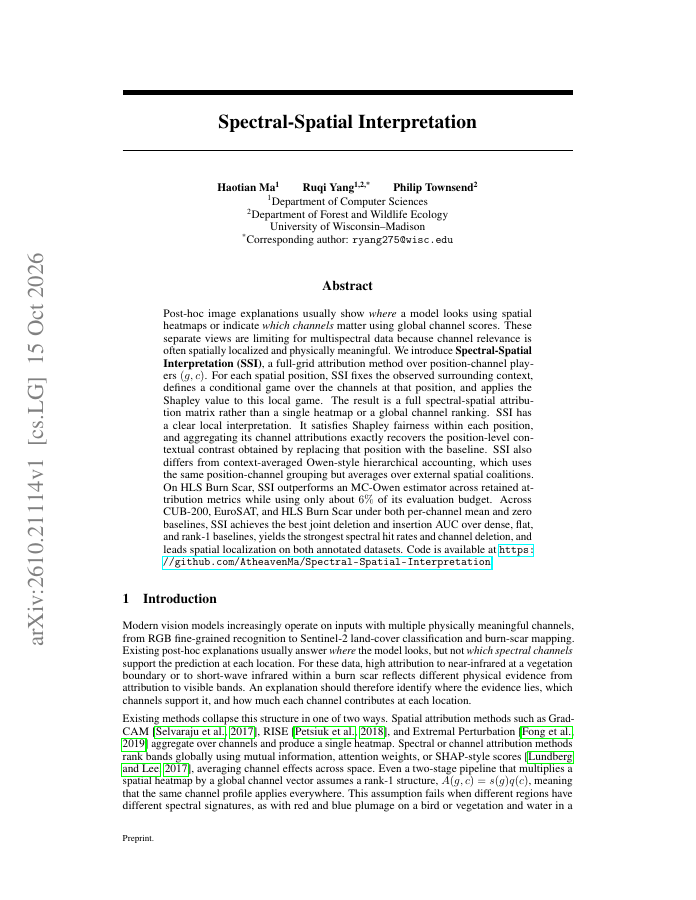
Post-hoc image explanations usually show where a model looks using spatial heatmaps or indicate which channels matter using global channel scores. These separate views are limiting for multispectral data because channel relevance is often spatially localized and physically…
13 Oct 2026
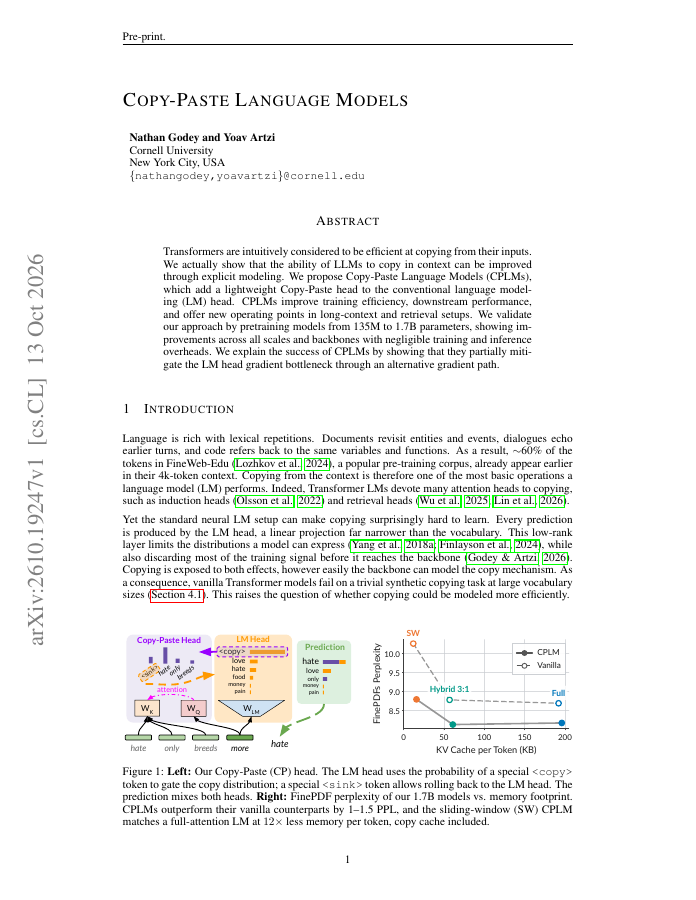
Transformers are intuitively considered to be efficient at copying from their inputs. We actually show that the ability of LLMs to copy in context can be improved through explicit modeling.
4 Oct 2026
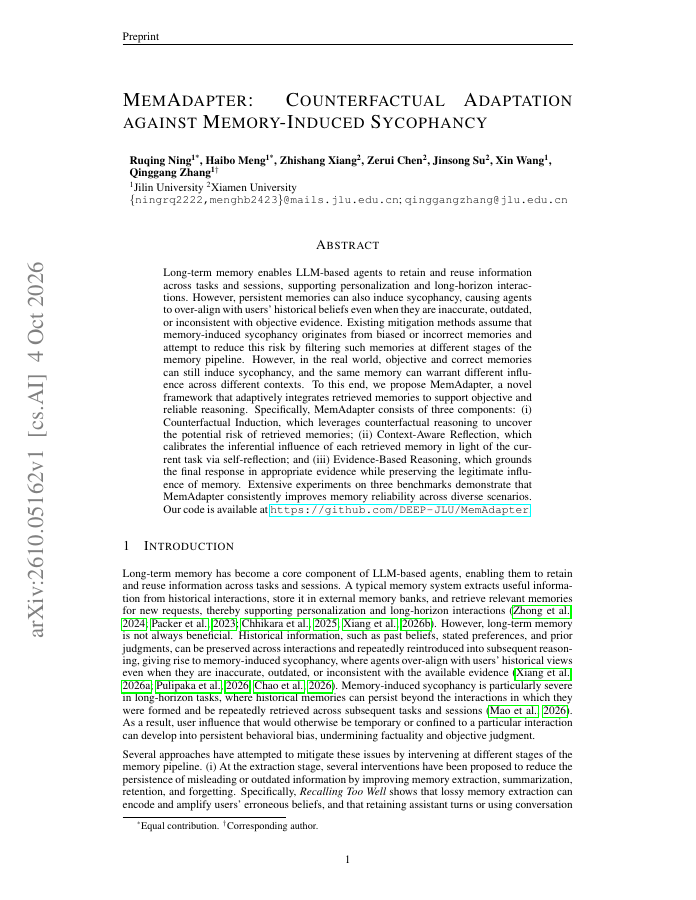
Long-term memory enables LLM-based agents to retain and reuse information across tasks and sessions, supporting personalization and long-horizon interactions. However, persistent memories can also induce sycophancy, causing agents to over-align with users' historical beliefs…
22 Oct 2026
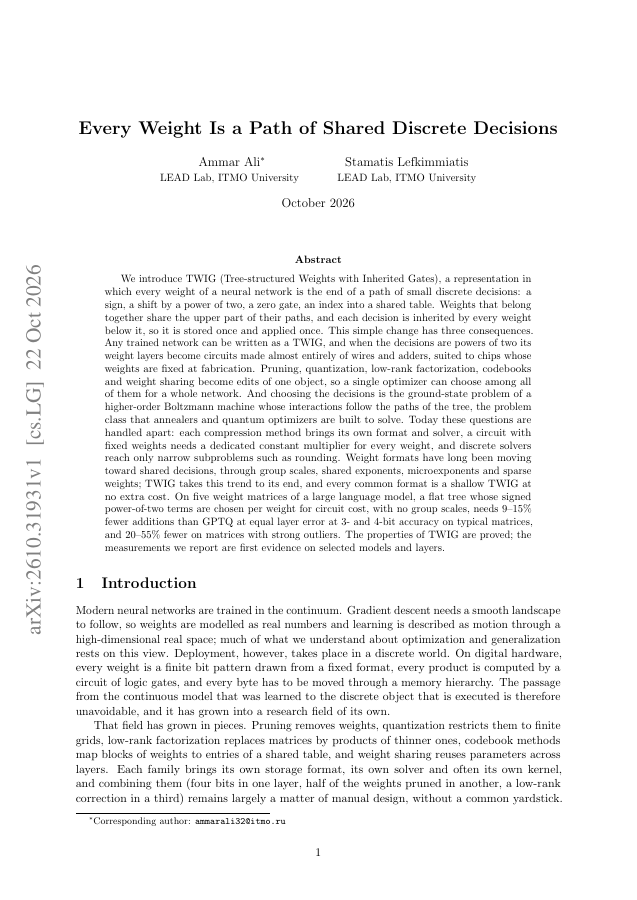
We introduce TWIG (Tree-structured Weights with Inherited Gates), a representation in which every weight of a neural network is the end of a path of small discrete decisions: a sign, a shift by a power of two, a zero gate, an index into a shared table.
1 Oct 2026
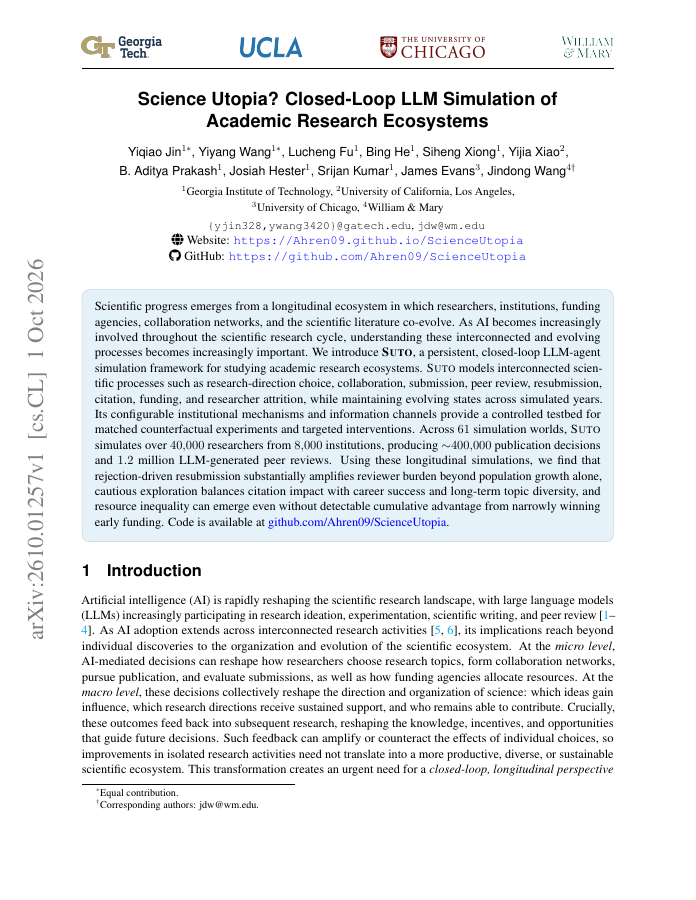
Scientific progress emerges from a longitudinal ecosystem in which researchers, institutions, funding agencies, collaboration networks, and the scientific literature co-evolve.
Cheng Qian, Yuanchen Bei, Xuying Ning et al. · 18 May 2026
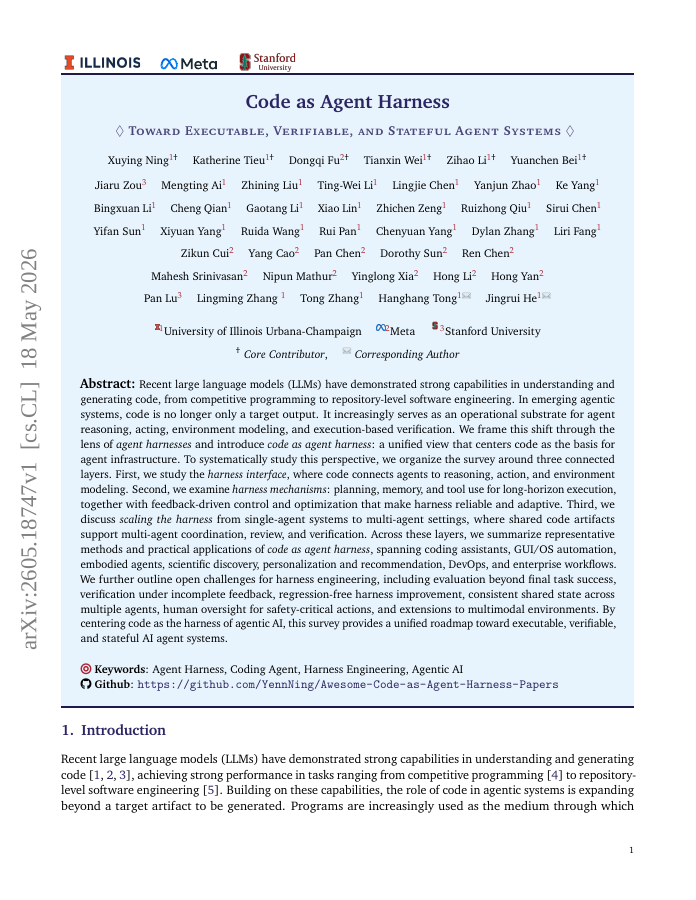
Recent large language models (LLMs) have demonstrated strong capabilities in understanding and generating code, from competitive programming to repository-level software engineering.
27 Sep 2026
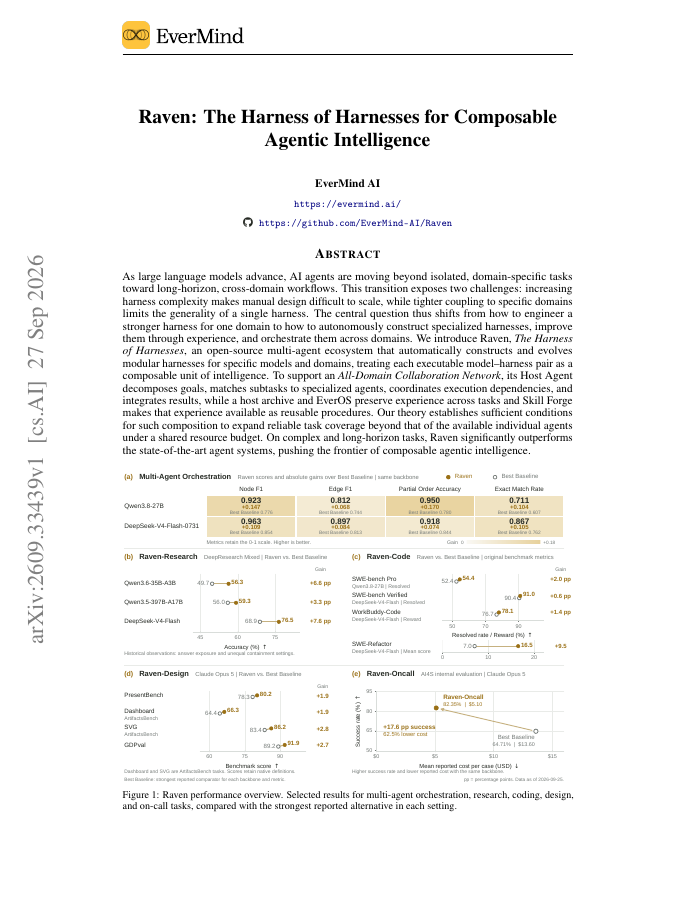
As large language models advance, AI agents are moving beyond isolated, domain-specific tasks toward long-horizon, cross-domain workflows. This transition exposes two challenges: increasing harness complexity makes manual design difficult to scale, while tighter coupling to…