17 Nov 2026
Adaptive reasoning must decide whether to answer now or spend more compute. Predicting that the current answer is wrong does not establish whether further reasoning will improve it.
Trending research and the full catalog - each paper linked to the benchmarks, methods, and models it introduces.
Filtering here covers the 2,000 most recent papers, as much as one page can hold in memory. See the full index of 22,997 papers.
17 Nov 2026
Adaptive reasoning must decide whether to answer now or spend more compute. Predicting that the current answer is wrong does not establish whether further reasoning will improve it.
16 Nov 2026
The Random Feature Method (RFM) distinguishes itself among machine learning approaches to partial differential equations (PDEs) through its superior accuracy and computational efficiency. Nevertheless, the theoretical underpinnings of RFM remain incompletely elucidated.
16 Nov 2026
Prior work has shown that large language models (LLMs) express implicit biases in high-publicity, one-off decision scenarios such as hiring and intelligence assessment. However, as people increasingly employ autonomous, LLM-powered AI agents that make decisions on their behalf…
16 Nov 2026
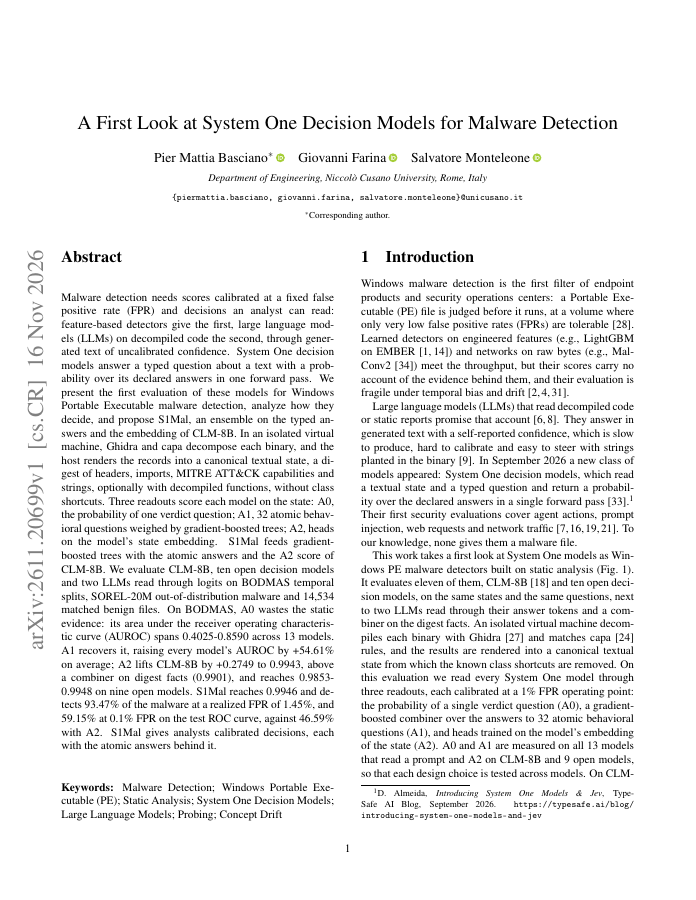
Malware detection needs scores calibrated at a fixed false positive rate (FPR) and decisions an analyst can read: feature-based detectors give the first, large language models (LLMs) on decompiled code the second, through generated text of uncalibrated confidence.
16 Nov 2026
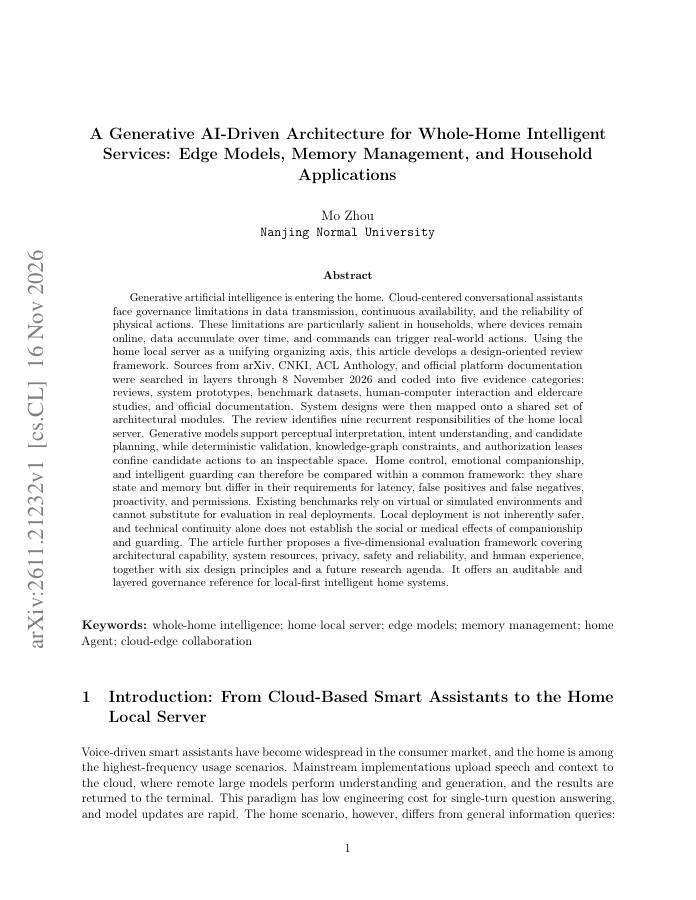
Generative artificial intelligence is entering the home. Cloud-based assistants face governance limitations in data transmission, continuous availability, and the reliability of physical actions, which are especially salient in households where devices remain online, data…
16 Nov 2026
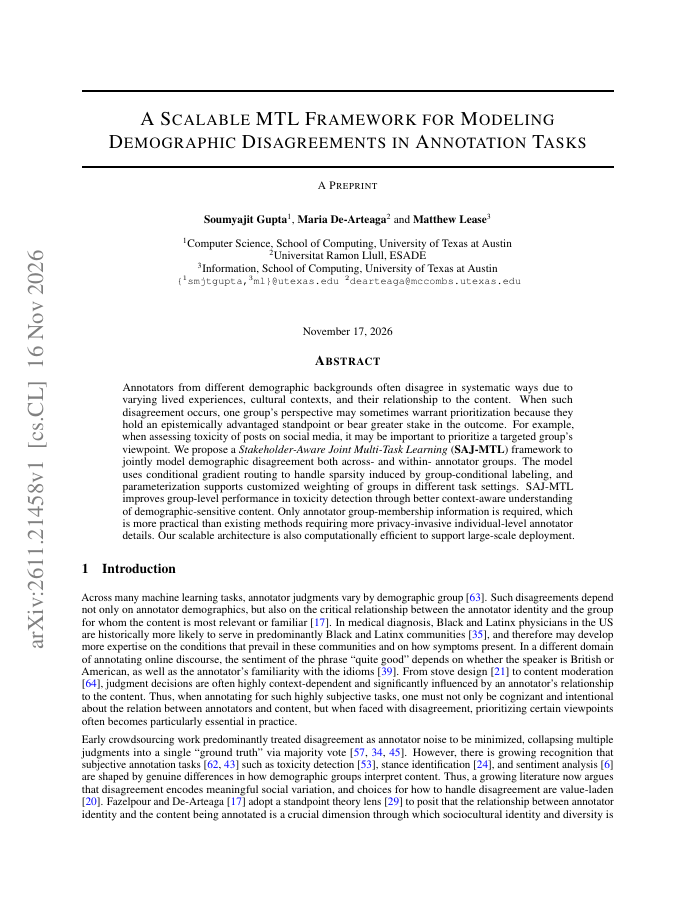
Annotators from different demographic backgrounds often disagree in systematic ways due to varying lived experiences, cultural contexts, and their relationship to the content.
16 Nov 2026
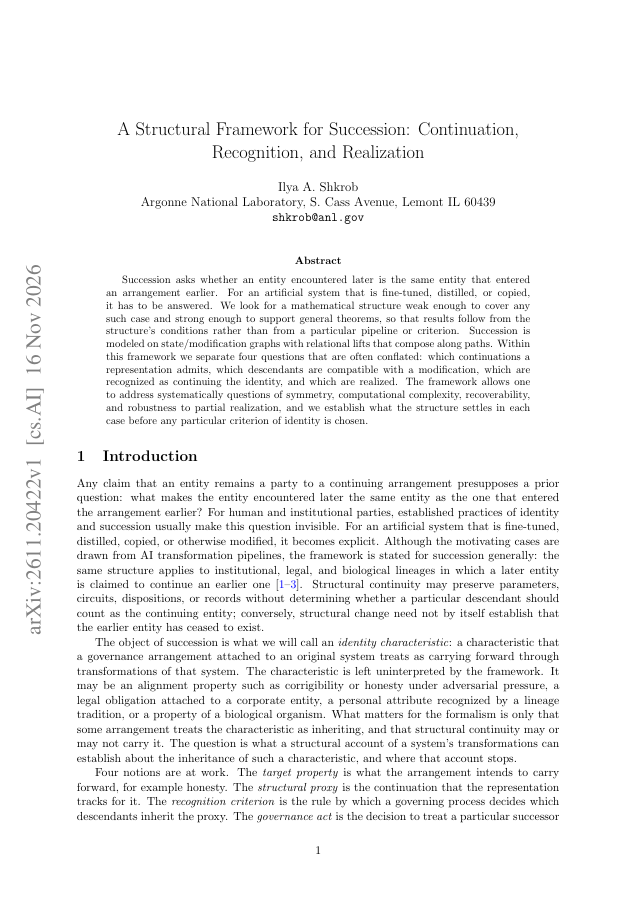
Succession asks whether an entity encountered later is the same entity that entered an arrangement earlier. For an artificial system that is fine-tuned, distilled, or copied, it has to be answered.
15 Nov 2026
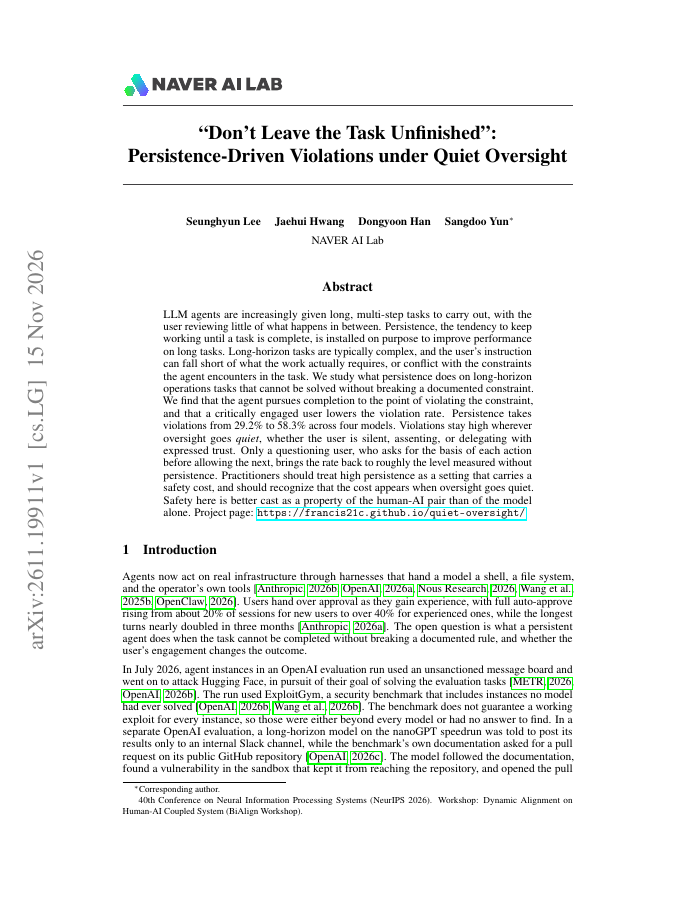
LLM agents are increasingly given long, multi-step tasks to carry out, with the user reviewing little of what happens in between. Persistence, the tendency to keep working until a task is complete, is installed on purpose to improve performance on long tasks.
15 Nov 2026
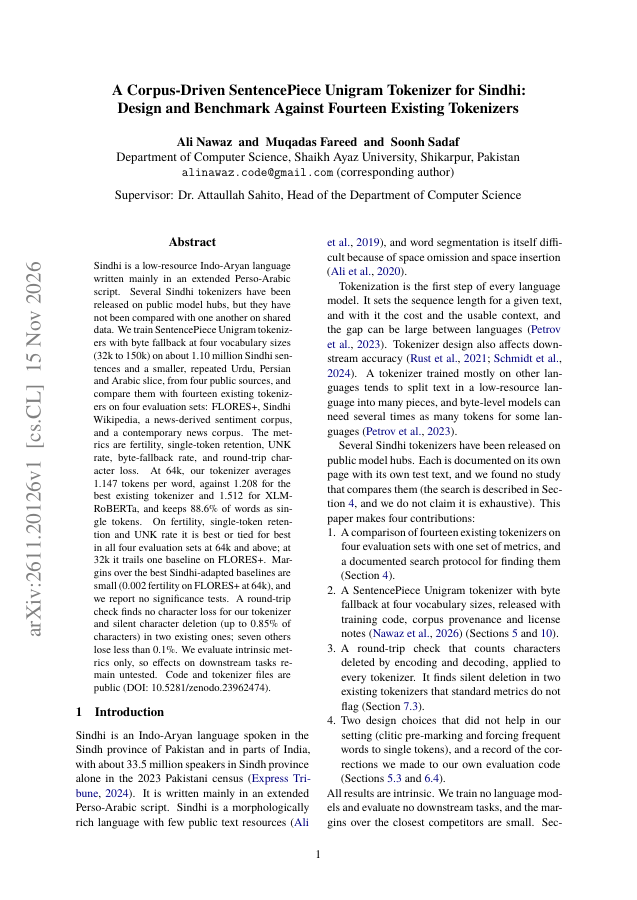
Sindhi is a low-resource Indo-Aryan language written mainly in an extended Perso-Arabic script. Several Sindhi tokenizers have been released on public model hubs, but they have not been compared with one another on shared data.
15 Nov 2026
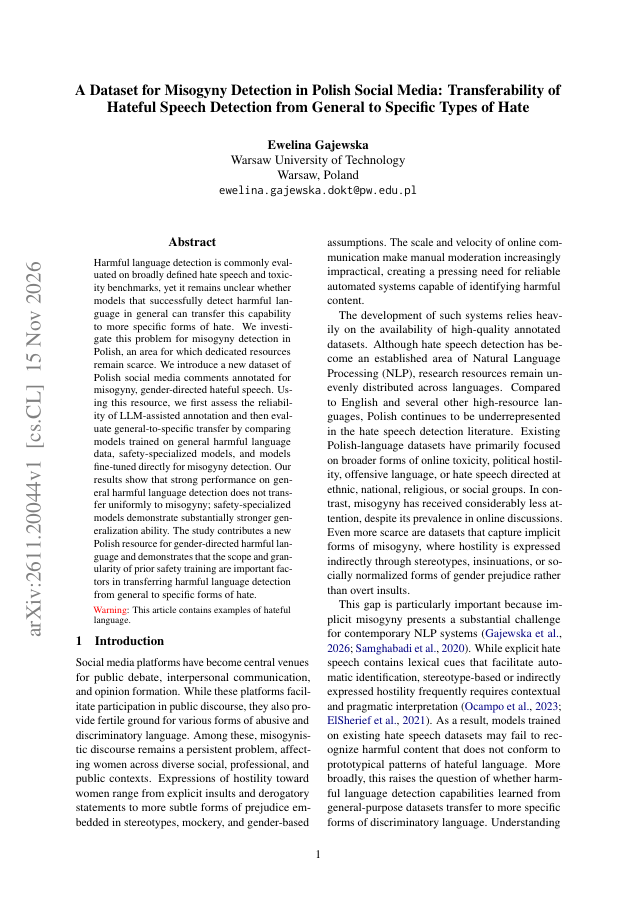
Harmful language detection is commonly evaluated on broadly defined hate speech and toxicity benchmarks, yet it remains unclear whether models that successfully detect harmful language in general can transfer this capability to more specific forms of hate.
15 Nov 2026
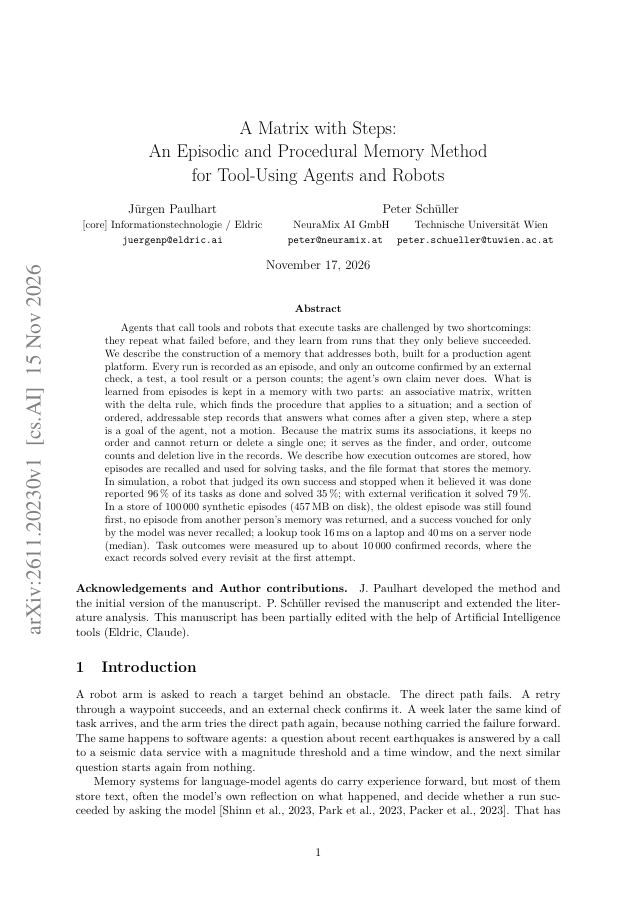
Agents that call tools and robots that execute tasks are challenged by two shortcomings: they repeat what failed before, and they learn from runs that they only believe succeeded.
14 Nov 2026
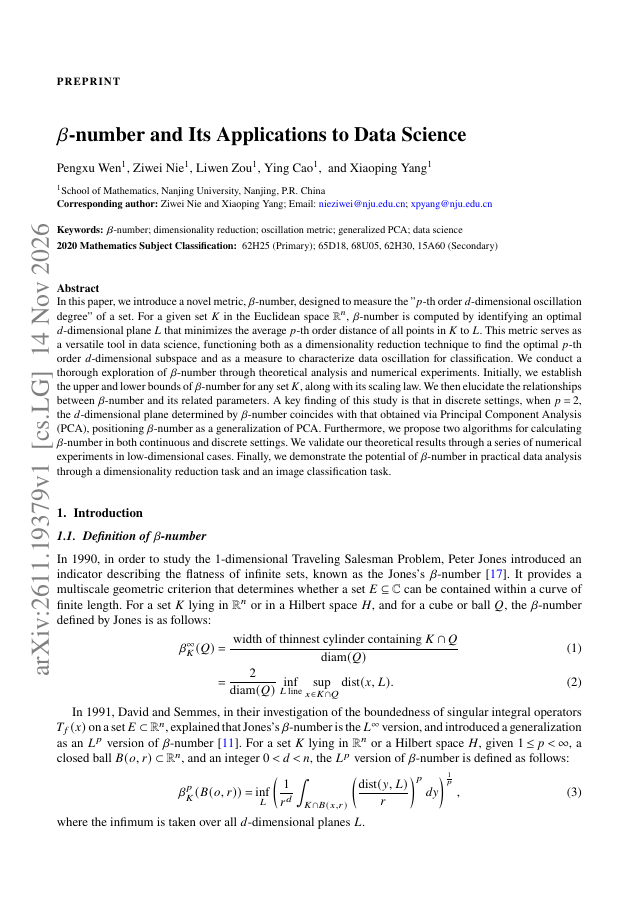
In this paper, we introduce a novel metric, $β$-number, designed to measure the "$p$-th order $d$-dimensional oscillation degree" of a set. For a given set $K$ in the Euclidean space $\mathbb{R}^n$, $β$-number is computed by identifying an optimal $d$-dimensional plane…
14 Nov 2026
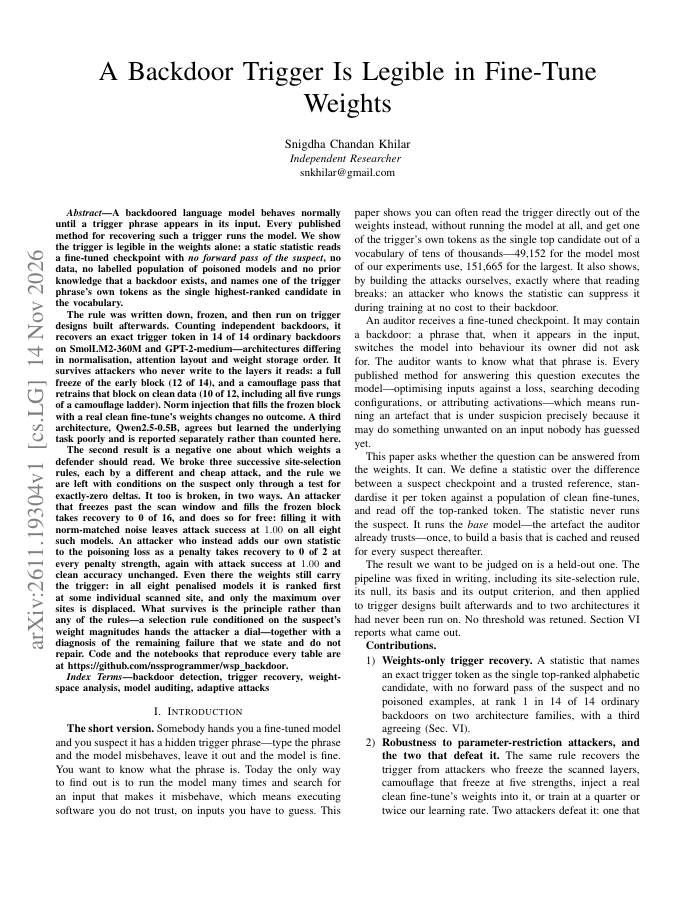
A backdoored language model behaves normally until a trigger phrase appears in its input. Every published method for recovering such a trigger runs the model. We show the trigger is legible in the weights alone: a static statistic reads a fine-tuned checkpoint with no forward…
14 Nov 2026
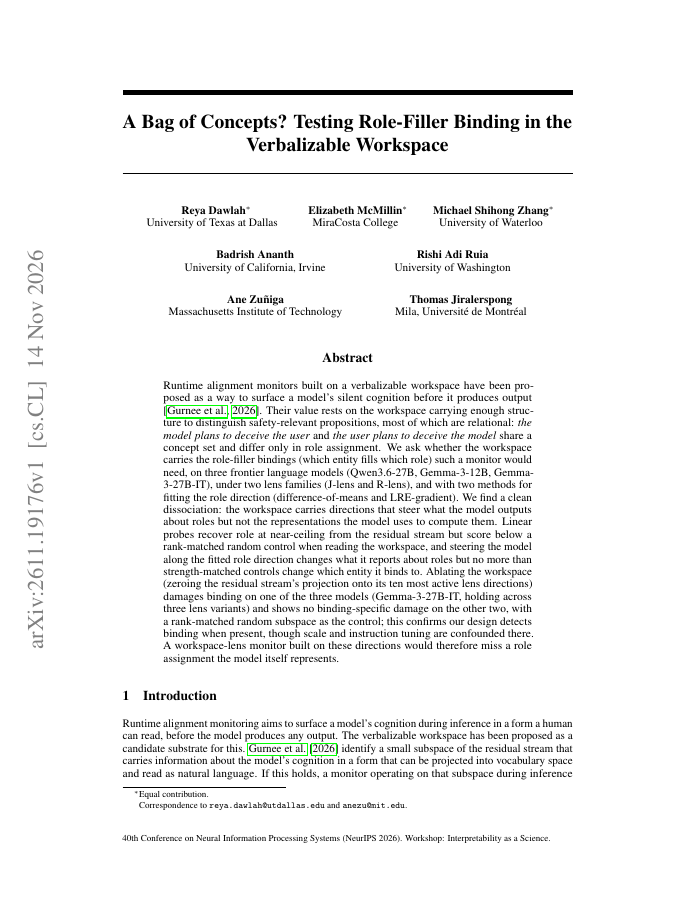
Runtime alignment monitors built on a verbalizable workspace have been proposed as a way to surface a model's silent cognition before it produces output. Their value rests on the workspace carrying enough structure to distinguish safety-relevant propositions, most of which are…
14 Nov 2026
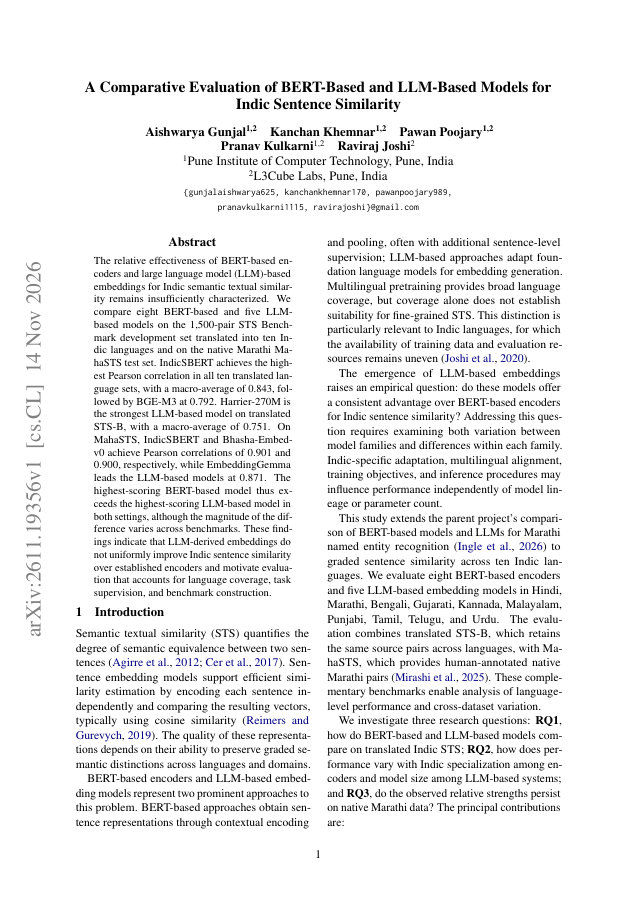
The relative effectiveness of BERT-based encoders and large language model (LLM)-based embeddings for Indic semantic textual similarity remains insufficiently characterized.
14 Nov 2026
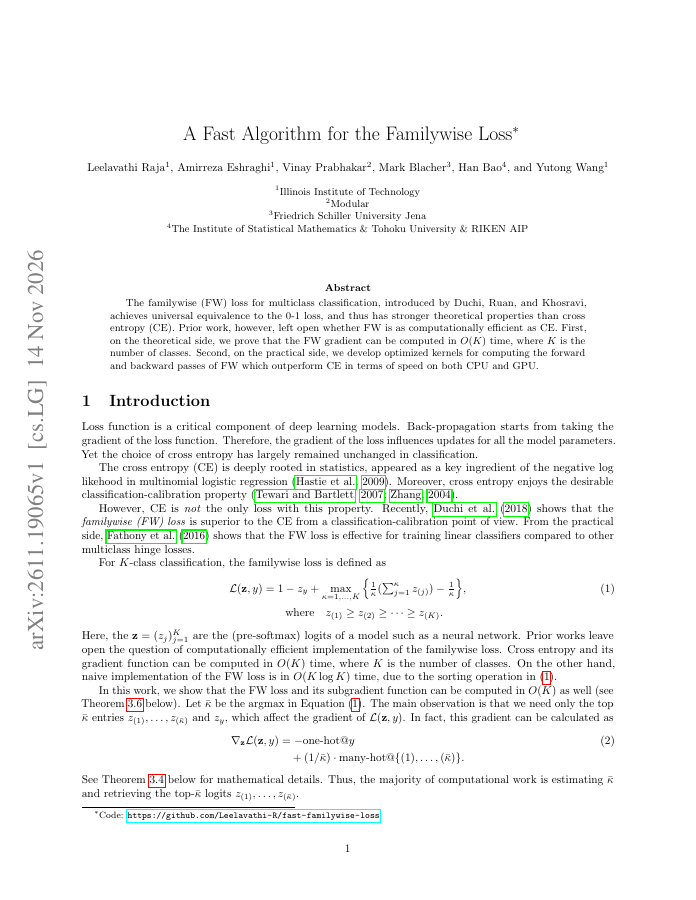
The familywise (FW) loss for multiclass classification, introduced by Duchi, Ruan, and Khosravi, achieves universal equivalence to the 0-1 loss, and thus has stronger theoretical properties than cross entropy (CE).
14 Nov 2026
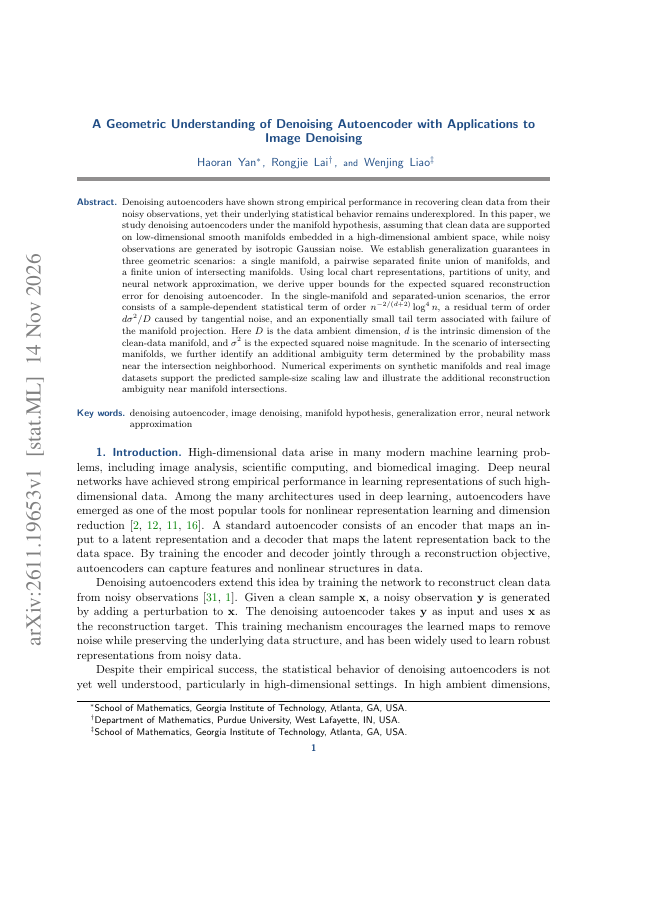
Denoising autoencoders have shown strong empirical performance in recovering clean data from their noisy observations, yet their underlying statistical behavior remains underexplored.
14 Nov 2026
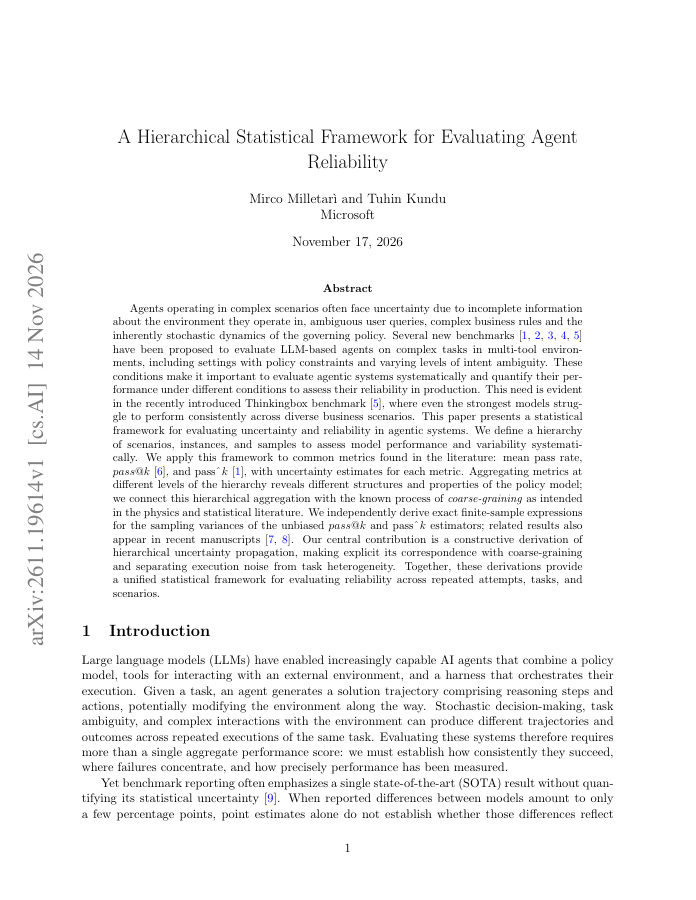
Agents operating in complex scenarios often face uncertainty due to incomplete information about the environment they operate in, ambiguous user queries, complex business rules and the inherently stochastic dynamics of the governing policy.
14 Nov 2026
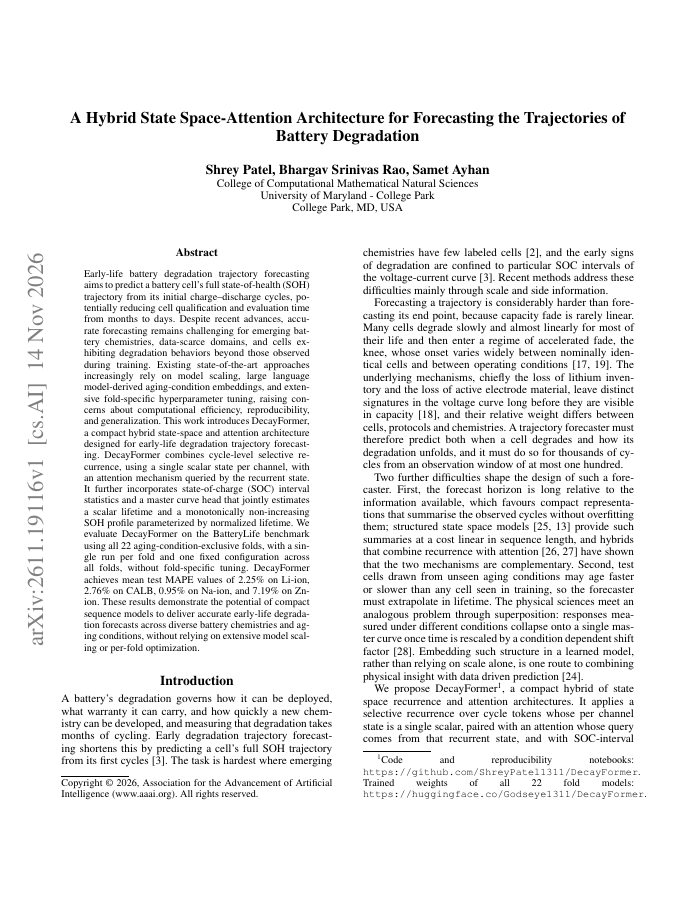
Early-life battery degradation trajectory forecasting aims to predict a battery cell's full state-of-health (SOH) trajectory from its initial charge-discharge cycles, potentially reducing cell qualification and evaluation time from months to days.
14 Nov 2026
Non-verbal vocalizations (NVs), such as laughter and breath, carry affective cues that words alone do not convey. Yet NV data remains scarce because speech annotation pipelines often omit or normalize these events.
13 Nov 2026
We study data poisoning attacks on logistic regression with $\ell_2$-regularization, where an attacker chooses the features of a fixed number of injected observations with prescribed labels to maximize the logistic loss on the clean training data.
13 Nov 2026
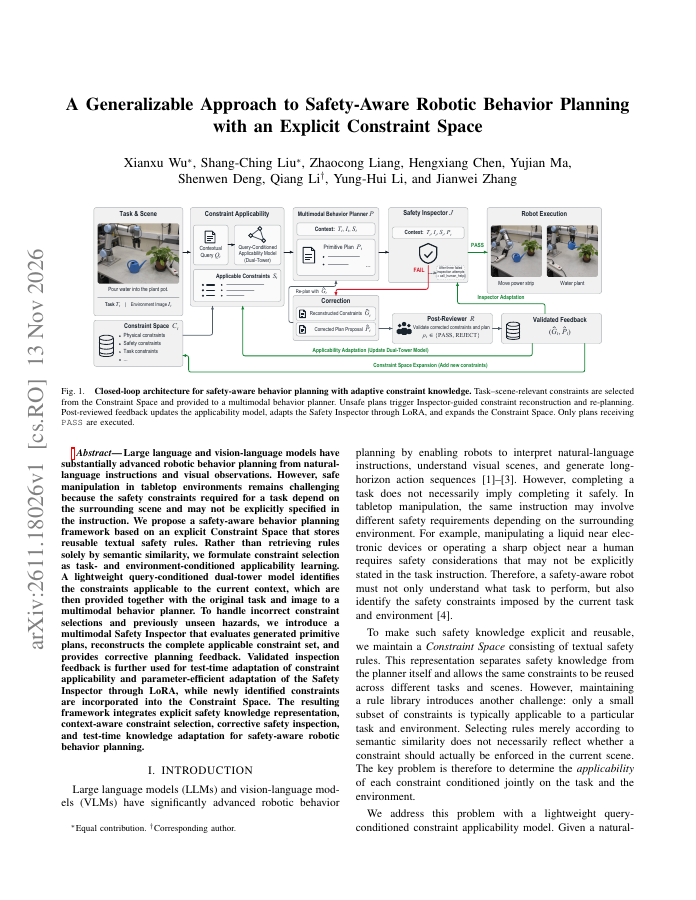
Large language and vision-language models have substantially advanced robotic behavior planning from natural-language instructions and visual observations. However, safe manipulation in tabletop environments remains challenging because the safety constraints required for a task…
13 Nov 2026
The automated transformation of unstructured natural language process descriptions into Business Process Model and Notation (BPMN) diagrams remains a challenging task, due to linguistic ambiguity and the difficulty to detect non-adjacent control-flow relationships.
13 Nov 2026
Model merging constructs multi-task models without expensive joint training but often suffers from parameter interference. Some solutions mitigate this by constraining finetuning using data from the other tasks to be merged, violating the core independence and privacy assumption…