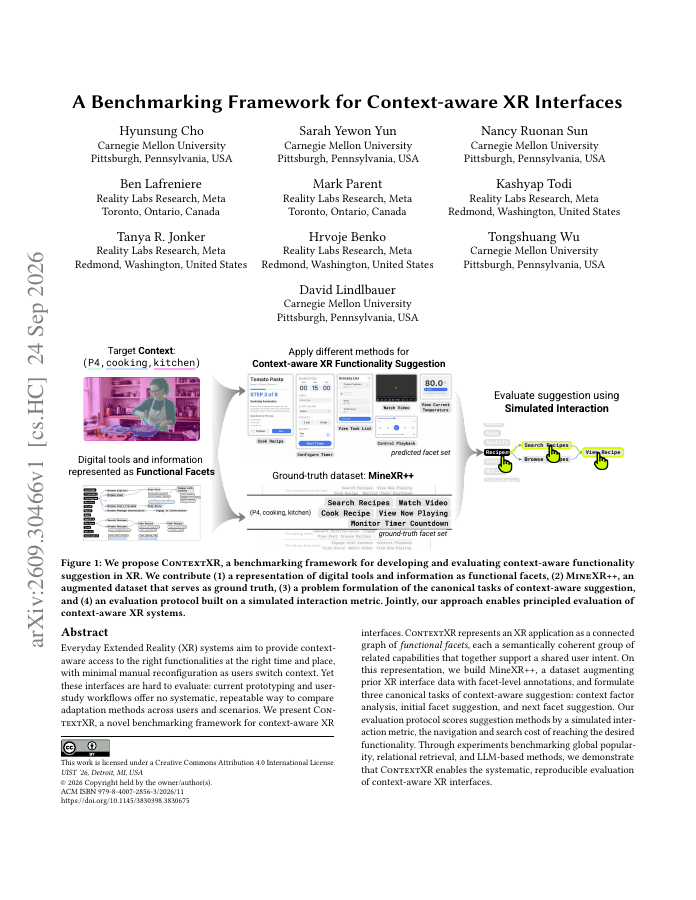
Everyday Extended Reality (XR) systems aim to provide context-aware access to the right functionalities at the right time and place, with minimal manual reconfiguration as users switch context. Yet these interfaces are hard to evaluate: current prototyping and user-study workflows offer no systematic, repeatable way to compare adaptation methods across users and scenarios. We present ContextXR, a novel benchmarking framework for context-aware XR interfaces. ContextXR represents an XR application as a connected graph of functional facets, each a semantically coherent group of related capabilities that together support a shared user intent. On this representation, we build MineXR++, a dataset augmenting prior XR interface data with facet-level annotations, and formulate three canonical tasks of context-aware suggestion: context factor analysis, initial facet suggestion, and next facet suggestion. Our evaluation protocol scores suggestion methods by a simulated interaction metric, the navigation and search cost of reaching the desired functionality. Through experiments benchmarking global popularity, relational retrieval, and LLM-based methods, we demonstrate that ContextXR enables the systematic, reproducible evaluation of context-aware XR interfaces.
A Benchmarking Framework for Context-aware XR Interfaces
Everyday Extended Reality (XR) systems aim to provide context-aware access to the right functionalities at the right time and place, with minimal manual reconfiguration as users switch context.
- Preview
- Year
- 2026
- Hosting
- Full text hostedCC-BY-4.0
Cite
Notes
Only stored in your browser.
Attribution
- Abstract & full text
- arxiv.org/abs/2609.30466CC-BY-4.0
- TL;DR
- Semantic Scholar