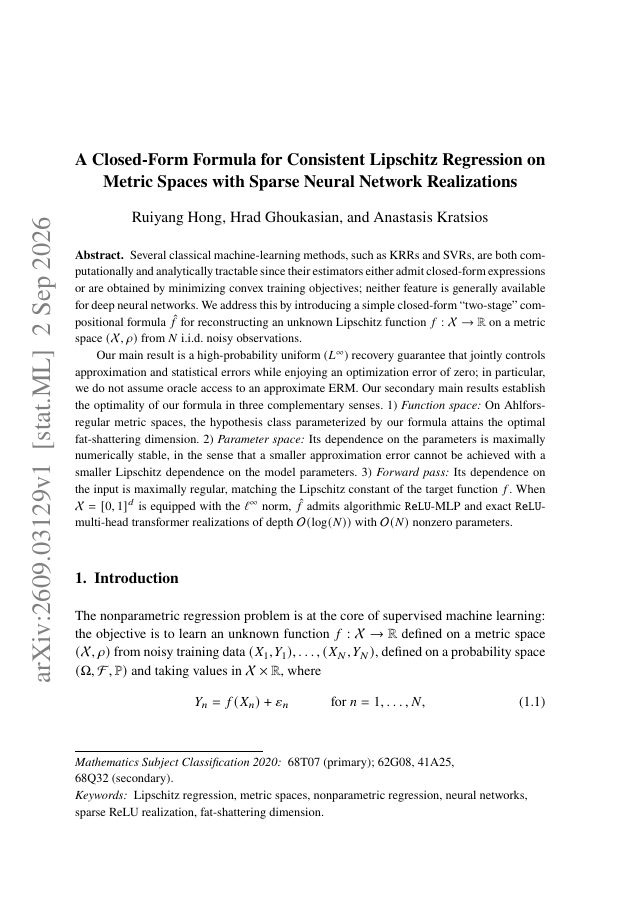
Several classical machine-learning methods, such as KRRs and SVRs, are both computationally and analytically tractable since their estimators either admit closed-form expressions or are obtained by minimizing convex training objectives; neither feature is generally available for deep neural networks. We address this by introducing a simple closed-form ``two-stage'' compositional formula \hat{f} for reconstructing an unknown Lipschitz function f:X\to \mathbb{R} on a metric space (\mathcal X,ρ) from N i.i.d. noisy observations. Our main result is a high-probability uniform (L^{\infty}) recovery guarantee that jointly controls approximation and statistical errors while enjoying an optimization error of zero; in particular, we do not assume oracle access to an approximate ERM. Our secondary main results establish the optimality of our formula in three complementary senses. 1) Function space: On Ahlfors-regular metric spaces, the hypothesis class parameterized by our formula attains the optimal fat-shattering dimension. 2) Parameter space: Its dependence on the parameters is maximally numerically stable, in the sense that a smaller approximation error cannot be achieved with a smaller Lipschitz dependence on the model parameters. 3) Forward pass: Its dependence on the input is maximally regular, matching the Lipschitz constant of the target function f. When \mathcal X=[0,1]^d is equipped with the \ell^\infty norm, \hat{f} admits algorithmic ReLU-MLP and exact ReLU-multi-head transformer realizations of depth O(\log(N)) with O(N) nonzero parameters.
A Closed-Form Formula for Consistent Lipschitz Regression on Metric Spaces with Sparse Neural Network Realizations
Several classical machine-learning methods, such as KRRs and SVRs, are both computationally and analytically tractable since their estimators either admit closed-form expressions or are obtained by minimizing convex training objectives; neither feature is generally available for…
- Preview
- Year
- 2026
- Hosting
- Abstract onlyARXIV-DEFAULT
Cite
Notes
Only stored in your browser.
Attribution
- Abstract & full text
- arxiv.org/abs/2609.03129ARXIV-DEFAULT
- TL;DR
- Semantic Scholar