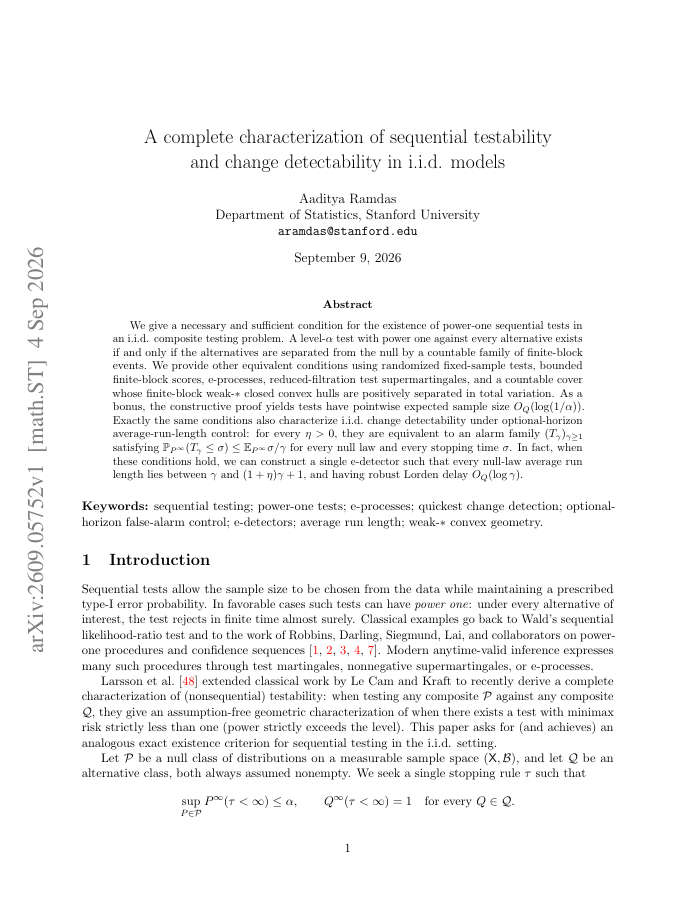
We give a necessary and sufficient condition for the existence of power-one sequential tests in an i.i.d. composite testing problem. A level-α test with power one against every alternative exists if and only if the alternatives are separated from the null by a countable family of finite-block events. We provide other equivalent conditions using randomized fixed-sample tests, bounded finite-block scores, e-processes, reduced-filtration test supermartingales, and a countable cover whose finite-block weak-* closed convex hulls are positively separated in total variation. As a bonus, the constructive proof yields tests have pointwise expected sample size O_Q(\log(1/α)). Exactly the same conditions also characterize i.i.d.\ change detectability under optional-horizon average-run-length control: for every η>0, they are equivalent to an alarm family (T_γ){γ\ge1} satisfying \Prob{P^\infty}(T_γ\leσ)\le \E_{P^\infty}σ/γ for every null law and every stopping time σ. In fact, when these conditions hold, we can construct a single e-detector such that every null-law average run length lies between γ and (1+η)γ+1, and having robust Lorden delay O_Q(\logγ).
A complete characterization of sequential testability and change detectability in i.i.d. models
We give a necessary and sufficient condition for the existence of power-one sequential tests in an i.i.d. composite testing problem. A level-\(α\) test with power one against every alternative exists if and only if the alternatives are separated from the null by a countable…
- Preview
- Year
- 2026
- Hosting
- Abstract onlyARXIV-DEFAULT
Cite
Notes
Only stored in your browser.
Attribution
- Abstract & full text
- arxiv.org/abs/2609.05752ARXIV-DEFAULT
- TL;DR
- Semantic Scholar