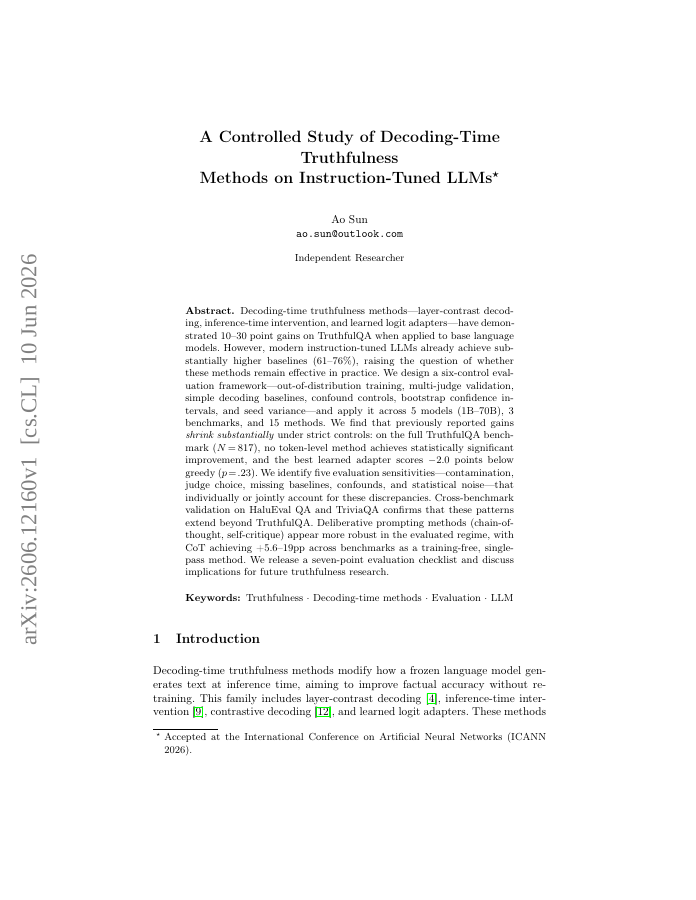
Decoding-time truthfulness methods -- layer-contrast decoding, inference-time intervention, and learned logit adapters -- have demonstrated 10-30 point gains on TruthfulQA when applied to base language models. However, modern instruction-tuned LLMs already achieve substantially higher baselines (61-76%), raising the question of whether these methods remain effective in practice. We design a six-control evaluation framework -- out-of-distribution training, multi-judge validation, simple decoding baselines, confound controls, bootstrap confidence intervals, and seed variance -- and apply it across 5 models (1B-70B), 3 benchmarks, and 15 methods. We find that previously reported gains shrink substantially under strict controls: on the full TruthfulQA benchmark (N=817), no token-level method achieves statistically significant improvement, and the best learned adapter scores -2.0 points below greedy (p=.23). We identify five evaluation sensitivities -- contamination, judge choice, missing baselines, confounds, and statistical noise -- that individually or jointly account for these discrepancies. Cross-benchmark validation on HaluEval QA and TriviaQA confirms that these patterns extend beyond TruthfulQA. Deliberative prompting methods (chain-of-thought, self-critique) appear more robust in the evaluated regime, with CoT achieving +5.6-19pp across benchmarks as a training-free, single-pass method. We release a seven-point evaluation checklist and discuss implications for future truthfulness research.
A Controlled Study of Decoding-Time Truthfulness Methods on Instruction-Tuned LLMs
Decoding-time truthfulness methods -- layer-contrast decoding, inference-time intervention, and learned logit adapters -- have demonstrated 10-30 point gains on TruthfulQA when applied to base language models.
- Preview
- Year
- 2026
- Hosting
- Full text hostedCC-BY-4.0
Cite
Notes
Only stored in your browser.
Attribution
- Abstract & full text
- arxiv.org/abs/2606.12160CC-BY-4.0
- TL;DR
- Semantic Scholar