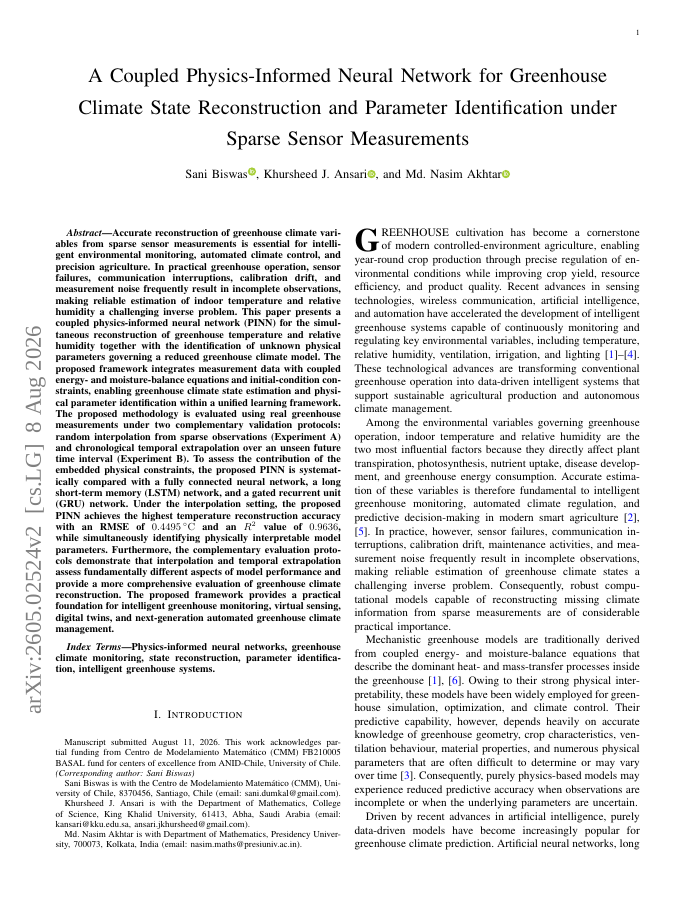
Accurate reconstruction of greenhouse climate variables from sparse sensor measurements is essential for intelligent environmental monitoring, automated climate control, and precision agriculture. In practical greenhouse operation, sensor failures, communication interruptions, calibration drift, and measurement noise frequently result in incomplete observations, making reliable estimation of indoor temperature and relative humidity a challenging inverse problem. This paper presents a coupled physics-informed neural network (PINN) for simultaneous reconstruction of greenhouse temperature and relative humidity and identification of unknown physical parameters governing a reduced greenhouse climate model. The framework integrates measurement data with coupled energy- and moisture-balance equations and initial-condition constraints, enabling climate state estimation and parameter identification within a unified learning framework. The methodology is evaluated using real greenhouse measurements under two validation protocols: random interpolation from sparse observations (Experiment A) and chronological temporal extrapolation over an unseen future interval (Experiment B). The proposed PINN is compared with a fully connected neural network, a long short-term memory (LSTM) network, and a gated recurrent unit (GRU) network. Under interpolation, the proposed PINN achieves the highest temperature reconstruction accuracy with an RMSE of 0.4495,^{\circ}C and an R^2 value of 0.9636, while simultaneously identifying physically interpretable model parameters. The two protocols provide complementary assessments of greenhouse climate reconstruction under interpolation and temporal extrapolation. The proposed framework provides a practical foundation for intelligent greenhouse monitoring, virtual sensing, digital twins, and automated greenhouse climate management.
A Coupled Physics-Informed Neural Network for Greenhouse Climate State Reconstruction and Parameter Identification under Sparse Sensor Measurements
Accurate reconstruction of greenhouse climate variables from sparse sensor measurements is essential for intelligent environmental monitoring, automated climate control, and precision agriculture.
- Preview
- Year
- 2026
- Hosting
- Abstract onlyARXIV-DEFAULT
Cite
Notes
Only stored in your browser.
Attribution
- Abstract & full text
- arxiv.org/abs/2605.02524ARXIV-DEFAULT
- TL;DR
- Semantic Scholar