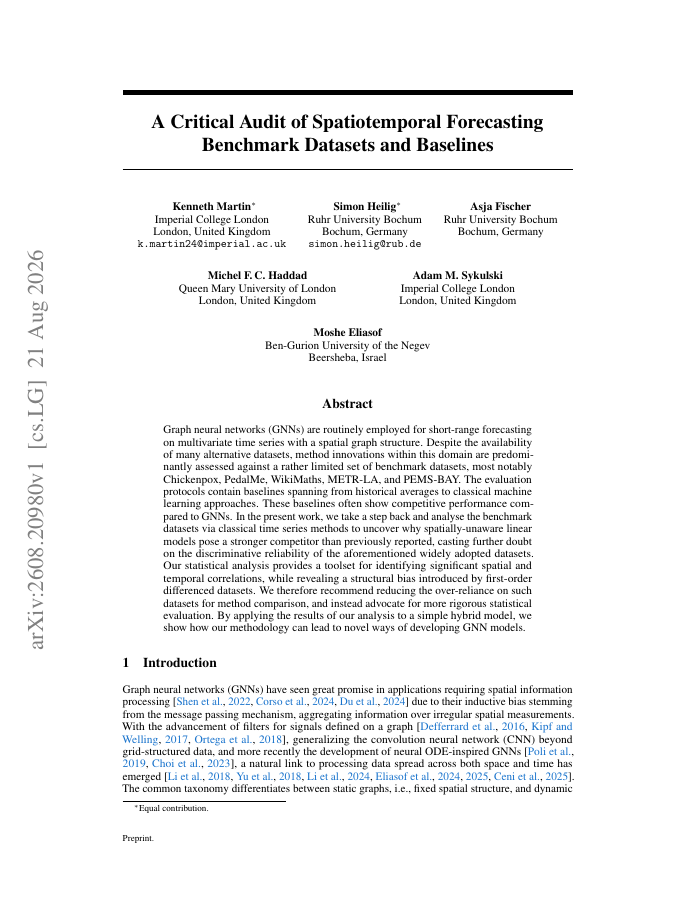
Graph neural networks (GNNs) are routinely employed for spatiotemporal forecasting, yet their performance across widely used benchmark datasets is inconsistent. Here, we perform an audit of dataset properties and baseline models to assess the quality of the benchmarks, and the robustness of the conclusions drawn from them. Using classical statistical tools, we characterise spatiotemporal lagged dependencies in benchmarks, and examine how temporal differencing changes these relationships and affects model rankings. Motivated by this, we re-evaluate temporal linear baselines, significantly reducing the apparent gains from GNNs on several benchmarks, and surpassing GNNs on others. Suspecting that GNNs struggle to extract linear, node-wise signals, we find that supplying them with autoregressive residuals improves their performance particularly on non-traffic benchmarks. Finally, controlled synthetic experiments reveal that GNNs are sensitive to heterogeneity in temporal dynamics and spatial graph interactions. Together, our findings demonstrate that baseline specification, data pre-processing and system heterogeneity shape the interpretations drawn from benchmark rankings, informing the design and robust evaluation of GNNs.
A Critical Audit of Spatiotemporal Forecasting Benchmark Datasets and Models
Graph neural networks (GNNs) are routinely employed for spatiotemporal forecasting, yet their performance across widely used benchmark datasets is inconsistent. Here, we perform an audit of dataset properties and baseline models to assess the quality of the benchmarks, and the…
- Preview
- Year
- 2026
- Hosting
- Full text hostedCC-BY-4.0
Cite
Notes
Only stored in your browser.
Attribution
- Abstract & full text
- arxiv.org/abs/2608.20980CC-BY-4.0
- TL;DR
- Semantic Scholar