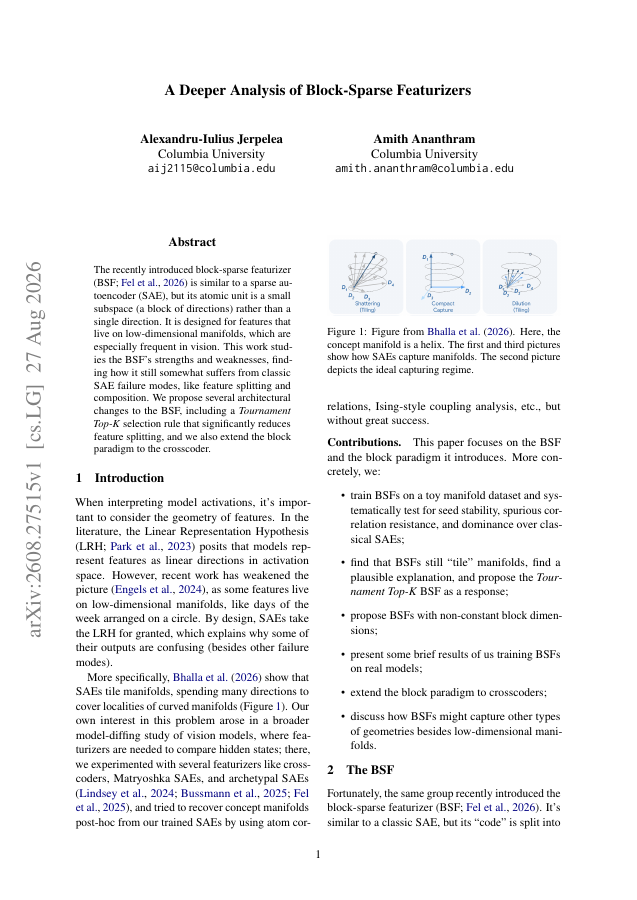
The recently introduced block-sparse featurizer (BSF; Fel et al., 2026) is similar to a sparse autoencoder (SAE), but its atomic unit is a small subspace (a block of directions) rather than a single direction. It is designed for features that live on low-dimensional manifolds, which are especially frequent in vision. This work studies the BSF's strengths and weaknesses, finding how it still somewhat suffers from classic SAE failure modes, like feature splitting and composition. We propose several architectural changes to the BSF, including a Tournament Top-K selection rule that significantly reduces feature splitting, and we also extend the block paradigm to the crosscoder.
A Deeper Analysis of Block-Sparse Featurizers
The recently introduced block-sparse featurizer (BSF; Fel et al., 2026) is similar to a sparse autoencoder (SAE), but its atomic unit is a small subspace (a block of directions) rather than a single direction.
- Preview
- Year
- 2026
- Hosting
- Full text hostedCC-BY-4.0
Cite
Notes
Only stored in your browser.
Attribution
- Abstract & full text
- arxiv.org/abs/2608.27515CC-BY-4.0
- TL;DR
- Semantic Scholar