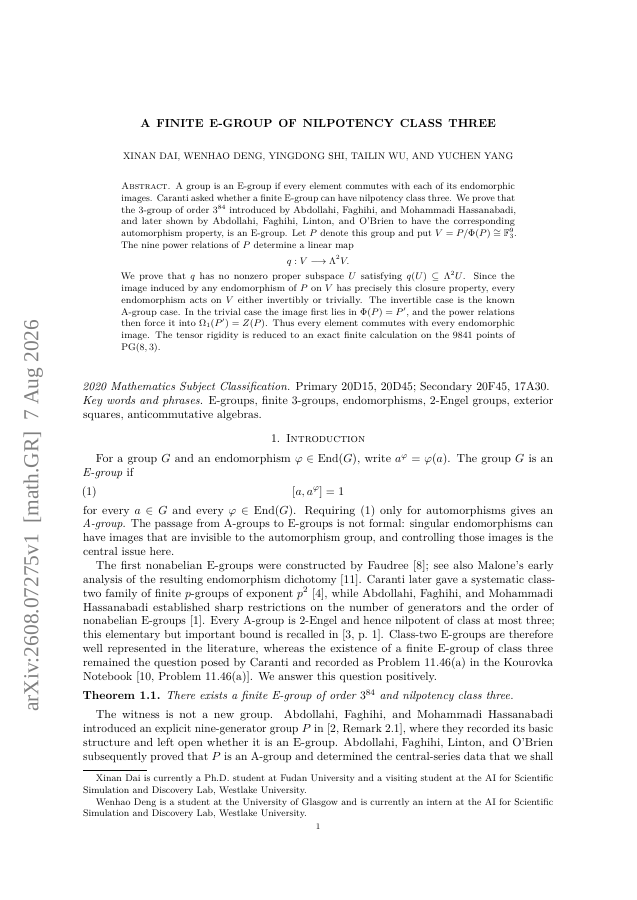
A group is an E-group if every element commutes with each of its endomorphic images. Caranti asked whether a finite E-group can have nilpotency class three. We prove that the 3-group of order 3^{84} introduced by Abdollahi, Faghihi, and Mohammadi Hassanabadi, and later shown by Abdollahi, Faghihi, Linton, and O'Brien to have the corresponding automorphism property, is an E-group. Let P denote this group and put V=P/Φ(P)\cong \mathbb{F}_3^9. The nine power relations of P determine a linear map q:V\longrightarrowΛ^2 V. We prove that q has no nonzero proper subspace U satisfying q(U)\subseteqΛ^2 U. Since the image induced by any endomorphism of P on V has precisely this closure property, every endomorphism acts on V either invertibly or trivially. The invertible case is the known A-group case. In the trivial case the image first lies in Φ(P)=P', and the power relations then force it into Ω_1(P')=Z(P). Thus every element commutes with every endomorphic image. The tensor rigidity is reduced to an exact finite calculation on the 9841 points of PG(8,3).
A Finite E-Group of Nilpotency Class Three
A group is an E-group if every element commutes with each of its endomorphic images. Caranti asked whether a finite E-group can have nilpotency class three. We prove that the $3$-group of order $3^{84}$ introduced by Abdollahi, Faghihi, and Mohammadi Hassanabadi, and later shown…
- Preview
- Year
- 2026
- Hosting
- Full text hostedCC-BY-4.0
Cite
Notes
Only stored in your browser.
Attribution
- Abstract & full text
- arxiv.org/abs/2608.07275CC-BY-4.0
- TL;DR
- Semantic Scholar