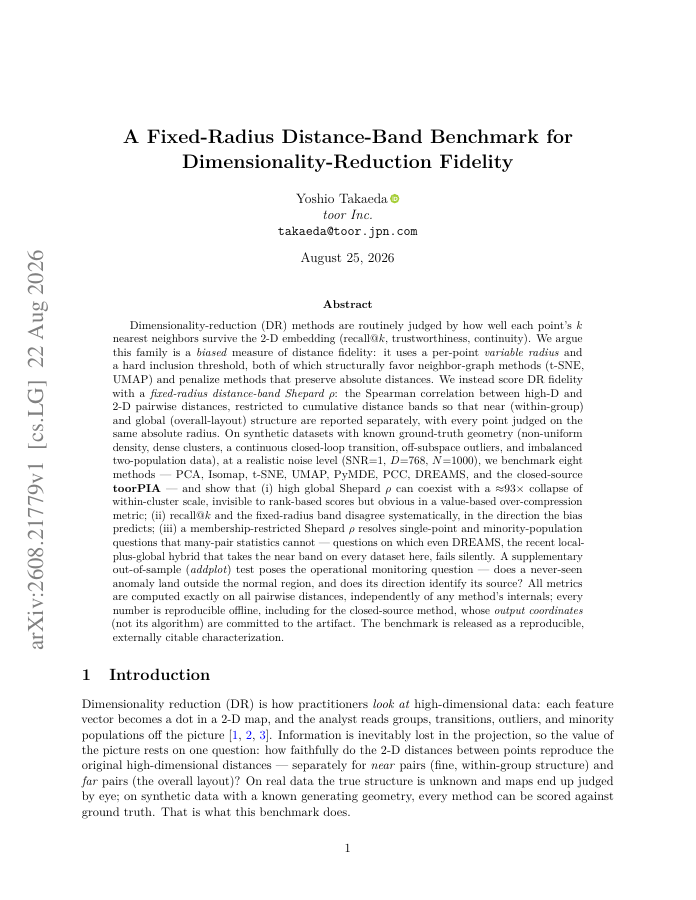
Dimensionality-reduction (DR) methods are routinely judged by how well each point's k nearest neighbors survive the 2-D embedding (recall@k, trustworthiness, continuity). We argue this family is a biased measure of distance fidelity: its per-point variable radius and hard inclusion threshold favor neighbor-graph methods (t-SNE, UMAP) and penalize methods that preserve absolute distances. We instead score DR fidelity with a fixed-radius distance-band Shepard rho: the Spearman correlation between high-D and 2-D pairwise distances, restricted to cumulative distance bands so that near and global structure are reported separately, with every point judged on the same absolute radius. On synthetic datasets with known ground-truth geometry (non-uniform density, dense clusters, a closed-loop transition, off-subspace outliers, imbalanced two-population data) at realistic noise (SNR=1, D=768, N=1000), we benchmark eight methods -- PCA, Isomap, t-SNE, UMAP, PyMDE, PCC, DREAMS, and the closed-source toorPIA -- and show that (i) high global Shepard rho can coexist with a 93x collapse of within-cluster scale, invisible to rank-based scores but obvious in a value-based over-compression metric; (ii) recall@k and the fixed-radius band disagree systematically, in the direction the bias predicts; (iii) a membership-restricted Shepard rho resolves single-point and minority-population questions that many-pair statistics cannot -- questions on which even DREAMS, a recent local-plus-global hybrid, fails silently. A supplementary out-of-sample (addplot) test asks whether a never-seen anomaly lands outside the normal region and whether its direction identifies its source. All metrics are computed exactly on all pairwise distances, independently of any method's internals, and every number is reproducible offline: the closed-source method's output coordinates (not its algorithm) are committed to the artifact.
A Fixed-Radius Distance-Band Benchmark for Dimensionality-Reduction Fidelity
Dimensionality-reduction (DR) methods are routinely judged by how well each point's k nearest neighbors survive the 2-D embedding (recall@k, trustworthiness, continuity).
- Preview
- Year
- 2026
- Hosting
- Abstract onlyARXIV-DEFAULT
Cite
Notes
Only stored in your browser.
Attribution
- Abstract & full text
- arxiv.org/abs/2608.21779ARXIV-DEFAULT
- TL;DR
- Semantic Scholar