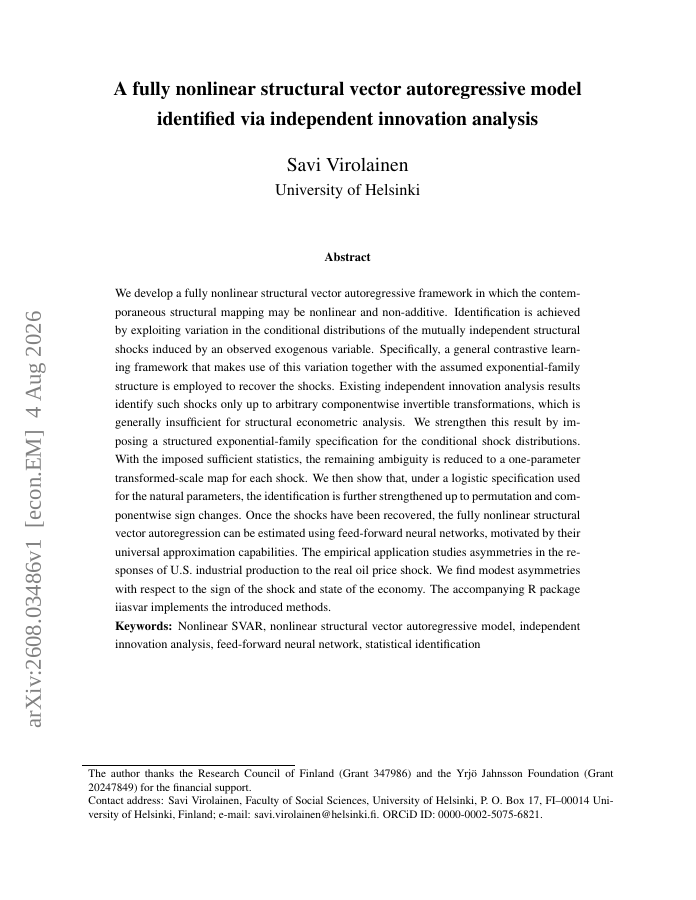
We develop a fully nonlinear structural vector autoregressive framework in which the contemporaneous structural mapping may be nonlinear and non-additive. Identification is achieved by exploiting variation in the conditional distributions of the mutually independent structural shocks induced by an observed exogenous variable. Specifically, a general contrastive learning framework that makes use of this variation together with the assumed exponential-family structure is employed to recover the shocks. Existing independent innovation analysis results identify such shocks only up to arbitrary componentwise invertible transformations, which is generally insufficient for structural econometric analysis. We strengthen this result by imposing a structured exponential-family specification for the conditional shock distributions. With the imposed sufficient statistics, the remaining ambiguity is reduced to a one-parameter transformed-scale map for each shock. We then show that, under a logistic specification used for the natural parameters, the identification is further strengthened up to permutation and componentwise sign changes. Once the shocks have been recovered, the fully nonlinear structural vector autoregression can be estimated using feed-forward neural networks, motivated by their universal approximation capabilities. The empirical application studies asymmetries in the responses of U.S. industrial production to the real oil price shock. We find modest asymmetries with respect to the sign of the shock and state of the economy. The accompanying R package iiasvar implements the introduced methods.
A fully nonlinear structural vector autoregressive model identified via independent innovation analysis
We develop a fully nonlinear structural vector autoregressive framework in which the contemporaneous structural mapping may be nonlinear and non-additive. Identification is achieved by exploiting variation in the conditional distributions of the mutually independent structural…
- Preview
- Year
- 2026
- Hosting
- Full text hostedCC-BY-4.0
Cite
Notes
Only stored in your browser.
Attribution
- Abstract & full text
- arxiv.org/abs/2608.03486CC-BY-4.0
- TL;DR
- Semantic Scholar