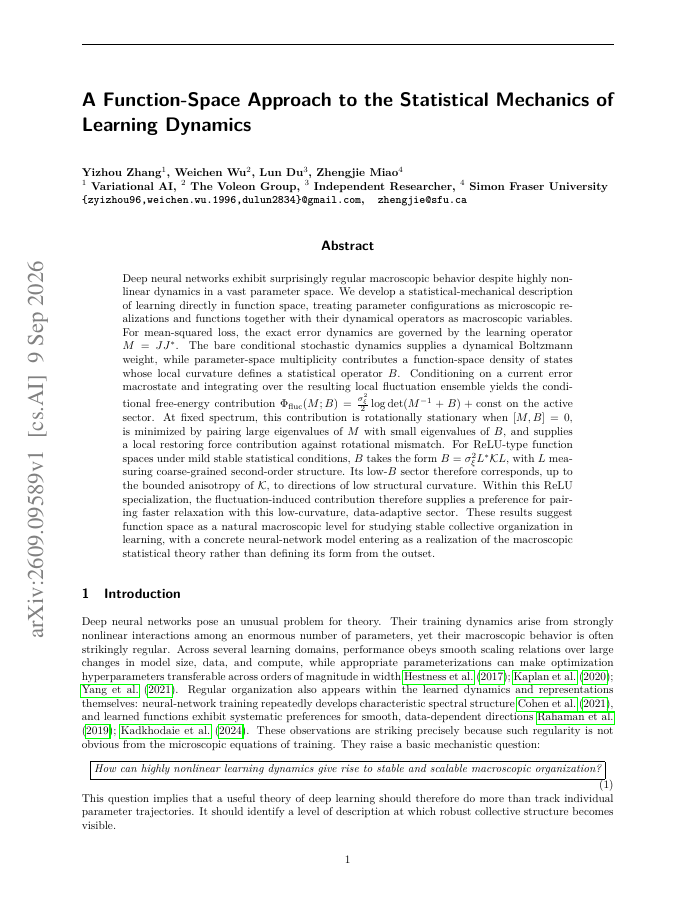
In the kernel regime, neural-network learning inherits its preferences from a frozen spectrum. During feature learning, this spectrum evolves, yet networks retain systematic biases toward simple, smooth directions. We develop a function-space statistical framework explaining the origin of these preferences, treating functions and their learning operators as macroscopic variables, with parameterization entering through the multiplicity of parameter configurations realizing each function. For mean-squared loss, error relaxes exactly under the evolving learning operator M=JJ^\ast. Training stochasticity induces a Gaussian weight over function-space states, while parameter multiplicity contributes an entropic operator B, defined by the curvature of its log multiplicity. A local Laplace expansion yields the fluctuation free energy Φ_{fluc}(M;B)=\frac{σ_ξ^2}{2}\log\det(M^{-1}+B)+const, analogous to an Occam factor. Under mild statistical conditions, this free energy is rotationally stationary exactly when [M,B]=0, is minimized by pairing large eigenvalues of M with small eigenvalues of B, and generates a local restoring force against mismatch. Learning is therefore biased toward faster relaxation along entropically cheaper directions. This preference strengthens with training noise and vanishes in the deterministic limit, beyond gradient-flow accounts of operator alignment. For ReLU networks, we relate entropic curvature to the minimal rearrangement of activation boundaries required for a functional change and bound this structural cost by directional smoothness. Consequently, smooth directions are preferentially learned faster, in a data-adaptive manner, even as the learning operator evolves.
A Function-Space Approach to the Statistical Mechanics of Learning Dynamics
In the kernel regime, neural-network learning inherits its preferences from a frozen spectrum. During feature learning, this spectrum evolves, yet networks retain systematic biases toward simple, smooth directions.
- Preview
- Year
- 2026
- Hosting
- Abstract onlyARXIV-DEFAULT
Cite
Notes
Only stored in your browser.
Attribution
- Abstract & full text
- arxiv.org/abs/2609.09589ARXIV-DEFAULT
- TL;DR
- Semantic Scholar