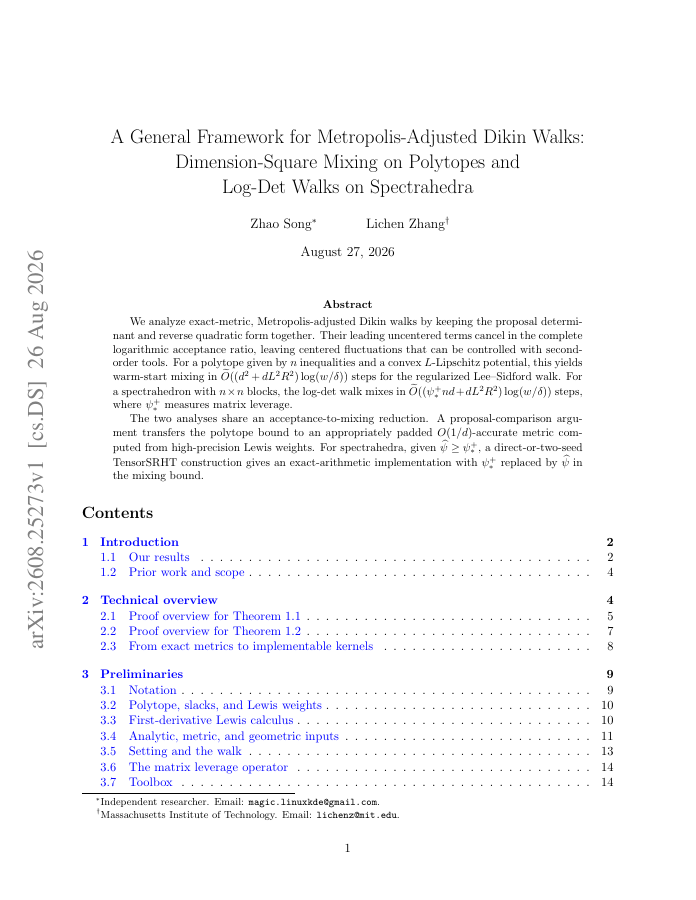
We analyze exact-metric, Metropolis-adjusted Dikin walks by keeping the proposal determinant and reverse quadratic form together. Their leading uncentered terms cancel in the complete logarithmic acceptance ratio, leaving centered fluctuations that can be controlled with second-order tools. For a polytope given by n inequalities and a convex L-Lipschitz potential, this yields warm-start mixing in \widetilde O((d^{2}+dL^{2}R^{2})\log(w/δ)) steps for the regularized Lee--Sidford walk. For a spectrahedron with n\times n blocks, the log-det walk mixes in \widetilde O((ψ^\star nd+dL^{2}R^{2})\log(w/δ)) steps, where ψ^\star measures matrix leverage. The two analyses share an acceptance-to-mixing reduction. A proposal-comparison argument transfers the polytope bound to an appropriately padded O(1/d)-accurate metric computed from high-precision Lewis weights. For spectrahedra, given \widehatψ\geψ^\star, a direct-or-two-seed TensorSRHT construction gives an exact-arithmetic implementation with ψ^\star replaced by \widehatψ in the mixing bound.
A General Framework for Metropolis-Adjusted Dikin Walks: Dimension-Square Mixing on Polytopes and Log-Det Walks on Spectrahedra
We analyze exact-metric, Metropolis-adjusted Dikin walks by keeping the proposal determinant and reverse quadratic form together. Their leading uncentered terms cancel in the complete logarithmic acceptance ratio, leaving centered fluctuations that can be controlled with…
- Preview
- Year
- 2026
- Hosting
- Excerpt onlyCC-BY-NC-SA-4.0
Cite
Notes
Only stored in your browser.
Attribution
- Abstract & full text
- arxiv.org/abs/2608.25273CC-BY-NC-SA-4.0
- TL;DR
- Semantic Scholar