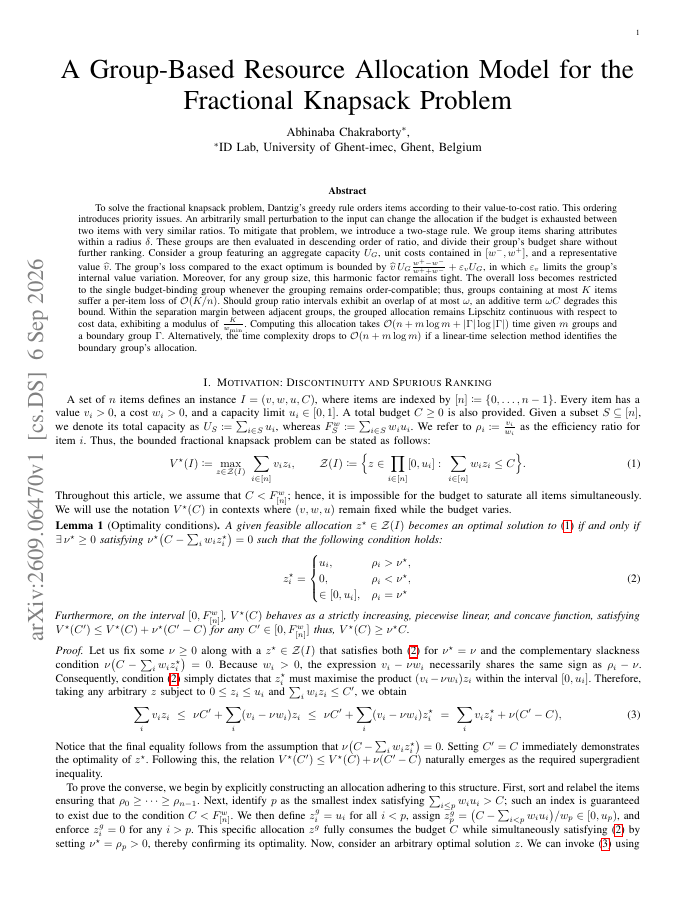
To solve the fractional knapsack problem, Dantzig's greedy rule orders items according to their value-to-cost ratio. This ordering introduces priority issues. An arbitrarily small perturbation to the input can change the allocation if the budget is exhausted between two items with very similar ratios. To mitigate that problem, we introduce a two-stage rule. We group items sharing attributes within a radius δ. We then evaluate these groups in descending order of ratio and divide their group's budget share without further ranking. Consider a group featuring an aggregate capacity U_G, unit costs contained in [w^-,w^+], and a representative value \widehat{v}. The group's loss relative to the exact optimum is bounded by \widehat{v}, U_G\frac{w^+-w^-}{w^++w^-}+\varepsilon_v U_G, where \varepsilon_v limits the group's internal value variation. Moreover, this harmonic factor remains tight for any group size. The overall loss becomes restricted to the single budget-binding group whenever the grouping remains order-compatible; thus, groups containing at most K items suffer a per-item loss of O(\frac{K}{n}). Should group ratio intervals exhibit an overlap of at most ω, an additive term ωC degrades this bound. Within the separation margin between adjacent groups, the grouped allocation remains Lipschitz continuous with respect to cost data, exhibiting a modulus of \frac{K}{w_{\min}}. Computing this allocation takes O(n+m\log m+|Γ|\log|Γ|) time given m groups and a boundary group Γ. Alternatively, the time complexity drops to O(n+m\log m) if a linear-time selection method identifies the boundary group's allocation.
A Group-Based Resource Allocation Model for the Fractional Knapsack Problem
To solve the fractional knapsack problem, Dantzig's greedy rule orders items according to their value-to-cost ratio. This ordering introduces priority issues. An arbitrarily small perturbation to the input can change the allocation if the budget is exhausted between two items…
- Preview
- Year
- 2026
- Hosting
- Full text hostedCC-BY-4.0
Cite
Notes
Only stored in your browser.
Attribution
- Abstract & full text
- arxiv.org/abs/2609.06470CC-BY-4.0
- TL;DR
- Semantic Scholar