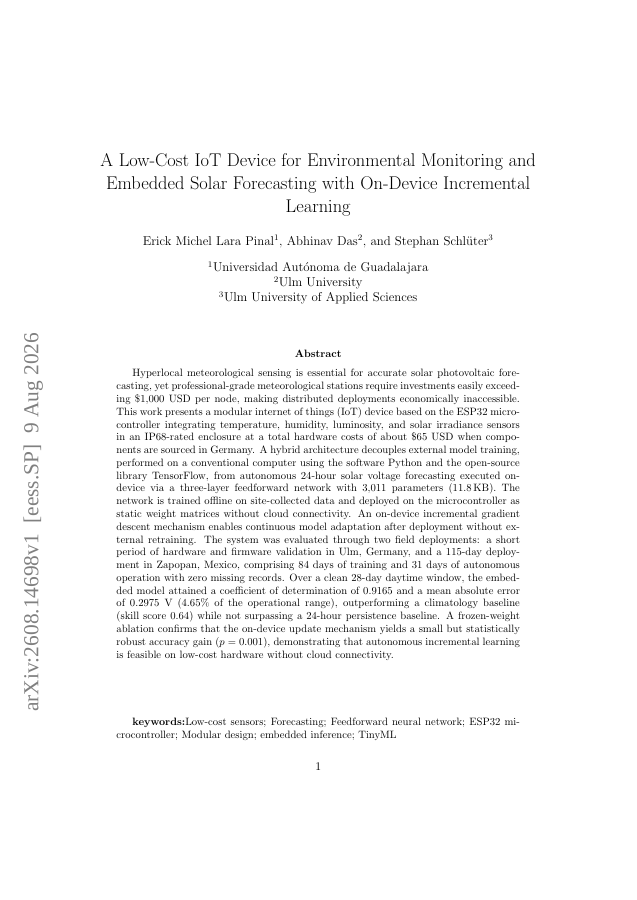
Hyperlocal meteorological sensing is essential for accurate solar photovoltaic forecasting, yet professional-grade meteorological stations require investments easily exceeding 1000 USD per node, making distributed deployments economically inaccessible. This work presents a modular internet of things (IoT) device based on the ESP32 microcontroller integrating temperature, humidity, luminosity, and solar irradiance sensors in an IP68-rated enclosure at a total hardware costs of about \65 USD when components are sourced in Germany. A hybrid architecture decouples external model training, performed on a conventional computer using the software Python and the open-source library TensorFlow, from autonomous 24-hour solar voltage forecasting executed on-device via a three-layer feedforward network with 3{,}011 parameters (11.8,KB). The network is trained offline on site-collected data and deployed on the microcontroller as static weight matrices without cloud connectivity. An on-device incremental gradient descent mechanism enables continuous model adaptation after deployment without external retraining. The system was evaluated through two field deployments: a short period of hardware and firmware validation in Ulm, Germany, and a 115-day deployment in Zapopan, Mexico, comprising 84 days of training and 31 days of autonomous operation with zero missing records. Over a clean 28-day daytime window, the embedded model attained a coefficient of determination of 0.9165 and a mean absolute error of 0.2975 V (4.65% of the operational range), outperforming a climatology baseline (skill score 0.64) while not surpassing a 24-hour persistence baseline. A frozen-weight ablation confirms that the on-device update mechanism yields a small but statistically robust accuracy gain (p = 0.001$), demonstrating that autonomous incremental learning is feasible on low-cost hardware without cloud connectivity.
A Low-Cost IoT Device for Environmental Monitoring and Embedded Solar Forecasting with On-Device Incremental Learning
Hyperlocal meteorological sensing is essential for accurate solar photovoltaic forecasting, yet professional-grade meteorological stations require investments easily exceeding 1000~USD per node, making distributed deployments economically inaccessible.
- Preview
- Year
- 2026
- Hosting
- Abstract onlyARXIV-DEFAULT
Cite
Notes
Only stored in your browser.
Attribution
- Abstract & full text
- arxiv.org/abs/2608.14698ARXIV-DEFAULT
- TL;DR
- Semantic Scholar